
On this page
Start here
Quick answer
If detergent remains in a Samsung dishwasher, first check the dispenser fill level and residue, then confirm the tablet or door is not blocked by dishes. Verify the incoming water is warm enough for the detergent instructions and run one empty test. If it still does not open or dissolve, request service rather than replacing a part based on the symptom alone.
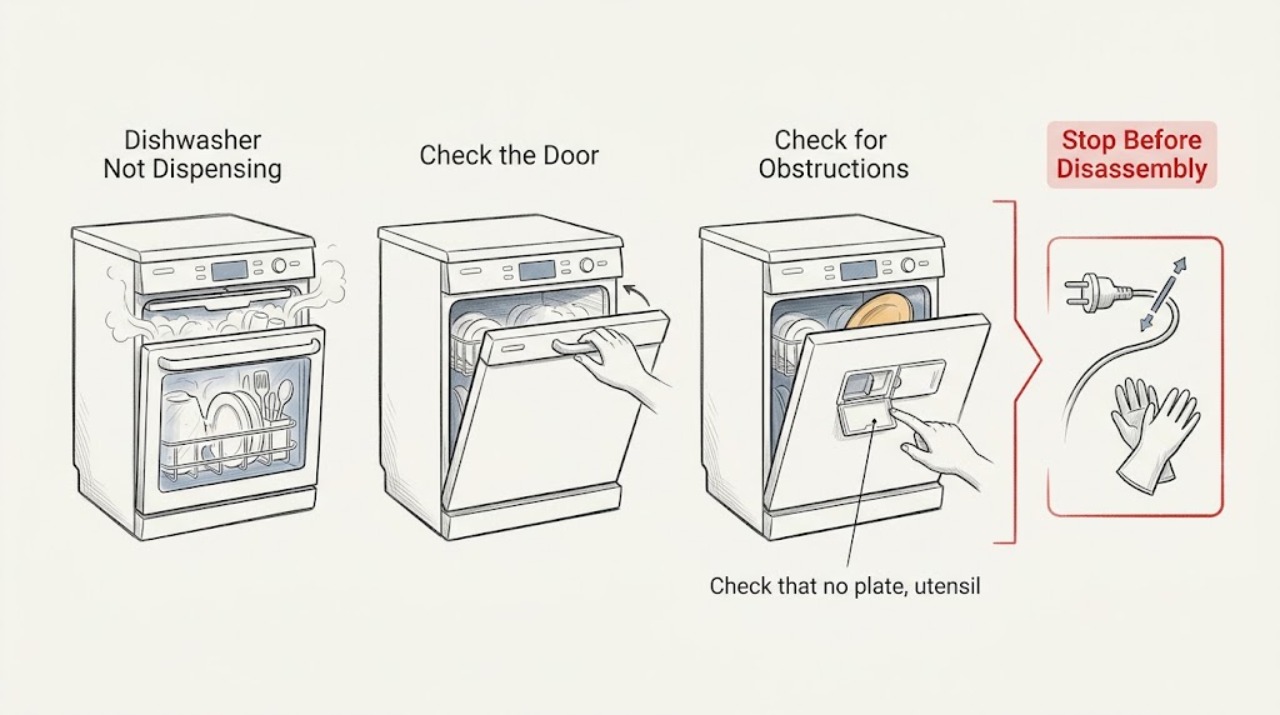
Work through in order
Diagnostic checks
Use only checks that match the exact appliance or system and its official guide.
-
Check 1
Inspect the detergent dispenser and fill only to or below its marked line; place a tablet correctly and close the door.
Expected result: The cup is overfilled, the tablet is misplaced, or the door is closed and clear.
Next step: Remove excess detergent and reload according to the model manual before testing.
Why this matters
Why: Overfilling or incorrect placement can prevent proper dispensing; a correctly loaded cup shifts attention to residue or obstruction.
-
Check 2
Clean detergent residue from the dispenser surfaces with warm water and check that the door can move freely.
Expected result: Sticky buildup is present, or the dispenser is clean but still does not open.
Next step: Run an empty test cycle after cleaning; do not force the door or disassemble the dispenser.
Why this matters
Why: Samsung says residue can prevent the dispenser door from opening; a clean, free door makes a persistent mechanism fault more likely.
-
Check 3
Check that no plate, utensil, spray arm, nozzle, or model-specific water reflector is blocking the dispenser or spray path.
Expected result: A load item blocks movement, spray holes are clogged, or all moving parts are clear.
Next step: Reload with clearance and clean accessible nozzle holes as the manual permits.
Why this matters
Why: Obstructions can stop the door or reduce water reaching the detergent; a clear path requires a cycle result to distinguish water/dispensing failure.
-
Check 4
Check the hot-water supply at the sink and run one empty cycle with the correct detergent.
Expected result: Supply water is below the detergent instructions, or the empty cycle dispenses normally / still leaves detergent.
Next step: Use the water requirement in the manual; request service if a clear empty cycle still does not dispense.
Why this matters
Why: Cool water can leave tablets or detergent residue; normal empty dispensing points to loading, while persistent failure points to service.
Use your observations
Decision map
Find the observation that best matches what you see, then follow the next safe action.
-
PATH 01Next step
What you see
Detergent dispenses on an empty cycle but not with dishes loaded.
Do this next
Reload so the door, nozzles, and any reflector can move freely and retest once.
Why this path and its safety boundary
Why it matters: A loading obstruction or spray-path issue is more likely than a failed dispenser.
-
PATH 02Next step
What you see
The dispenser is clean and unobstructed but remains closed or full after an empty cycle.
Do this next
Request model-specific service; do not order a dispenser part without confirming compatibility.
Why this path and its safety boundary
Why it matters: Samsung's user-level checks did not resolve a persistent dispenser problem.
-
PATH 03Next step
What you see
The dispenser opens but detergent remains partly undissolved and water is cool.
Do this next
Follow the detergent and model water-temperature requirements and run one supervised test.
Why this path and its safety boundary
Why it matters: Water temperature or detergent instructions may explain dissolving residue.
Helpful context
Understand the symptom
Dispensing and dissolving are different
A closed dispenser, residue left in the cup, and a tablet that does not dissolve can look similar. Check the mechanical path and water conditions separately before assuming the dispenser assembly failed.
When checks do not resolve it
Need a professional?
Request service if the dispenser fails on an empty cycle after cleaning and clearing obstructions, or if the cycle stops with an error code. Do not open electrical or control covers.
Common questions
FAQ
Why is detergent still in the Samsung dishwasher cup?
Samsung lists overfilling, residue, cool water, and load obstructions as checks. An empty-cycle test helps determine whether the dispenser itself still needs service.
Can I force the dispenser door open?
No. Clean residue and remove load obstructions within the manual's limits; force or electrical disassembly is not a safe user-level test.
Read the exact guide
Official sources
- Detergent does not dispense in Samsung dishwasherSamsung Support US · Samsung dishwasher detergent dispensing and dissolving troubleshooting
- Routine and deep clean your Samsung dishwasherSamsung Support US · Samsung dishwasher nozzle and filter cleaning
Community feedback
Share a repair observation
Share a plain-text repair observation. Accepted observations are published automatically; this page may take a moment to update.