
On this page
Start here
Quick answer
For a Samsung DW80M2020US that gains water while switched off, first determine whether you are seeing the small amount of water Samsung considers normal in the sump or a rising/dirty pool. If floodwater or drain water is present around the dishwasher, do not touch the unit: keep hands and feet out of standing water, turn off power at a dry accessible breaker, close the dishwasher water supply, and have the area made safe. Once safe, observe without removing the dishwasher: does water rise after the sink or disposal drains, does it appear clear and clean from the supply side, or does it remain only in the filter/sump area? Samsung's drain guidance says an air gap or correctly routed high loop helps prevent backflow; a separate owner-installed “check valve” is not established by the public model material and should not be improvised. An inlet valve that allows clean water into an otherwise idle machine and any water outside the sump needs appliance service. Dirty or foul water appearing after a sink backup points first to household plumbing or drain-hose routing, so use a qualified plumber for the building drain and Samsung or appliance service for the dishwasher connection or internal leak.
Before you begin
Safety first
- Owner checks are limited to safe power/water isolation, observing the amount and character of residual water from the open door, looking at accessible under-sink drain/supply routing from a dry position, and documenting the first wet point. Do not touch floodwater, move or tilt the dishwasher, remove panels, work in a wet electrical area, disconnect shared plumbing, or restore power to reproduce the pool.
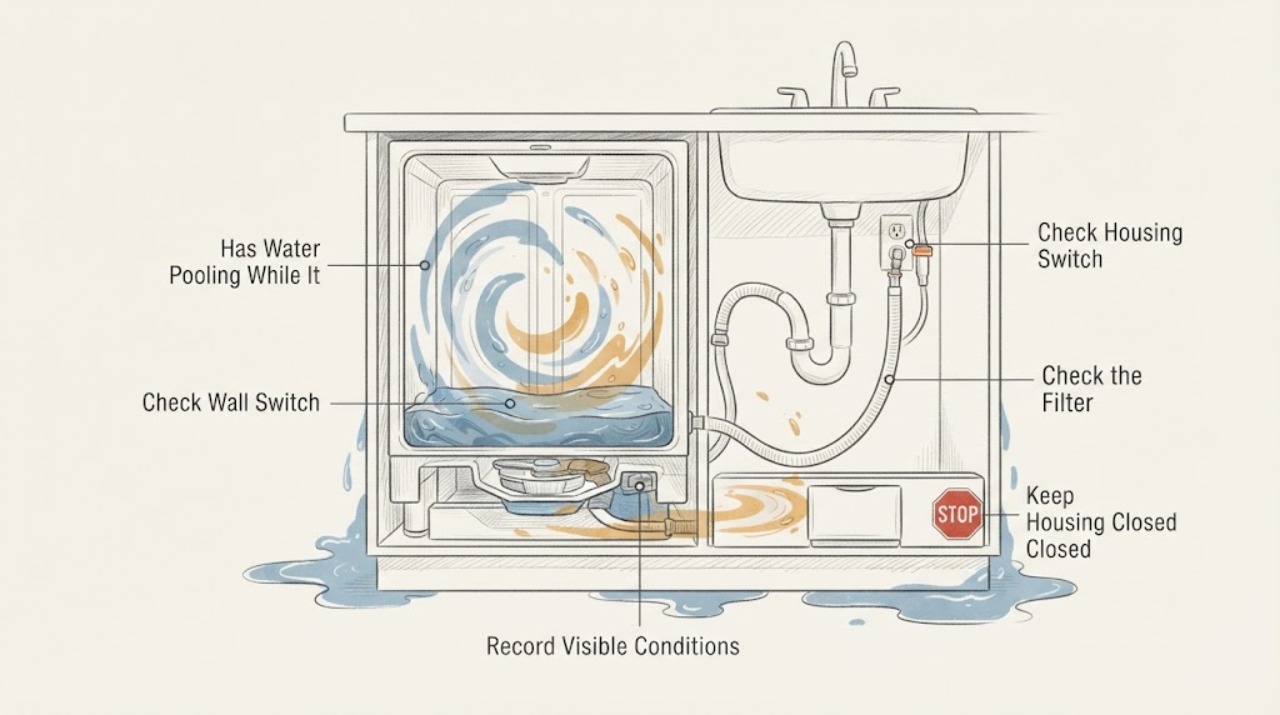
Work through in order
Diagnostic checks
Use only checks that match the exact appliance or system and its official guide.
-
Check 1
If floodwater, sewage-colored water, or standing water is around the dishwasher, do not step into it or touch the appliance. From a dry, safe location, switch off the dishwasher circuit, close the dishwasher supply valve if it is safely accessible, and keep the cabinet and surrounding area undisturbed. Do not restore power merely to see whether it drains.
Expected result: Water is still rising, the outlet/circuit area is wet, the water is contaminated or from a storm/sewer event, or the water has stopped and the electrical area is dry.
Next step: Keep the dishwasher off, restrict access, and involve emergency property/plumbing support for flooding. Once the area is dry and safe, have a qualified appliance technician inspect the dishwasher; do not move or tip it yourself.
Stop if: Stop immediately if reaching the breaker/valve requires standing in water, if there is smoke/arcing, or if the cord/outlet is damaged.
Why this matters
Why: An appliance in or beside floodwater creates shock and contamination risks before any drain diagnosis. Power isolation and stopping incoming water reduce damage but do not establish whether the source is a household backflow, supply valve, or internal dishwasher leak.
-
Check 2
With power isolated and no active flood hazard, inspect through the open door only: note whether water is a shallow amount confined to the lowest sump/filter area, whether it covers the tub floor, whether it is clear versus dirty or foul-smelling, and whether it is rising while the dishwasher remains off. Do not scoop through sharp debris, remove the filter, or put hands into standing water.
Expected result: Only a small amount remains in the sump; the whole tub is filling; the water is dirty/smelly; or the level is stable but more than a small residual amount.
Next step: For a small stable sump amount, follow the exact user manual rather than adding a valve. For a rising, dirty, or large pool, keep the unit off, close the water supply, and use the drain/backflow branch below or arrange service.
Stop if: Do not run a cycle, activate the drain pump, probe the sump, or clean sharp debris while water or flood contamination is present.
Why this matters
Why: Samsung states that a small amount of leftover water can be normal, while a large amount remaining indicates a drain problem. Dirty or foul water after a sink event makes drain backflow or household plumbing more likely; clean water rising while idle makes an inlet-side seep or internal valve issue more concerning, but neither identifies a part without inspection.
-
Check 3
Without disconnecting anything, look under the sink at the visible dishwasher drain-hose connection, air-gap body if present, garbage-disposal connection, and sink basin. Record whether the hose has a high loop above its connection point, whether it is kinked or pinched, whether the sink/disposal backs up, and whether water appears only after the sink drains. Do not loosen clamps, pull the dishwasher out, or add a generic check valve.
Expected result: The sink backs up, the drain hose lacks a visible high loop/air gap, the hose is kinked or pinched, the disposal was recently changed, or the household drain is clear and the dishwasher still gains water while idle.
Next step: Use a qualified plumber for a sink/disposal or household drain backup and a professional installer/appliance technician for drain-hose routing or a dishwasher-side connection. Keep the water supply closed and the dishwasher unpowered until the source is resolved.
Stop if: Do not dismantle the shared drain, cut the hose, remove the disposal, or work under a wet sink with power connected.
Why this matters
Why: Samsung says a blocked sink/disposal or a drain hose without an air gap or high loop can allow water to backflow into the dishwasher; local rules determine the required configuration. A separate check valve is not established by these guides, and backflow can still coexist with an internal leak.
-
Check 4
After the area is dry and without energizing the dishwasher, inspect the accessible supply-line connection and the floor/cabinet edges for clean water, wet fittings, a loose connection, or water that appears even when the sink and dishwasher have not been used. Do not pull the built-in unit forward or touch the inlet valve, junction box, or wiring.
Expected result: Clean water appears at the supply connection or under the dishwasher while the unit is idle; only dirty water follows sink drainage; or no external wet point can be found.
Next step: Keep the appliance supply closed and request Samsung/appliance service for a dishwasher-side leak or unexplained clean water. Use a plumber for the home drain or supply if the source is on the building side.
Stop if: Do not remove the kick plate, open the junction box, test the inlet valve, or move the dishwasher while wet or connected.
Why this matters
Why: A supply-side seep can continue while the dishwasher is off and requires a water shutoff and appliance/installation inspection. Dirty water tied to sink drainage favors backflow. No external wet point leaves an internal valve, sump, hose, or leak-protection area unresolved; it is not evidence that a check valve is missing.
-
Check 5
Record the complete model and serial information, whether the label says DW80M2020US/AC or another market suffix, the last cycle and its stage, water color/odor, amount and rate of pooling, sink/disposal activity, recent storm or plumbing work, visible high-loop/air-gap arrangement, and whether the dishwasher was moved or flooded. Take photos only from a dry safe position.
Expected result: The pool recurs while off, the cause is not visible, the exact market suffix is uncertain, or the issue began after a flood, drain alteration, or dishwasher installation change.
Next step: Keep DW80M2020US off and provide the record to Samsung or a qualified appliance technician. If the sink or household drain backs up independently, have a qualified plumber correct that condition before any dishwasher retest.
Stop if: Do not restore power, clear a hidden leak by tilting the unit, add chemicals, or order a pump, valve, check valve, or hose from the pool location alone.
Why this matters
Why: Samsung's model page provides model-specific manuals and support, while its drain guidance makes local installation requirements relevant. A precise timeline and first wet point let a plumber and appliance technician separate backflow from a dishwasher-side leak without guessing at a generic valve.
Use your observations
Decision map
Find the observation that best matches what you see, then follow the next safe action.
-
PATH 01Next step
What you see
The dishwasher is surrounded by storm/flood water, water is rising, or the outlet/circuit area is wet or damaged.
Do this next
Do not touch or move the dishwasher. Isolate power and water only from a safe dry location, keep people away, and use qualified emergency property, plumbing, and appliance support.
Why this path and its safety boundary
Why it matters: This is an immediate electrical and property-safety event; the drain-valve question is secondary.
-
PATH 02Next step
What you see
Only a small, stable amount of clean water is confined to the bottom sump/filter area after a completed cycle, with no odor or rising level.
Do this next
Consult the exact DW80M2020US/AC manual for normal residual water and monitor without adding hardware. Escalate if the amount increases, becomes dirty, spreads outside the sump, or appears between uses.
Why this path and its safety boundary
Why it matters: Samsung says a small amount of leftover water is normal; this observation does not demonstrate a missing check valve.
-
PATH 03Next step
What you see
Dirty or foul water appears after the sink/disposal drains, the sink backs up, or the drain hose has no compliant high loop or air gap.
Do this next
Keep the dishwasher off and have a qualified plumber correct the sink/disposal or drain routing under local rules; have appliance service inspect the dishwasher if pooling continues afterward.
Why this path and its safety boundary
Why it matters: The pattern favors household drain backflow or drain-hose installation over a separately missing dishwasher check valve, though an internal leak is not ruled out.
-
PATH 04Next step
What you see
Clear water enters or rises while the dishwasher and sink are unused, or a supply connection is visibly wet.
Do this next
Close the dishwasher water supply, keep power off, and request Samsung or qualified appliance service. Do not buy or install a generic check valve as a substitute for locating the first wet point.
Why this path and its safety boundary
Why it matters: An inlet-side seep or dishwasher-side water-path fault is more likely than drain backflow, but the exact inlet valve, hose, or sump cannot be identified without service inspection.
-
PATH 05Next step
What you see
The water is more than normal residual, the first wet point cannot be found without removing the dishwasher, or pooling continues after the visible drain/plumbing issue is corrected.
Do this next
Leave DW80M2020US unpowered and water-isolated and arrange model-specific appliance service. Do not tip, pull, open the bottom, clear a sensor, or run a verification cycle yourself.
Why this path and its safety boundary
Why it matters: A concealed dishwasher leak, valve, hose, sump, or leak-protection area remains possible. The floor pool and absence of a visible check valve do not identify the failed part.
Helpful context
Understand the symptom
“Water in the dishwasher while off” has two very different meanings: a shallow, clean amount remaining in the sump after a cycle, or water that is rising, foul, or spreading beyond the sump. The hurricane or flooding context raises the priority of electrical and household-drain safety. Do not treat a visible pool as a reason to run a cycle, pull the machine from the cabinet, or investigate a bottom component.
The exact support page lists DW80M2020US/AC as a Samsung dishwasher with a hybrid tub and provides the model's installation and user-manual route. Public Samsung guidance describes backflow prevention through an air gap or high loop according to local requirements; it does not prove that this unit should have a separately visible drain check valve. Preserve the existing installation and have the exact manual or a qualified installer determine whether the routing complies.
Only after diagnosis
Potential parts
- model-specific drain-hose/high-loop installation, inlet valve, sump, internal hose, or leak-protection component
Consider a component only after a qualified inspection identifies whether the first wet point is household backflow, the dishwasher-side supply, or an internal water path. The absence of a visible check valve does not select a replacement part.
Confirm DW80M2020US/AC, exact market suffix, installation revision, and Samsung fit information before any part or routing change; do not install a generic check valve or cross-model component.
When checks do not resolve it
Need a professional?
Contact Samsung or a qualified appliance technician for unexplained pooling, clean water entering while off, recurrence after drain correction, or any concealed leak. Contact a qualified plumber for sink/disposal backup, household drain, or supply problems. Escalate immediately for floodwater, contamination, shock risk, smoke, arcing, or damaged wiring.
Safety scope: Owner checks are limited to safe power/water isolation, observing the amount and character of residual water from the open door, looking at accessible under-sink drain/supply routing from a dry position, and documenting the first wet point. Do not touch floodwater, move or tilt the dishwasher, remove panels, work in a wet electrical area, disconnect shared plumbing, or restore power to reproduce the pool.
Have this ready
- Provide DW80M2020US/AC and serial/market details, last cycle, pool amount and color/odor, whether the sink/disposal was used, high-loop or air-gap arrangement, supply/drain wet points, flood or plumbing history, and photos taken from a dry safe position.
Common questions
FAQ
Does this Samsung dishwasher need a separate drain check valve?
Do not infer that from the absence of a visible valve. Samsung's opened drain guidance describes an air gap or correctly routed high loop to help prevent backflow and says local requirements vary. Use the exact installation manual or a qualified installer; do not add a generic valve or alter the drain path by guesswork.
Is any water in the bottom normal when the dishwasher is off?
Samsung says a small amount of leftover water can be normal. A rising, foul, dirty, or large pool, or water that appears between uses, is different and needs the backflow/supply split and likely service.
Can I run a cycle to see where the water comes from?
Not while there is an active pool or flood hazard. Keep the dishwasher unpowered and water-isolated, document what is safely visible, and have a plumber or appliance technician identify the first wet point. Do not remove the bottom or run the unit with covers off.
Read the exact guide
Official sources
- Samsung dishwasher is leaking or has a leakage error codeSamsung Support · Opened official leak guide; used for power isolation, supply/drain hose inspection, detergent/foam and leveling context, and service boundary. It does not authorize operating a flooded or opened dishwasher.
- DW80M2020US Dish Washer with Hybrid Tub | Samsung Support CASamsung Canada Support · Opened exact-model support page; used to confirm the model/market family and direct exact installation/user-manual and service handling. It does not identify a missing check valve or internal leak part.
- Install a Samsung washing machine in your homeSamsung Support · Opened official Samsung installation safety page; used only for the general caution that water-supply leaks can lead to electric shock, not for dishwasher-specific dimensions or routing.
- Samsung Dishwasher stinks or has a musty smellSamsung Support · Opened official Samsung guide; used only for the distinction between a small amount of normal leftover water and a large amount indicating a drain problem.
- Samsung dishwasher is not drainingSamsung Support · Opened official Samsung drain guide; used for sink/disposal checks, drain-hose routing, air-gap/high-loop backflow prevention, and plumber/service division. It is not a DW80M2020US-specific exploded diagram.
Community feedback
Share a repair observation
Share a plain-text repair observation. Accepted observations are published automatically; this page may take a moment to update.