
On this page
Start here
Quick answer
A Samsung dryer odor should be sorted by what it smells like and what happens with heat. A musty, sour or mildew odor can come from damp clothes or the washer rather than the dryer. A new-dryer smell can be shipping oil or packing residue and should fade after the model-appropriate empty run described by Samsung. A burning or electrical odor, smoke, sparks, melting, unusually hot cabinet, scorched fabric or a repeated breaker trip means stop the dryer and arrange service; do not keep testing it. If a gas dryer smells of gas or is smoking, do not operate switches or appliances, clear everyone from the building and contact emergency help from a safe location. For a non-hazardous odor, cool the dryer, remove the load, clean the lint filter and accessible drum, inspect the visible exhaust path and use only settings suitable for the fabric. Do not open panels, defeat a safety device or use flammable cleaners. If the odor returns after one safe check, leave the dryer off and provide the model, fuel type, odor timing and airflow observations to qualified Samsung service.
Before you begin
Safety first
- Do not open panels, probe live wiring, adjust gas components, bypass a thermal or door interlock, run with a missing or damaged lint filter, add flammable cleaner or continue testing after smoke, sparks, abnormal heat, a strong burning odor or gas odor.
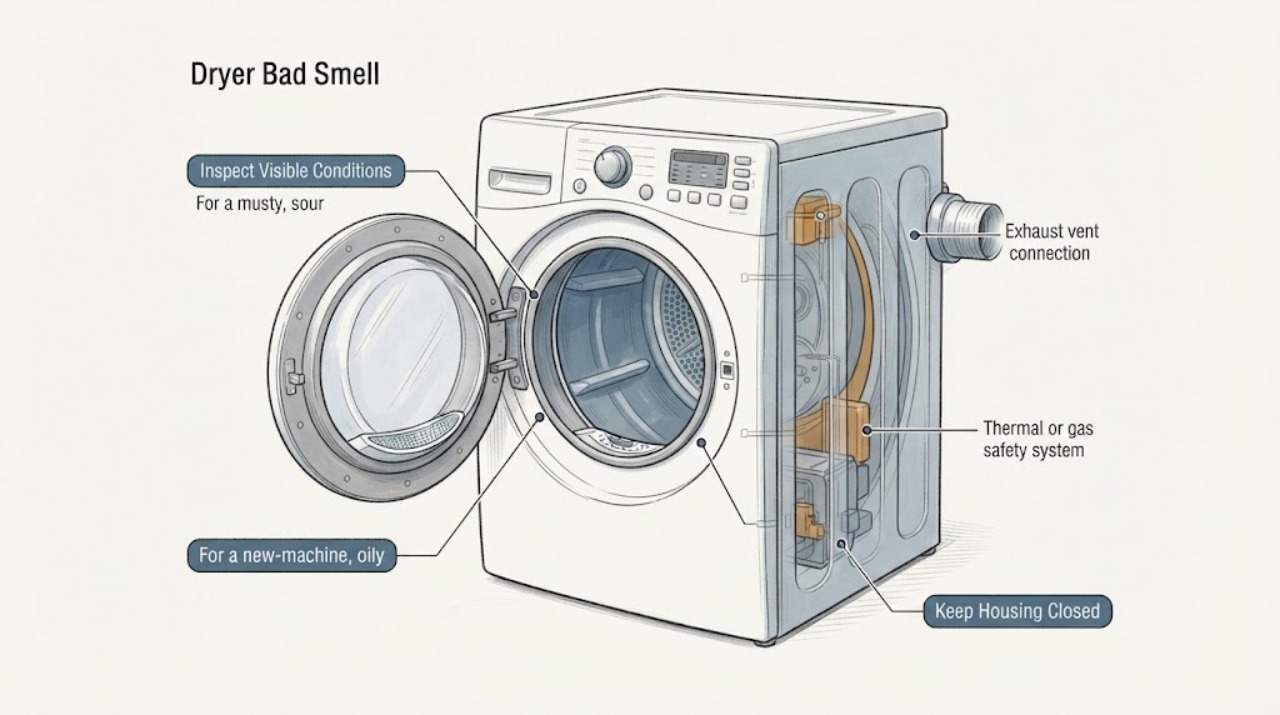
Work through in order
Diagnostic checks
Use only checks that match the exact appliance or system and its official guide.
-
Check 1
Stop the dryer and classify the odor before another cycle. Note whether it is musty or sour, new-appliance or oily, hot fabric or burning, electrical or plastic, animal-related, or gas-like. Look for smoke, sparks, melting, charred fabric, abnormal cabinet heat, moisture near electrical parts and a breaker that opened. Record whether the dryer is gas or electric, the model, when the smell starts and whether the smell is in the load or the cabinet.
Expected result: There is gas odor, smoke, sparking, melting, a strong electrical or burning odor, scorched fabric, abnormal heat or a repeated breaker trip; or the odor is limited to damp clothing or appears only at first use.
Next step: For gas odor or smoke, do not operate switches or appliances; clear the building and contact emergency help from a safe location. For burning, electrical odor, heat, sparks, melting or a repeated trip, isolate the dryer only if safe and arrange service. Otherwise continue with the matching odor path below.
Why this matters
Why: Gas and smoke are emergency conditions. Burning or electrical symptoms can indicate fire or shock risk. Damp-clothing and first-use odors have different, lower-risk paths only when no hazard sign is present.
-
Check 2
For a musty, sour or mildew smell, remove the load and check whether the odor is present in the dry drum or only in the clothing. Do not heat the same load again to mask the smell. Consider whether wet clothes sat in the washer, whether the washer has an odor, and whether the water has a sulfur-like smell. Once the source is corrected and the dryer is cool, wipe the accessible drum with a clean, damp cloth and dry it.
Expected result: The empty drum is neutral but the clothes smell, the odor is also in the washer, the odor follows water or the empty drum itself remains musty.
Next step: Rewash or otherwise handle affected laundry using the garment and washer instructions, clean and dry the washer as its manual permits, and improve laundry-room ventilation. If the empty dryer still smells after safe surface cleaning, stop and request Samsung support; do not mix cleaning chemicals.
Why this matters
Why: Samsung notes that heating can reveal sulfur or mildew odors already in wet laundry and that the washer or water can be the actual source. A persistent empty-drum odor may need model-specific cleaning or service rather than repeated heating.
-
Check 3
For a new-machine, oily or residue odor with no smoke or abnormal heat, verify that shipping material has been removed and check the matching Samsung guide for the permitted first-use procedure. Samsung's odor guide describes an empty run of about 15 minutes for a new dryer; use that only when the model and installation are correct, the drum is empty and no hazard is present. After the dryer cools, clean the drum as directed and wash any load that picked up residue.
Expected result: The odor fades during the permitted empty first-use run, remains unchanged, transfers to clothing, or is accompanied by smoke, heat or a plastic/electrical smell.
Next step: Stop after the one model-appropriate check if the smell persists or any hazard appears. Request service and provide the model, installation date and exact odor description; do not add solvents, sprays or flammable material to the drum.
Why this matters
Why: A fading first-use odor supports shipping residue. An odor that persists, transfers to clothing or changes into burning or electrical odor is not a normal break-in result.
-
Check 4
For an odor that appears during heating or with long cycles, let the dryer cool, clean the lint filter, and inspect only the accessible exhaust outlet, duct connection and outside hood for lint, debris, animal entry, crushing, kinks or poor airflow. Confirm the vent follows the model manual and is not plastic or foil where a vented model requires an approved duct. If the model provides a vent-blockage test, run it only with a cool, empty drum and exactly as the manual specifies.
Expected result: The lint filter is coated or damaged, the duct is restricted or crushed, the outside hood has little air movement or debris, a blockage code appears, or the accessible path is clear.
Next step: Clean the lint filter and arrange safe full-duct cleaning when needed; replace a damaged screen or duct only with model-correct parts. Do not run the dryer with a missing or damaged filter. If abnormal heat or odor returns, leave it off for qualified service.
Why this matters
Why: Lint and restricted exhaust can hold heat and moisture in the dryer and create a fire risk. A clear visible outlet does not prove that the internal blower, heater, sensor or thermal protection is sound.
-
Check 5
After a non-hazardous source has been corrected and the dryer is fully cool, perform at most one short, model-appropriate check with a suitable load and fabric setting. Observe the first warm-air period, cabinet temperature, exhaust movement and odor. Do not test with synthetic fabric on an unsuitable high-heat setting, do not run an unattended experiment and do not open panels or bypass a thermal, door or gas safety device.
Expected result: The odor is gone, the odor returns only with a particular fabric or setting, the dryer becomes unusually hot, smoke or sparks appear, the breaker trips or the odor returns with an empty drum.
Next step: Stop immediately for smoke, sparks, heat, electrical or gas odor, scorched fabric or a repeated trip. Otherwise avoid the triggering fabric or setting only when the manual supports that choice; persistent recurrence requires Samsung or qualified appliance service.
Why this matters
Why: A single normal run after removing a confirmed external source supports a load, setting or contamination cause. Recurrence with heat or an empty drum suggests an unresolved airflow, heater, motor, wiring, sensor, thermal or gas-system fault.
Use your observations
Decision map
Find the observation that best matches what you see, then follow the next safe action.
-
PATH 01Next step
What you see
A gas dryer smells of gas or is smoking, or anyone sees smoke, sparks, melting or an active fire sign.
Do this next
Do not operate appliances, switches or ignition controls. Clear everyone from the building and contact emergency help from a safe location. Do not re-enter or restart until authorities or qualified responders say it is safe.
Why this path and its safety boundary
Why it matters: This is an emergency gas or fire condition, not a cleaning problem.
-
PATH 02Next step
What you see
The odor is electrical, burning or plastic-like, the cabinet or fabric is abnormally hot, or a breaker trips again.
Do this next
Stop use, isolate power only from a safe dry position and request qualified service. Do not reset and repeatedly run the dryer, probe live wiring or remove panels.
Why this path and its safety boundary
Why it matters: The dryer may have a fire, wiring, heater, motor or thermal-protection fault.
-
PATH 03Next step
What you see
The smell is musty, sour or sulfur-like and is strongest in warm clothing, while the empty dryer is neutral.
Do this next
Handle the laundry and washer according to their manuals, clean and dry the accessible dryer drum, and improve ventilation. Service for the dryer is not normally needed unless the empty drum also smells or another symptom appears.
Why this path and its safety boundary
Why it matters: The washer, wet laundry or water is more likely to be the source than the dryer.
-
PATH 04Next step
What you see
The dryer is new and has a mild oily or packing-residue smell without smoke, abnormal heat or electrical symptoms.
Do this next
Confirm the model manual and installation are correct, then perform only the permitted empty first-use procedure. Stop and request service if the smell persists, worsens or transfers to clothing.
Why this path and its safety boundary
Why it matters: Samsung identifies a first-use shipping-oil odor that should dissipate under its permitted empty-run guidance.
-
PATH 05Next step
What you see
The odor follows long cycles, weak exhaust, lint at the outlet, a blockage indication or a very warm cabinet.
Do this next
Cool the dryer, clean the lint filter and arrange safe duct inspection or cleaning. Do not use a damaged or missing filter; escalate if the odor or heat returns after the path is clear.
Why this path and its safety boundary
Why it matters: Restricted exhaust or a lint problem may be retaining heat and moisture and can create a fire risk.
-
PATH 06Next step
What you see
The odor returns with an empty, cool-to-start drum after safe cleaning, or a heat, sensor, power or gas fault remains.
Do this next
Keep the dryer off and arrange Samsung or qualified appliance service. Provide the full model, fuel type, odor timing, cycle and fabric setting, vent observations, error indication and any heat or power event.
Why this path and its safety boundary
Why it matters: An internal component or installation issue cannot be identified safely from odor alone.
Helpful context
Understand the symptom
Make the safety decision before cleaning
Do not treat every odor as lint. Smoke, a strong burning or electrical smell, sparks, melting, a very hot cabinet, scorched fabric, a repeated breaker trip or any gas odor ends user testing. A gas dryer that smells of gas or smokes requires clearing the building and contacting emergency help from outside or another safe location. For an electric dryer that smokes, switch it off if safe and request service. Never use a control, switch or cleaner to investigate a suspected gas leak.
Use the load and timing to identify the source
If the odor is only on warm clothes and is sour or musty, the washer, standing wet laundry or water supply may be the source. A first-use smell on a new machine can be shipping oil or packing residue. A smell that follows a hot cycle, appears with long dry times or accompanies a very warm cabinet points toward lint, restricted exhaust or a heat-related fault. Record the smell before attempting a correction.
Keep model and fuel differences explicit
Samsung sells gas and electric dryers, vented and ventless models, and controls differ by model. Use the model label and the matching Samsung manual for cycle, vent, cleaning and gas instructions. The external checks below do not authorize cabinet disassembly, gas-system work, live electrical testing or replacement of thermal parts.
Safety boundary
Stop conditions
- Gas odor, visible smoke, sparks, melting or an active fire sign
- Electrical, plastic or burning odor that persists or returns
- Abnormal cabinet or drum heat, scorched clothing or a repeated breaker trip
- Water near electrical parts or a damaged power cord or outlet
- A blocked, crushed or damaged exhaust path that cannot be cleared safely
- Any need to open the cabinet, work on gas or live wiring, or bypass thermal protection
Only after diagnosis
Potential parts
- lint filter or exhaust duct
Consider a replacement only when the filter or duct is visibly damaged and the exact model manual confirms the fit; a dirty path may only need safe cleaning.
Confirm the complete Samsung model and vent configuration before selecting a part. - moisture sensor or temperature sensor
Consider this only when the sensor area is clean but odor, cycle or temperature behavior remains abnormal and qualified diagnosis identifies the sensor.
Sensor and control components are model-specific; do not open the cabinet for a user test. - heater, igniter or thermal limiter
Consider this only after airflow and external settings are addressed and a qualified technician confirms a heat or thermal fault.
Gas ignition and thermal-protection parts are safety-critical and must not be bypassed or substituted casually.
When checks do not resolve it
Need a professional?
Arrange Samsung or qualified appliance service for gas odor, smoke, electrical or burning odor, sparks, melting, scorched fabric, abnormal heat, a repeated breaker trip, an odor that returns with an empty drum, an unresolved vent fault, a recurring error or any symptom requiring cabinet, gas or live electrical work.
Safety scope: Do not open panels, probe live wiring, adjust gas components, bypass a thermal or door interlock, run with a missing or damaged lint filter, add flammable cleaner or continue testing after smoke, sparks, abnormal heat, a strong burning odor or gas odor.
Common questions
FAQ
Why does my Samsung dryer smell bad when it heats?
Heat can reveal mildew or sulfur already in wet clothing, while lint or restricted exhaust can retain heat and moisture. A new dryer can have a limited shipping-residue odor. Burning, electrical, smoke, gas, spark, melting or abnormal-heat symptoms are not normal; stop using the dryer and arrange the appropriate emergency or qualified help.
Is a burning smell from a new Samsung dryer normal?
Samsung describes a first-use shipping-oil odor that should dissipate during its permitted empty-run guidance. Use the exact model manual and stop if smoke, abnormal heat, electrical or plastic odor appears, or if the smell persists or transfers to clothing.
What should I do if my Samsung gas dryer smells like gas?
Do not operate switches, appliances or ignition controls. Clear everyone from the building and contact emergency help from a safe location. Do not re-enter or restart the dryer until qualified responders say it is safe.
Can a Samsung dryer odor actually come from the washer?
Yes. Samsung explains that sulfur, mildew or sour odors may be in wet laundry or come from a washer or water supply and become more noticeable when the clothes are heated. Compare the smell in the empty drum with the smell in the load, then address the washer or laundry source using its model guidance.
When should a bad-smelling Samsung dryer be serviced?
Request service for persistent burning or electrical odor, smoke, sparks, abnormal heat, scorched fabric, a repeated breaker trip, a recurring odor with an empty drum, a continuing vent or temperature fault, or any need to open the cabinet or work on gas or live wiring.
Read the exact guide
Official sources
- Dryer SupportSamsung Support US · Samsung dryer model manuals and support routing
- Clothes are not dry after using Samsung dryerSamsung Support US · Samsung dryer lint, exhaust, heat, vent-blockage test and sensor guidance
- Samsung dryer smells or smokesSamsung Support US · Samsung dryer odor, smoke, gas, burning, electrical, new-appliance and mildew guidance
- Samsung dryer loses power or won't turn onSamsung Support US · Samsung dryer power isolation and repeated-breaker guidance
Community feedback
Share a repair observation
Share a plain-text repair observation. Accepted observations are published automatically; this page may take a moment to update.