
On this page
Start here
Quick answer
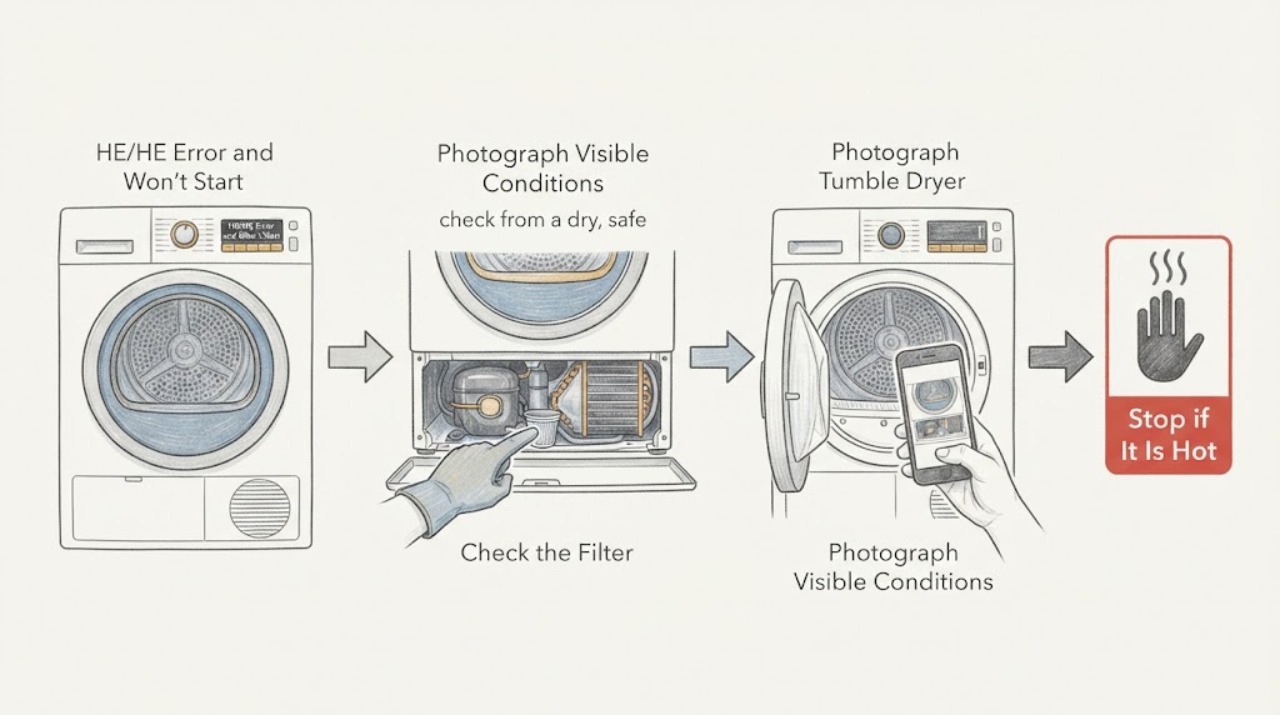
On the Samsung DV70F5E0HGW/EN UK dryer, hE or HE must be read as the complete displayed code, not as the similarly named Samsung washer code. Samsung UK's dryer information table describes HC/HE as compressor overheating or a high-temperature heating check. That can prevent a start, so do not keep clearing it or guess a compressor, sensor, heater, or control board. Photograph the display and model label, let the dryer cool, then make only the external checks the model allows: lint filter, accessible heat-exchanger area, water tank or drain condition, closed door, selected cycle, and visible power supply. If HE returns, the dryer still will not start, the cabinet or plug is unusually hot, or there is a burning smell, smoke, sparking, or a trip, leave internal diagnosis and any energized work to Samsung or a qualified service professional.
Work through in order
Diagnostic checks
Use only checks that match the exact appliance or system and its official guide.
-
Check 1
With the dryer idle, photograph every display character exactly as shown (including whether it is hE or HE), the programme and stage, and the complete label showing DV70F5E0HGW/EN. Note whether the display is responsive, whether the drum ever turns, and whether the code appears immediately or after heating.
Expected result: The exact model and HE code are clear, or the display could be a different code, a blinking maintenance indication, or a partial character.
Next step: If the label or code is uncertain, stop code-specific diagnosis and obtain the matching Samsung manual or service assessment. If DV70F5E0HGW/EN and HE are clear, continue with the safety and external checks below.
Why this matters
Why: Samsung says information codes can vary by model and that an unlisted pattern needs the manual for that specific model. A partial character is not enough to assign the HE high-temperature meaning.
-
Check 2
Before trying to start it, check from a dry, safe position for smoke, a burning smell, scorching, an unusually hot cabinet, sparks, a hot or damaged plug or cord, water around electrical parts, or a breaker that has tripped. Do not remove the cabinet or reach behind the machine.
Expected result: Any hazard sign is present, or the exterior appears normal and the supply has not tripped.
Next step: For any hazard, stop use and isolate power only if that can be done without touching a hot or damaged connection; arrange qualified appliance or electrical service. If there is no hazard, proceed with the dryer powered off and cool.
Stop if: Do not restart after smoke, burning smell, sparks, abnormal heat, water near electrical parts, or a repeated trip.
Why this matters
Why: A fire, electrical, water, or abnormal-heat warning takes priority over interpreting HE. A normal exterior does not prove that the compressor, heater, sensor, or control circuit is healthy.
-
Check 3
After the dryer has cooled and is powered off, clean the lint filter and inspect only the accessible heat-exchanger area or cover as the DV70F5E0HGW instructions permit. Remove lint gently without bending fins or opening sealed panels; do not assume a vented-dryer duct test applies to this heat-pump model.
Expected result: The filter or accessible heat-exchanger area is visibly obstructed, the cover is not seated, or those areas are clean and intact.
Next step: Restore only the cover and filter arrangement described for the exact model. If HE remains or returns after this external maintenance, stop testing and request service rather than cleaning deeper or ordering a part.
Why this matters
Why: Samsung lists a clogged lint filter or heat exchanger as a check for dryer temperature and heating information codes. The exact model page's heat-pump support context makes accessible heat-exchanger and condensate maintenance more relevant than assuming an external exhaust fault, but cleaning does not prove an internal HE cause is fixed.
-
Check 4
Check the user-accessible moisture path: if this model is using its water tank, empty it; if a drain hose is fitted, look for a visible kink or damage without disconnecting a pressurised connection. Confirm the door is closed normally, no laundry is caught at the latch, a cycle is selected, and the chosen cycle is not an intentional no-heat or cool-air programme.
Expected result: The tank is full, the visible drain hose is kinked, the door does not latch normally, laundry is caught, no cycle is selected, or all these conditions appear normal.
Next step: Correct only a visible tank, hose, door-edge, or programme condition and make one model-approved retry once the dryer is cool and hazard-free. If HE reappears, do not continue cycling it.
Why this matters
Why: Samsung's UK no-run guidance includes emptying the water tank, cleaning the filter and heat exchanger, closing the door, selecting a cycle, and checking the household fuse box. These observations can explain a no-start condition, but they do not reclassify a recurring HE code as a simple tank or latch fault.
-
Check 5
Check only the visible plug, cord, outlet and household fuse box from a dry position. If a breaker has tripped, do not repeatedly reset it; note whether other appliances on the circuit are affected and leave any connection or supply work to a licensed electrician.
Expected result: The dryer has no visible supply issue and the breaker is stable, or the plug/cord is damaged, the breaker trips again, or the installation is uncertain.
Next step: For a damaged or unstable supply, leave the dryer off and arrange licensed electrical service. With a normal visible supply, one cooled, model-approved retry is the limit; a returning HE needs Samsung or qualified appliance service.
Why this matters
Why: Samsung lists the household fuse box as a no-run check and says to check the circuit breaker for HC/HE. A repeated trip or damaged connection is a supply safety issue, not evidence that replacing an internal dryer part will help.
Use your observations
Decision map
Find the observation that best matches what you see, then follow the next safe action.
-
PATH 01Next step
What you see
The label is DV70F5E0HGW/EN, the complete display is hE/HE, and there is no smoke, burning smell, unusual heat, water near electrics, or repeated trip.
Do this next
Let it cool, complete only the accessible filter, heat-exchanger, tank/drain, door, cycle, and visible supply checks, then make at most one model-approved retry. Arrange service if HE returns or it still will not start.
Why this path and its safety boundary
Why it matters: The assigned identity matches the UK Samsung dryer evidence, and HE is best treated as the documented compressor-overheating / high-temperature heating check rather than a generic no-start code.
-
PATH 02Next step
What you see
HE returns immediately or after a short retry even though the accessible filter, heat-exchanger area, door, tank/drain, selected cycle, and visible supply are normal.
Do this next
Keep the dryer out of use and give Samsung or a qualified technician the code photo, exact model, programme stage, maintenance observations, and any temperature or odor symptom. Do not open the cabinet or substitute a part from another Samsung dryer.
Why this path and its safety boundary
Why it matters: The remaining possibilities include an internal temperature or compressor protection path, heating or sensor circuit, control state, or another model-specific fault. The code alone does not identify which part failed.
-
PATH 03Next step
What you see
The water tank is full, a visible drain hose is kinked, the door is not catching, laundry is caught at the latch, or no valid cycle is selected, and there is no active safety warning.
Do this next
Correct only the visible condition, close the door normally, and retry once after the dryer is cool. If HE remains or the dryer does not start, stop and request service.
Why this path and its safety boundary
Why it matters: One of Samsung's documented no-run conditions may be present, but that observation does not prove HE was caused by the tank, door, or cycle selection.
-
PATH 04Next step
What you see
There is smoke, a burning smell, scorching, an unusually hot cabinet or plug, sparking, water near electrical parts, or a breaker trips again.
Do this next
Stop using the dryer, isolate power only from a safe dry position if possible, keep clear of damaged parts, and arrange qualified appliance or electrical service. Do not restart it to see whether HE clears.
Why this path and its safety boundary
Why it matters: This is a fire, electrical, water, or overheating boundary, not a routine filter-cleaning branch.
-
PATH 05Next step
What you see
The display may be a different code, a blinking maintenance light, or a partial character, or the label is not actually DV70F5E0HGW/EN.
Do this next
Stop applying this article's HE branch, photograph the display and label, and use the exact model manual or Samsung service route.
Why this path and its safety boundary
Why it matters: The HE definition is not established for the observed identity. Samsung warns that code meanings differ by model and directs users to the manual for an unlisted code.
Helpful context
Understand the symptom
The identity matters here: DV70F5E0HGW/EN is an exact UK Samsung dryer support entry, and its support page includes heat-pump tumble-dryer topics. Samsung's UK dryer table lists HE with HC under compressor overheating / high-temperature heating check. Do not transfer the HE meaning from a Samsung washer, another market, or another dryer family.
Because the symptom is an HE display followed by no start, the useful decision is whether this is a recoverable external condition or a returning heat-pump/high-temperature fault. A full code and model photo, the point in the programme when it appeared, and any heat or odor warning are more useful than a guessed replacement part.
When checks do not resolve it
Need a professional?
Arrange Samsung or qualified appliance service when HE returns after the exact external checks and one cooled, model-approved retry, when the dryer still will not start, or when the model/code cannot be matched. Stop immediately for smoke, burning smell, scorching, abnormal cabinet or plug heat, sparks, water near electrical parts, or a repeated electrical trip; isolate power only if safe and leave internal, sealed-system, and energized work to qualified professionals.
Common questions
FAQ
What does HE or hE mean on a Samsung DV70F5E0HGW dryer?
Samsung UK's opened dryer information table groups HC and HE as compressor overheating or a high-temperature heating check. Confirm the complete display and exact DV70F5E0HGW/EN label first; do not use the HE meaning from a Samsung washer or another market as proof for this dryer.
Can I reset the Samsung DV70F5E0HGW HE code?
Samsung UK gives a general 30-second unplug/reconnect step for dryer information codes, but an HE code is also described as a compressor-overheating or high-temperature check. Let the dryer cool, remove only accessible maintenance causes, and make at most one model-approved retry when there is no hazard. A returning HE or a no-start condition needs service rather than repeated resets.
Should I replace the compressor, thermistor, heater, or control board for HE?
No part is justified by HE alone. Samsung's code table gives external checks and routes a persistent code to service; the code does not distinguish a compressor, temperature sensor, heating circuit, control, wiring, or another model-specific cause. Give the technician the code and observation record instead.
Does this UK Samsung heat-pump dryer need an external exhaust-duct test for HE?
Do not assume a vented-dryer procedure applies. The exact DV70F5E0HGW/EN support page identifies heat-pump tumble-dryer support topics, while Samsung UK's no-run and HE guidance emphasizes the lint filter, heat exchanger, water tank or drainage, supply, and service path. Inspect only the accessible areas allowed by the exact instructions.
Read the exact guide
Official sources
- Samsung Tumble Dryer error codes - what do they mean?Samsung UK · The UK dryer table says HC/HE means compressor overheating / high temperature heating check, lists circuit-breaker, professional heating-element wiring, and lint-filter checks, and sends a recurring code to Samsung service. It also warns that codes differ by model and an unlisted code requires the specific manual.
- How do I troubleshoot my Samsung dryer?Samsung UK · The opened UK troubleshooting page lists closed door, plugged-in cord, selected cycle, empty water tank, lint filter, heat exchanger, and fuse-box checks for a dryer that is not running; it also distinguishes Cool Air and cycle cool-down from a no-heat complaint.
- DV70F5E0HGW/EN | Samsung Support UKSamsung UK · The exact UK model page identifies DV70F5E0HGW/EN, lists the UK support scope, and includes support topics for a Samsung Heat Pump Tumble dryer, cleaning the heat exchanger, draining the water tank, and dryer error information.
Community feedback
Share a repair observation
Share a plain-text repair observation. Accepted observations are published automatically; this page may take a moment to update.