
On this page
Start here
Quick answer
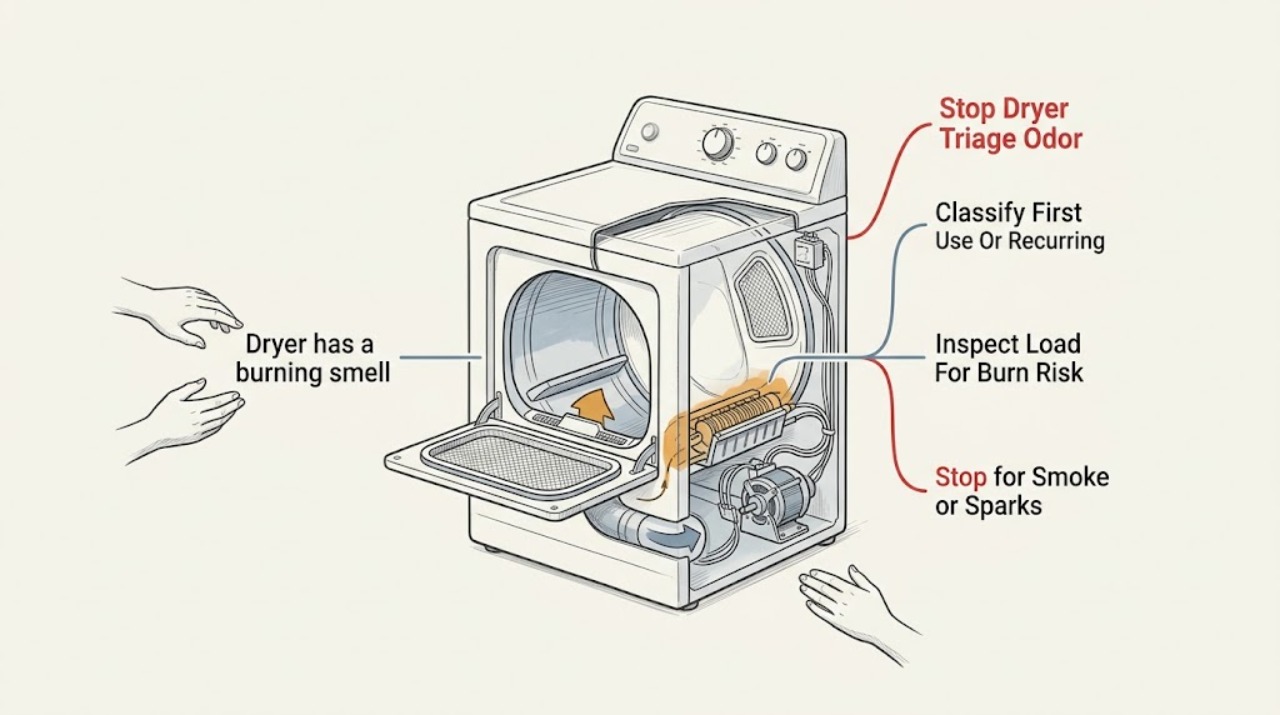
Stop the Samsung dryer and separate a harmless first-use odor from an active safety problem. Samsung says a new dryer may release shipping oil residue and that an empty run of about 15 minutes can dissipate that odor, but this exception does not apply to smoke, gas odor, an electrical smell, abnormal heat, or a burning smell that continues. For those symptoms, keep the dryer off; Samsung directs owners to shut off the dryer at the circuit breaker for a continuing burning or electrical smell and request service. For a gas dryer with smoke or gas odor, clear the building and contact emergency services without operating switches or appliances. After the appliance is cool and de-energized, inspect only the lint filter, visible drum, load, and accessible external exhaust condition. Do not open the cabinet, bypass a safety device, or keep restarting the dryer to test the smell.
Before you begin
Safety first
- Owner checks end at stopping the dryer, emergency triage, de-energized visual inspection of accessible load, filter, drum, and external vent areas, and the exact model's limited first-use guidance when no hazard exists. A qualified professional must handle heater, motor, blower, wiring, control, cabinet, gas, internal vent, and safety-device work.
Work through in order
Diagnostic checks
Use only checks that match the exact appliance or system and its official guide.
-
Check 1
Stop the dryer and observe from a safe position. Wait for the drum to stop; do not reach through the door or touch hot glass, the drum, cord, cabinet, or lint path. Note whether there is visible smoke, a gas odor, an electrical or melting-plastic smell, abnormal heat, sparks, flames, or a tripped breaker.
Expected result: There is only a mild odor on a brand-new dryer and no smoke or heat; the smell is persistent or electrical; or smoke, gas odor, sparks, flames, or abnormal heat is present.
Next step: For smoke, flames, or gas odor, leave the building as appropriate and contact emergency services from a safe location; do not operate switches or appliances in a gas-smell situation. For persistent, electrical, or heat-related odor without an active emergency, keep the dryer off and arrange qualified appliance or electrical service.
Stop if: Stop immediately for smoke, fire, gas odor, sparks, exposed wiring, melting plastic, a hot cabinet, an electrical smell, or a breaker that trips; never restart to reproduce the odor.
Why this matters
Why: Samsung treats first-use shipping residue as a limited explanation, while persistent burning or electrical smell requires the dryer to be shut off and serviced. Smoke or gas odor changes the situation to an emergency rather than a troubleshooting exercise.
-
Check 2
When the dryer is cool and safe, record whether it is newly installed, whether the odor appeared on the first use, whether it dissipated, and whether it returned on a later load. Do not run an old or already-warmed dryer solely to perform this comparison; a new-unit exception applies only when there is no smoke, gas odor, electrical smell, or overheating.
Expected result: The unit is new and the odor is fading; the unit is not new; the odor returns after prior use; or the odor grows stronger or changes to electrical or melted-plastic.
Next step: Do not continue operating a recurring or worsening odor. For a brand-new dryer with only the described mild first-use residue and no hazard, follow the exact model's first-use guidance once; if it does not dissipate, stop and request service.
Stop if: Stop for any odor that does not dissipate as described by the exact manual, or for smoke, electrical smell, abnormal heat, gas odor, or visible damage.
Why this matters
Why: A fading first-use odor is consistent with Samsung's shipping-residue guidance. A recurring or intensifying odor is not explained by that exception and can involve lint, the load, venting, heater, motor, wiring, or another internal condition.
-
Check 3
With the drum stationary and safe to approach, remove laundry and inspect it for scorching, melted fibers, oily or solvent residue, foam or rubber material, or a metal or plastic item that could have overheated. Check the care labels and recent washing or stain-treatment history. Do not place suspicious or solvent-contaminated items back in the dryer.
Expected result: A garment is scorched or melted; the load contains foam rubber, oil, gasoline, solvent, or another flammable residue; one item smells while the empty drum does not; or the load appears normal.
Next step: Keep damaged or contaminated items out of the dryer and follow the fabric or chemical manufacturer's safe handling guidance. If the dryer or an empty drum still smells, keep it off and arrange service; do not use another load as a test.
Stop if: Stop for scorching, smoke from fabric, melted material, oil or solvent odor, hot contaminated items, or any need to handle a potentially flammable load while hot.
Why this matters
Why: The load can be the odor source, but scorching or flammable contamination also creates a fire risk. Samsung warns about heated foam rubber, clothing exposed to flammable substances, and some synthetic fabrics on high heat; a normal-looking load does not clear the dryer itself.
-
Check 4
After power is safely disconnected and the dryer has cooled, inspect the lint filter and its compartment, the visible drum, door seal area, and surrounding floor for lint, a forgotten pen or crayon, melted residue, or a foreign object. Clean only accessible surfaces according to the exact Samsung manual; do not use metal tools, pour liquid into the appliance, or open panels.
Expected result: The filter is blocked, missing, or damaged; lint or residue is visible; an object or melted material is in the drum; or the visible areas are clean.
Next step: Clean or reinstall only the model-approved filter and accessible drum residue when the appliance is cool and de-energized. Do not operate with a missing or damaged filter; keep the dryer off and request service for melted material, internal lint, a trapped object, or a returning odor.
Stop if: Stop for a damaged filter housing, melted plastic, heavy internal lint, a trapped object, sharp edges, or any need to reach behind the drum, heater, blower, or cabinet.
Why this matters
Why: Samsung says a clogged, missing, or damaged filter can reduce performance and cause a fire, and recommends checking the drum for forgotten objects. A clear visible drum does not rule out lint or a failed heater, motor, wiring, or blower inside the cabinet.
-
Check 5
From outside the cabinet and only when the dryer is off and cool, inspect the visible exhaust connection and outside hood for a disconnected, crushed, kinked, lint-blocked, or damaged duct and check that the hood damper can move freely. Do not disconnect the duct or run a heated test after a burning smell; use the exact model manual or a professional vent cleaner for inaccessible sections.
Expected result: The visible duct is crushed or kinked; lint blocks the hood; the vent is disconnected or unsuitable; the hood does not open freely; or the visible exhaust path appears intact.
Next step: Keep the dryer off when the vent is disconnected, damaged, restricted, or uncertain. Arrange qualified vent or appliance service as appropriate; do not use a burning smell as a reason to run a vent-blockage or heat test.
Stop if: Stop for a blocked or damaged vent, lint at the heat path, a disconnected gas-dryer exhaust, smoke, gas odor, or any need to move the appliance or work inside the duct or cabinet.
Why this matters
Why: Samsung says lint and restricted exhaust can prevent heat and moisture from leaving, while unsuitable or crushed venting can trap lint and increase fire risk. An intact exterior path does not prove the internal exhaust, heater, motor, or wiring is safe.
-
Check 6
Prepare a service record with the full Samsung model and serial information, electric or gas configuration, installation age, odor description and timing, load and fabric history, filter and drum observations, visible exhaust condition, and any smoke, heat, sparks, damage, code, or breaker event. Do not remove panels, test live circuits, or restart a hazardous dryer for a better recording.
Expected result: The odor has fully dissipated under the narrow first-use condition; it returns on later cycles; it remains with an empty drum; or a safety symptom is present.
Next step: Keep the dryer unused for recurring, empty-drum, load-damaging, electrical, hot, smoky, or gas-related odors and provide the record to qualified Samsung appliance service. Include any vent-service findings and the exact model manual used.
Stop if: End owner troubleshooting when the symptom recurs or diagnosis requires cabinet, heater, motor, blower, wiring, gas, vent-internal, or safety-device access.
Why this matters
Why: A one-time fading first-use odor is different from a recurring or empty-drum odor. Persistent odor can require inspection of the heater, motor, belt, blower, wiring, controls, drum, and exhaust system, none of which can be confirmed by smell alone.
Use your observations
Decision map
Find the observation that best matches what you see, then follow the next safe action.
-
PATH 01Next step
What you see
The Samsung dryer is newly installed, has no smoke, gas odor, electrical smell, or abnormal heat, and the mild burning odor is fading during the narrow first-use condition.
Do this next
Follow the exact model's first-use guidance once, such as the documented empty run of about 15 minutes, and stop if the odor does not dissipate. Request service for any recurrence or hazard.
Why this path and its safety boundary
Why it matters: Shipping oil residue is a plausible explanation because Samsung documents it for a new dryer. This does not authorize repeated runs or apply to an older dryer or a worsening smell.
-
PATH 02Next step
What you see
The dryer is not new, the smell returns after a prior run, the odor persists with the load removed, or it smells electrical, melting-plastic, or like overheated wiring.
Do this next
Keep the dryer off and follow Samsung's direction to shut off the dryer at the circuit breaker for a continuing burning or electrical smell, then request qualified service. Do not open the cabinet or replace a heater, fuse, motor, or wiring part from the odor alone.
Why this path and its safety boundary
Why it matters: A lint, heater, motor, blower, wiring, control, or other internal fault is more likely than shipping residue. Smell alone cannot identify the component.
-
PATH 03Next step
What you see
The odor is isolated to one load and the load contains scorching, melted fibers, foam rubber, oil, gasoline, solvent, or a synthetic item exposed to unsuitable heat, while the dryer has no independent smoke or electrical symptom.
Do this next
Keep the suspicious items out of the dryer and follow safe handling instructions for the fabric or contaminant. If the odor remains in the drum or returns with safe laundry, keep the dryer off and arrange service.
Why this path and its safety boundary
Why it matters: The laundry or its contamination may be the source, but the material can still present a fire or handling hazard. A load-only pattern does not prove the dryer is safe if the drum or lint path also smells.
-
PATH 04Next step
What you see
The filter is blocked, missing, or damaged, or the visible exhaust hood or duct is restricted, crushed, kinked, disconnected, or accumulating lint, with a hot or burning odor.
Do this next
Do not operate until the filter and vent condition is corrected by an appropriate qualified person. If the smell persists after safe vent work, request appliance service; do not run a heated test to see whether the restriction improved.
Why this path and its safety boundary
Why it matters: Restricted airflow can trap heat and raise fire risk. Samsung's maintenance and installation guidance calls for a clean filter, suitable exhaust, and periodic vent cleaning; the restriction may coexist with an internal defect.
-
PATH 05Next step
What you see
There is visible smoke, a gas odor on a gas dryer, sparks, flames, a rapidly heating cabinet, or another active hazard.
Do this next
Leave the area as appropriate and contact emergency services from a safe location for gas, smoke, or fire. Do not use a phone inside during a gas-smell emergency, and do not re-enter or restart until the appliance and installation are cleared by qualified responders.
Why this path and its safety boundary
Why it matters: Emergency safety takes priority over identifying a part. Samsung says to clear the building for a smoking or gas-smelling gas dryer, avoid appliances and electrical switches, and contact emergency services; electric-dryer smoke requires shutdown and service.
Helpful context
Understand the symptom
First-use odor is a narrow exception
Samsung says a new dryer can smell as shipping oil residue heats for the first time and recommends an empty run of about 15 minutes until the odor dissipates. Treat that as a single, model-appropriate first-use condition only. A smell that persists, returns after the initial run, appears with smoke or unusual heat, or smells electrical is not a normal break-in symptom.
Lint and vent checks are preventive, not a reason to run a hot dryer
Samsung recommends cleaning the lint filter before or after every load and keeping the exhaust path clear; its installation guidance warns against crushed, kinked, or unsuitable venting. Look for visible lint accumulation, a damaged or missing filter, a blocked outside hood, or a crushed visible duct only after the dryer is off and cool. Internal vent, heater, motor, wiring, and blower work belongs to qualified service.
The load itself can be the odor source
A burning smell can come from a fabric or item that is not safe for the selected heat. Samsung cautions against drying foam rubber and clothing contaminated with flammable solvents or oils, and warns that some synthetic fabrics on high heat can potentially burn. Remove suspicious laundry only when the drum is stationary and safe; do not handle hot oil-contaminated items as ordinary laundry.
Safety boundary
Stop conditions
- Stop immediately for smoke, flames, gas odor, sparks, electrical or melting-plastic smell, exposed wiring, abnormal heat, scorching, a damaged cord, or a breaker that trips; leave and seek emergency help from a safe location when appropriate.
- Never reach into a moving or hot drum, touch hot door glass, probe the heater or blower, open the cabinet, test live circuits, bypass a thermal or door safety device, or replace an internal component from an odor alone.
- Do not operate with a missing or damaged lint filter, blocked or disconnected exhaust, unsuitable venting, or lint accumulating near the heat path. Do not run repeated heated cycles to reproduce a smell.
- Do not dry foam rubber or items contaminated with gasoline, solvents, oils, or other flammable substances; handle hot suspicious laundry as a potential fire hazard rather than ordinary clothing.
- Call qualified Samsung appliance service when the odor persists or returns, occurs with an empty drum, accompanies clothing damage or overheating, or requires heater, motor, blower, wiring, control, cabinet, gas, internal vent, or safety-device access.
Only after diagnosis
Potential parts
- Samsung dryer lint filter or filter housing
Consider this only if qualified inspection finds a damaged, missing, warped, or ill-fitting filter or housing that is contributing to lint escape or unsafe airflow.
Confirm the exact Samsung model, filter dimensions, housing design, and manufacturer fit information; do not operate with a damaged or missing filter. - Samsung dryer exhaust duct or hood component
Consider this only after qualified inspection confirms a damaged, crushed, unsuitable, or incorrectly fitted exhaust component and the installation requirements are known.
Verify the exact model, vent material, routing, local requirements, and manufacturer installation guidance; a burning smell does not identify a duct part by itself. - Samsung dryer heater or thermal protection component
Consider this only when qualified testing localizes recurring heat or odor to the heater or thermal protection after airflow and load conditions are addressed.
Confirm exact model, electrical or gas configuration, ratings, connectors, and safety-device specifications; never bypass or substitute thermal protection. - Samsung dryer motor, blower, belt, or wiring component
Consider this only when qualified diagnosis localizes the odor, heat, or noise to a drive, blower, or wiring component after safe external checks.
Verify exact model, component configuration, connectors, ratings, and service procedure; an odor alone does not prove which internal part needs replacement.
When checks do not resolve it
Need a professional?
Request qualified Samsung appliance service when a burning smell continues after the narrow first-use condition, returns on later cycles, remains with the load removed, smells electrical, or is accompanied by abnormal heat, scorching, smoke, sparks, or a breaker event. Arrange qualified vent service for a blocked, crushed, disconnected, or inaccessible exhaust. For a gas dryer with smoke or gas odor, clear the building and contact emergency services from a safe location.
Safety scope: Owner checks end at stopping the dryer, emergency triage, de-energized visual inspection of accessible load, filter, drum, and external vent areas, and the exact model's limited first-use guidance when no hazard exists. A qualified professional must handle heater, motor, blower, wiring, control, cabinet, gas, internal vent, and safety-device work.
Common questions
FAQ
Why does my Samsung dryer smell like it is burning?
For a brand-new dryer, Samsung documents a limited first-use shipping-oil odor that should dissipate. Otherwise the source may be laundry, lint, restricted exhaust, overheating, or an electrical or internal fault. A continuing smell requires the dryer to stay off and be serviced.
Is a burning smell normal on a new Samsung dryer?
It can be a first-use shipping-residue odor if it is mild, there is no smoke or abnormal heat, and it fades. Samsung describes an empty run of about 15 minutes for that narrow situation. Stop and request service if the odor does not dissipate or any hazard appears.
What should I do if my Samsung dryer has an electrical smell?
Keep it off. Samsung directs owners to turn off the dryer at the circuit breaker and request service for an electrical smell. Do not open the cabinet, touch wiring, or restart it to see if the smell goes away.
What if my gas Samsung dryer smells like gas or is smoking?
Treat it as an emergency: clear the building and contact emergency services from a safe location. Do not turn on appliances or electrical switches, and do not use a phone inside during the gas-smell emergency.
Can a clogged lint filter cause a burning smell in a Samsung dryer?
Restricted lint airflow can contribute to heat and fire risk. Samsung says to clean the lint filter before or after every load and never operate with it missing or damaged. If there is already a burning odor, keep the dryer off and have the condition assessed rather than using a filter check as a restart test.
Can the exhaust vent cause a Samsung dryer to smell burnt?
A blocked, crushed, kinked, or unsuitable exhaust can trap heat and lint. Inspect only visible external sections when the dryer is off and cool; use the exact manual or qualified vent service for inaccessible areas. Persistent odor still requires appliance service.
Could my clothes be the source of the burning smell?
Yes. Samsung warns that some synthetic fabrics on high heat can potentially burn and that foam rubber or items contaminated with flammable substances must not be dried. Remove suspicious laundry only when safe and do not place it back in the dryer.
Should I run my Samsung dryer empty to test the smell?
Only Samsung's narrow first-use shipping-residue guidance describes an approximately 15-minute empty run, and only when there is no smoke, gas odor, electrical smell, or abnormal heat. Do not run an older, recurring, or hazardous odor to test it.
Can I replace the Samsung dryer heating element because it smells burnt?
Do not choose or replace an internal part from the smell alone. A heater, thermal protection device, motor, blower, wiring, control, lint path, or load may be involved. Keep the dryer off and have qualified service diagnose the exact model.
When should I call a technician for a Samsung dryer burning smell?
Call when the smell persists or returns, occurs with an empty drum, smells electrical, or comes with abnormal heat, scorching, smoke, sparks, or a breaker event. A gas smell or smoke from a gas dryer requires emergency action before service scheduling.
Read the exact guide
Official sources
- Samsung dryer displays an error codeSamsung Support · Official Samsung Support error-code article; no error code was supplied for this topic, so any displayed code must be interpreted by the exact model guide.
- Samsung dryer setup and installationSamsung Support · Official Samsung Support installation article; exact model, vented or ventless design, and local requirements control installation.
- Run a Vent Blockage test on your Samsung dryerSamsung Support · Official Samsung Support vent article; do not run a test after a burning odor or other hazard, and use the exact model manual.
- Home Appliance Terms and ConditionsSamsung Support · Official Samsung safety terms for home appliances; the exact current model manual and local emergency guidance take precedence.
- Samsung dryer smells or smokesSamsung Support · Official Samsung Support article for dryer odors and smoke; exact model and electric/gas configuration control procedures.
- How to clean your Samsung dryerSamsung Support · Official Samsung Support cleaning article; cleaning access and component layout vary by model.
Community feedback
Share a repair observation
Share a plain-text repair observation. Accepted observations are published automatically; this page may take a moment to update.