
On this page
Start here
Quick answer
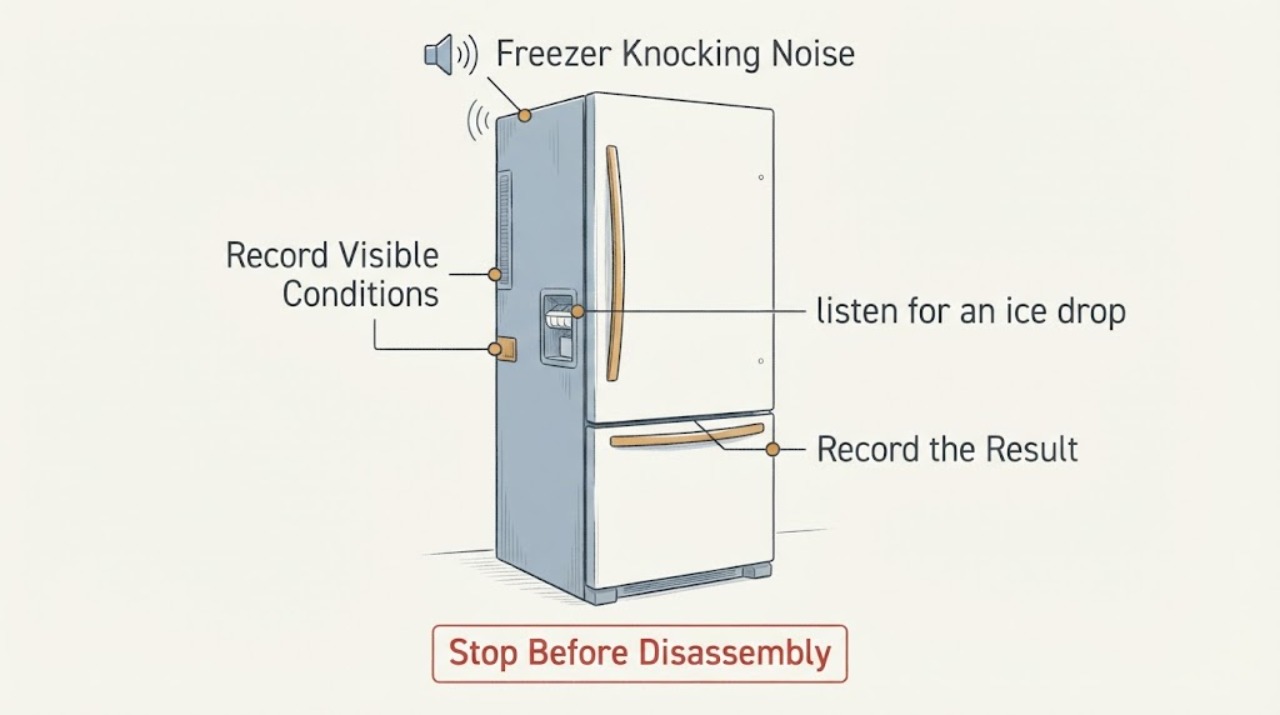
For a Samsung RF28HFEDTSR freezer that makes a knocking sound, first record whether the sound is a brief ice drop, a temperature-related crack, a steady loud thump, or a noise that stops when the freezer is opened. Samsung says a consistent, very loud thump or knock that is not ice falling needs service, and it specifically routes a fan noise that stops when the door opens to service because ice may be around the fan. Check only accessible conditions such as a loose item, the ice bucket, rear contact or clearance, and the sound location. Do not remove the freezer evaporator cover, probe a fan, or infer a failed motor or fan from the sound alone.
Work through in order
Diagnostic checks
Use only checks that match the exact appliance or system and its official guide.
-
Check 1
From outside the appliance, record the exact moment and location of the sound. Note whether it occurs when the ice maker drops ice, while the refrigerator is cooling, during or after a defrost cycle, only with the freezer drawer closed, or continuously. Make a short recording from the front, freezer area, and rear without opening panels.
Expected result: The noise is a single brief impact, a repeating thump, a crack or pop during temperature change, a rear rattle, or a fan-like knock that stops when the freezer is opened.
Next step: Use the matching branch below. If the sound is loud, persistent, or unclear after one observation, stop trying to reproduce it and arrange Samsung service with the recording and model number.
Why this matters
Why: Samsung describes brief ice falling and thermal expansion sounds as normal possibilities, while a consistent very loud thump or knock is a service condition. A sound that changes with the freezer door is a different decision from a rear cabinet rattle; the observation does not identify the failed component.
-
Check 2
With the freezer drawer closed and the refrigerator operating normally, listen for an ice drop and inspect only the accessible ice bucket and surrounding drawer contents. Make sure no loose container, divider, or stored item can strike the drawer or cabinet, and note whether ice is landing normally in the bucket. Do not reach toward an operating ice maker or insert anything into a chute or fan opening.
Expected result: The impact coincides with ice entering the bucket; a loose item is touching the cabinet; or the bucket and contents are stable while the knock continues.
Next step: Remove only a clearly loose accessible item, then observe once. If the sound remains with the bucket and drawer contents stable, use the freezer-door and service checks rather than opening the ice-maker or evaporator area.
Why this matters
Why: Samsung says ice falling from the ice maker can sound like blocks hitting a table, and an unsteady item can make a similar sound. If the bucket and contents are stable and the knocking is regular or very loud, the normal ice-drop explanation is weaker, but the sound still does not prove a motor or fan fault.
-
Check 3
Compare the sound with the freezer door open and closed without defeating the door switch or using a magnet. Do not place hands near the fan or use a tool to test a hidden switch. Record whether opening the drawer stops the noise immediately, changes it, or has no effect.
Expected result: The fan-like or knocking sound stops when the freezer is opened; the sound continues with the drawer open; or only a normal ice-drop sound occurs.
Next step: If the fan-like noise stops with the door open, stop repeated tests and request service. Do not remove the evaporator cover or attempt to clear hidden ice with a tool or heat source.
Why this matters
Why: Samsung explicitly describes a fan hitting ice as a noise that stops when a door is opened and says service is needed; this is a symptom pattern, not permission to dismantle the freezer. A noise that does not change with the door needs the general sound, rear-clearance, and service checks instead.
-
Check 4
If the sound comes from behind the refrigerator, check from the front and sides for an accessible object or tubing touching the cabinet. Confirm the refrigerator has the installation clearance stated in Samsung's RF28HFEDTSR planning sheet, and do not pull the 326-pound appliance out alone or disturb water and power connections.
Expected result: A loose object or contact point is visible behind the unit; the refrigerator is crowded against a wall; or the rear area is clear and the knock persists.
Next step: Remove only a safe loose object and have a second adult help with any repositioning while keeping the specified connections and clearance intact. If the noise remains or the area cannot be inspected safely, arrange service instead of moving the appliance further.
Why this matters
Why: Samsung says a rear rattle can come from something touching the refrigerator and may improve when the unit is moved slightly, while the RF28HFEDTSR sheet specifies rear and side clearance for airflow and connections. A clear rear area does not establish a compressor or fan failure.
-
Check 5
If Samsung's fan-on-ice pattern is present, or if the noise is consistently loud, stop operating the appliance and arrange qualified service. If Samsung service specifically directs a manual defrost as a temporary measure, remove perishables and ice, unplug the refrigerator, prop the doors open, place towels below it, and allow at least 24 hours; never use a hair dryer, heat gun, or other heat source.
Expected result: The sound is no longer present after a properly completed manual defrost but later returns; it remains present; or the refrigerator is not maintaining safe food temperature or has water, smoke, sparks, or damaged wiring.
Next step: Keep the refrigerator out of service for the noise or safety condition and request Samsung or qualified appliance service with the model, recording, sound location, door-state result, and any defrost history. Do not replace a fan or sealed-system part based on the noise alone.
Why this matters
Why: Samsung says manual defrost may remove ice around a fan temporarily but service is needed to correct the original cause, and a recurring sound should not be treated as fixed. Food-temperature loss, leaks, smoke, sparks, and damaged wiring add an immediate safety or food-safety boundary.
Use your observations
Decision map
Find the observation that best matches what you see, then follow the next safe action.
-
PATH 01Next step
What you see
The sound is a brief impact that coincides with ice dropping into the bucket, or it is a quiet occasional crack during cooling or defrost.
Do this next
Monitor the sound without opening the appliance. If it becomes consistent, very loud, or changes into a fan-like knock, stop normal troubleshooting and arrange service.
Why this path and its safety boundary
Why it matters: Samsung identifies ice falling and thermal expansion as normal refrigerator sounds when they are not unusually loud or persistent.
-
PATH 02Next step
What you see
The knocking is steady and very loud, or it is not explained by ice falling, a loose item, thermal cracking, or a rear contact point.
Do this next
Stop trying to reproduce the noise and request Samsung service with the exact RF28HFEDTSR model and a recording of when and where it occurs.
Why this path and its safety boundary
Why it matters: Samsung treats a consistent very loud thump or knock as a service condition; the sound does not identify which internal part is responsible.
-
PATH 03Next step
What you see
A fan-like noise stops as soon as the freezer drawer is opened, or the sound is accompanied by evidence of frost, reduced airflow, or worsening cooling.
Do this next
Stop opening panels or testing the fan. Arrange service, protect perishable food, and never accelerate defrost with a hair dryer or other heat source.
Why this path and its safety boundary
Why it matters: Samsung describes this pattern as a fan hitting ice and says service is needed; a temporary defrost does not correct the original cause.
-
PATH 04Next step
What you see
The sound comes from behind the refrigerator and changes when an accessible object is moved or the unit is safely repositioned with adequate clearance.
Do this next
Remove only the accessible contact, preserve Samsung's clearances, and observe once. If the knock persists or the refrigerator cannot be moved safely, use qualified service.
Why this path and its safety boundary
Why it matters: A cabinet contact or installation condition is more likely than a confirmed internal component fault, but the appliance should remain stable and connected safely.
Helpful context
Understand the symptom
The sound location and timing are more useful than the word “knocking.” On the RF28HFEDTSR, the freezer has a filtered ice maker, so a brief drop into the bucket can sound like a thump. A noise that continues while the freezer is closed, disappears when a door opens, or is loud enough to interrupt conversation belongs on a different service path. A sound description alone does not identify a fan, motor, compressor, or other part.
Keep the inspection external. Samsung's guide says not to speed a manual defrost with a hair dryer or another heat source, and says service is needed when a fan is hitting ice. If food temperature is rising, water is leaking, the appliance is sparking, or the noise is severe, protect the food and stop testing while arranging service.
When checks do not resolve it
Need a professional?
Arrange Samsung or qualified appliance service when the RF28HFEDTSR makes a consistent loud knock, the sound stops when the freezer opens, the noise returns after a temporary defrost, cooling or food safety is affected, or any internal fan, evaporator, compressor, sealed-system, wiring, or control work would be required. The sound alone does not justify ordering a part.
Common questions
FAQ
Is a knocking sound always a failed freezer fan?
No. Samsung lists ice falling into the bucket and thermal expansion among normal sounds. A fan-like noise that stops when the door opens is a different pattern that Samsung routes to service, but even that pattern does not identify a specific replacement part for the RF28HFEDTSR.
Can I use a hair dryer to melt suspected ice around the fan?
No. Samsung expressly says not to use a hair dryer or another heat source to speed a manual defrost. If service guidance calls for a manual defrost, unplug the refrigerator, keep the doors open, place towels below it, and allow the documented time without applying heat.
What should I give the technician?
Provide RF28HFEDTSR, the sound recording, whether it stops with the freezer open, where it is loudest, whether it coincides with ice dropping or cooling, and whether the sound returned after a defrost. Those observations are more useful than naming an unverified fan, motor, or compressor fault.
Read the exact guide
Official sources
- Refrigerators | Samsung Support USSamsung · Samsung refrigerator model-code support, user-manual lookup, and repair request routing
- Warranty | Samsung Support US - RF28HFEDTSRSamsung · Samsung RF28HFEDTSR/AA support identity and official service context
- Understanding the different noises coming from your Samsung refrigeratorSamsung · Samsung refrigerator sound classification, external observations, manual-defrost safety, and service boundary
- RF28HFEDTSR.inddSamsung Electronics America · Samsung RF28HFEDTSR refrigerator model identity and installation planning
Community feedback
Share a repair observation
Share a plain-text repair observation. Accepted observations are published automatically; this page may take a moment to update.