
On this page
Start here
Quick answer
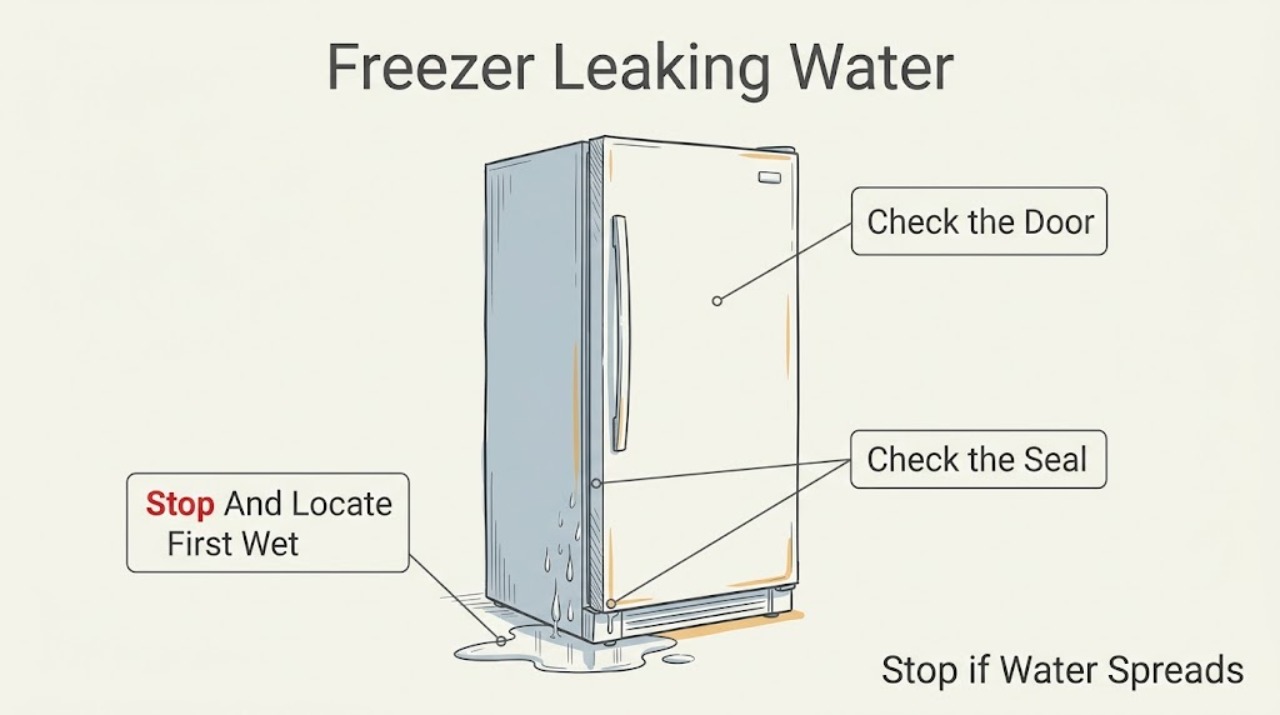
Start by turning off ice making or cooling through the normal controls if water is actively leaking, and identify the first wet point before assuming the freezer itself is the source. Samsung says water under drawers or under the refrigerator can be condensation after a power interruption or a food spill, while water can also follow a blocked drain, melting frost, an ice-maker or water-line issue, or a door that is not sealing. Check that food, shelves and bins are not holding the freezer door or drawer open, inspect the rubber seal for dirt or damage, and keep rear vents clear. Look only at an accessible drain opening, tray, water filter housing or supply connection for obvious water or ice; do not remove interior panels, force a drain, disconnect tubing, chip ice, or work near live wiring. A leak that returns, a damaged seal or water line, persistent frost, weak cooling, or water near electrical parts needs qualified Samsung appliance service. Leave the area and seek urgent help for flooding, smoke, burning odor, sparks or a damaged cord.
Before you begin
Safety first
- This article supports only normal controls, safe source observation, clearing loose storage obstructions, cleaning an accessible seal, checking visible vents and recording symptoms. Drain, pan, defrost, ice-maker, water-line, electrical, cooling-system and internal-panel work require qualified service or exact model instructions.
Work through in order
Diagnostic checks
Use only checks that match the exact appliance or system and its official guide.
-
Check 1
Turn off the ice maker or cooling function using the normal user controls if water is actively leaking, then dry and protect the floor without blocking ventilation. Observe whether the first wet point is inside the freezer, under drawers, below the appliance, near a dispenser or ice maker, at a visible water line, or only a one-time spill.
Expected result: Water is continuous, pooling or spraying; the source is a spill or condensation; the first wet point is inside the compartment, near the rear or beneath the appliance; or the source remains uncertain.
Next step: Keep the affected function off, record the location and timing, and arrange qualified Samsung service for recurring water, an active leak or an uncertain source. For a spill, clean and continue with closure and frost checks only after the area is safe.
Stop if: Stop immediately for flooding, spraying water, smoke, burning odor, sparks, a damaged cord or water contacting electrical components; leave the area and seek emergency or electrical help.
Why this matters
Why: A one-time spill or condensation after a power interruption may not be an appliance leak. Water returning from inside, the rear, a drawer or a supply area keeps drainage, thawing frost, ice making and water-line causes in consideration. Water near electrical parts is a hazard regardless of the source.
-
Check 2
Inspect the freezer door or drawer edge, shelves, bins and packages for anything preventing full closure. For a pull-out freezer, check behind the drawer and whether storage bins are seated; remove or reposition only loose items and do not force the door.
Expected result: Food, a shelf, bin, drawer or frost holds the door open, or the door path is clear but leakage continues.
Next step: Close the door normally after clearing loose items and monitor whether the leak or frost stops increasing. If the door still does not close or water returns, arrange model-specific service rather than pushing harder.
Stop if: Do not force a drawer, remove fixed rails, pry frost from a seal or use a sharp tool on ice.
Why this matters
Why: A closure obstruction can admit warm air, create frost and produce meltwater without a failed drain. If the path is clear, the gasket, door alignment, drainage, ice maker or water system becomes more likely.
-
Check 3
Inspect the full rubber door or drawer seal and its mating surface for dirt, tears, splits, warping, pulled-out sections and visible gaps. Clean dirt with warm soapy water and a soft cloth, dry it, and keep food away from the rear vents; do not remove the seal or open a panel.
Expected result: The seal is dirty but intact, pulled from its channel, warped or damaged, the door fails a gentle paper or light-gap check, or the seal contacts evenly.
Next step: Close the door and repeat a gentle visual or paper contact check at several points. Arrange service for a damaged seal, repeatable gap, returning frost or continuing water; do not glue, stretch or replace the seal by appearance alone.
Stop if: Stop if cleaning exposes a sharp liner edge, damaged insulation, wet electrical area or a seal that will not remain seated without force.
Why this matters
Why: Dirt or a loose section can interrupt contact and allow moisture in; a torn, warped or persistently loose seal points to service. Blocked vents can worsen frost and cooling behavior even if the seal looks good.
-
Check 4
Look for frost or ice around the freezer opening, rear vents, bottom of the compartment, drain area or ice-maker compartment, and note whether water appears after frost melts or after a power interruption. Wipe light accessible moisture only; do not chip ice, use a hair dryer or remove interior covers.
Expected result: Frost is localized near the door, vents or drain area, heavy frost blocks access, water follows a thaw, or no frost is visible.
Next step: Keep the freezer closed and follow only the exact model's defrost instructions if the manual calls for user defrosting. Arrange service for heavy or recurring frost, a blocked drain, or water that returns after thawing.
Stop if: Do not puncture the liner, scrape with metal, heat the compartment, pour hot water into a drain or continue operation when water reaches wiring or controls.
Why this matters
Why: Localized frost supports warm-air entry through a seal or obstruction; frost at vents can block airflow; water after thawing may be condensation or an overflowing drain. Heavy or recurring frost can also require defrost-system service, and no visible frost does not rule out a blocked drain or water source.
-
Check 5
If the Samsung refrigerator has an ice maker or water dispenser, inspect only the accessible water-filter housing, visible tubing and connection areas for a crack, drip, loose-looking fitting or ice residue. Do not disconnect a line, remove a filter under pressure, or reach behind panels; if there is no water system, skip this check.
Expected result: Water appears near the filter housing, ice maker, dispenser, visible tubing or rear connection, the filter was recently changed, or no water-system clue is present.
Next step: Turn off the refrigerator water supply only if the shutoff is known and accessible without entering an unsafe area, keep ice making off, and arrange qualified appliance or plumbing service for a recurring water-system leak.
Stop if: Do not disconnect tubing, tighten hidden fittings, touch wet wiring, operate a cracked filter housing or work behind the refrigerator if it could tip or expose live parts.
Why this matters
Why: A wet filter housing, connection or ice-maker area makes a water-supply or ice-melt issue more likely than a freezer drain alone. A recently changed filter can leave a fitting or housing problem. No visible water-system clue keeps drain, frost, condensation and seal causes in consideration.
-
Check 6
Record the Samsung model and serial information from ordinary-access paperwork or labeling, whether the unit is a standalone freezer or refrigerator-freezer, the first wet point, frost pattern, door-seal result, water-system status, room conditions and whether food is soft or warming. Observe cabinet stability and normal temperature controls without moving the appliance or opening panels.
Expected result: Water returns after the door path and seal checks, the cabinet is unstable, cooling is weak, food is warming, frost is heavy or recurring, or the cause remains uncertain.
Next step: Keep the affected function off and arrange qualified Samsung appliance service. Provide the model, records and safe photos; protect food under local food-safety guidance if temperature cannot be maintained.
Stop if: Stop and seek urgent appliance or electrical help for flooding, smoke, burning odor, sparks, a damaged cord, exposed wiring, a punctured liner or an appliance that could tip.
Why this matters
Why: Persistent water can involve a drain, tray, pan, defrost system, door seal, ice maker, water line, leveling or temperature-control issue. Warming food or recurring frost raises the need for service; visible water alone does not identify a compatible part.
Use your observations
Decision map
Find the observation that best matches what you see, then follow the next safe action.
-
PATH 01Safety boundary
What you see
Do this next
Dry the area, keep the door sealed and observe normally without repeatedly opening the freezer. Arrange service if water returns or cooling changes.
Why this path and its safety boundary
Why it matters: A spill or condensation event is more likely than a continuing appliance leak, but a recurring puddle needs source tracing.
Safety stop: Stop for water near controls, damaged wiring, flooding, smoke, burning odor or sparks.
-
PATH 02Safety boundary
What you see
Do this next
Clear loose obstructions, clean the seal gently and repeat the closure check. Arrange service for a damaged seal, persistent gap or returning frost and water.
Why this path and its safety boundary
Why it matters: Warm-air entry through a closure or seal problem is more likely, and the resulting frost can contribute to water as it thaws.
Safety stop: Do not glue, stretch or remove the gasket, force the door or heat or chip ice.
-
PATH 03Safety boundary
What you see
Do this next
Keep the appliance off if water is active and arrange qualified Samsung service to inspect the drain, pan, defrost system and airflow. Follow only model-specific defrost instructions.
Why this path and its safety boundary
Why it matters: A drain, tray, defrost or airflow issue is more likely than a simple spill; a hidden pan or defrost fault cannot be diagnosed safely from outside.
Safety stop: Do not probe, flush, puncture, scrape or heat the drain or liner, and do not open interior panels.
-
PATH 04Safety boundary
What you see
Do this next
Keep ice making off, close a known accessible water shutoff when safe and arrange qualified appliance or plumbing service. Do not disconnect or tighten hidden tubing.
Why this path and its safety boundary
Why it matters: A water-supply connection, filter housing, ice-maker or dispenser issue is more likely than a freezer drain problem.
Safety stop: Stop for spraying water, water near wiring, a cracked filter housing, an unstable refrigerator or any exposed electrical hazard.
-
PATH 05Safety boundary
What you see
Do this next
Keep the refrigerator or freezer function off as appropriate, protect food and arrange qualified Samsung service with the model and symptom record.
Why this path and its safety boundary
Why it matters: A persistent drain, seal, defrost, ice-maker, water-line, leveling or cooling fault needs model-specific diagnosis.
Safety stop: Do not keep operating an appliance with an active leak near electrical parts, flooding, smoke, burning odor, sparks or a damaged cord.
Helpful context
Understand the symptom
Locate the first wet point before choosing a repair
Water under a Samsung freezer may be a spill, condensation, thawing frost, a drain or tray overflow, or water from an ice maker or supply line. Water can travel along shelves and cabinet surfaces, so the puddle location is not always the leak location. Dry the area safely and watch only long enough to identify where water starts.
Treat the door seal as part of the water diagnosis
A door or drawer held open by food, a shelf, a bin or frost lets warm moist air enter. That air can freeze around the opening and later melt into the freezer or onto the floor. Samsung recommends checking closure, the rubber seal, storage placement and rear vents before assuming a hidden component has failed.
Keep water, power and refrigeration work separate
User checks are limited to normal controls, safe exterior observation, clearing loose storage obstructions and cleaning an accessible seal. Do not open panels, disconnect water tubing, probe a drain, chip ice, test valves or wiring, or handle refrigerant. A persistent leak needs model-specific service.
Safety boundary
Stop conditions
- Stop and leave the area if there is flooding, spraying water, smoke, burning odor, sparks, a damaged cord or water contacting electrical components; obtain appropriate emergency, electrical or appliance help.
- Do not open interior panels, disconnect water tubing, probe a drain or tray, test a valve or wiring, handle refrigerant, or move an unstable refrigerator.
- Do not chip ice with a knife, puncture the liner, use a hair dryer or other heat source, pour chemicals or hot water into a drain, or force a door or drawer.
- Keep cooling or ice making off for an active or recurring leak, warming food, persistent frost or water near controls; protect food under local food-safety guidance.
- Arrange qualified Samsung appliance service when water returns after safe checks, the leak source is uncertain, a seal or water component is damaged, frost persists, or cooling performance changes.
Only after diagnosis
Potential parts
- Samsung freezer door gasket
Consider this part only if qualified diagnosis confirms a torn, warped or persistently nonsealing gasket after storage obstructions and alignment are checked.
Gasket profile, mounting and dimensions vary by exact Samsung model and door design; confirm model fit before ordering. - Samsung freezer drain tube or drain-tray component
Consider this category only when service confirms a blocked, cracked, disconnected or damaged drainage component rather than a spill, door seal or ice-maker leak.
Drain routing, tray shape and connections are model-specific; internal access and replacement require qualified service. - Samsung ice-maker or water-line component
Consider this category only when qualified diagnosis traces the leak to the ice maker, filter housing, tubing, valve or dispenser rather than the freezer drain.
Water-line routing, filter housing, valve and ice-maker compatibility depend on the exact model and configuration; do not substitute by appearance. - Samsung defrost or temperature-control component
Consider this category only when recurring frost or thaw water remains after the door seal and storage checks and qualified diagnosis identifies an internal control or defrost fault.
Defrost and temperature components are model-specific and require qualified diagnosis and installation.
When checks do not resolve it
Need a professional?
Arrange qualified Samsung appliance service when water returns after drying and safe exterior checks, the first wet point is inside the freezer or under the appliance, a drain or tray appears blocked or damaged, the door seal has a gap, the ice maker or water line is wet, frost persists, or food is warming. Provide the exact model and serial information if safely visible, leak location and timing, frost and door-seal observations, water-system status and photos. Seek urgent appliance or electrical help for flooding, smoke, burning odor, sparks, a damaged cord, exposed wiring or water contacting controls.
Safety scope: This article supports only normal controls, safe source observation, clearing loose storage obstructions, cleaning an accessible seal, checking visible vents and recording symptoms. Drain, pan, defrost, ice-maker, water-line, electrical, cooling-system and internal-panel work require qualified service or exact model instructions.
Common questions
FAQ
Why is my Samsung freezer leaking water?
The source may be condensation or a spill, thawing frost from a door-seal problem, a drain or tray issue, or an ice-maker, filter or water-line leak if the appliance has those features. Locate the first wet point, turn off the affected function and arrange service when water returns or reaches electrical parts.
Can a bad Samsung freezer door seal cause water?
Yes. A door held open by food or a damaged seal lets warm moist air in, which can form frost and later produce meltwater. Check closure, storage and the rubber seal, but do not stretch, glue or remove the gasket; arrange service for a repeatable gap or damaged seal.
How can I tell if Samsung freezer water is from a drain or frost problem?
Water that appears inside or below the freezer after frost builds or thaws, especially with a blocked-looking drain area, keeps a drain, tray or defrost cause in consideration. A localized frost line near the door points more toward warm-air entry. Do not probe or flush the drain; provide the timing and frost pattern to service.
Could the Samsung ice maker or water filter be leaking into the freezer?
If the appliance has an ice maker or dispenser, water near the filter housing, ice maker, chute or visible tubing can point to that water system rather than the freezer drain. Keep ice making off, inspect only accessible areas and arrange appliance or plumbing service for a recurring leak.
When should I call Samsung service for a freezer leak?
Arrange service when water returns after drying, the leak source is uncertain, a seal or water connection is damaged, frost persists, cooling is weak or food is warming. Seek urgent appliance or electrical help for flooding, smoke, burning odor, sparks, a damaged cord or water near controls.
Read the exact guide
Official sources
- Samsung refrigerator or freezer doors will not closeSamsung · Official Samsung US support guide used for seal inspection, food and drawer obstruction checks, model-specific adjustment and service escalation.
- Why is my Samsung refrigerator leaking water?Samsung Gulf · Official Samsung regional support guide used only for additional water-system and drain-source categories; exact models and settings vary by region, so the article defers model-specific work to service.
- Water leaks in a Samsung refrigeratorSamsung · Official Samsung US support guide used for distinguishing condensation or spills from recurring leaks and for water-system and service boundaries.
- Frost forms in the Samsung freezer, refrigerator, or ice bucketSamsung · Official Samsung US support guide used for warm-air entry, closure obstructions, vent clearance, seal cleaning and damage, safe frost removal and recurring-frost escalation.
- Cooling issues with Samsung refrigerator or freezerSamsung · Official Samsung US support guide used for door-seal paper checks, keeping food away from vents and connecting water or frost symptoms to cooling performance.
Community feedback
Share a repair observation
Share a plain-text repair observation. Accepted observations are published automatically; this page may take a moment to update.