
On this page
Start here
Quick answer
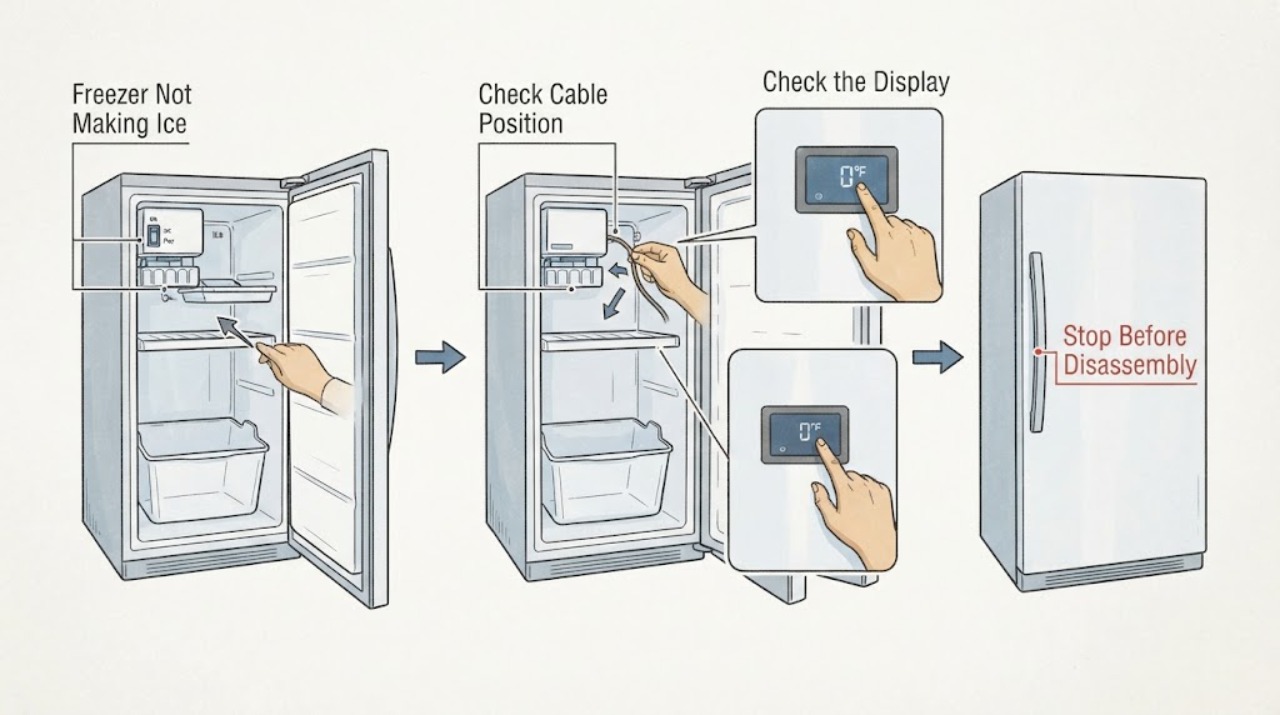
If a Samsung freezer is not making ice, first verify that the ice maker is turned on, the freezer is cold enough for ice production, and the freezer door or ice-bucket seal closes correctly. Then check for an empty or incorrectly seated bucket, a kinked water line, a fully open household water valve, low water flow, or a filter that needs replacement. A single model-appropriate Test-button cycle is a last step, not a repeated experiment; Samsung warns that repeated tests can overflow water or jam ice. Do not force out a frozen bucket, chip ice with a tool, use a hair dryer, or work near live electrical parts. Stop immediately for continuous leaking, water near electrical controls, damaged wiring, unusual grinding or arcing, smoke, a burning odor, or food that is no longer safely frozen. If the test produces no movement or water, the freezer cannot reach its documented ice-making temperature, or ice does not return after the official recovery period, arrange qualified refrigerator service.
Work through in order
Diagnostic checks
Use only checks that match the exact appliance or system and its official guide.
-
Check 1
Before troubleshooting, check the freezer temperature display and the food condition, then look from a dry, safe position for continuous water, water near controls or wiring, smoke, burning odor, arcing, unusual grinding, a hot cable, or a damaged door seal.
Expected result: Food is warming, water is leaking continuously, water is close to electrical parts, a fire or electrical symptom is present, or the freezer is cold and dry with no immediate hazard.
Next step: For unsafe food, move it to a reliably cold location and follow local food-safety guidance. For water or electrical hazards, stop the appliance and isolate power only when safe before arranging qualified service. If safe, continue with the external control check.
Stop if: Do not touch wet electrical areas, scrape ice near wiring, open sealed panels, use a hair dryer, or keep the freezer running when food or wiring is unsafe.
Why this matters
Why: Food safety and electrical or water hazards take priority over ice production. A warm freezer may indicate a refrigerator cooling issue rather than an isolated ice-maker fault.
-
Check 2
Check the displayed freezer temperature and confirm that the freezer door closes fully, the gasket contacts the cabinet, frost is not preventing closure, and the ice-maker compartment or bucket is seated and sealed as the exact model manual shows.
Expected result: The freezer is warmer than its documented ice-making requirement, the door or gasket has a gap, frost is present, the bucket is not seated, or temperature and sealing appear normal.
Next step: Correct only an obvious cool door or bucket seating issue according to the manual. If the freezer cannot reach its documented temperature, frost returns, or the door does not seal, stop ice troubleshooting and arrange refrigerator service.
Stop if: Stop for a torn gasket, heavy frost, a door that cannot close, food temperature loss, or any need to remove panels or access the sealed cooling system.
Why this matters
Why: Samsung says ice production needs a sufficiently cold freezer and that warm air from a door or ice-maker seal problem can prevent freezing. A warm freezer must be treated as a cooling or sealing branch first.
-
Check 3
Using the exact Samsung manual, verify that the affected ice maker is on, the Ice Off indicator is not active, the bucket contains only ice, and the bucket clicks fully into place. For a dual cubed and Ice Bites model, verify that the scoop holder is oriented as Samsung shows and is not blocking a sensor.
Expected result: The ice maker is off, the panel is locked, the bucket is full, blocked, incorrectly oriented, or not seated, or the setting and bucket are correct.
Next step: Turn the ice maker on or unlock the panel only through the documented control path. Remove only loose non-ice items and gently reseat an obvious bucket; if it is stuck, frozen, or will not seat, request service rather than forcing it.
Stop if: Stop for a fused bucket, a sensor wire or scoop obstruction that will not clear gently, broken plastic, a leaking bucket, or any need to pry, chip, or remove the ice-maker housing.
Why this matters
Why: An off setting, a bucket sensor that thinks the bucket is full, or an incorrectly fitted dual-ice bucket can stop production without a failed water system.
-
Check 4
If the model has a water connection, inspect only the visible line for a kink or damage, confirm the household water valve is open, and verify that the filter is fully seated and within its service life. If the model has a dispenser and the guide permits a flow check, use a container at the dispenser with dry hands; never loosen a water fitting while pressurized.
Expected result: The valve is closed, the line is kinked or damaged, the filter is loose or overdue, water flow is weak or absent, or the accessible water path appears normal.
Next step: Open only an accessible household valve, unkink an undamaged visible line, or reinstall or replace the model-approved filter according to Samsung instructions. If flow stays weak, the line leaks, or the filter is not the cause, arrange qualified plumbing or refrigerator service.
Stop if: Stop for a split line, continuous leak, water near electrical parts, a stuck filter that needs force, or any need to open a valve, harness, inlet valve, or internal tubing.
Why this matters
Why: Samsung links low water pressure, a kinked line, and a clogged or old filter to no or insufficient ice. A damaged line or persistent leak requires a plumbing or refrigerator service path rather than continued ice-maker testing.
-
Check 5
Only after the earlier checks, locate the model-specific Test button from the Samsung manual, remove the bucket only as instructed, and press Test once until the documented chime or movement occurs. Do not press it repeatedly; if the guide allows a power cycle for no response, perform that step only once and only when the refrigerator is safe to power down.
Expected result: The ice maker chimes or moves, it does not respond, water enters during the test, no water enters, a code appears, or the bucket cannot be replaced correctly.
Next step: Reinstall the bucket as the manual shows and allow the official recovery period. If there is no response, no fill, a returning code, or a repeated jam, stop testing and arrange service. If the test passes but production does not return, continue to the service handoff.
Stop if: Do not press Test repeatedly, force the tray or bucket, use heat to thaw ice, touch a valve or heater, or operate the unit with exposed wiring or a leak.
Why this matters
Why: Movement and water entry show which part of the ice-making cycle responds. No movement, a failed fill, a returning code, or a bucket that cannot seat shifts the problem to service; repeated tests can overflow or jam ice.
-
Check 6
Prepare the exact Samsung model, freezer temperature, door and seal result, Ice Off state, bucket position, water-line and filter observations, Test-button response, fill result, any display code, and any leak, frost, noise, food-temperature, smoke, or electrical symptom.
Expected result: Ice production resumes after a documented safe correction, or the freezer remains cold but the ice maker is empty, undetected, jammed, unresponsive, leaking, or error-affected.
Next step: If no ice returns after the official recovery period, or any safety symptom is present, stop using the affected function and arrange qualified refrigerator service. Do not order an inlet valve, ice maker, sensor, or control from the symptom alone.
Stop if: Do not open the sealed cooling system, remove internal covers, test energized circuits, force a frozen bucket, or bypass a sensor or door safety.
Why this matters
Why: This record separates cooling, sealing, settings, water flow, filter, bucket sensing, ejector, and control faults so the correct service path can be selected.
Use your observations
Decision map
Find the observation that best matches what you see, then follow the next safe action.
-
PATH 01Next step
What you see
Food is warming, water leaks continuously or reaches electrical parts, smoke, burning odor, arcing, unusual grinding, or damaged wiring is present.
Do this next
Arrange qualified service and follow the exact model guidance.
Why this path and its safety boundary
Why it matters: Stop the affected appliance function, protect food as appropriate, isolate power only when safe, and arrange qualified refrigerator, plumbing, or electrical service. Do not retest.
-
PATH 02Next step
What you see
The freezer is warmer than the documented ice-making requirement, frost blocks sealing, the door does not close, or the ice-maker compartment is not sealed.
Do this next
Arrange qualified service and follow the exact model guidance.
Why this path and its safety boundary
Why it matters: Resolve only an obvious cool door or bucket seating issue according to the manual. If cooling or sealing remains abnormal, troubleshoot that issue and arrange service before testing ice production.
-
PATH 03Next step
What you see
The Ice Off state is active, the bucket is full or blocked, the bucket is not seated, or a dual-ice scoop holder blocks a sensor.
Do this next
Arrange qualified service and follow the exact model guidance.
Why this path and its safety boundary
Why it matters: Use the exact manual to turn the ice maker on and gently correct an obvious bucket position. Do not force, chip, or heat a frozen bucket; request service if it will not seat.
-
PATH 04Next step
What you see
The water valve is closed, the line is kinked, the filter is loose or overdue, water flow is weak, or the test does not fill the ice maker.
Do this next
Arrange qualified service and follow the exact model guidance.
Why this path and its safety boundary
Why it matters: Correct only an accessible valve, undamaged visible line, or model-approved filter condition. Persistent weak flow or any leak needs qualified plumbing or refrigerator service.
-
PATH 05Next step
What you see
The single official Test cycle produces no chime or movement, no water enters, a code returns, or the bucket cannot be reinstalled.
Do this next
Arrange qualified service and follow the exact model guidance.
Why this path and its safety boundary
Why it matters: Stop testing and arrange qualified refrigerator service. Do not repeat Test, force the tray, use heat, or access the valve, heater, wiring, or controls.
-
PATH 06Next step
What you see
The freezer is cold and sealed, the ice maker is on, the bucket and water path are correct, and ice production returns after one permitted test or external correction.
Do this next
Arrange qualified service and follow the exact model guidance.
Why this path and its safety boundary
Why it matters: Monitor one normal cycle and retain the model, filter, and setting record. Request service if production stops again or any safety symptom appears.
Helpful context
Understand the symptom
First separate no ice from no dispensing
Open the bucket and determine whether it is empty, full of fused ice, or holding ice that simply will not dispense. A freezer that has no newly formed ice follows a different path from a dispenser jam. Also record whether one ice maker or every ice maker is affected, whether the Ice Off indicator is lit, and whether the freezer display shows an error.
Temperature and door sealing come before a reset
Samsung says the freezer must reach its ice-making temperature before the ice maker can operate. Check the displayed freezer temperature and whether the door closes fully. Frost, a door gap, or an improperly seated bucket can let warm air reach the ice-maker area. If the freezer itself is not cold enough, troubleshoot cooling before testing the ice maker.
Check the ice setting and bucket without forcing anything
Most Samsung models show an Ice Off indicator or an Ice On control; connected models may expose the setting in a refrigerator app. Use the exact manual for the model. The bucket should contain only ice and should click fully into position. For a dual cubed and Ice Bites design, the scoop holder and bucket direction can affect sensor clearance. Do not force a stuck bucket or chip out a block.
Water flow and the filter are a separate branch
If the ice maker test does not supply water, inspect only the accessible water valve position, visible line, and filter seating. Samsung links low flow, a kinked line, and a clogged or expired filter to poor ice production. Replace a filter only with the model-approved Samsung filter and follow the model instructions; a leaking connection or water near electrics is a stop condition.
Use one official test, then stop
After the temperature, setting, bucket, and water checks, use the Test button only if the model has one and the manual identifies it. Samsung says not to press Test repeatedly because water can overflow or ice can jam. A chime or movement is useful evidence; no response after the permitted model-specific power cycle means service, not more force or repeated tests.
Protect food and avoid unsafe ice-maker work
Move perishable food to a reliably cold location if the freezer temperature is rising, and do not use questionable ice. Never use a hair dryer to thaw the ice maker, force out a frozen bucket, remove a cover that is not user-removable, or probe a valve, heater, harness, or control. Smoke, burning odor, arcing, abnormal noise, water near electrics, or a damaged seal needs immediate shutdown and qualified service.
Only after diagnosis
Potential parts
- ice maker assembly or ejector mechanism
Consider only after qualified service confirms that the ice maker fails its model-specific test while temperature, settings, bucket, and water supply are correct.
Confirm the exact Samsung model and manufacturer fit information; a no-ice symptom alone does not identify the assembly. - water inlet valve or water-line component
Consider only when qualified service confirms a fill or water-path fault after safe accessible flow and filter checks.
Water connections can leak and model routing differs; do not open a pressurized line or replace a valve as a user test. - temperature, bucket-sensing, or control component
Consider only when qualified service links a persistent cold, sealed freezer and successful water path to a named sensor or control fault.
Sensor and control compatibility is model-specific and cannot be inferred from an empty bucket.
When checks do not resolve it
Need a professional?
Food is warming, continuous water is leaking, water reaches electrical parts, smoke, burning odor, arcing, unusual grinding, or damaged wiring appears., The freezer cannot reach its documented ice-making temperature, frost prevents the door or bucket from sealing, or the door remains damaged or open., The bucket is frozen in place, will not seat, contains a fixed block of ice, or requires prying, chipping, or heat to remove., Water flow remains weak or absent after accessible valve, visible line, and model-approved filter checks, or a water line or filter connection leaks., The official Test cycle produces no movement, no fill, a returning code, or repeated jams, or ice does not return after the model's recovery period., The next step would require opening panels, testing energized circuits, accessing the inlet valve or heater, bypassing a sensor, or opening the sealed cooling system.
Common questions
FAQ
Why is my Samsung freezer not making any ice?
Check that the freezer is cold enough, the ice maker is on, the door and bucket seal correctly, and the water line and filter provide normal flow. Use the model-specific Test button once only after those checks. Persistent no ice needs qualified service.
Can a Samsung Ice Off setting stop ice production?
Yes. Samsung says most models show an Ice Off state when the ice maker is disabled. Use the exact owner manual or model control panel to turn it on; connected models may use a refrigerator app.
Why does my Samsung ice maker have water but make no ice?
Check freezer temperature, door and bucket sealing, frost, and whether the tray or ejector is jammed. Do not force a frozen bucket or use a hair dryer. If the freezer is cold and the problem returns, request service.
Could a Samsung water filter stop the freezer from making ice?
Yes. Samsung links a clogged or expired filter and low water pressure to no or insufficient ice. Confirm the filter is seated and use the model-approved Samsung filter; stop if the filter or line leaks.
How often can I reset a Samsung ice maker?
Treat the Test button as a last step and follow the exact model guide. Samsung warns that repeated tests can overflow water or jam ice. If one permitted test does not produce the documented response, arrange service instead of pressing it again.
When should I stop troubleshooting a Samsung freezer ice maker?
Stop for continuous leaking, water near electrical parts, warming food, smoke, burning odor, arcing, unusual grinding, damaged wiring, a stuck bucket, a returning code, or a repeat electrical trip. Also stop when the next step would require opening panels, touching a valve or heater, or forcing ice free.
Read the exact guide
Official sources
- How to replace the water filter in a Samsung refrigeratorSamsung · Opened official Samsung filter guide; filter location and approved filter family vary by model.
- Samsung 4-Door Flex refrigerator is not making any iceSamsung · Opened official Samsung guide for affected 4-Door Flex models; the scoop-holder detail does not apply to every freezer.
- Reset the ice maker in the back of freezer doorSamsung · Opened official Samsung guide for freezer-door ice makers; use the exact manual for other layouts.
- Water leaks in a Samsung refrigeratorSamsung · Opened official Samsung leak troubleshooting guide; exact line and door access depends on the model.
- Connect and install the water line to your Samsung refrigeratorSamsung · Opened official Samsung water-line guide; installation routing and household plumbing conditions vary.
- Test or reset your Samsung ice makerSamsung · Opened official Samsung reset guide; the button location and bucket procedure depend on the refrigerator model.
- Samsung ice maker is not workingSamsung · Opened official Samsung troubleshooting guide; exact controls, compartments, and ice-maker locations vary by model.
Community feedback
Share a repair observation
Share a plain-text repair observation. Accepted observations are published automatically; this page may take a moment to update.