
On this page
Start here
Quick answer
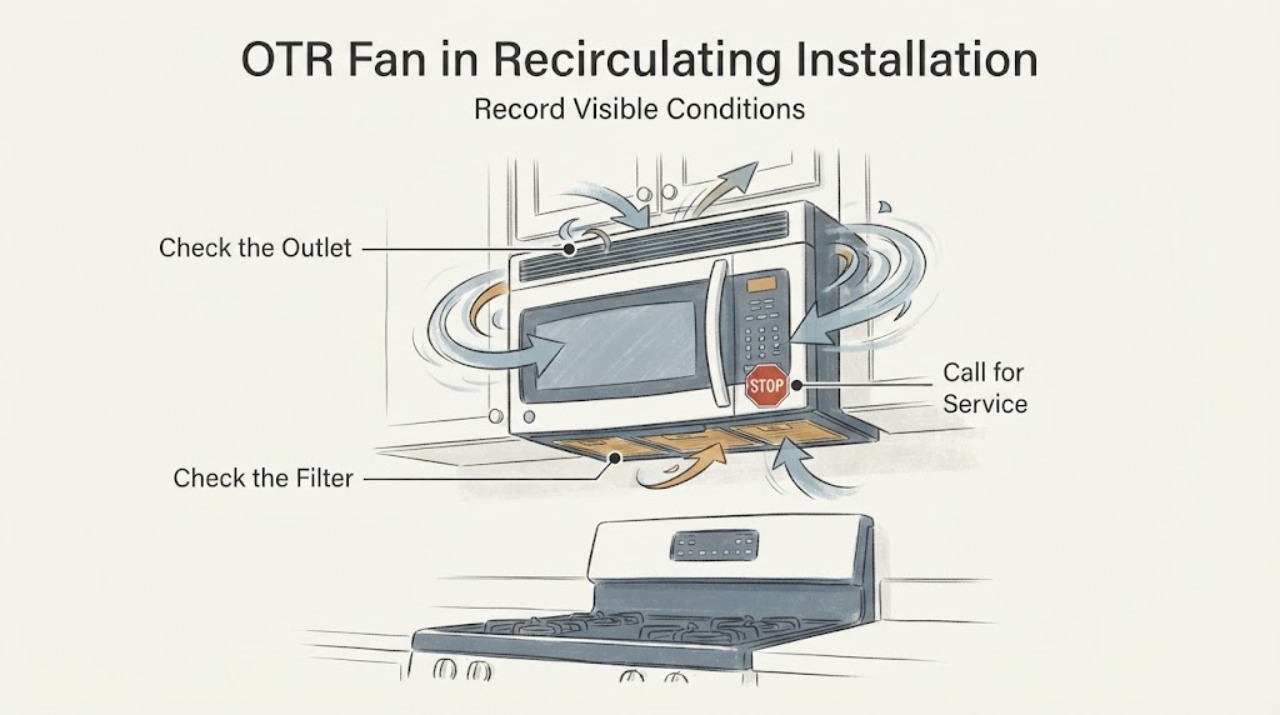
For a Samsung ME19R7041FS installed as a recirculating OTR microwave, the vent fan should return cooktop air to the kitchen through the microwave's recirculating outlet rather than send it through an outside duct. Samsung's exact-model installation guide lists recirculating as one of three ventilation configurations and requires the charcoal filter for the non-vented setup; its recirculating configuration also changes the blower orientation. Because that configuration involves the blower and wiring area, do not open or reconfigure it yourself. First identify where air is coming out, test the documented fan speeds, and check only the accessible grease/charcoal-filter condition. If the fan has the same behavior at every speed, makes abnormal noise, or the installation is directing air into a cabinet or an unintended opening, stop and have the installer or a qualified Samsung technician verify the setup.
Work through in order
Diagnostic checks
Use only checks that match the exact appliance or system and its official guide.
-
Check 1
With the microwave off, record the complete model label and identify the actual air outlet by looking from outside: note whether air returns through the upper/front grille into the kitchen, leaves through a visible top or rear duct, or is being directed into a cabinet or an unintended opening. Do not remove the mounting hardware or open the microwave.
Expected result: The label identifies ME19R7041FS and the air returns to the room, or the outlet direction does not match the intended recirculating installation.
Next step: If the outlet is not returning air safely to the kitchen or is blocked by the cabinet, stop using the vent and ask the installer or a qualified technician to compare the installation with Samsung's exact-model guide. Do not cut cabinets, add ducting, or alter wiring yourself.
Why this matters
Why: The exact Samsung guide supports both recirculating and exterior exhaust arrangements, so the visible outlet path determines whether this is an installation-mode question before it is treated as a fan failure.
-
Check 2
From outside the appliance, select each available Vent speed using the normal control and listen and feel for the change at the intended outlet. Do not run the microwave empty and do not reach into any grille or fan opening.
Expected result: Airflow and sound change between speeds with no abnormal noise, or every speed sounds and behaves the same or produces an abnormal noise.
Next step: If speeds differ normally, continue with the accessible filter and outlet checks. If they do not differ or the noise is abnormal, stop troubleshooting and request Samsung or qualified appliance service.
Why this matters
Why: Samsung says different normal behavior at the speed settings indicates the vent fan is functioning for that check; unchanged behavior or abnormal noise warrants service. This test does not prove that the blower was installed in the correct direction.
-
Check 3
After disconnecting power only as described by Samsung's filter instructions, inspect the user-accessible grease filters under the microwave and confirm that the recirculating setup has the correct charcoal-filter provision behind the upper grille. Clean or replace filters only according to the exact model instructions; do not remove the blower or alter duct parts.
Expected result: A grease filter is heavily soiled, the charcoal filter is absent or overdue, or the filters are present and the airflow path is unobstructed.
Next step: Correct only the documented filter condition, restore the filters and grille, and make one normal fan check. If the direction is still wrong or the fan remains unchanged at every speed, arrange service instead of opening the unit.
Why this matters
Why: Samsung says grease filters support airflow and charcoal filters are used for air recirculation and cannot be cleaned and reused. A filter condition can affect odor and airflow perception, but it does not prove a motor or blower fault.
-
Check 4
If the unit was installed where an old hood was located and the visible outlet, fan behavior, or filter arrangement still does not match the recirculating configuration, provide the installer or technician the full model, photos of the exterior outlet area, selected ventilation mode, and the speed-test result. Keep the microwave unmodified.
Expected result: The issue requires access behind the upper grille, blower compartment, mounting plate, house duct, cabinet, or electrical connection, or the fan remains abnormal after the accessible checks.
Next step: Stop and arrange qualified installation or Samsung service. Do not rotate the blower, splice wiring, drill/cut the cabinet, add an improvised duct, or bypass a safety feature as a user workaround.
Why this matters
Why: Samsung's exact installation guide places the recirculating blower conversion and wiring near an internal installation area. A direction problem can therefore be an installation configuration issue, while unchanged speeds or abnormal noise can require appliance service; neither observation identifies a replaceable part by itself.
Use your observations
Decision map
Find the observation that best matches what you see, then follow the next safe action.
-
PATH 01Next step
What you see
The microwave is supposed to recirculate, but air is not returning through the intended upper/front outlet or is being directed into a cabinet or another enclosed space.
Do this next
Stop using the vent and have the installer or a qualified technician compare the blower orientation, grille, charcoal filter, cabinet and duct configuration with Samsung's exact-model guide. Do not modify the structure or wiring yourself.
Why this path and its safety boundary
Why it matters: The observed path does not match the selected non-vented installation, so this is an installation verification problem before it is a motor diagnosis.
-
PATH 02Next step
What you see
The fan changes normally between its available speeds, makes no abnormal noise, and air returns through the intended recirculating outlet.
Do this next
Keep the grease filters clean and the charcoal filter maintained according to Samsung's model instructions, and monitor the outlet during normal cooktop use.
Why this path and its safety boundary
Why it matters: Samsung's weak-fan guidance treats this pattern as normal fan operation for the check; a modest sensation of airflow alone does not prove the unit is defective.
-
PATH 03Next step
What you see
Every fan speed behaves the same, the fan makes an abnormal noise, or the fan does not run when selected.
Do this next
Stop testing and request Samsung or qualified appliance service. Do not open the microwave, reach into the blower area, or attempt live electrical checks.
Why this path and its safety boundary
Why it matters: Samsung identifies unchanged speed behavior or abnormal noise as a reason to request service; the symptom does not establish whether the fault is the motor, control, wiring, or blower.
-
PATH 04Next step
What you see
There is smoke, a burning or electrical odor, sparking, a hot or damaged cord, water near the appliance, a loose mounting condition, or the microwave starts or runs without a normal command.
Do this next
Stop using the appliance, isolate power from a safe accessible location if possible, keep clear, and arrange qualified or emergency assistance. Do not repeatedly energize the microwave or bypass the door/interlock system.
Why this path and its safety boundary
Why it matters: This is outside routine vent troubleshooting and can involve an electrical, mounting, or microwave safety hazard.
Helpful context
Understand the symptom
Recirculation is a defined installation mode
Samsung lists three ventilation choices for the ME19R7041FS installation guide: outside top exhaust, recirculating non-vented, and outside back exhaust. Replacing an old hood does not by itself determine which one was installed. In the recirculating mode, air is returned to the kitchen through the microwave rather than carried to an exterior duct, and Samsung requires the charcoal filter for that mode.
Direction and strength are separate observations
A fan can be running while the air returns through the wrong opening, or the direction can be correct while airflow is weak. Observe the outlet location and compare the fan's available speed settings without placing hands, paper, or tools into a grille. Samsung's weak-fan guidance treats different normal behavior at different speeds differently from a fan that sounds or behaves the same at every speed.
The filter depends on the selected ventilation mode
Samsung says the grease filters sit under the microwave and that a charcoal filter is used when air recirculates into the kitchen. A charcoal filter is not the same as an outside-duct connection, and a filter that is missing, saturated, or installed for a different configuration can affect odor and perceived airflow. Filter access is limited to the user-facing instructions; blower conversion and duct changes are installation work.
When checks do not resolve it
Need a professional?
Call Samsung or a qualified installer when the visible airflow path does not match recirculation, the speed test fails, or verifying the blower/filter/duct configuration requires internal or mounting access.
Common questions
FAQ
Where should air go when the Samsung ME19R7041FS is set up to recirculate?
In a recirculating, non-vented setup, air returns to the kitchen through the microwave's intended grille rather than traveling through an exterior duct. Samsung's exact-model installation guide requires the charcoal filter and a recirculating blower configuration; an installer should verify the configuration if the outlet path is unclear.
Does weak airflow mean the Samsung microwave fan is broken?
Not necessarily. Samsung says to compare the available fan speeds. If the fan changes normally and the sound is normal, service is not required for that weak-fan check; identical behavior at every speed or abnormal noise is a service signal. Correct recirculation and filter setup also matter.
Can I rotate the blower myself to fix recirculation?
Do not use this article as a blower-conversion procedure. Samsung's installation guide shows that recirculation involves access to the blower and wiring area. Have the installer or a qualified technician verify it against the exact ME19R7041FS guide instead of opening the microwave or changing wiring.
Which filter matters for a recirculating OTR microwave?
Samsung distinguishes the washable grease filters under the microwave from the charcoal filter used for recirculating air. The charcoal filter is not washable and should be maintained or replaced according to the exact model guidance; a missing or saturated filter can affect odor and perceived airflow but does not prove an internal fan failure.
Read the exact guide
Official sources
- Vent fan is weak on over-the-range Samsung microwaveSamsung · Samsung over-the-range microwave vent-fan speed comparison and service threshold for unchanged speed behavior or abnormal noise
- 1.9 cu.ft. Over-the-Range Microwave with 400 CFM | Samsung Support CASamsung · Samsung ME19R7041FS/AC exact-model support page and model-specific installation/user manual listing; regional suffix must be matched before service or installation work
- Step-by-step installation guideSamsung · Samsung ME19R7041FS/AA over-the-range microwave installation, ventilation modes, recirculating blower orientation, charcoal filter, and duct configuration
- Checking the parts: ME19R7041F*Samsung · Samsung ME19R7041F* family accessory layout, including two grease filters, charcoal filter, exhaust adaptor, and exact-model manual/accessory verification
- Replace and clean Samsung microwave filtersSamsung · Samsung over-the-range microwave grease-filter and recirculating charcoal-filter distinction, accessible filter care, and airflow/odor maintenance for the ME19R7041FS family
- Use the lights and vents on your Samsung over-the-range microwaveSamsung · Samsung over-the-range microwave vent control and normal use of Vent On/Off and available speed controls
Community feedback
Share a repair observation
Share a plain-text repair observation. Accepted observations are published automatically; this page may take a moment to update.