
On this page
Start here
Quick answer
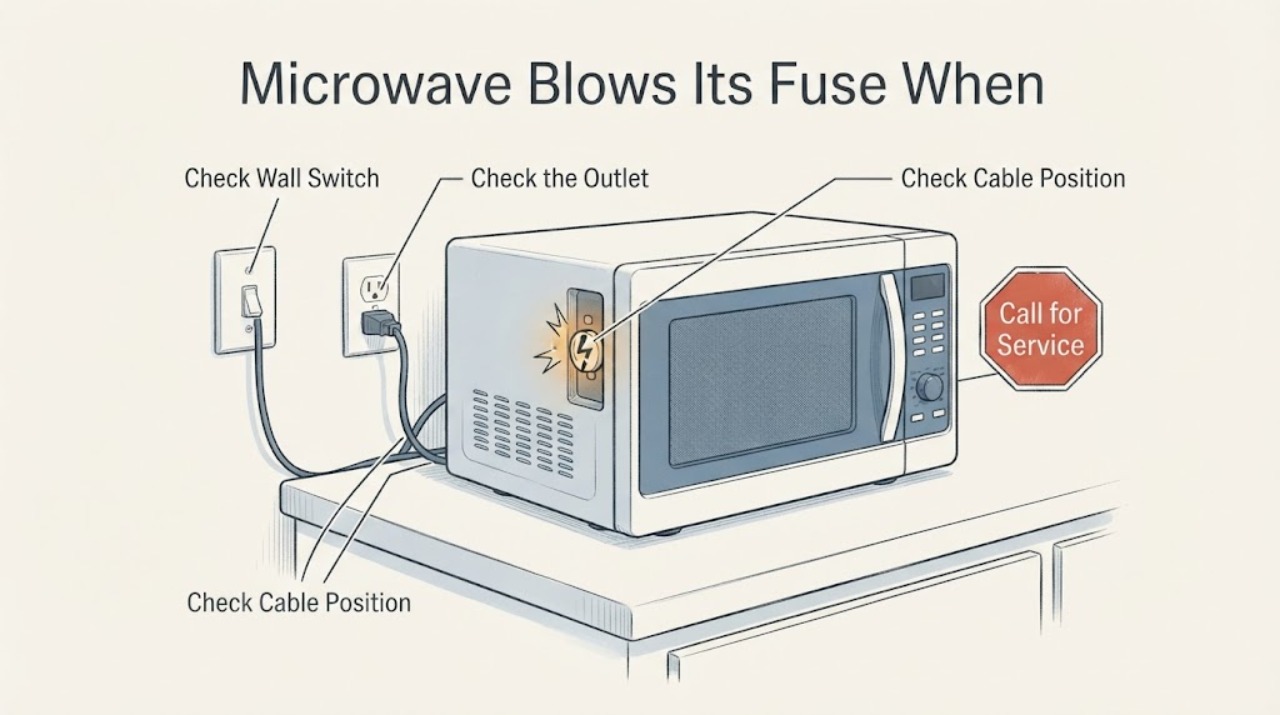
Stop using the assigned Samsung ME16702SES microwave if its fuse opens when Start is pressed. Do not keep replacing the fuse, bridge it with wire, open the cabinet, or perform high-voltage or live electrical tests. Samsung's safety guidance says a high-voltage current enters the product chassis, repairs should go to a Samsung service center, and a malfunction, burning smell, smoke, damage, or foreign substance requires immediate stop-use and safe disconnection. Check only the outside plug, cord, outlet, and cavity for visible damage from a safe position, then provide the technician with the full model, the exact moment the power was lost, and whether the home breaker or only the appliance fuse opened. The assigned 20A/250V fuse detail is not independently confirmed by the opened Samsung sources and must not be used to select a replacement.
Work through in order
Diagnostic checks
Use only checks that match the exact appliance or system and its official guide.
-
Check 1
Stop pressing Start and leave the microwave out of service. If the plug is accessible and there is no smoke, heat, liquid, or visible damage that makes contact unsafe, unplug it by gripping the plug; otherwise leave the area clear and switch off the circuit only if that can be done safely.
Expected result: The microwave is isolated without touching damaged equipment, or safe isolation is not possible because of smoke, heat, liquid, arcing, or a damaged cord or outlet.
Next step: Keep the appliance out of service. For smoke, fire, active arcing, or heat, leave the area and use local emergency procedures; do not approach the plug or breaker if doing so is unsafe.
Why this matters
Why: Repeated fuse operation or unsafe isolation can add electrical and fire risk. Samsung says to stop use for malfunction, burning smell, smoke, or damage and to disconnect power only when safe.
-
Check 2
From outside the appliance, inspect the plug, cord, and wall outlet for looseness, scorching, melting, cracks, moisture, or an unusual smell. Do not touch damaged surfaces, remove the plug from a damaged outlet, use an extension cord, or connect another appliance to test that outlet.
Expected result: The outlet, plug, and cord look intact, or there is visible damage, heat, moisture, or a burning odor.
Next step: If any damage or odor is present, leave the microwave disconnected and have a qualified electrician or appliance technician assess the supply and appliance. Do not test by repeatedly resetting the breaker.
Why this matters
Why: An external supply problem can be unsafe independently of the microwave's internal fuse. Samsung warns against loose or damaged electrical connections, extensions, and continued use after damage or burning odor.
-
Check 3
Without opening the cabinet or reaching through the door, look into the cavity for a cracked interior, exposed wire, burn mark, loose metal, damaged waveguide-cover area, liquid, or other foreign material. Do not remove a cover, scrape a mark, or run an empty or loaded test cycle.
Expected result: The cavity appears clean and undamaged, or there is a crack, exposed part, burn mark, liquid, or suspected arcing damage.
Next step: For any visible damage, liquid, or burn/arcing evidence, keep the microwave disconnected and arrange Samsung or qualified microwave service. Do not attempt to inspect behind the cover.
Why this matters
Why: Samsung identifies damaged internal components and persistent sparking as reasons for professional assistance, and its safety guidance warns that high voltage enters the chassis. A visually normal cavity does not clear the internal fuse or high-voltage circuit.
-
Check 4
Record what happened at the last event without repeating it: whether the display went dark at Start, whether the home breaker or GFCI opened, whether the failure occurred immediately or after heating began, and whether there was a pop, flash, smoke, odor, or unusual noise.
Expected result: Only the microwave lost power, the household protective device also opened, or a smoke, odor, flash, noise, or liquid symptom accompanied the loss of power.
Next step: Give the technician the model label, serial if available, event timing, protective-device behavior, visible damage, and whether the appliance had been moved, wet, or recently serviced. Do not supply a replacement fuse or ask the technician to bypass a protection device.
Why this matters
Why: These observations help service distinguish the event history, but they do not identify a fuse, switch, magnetron, capacitor, interlock, board, or wiring fault. The exact 20A/250V detail in the task is not verified by the opened official sources.
-
Check 5
Arrange Samsung support or qualified microwave service for diagnosis. Tell the service provider that the appliance fuse opens on Start and that the microwave has been left disconnected; ask for model-specific documentation and a safe repair assessment rather than an improvised fuse substitution.
Expected result: The technician confirms the model and can inspect the appliance using the applicable safety procedure, or the model label and fuse history remain uncertain.
Next step: Keep the appliance out of service until qualified service confirms it is safe. Do not open the chassis, replace the fuse yourself, bridge the fuse, or perform live/high-voltage measurements.
Why this matters
Why: A repeated fuse event can involve the appliance or its supply, and the public Samsung material does not authorize owner access to the high-voltage chassis. A model or fuse mismatch must be resolved before any part decision.
Use your observations
Decision map
Find the observation that best matches what you see, then follow the next safe action.
-
PATH 01Next step
What you see
The fuse opens immediately when Start is pressed, with no safe evidence that the event was only a household breaker or outlet issue.
Do this next
Leave the microwave disconnected and request qualified Samsung or microwave service. Do not install another fuse to see whether the result changes.
Why this path and its safety boundary
Why it matters: The symptom is an unresolved appliance or supply fault and should be treated as a stop-use condition; it does not prove which internal component failed.
-
PATH 02Next step
What you see
The wall outlet, plug, or cord shows scorching, looseness, melting, moisture, or burning odor.
Do this next
Do not touch or reuse the damaged connection. Arrange qualified electrical assessment and appliance service; do not reset and retest repeatedly.
Why this path and its safety boundary
Why it matters: The external electrical supply or connection is itself hazardous and may be contributing to the event.
-
PATH 03Next step
What you see
The cavity has a crack, exposed wire, burn mark, liquid, loose metal, or evidence of arcing, or the microwave produced smoke or a burning smell.
Do this next
Keep it disconnected and arrange service; if there is active smoke or fire, leave the area and use emergency procedures. Do not open the cabinet or try another cooking cycle.
Why this path and its safety boundary
Why it matters: Samsung treats visible damage, smoke, burning odor, and persistent sparking as reasons to stop using the microwave and obtain professional assistance.
-
PATH 04Next step
What you see
No external damage is visible and the home breaker did not open, but the appliance fuse still opens on Start.
Do this next
Keep the appliance out of service and provide the full model, event history, and the assigned fuse information to qualified Samsung service. Do not replace or bypass the fuse yourself.
Why this path and its safety boundary
Why it matters: A normal-looking exterior does not clear the internal power or high-voltage circuit, and the fuse rating or internal cause remains unverified.
Helpful context
Understand the symptom
A fuse that opens as the Samsung ME16702SES is started is a stop-use symptom, not a user fuse-replacement task. The opened Samsung safety material does not identify the failed component, and the public pages do not verify the assigned 20A/250V rating for this exact model. Treat the fuse rating and the internal cause as technician-only questions.
The only owner-level checks here are external and observational: isolate the appliance if safe, look for cord, plug, outlet, door, cavity, smoke, odor, liquid, or visible damage, and document whether the household breaker also trips. Do not run another cooking cycle to reproduce the failure.
Do not infer a fuse replacement from the symptom
When checks do not resolve it
Need a professional?
Use Samsung or qualified microwave service for the repeated fuse event. Use a qualified electrician when the wall outlet, plug, cord, or household protective device is damaged or involved.
Have this ready
- Provide the exact model label `ME16702SES`, serial if available, the stated 20A/250V fuse information as an unverified user report, the moment the fuse opened, whether the home breaker/GFCI also opened, any pop/flash/smoke/odor/noise, and exterior observations.
Common questions
FAQ
Can I replace the Samsung microwave fuse myself?
No. Samsung says high voltage enters the product chassis and directs repairs to a Samsung service center. Do not replace, bridge, or up-rate a fuse, and do not open the cabinet.
Should I reset the breaker and try the microwave again?
Do not repeatedly reset and retest after a fuse opens on Start. Leave the appliance disconnected and arrange qualified service, especially if the breaker, outlet, plug, or cord also shows a problem.
Does a 20A/250V fuse prove which part failed?
No. The assigned fuse rating is not independently confirmed by the opened Samsung sources, and a rating alone does not identify an internal component. Give the fuse information and event history to qualified service instead of selecting a part from the symptom.
What if the microwave also sparked or smelled burned?
Stop using it, disconnect power only if safe, and arrange professional service. Samsung says to stop when sparking persists or when there is smoke, burning odor, or visible damage; do not run another cycle or open the cabinet.
Read the exact guide
Official sources
- What to do if my Samsung microwave is sparking during operation?Samsung Gulf · Samsung microwave family guidance for external cavity observations and sparking safety; exact controls and model-specific repair procedures still require the exact manual or service path.
- Home Appliance Terms and ConditionsSamsung Electronics America · Samsung appliance safety guidance applicable to microwave stop-use and service boundaries; it does not identify the failed component or independently confirm the assigned ME16702SES fuse rating.
Community feedback
Share a repair observation
Share a plain-text repair observation. Accepted observations are published automatically; this page may take a moment to update.