
On this page
Start here
Quick answer
A faint high-frequency hiss, whine, or buzz from a plugged-in Samsung MG28J5215-family microwave while it is idle can be normal standby noise: Samsung describes standby squeak/noise as the switching power supply operating. Confirm the full suffix on the rating label because MG28J5215 is sold in regional variants, and keep the oven out of use if the sound is accompanied by smoke, a burning smell, heat, arcing, a tripped breaker, the display changing by itself, or the microwave starting without an interaction. Do not remove the cover or attempt any high-voltage test; if the sound is new, harsh, or persists with other symptoms, unplug it only when safe and request Samsung or qualified appliance service.
Before you begin
Safety first
- Do not remove the microwave cover, touch or discharge high-voltage components, insert tools through vents, run the oven empty, bypass door interlocks, repeatedly reset a breaker, or continue using the unit after smoke, burning odor, arcing, self-starting, or electrical damage.
Work through in order
Diagnostic checks
Use only checks that match the exact appliance or system and its official guide.
-
Check 1
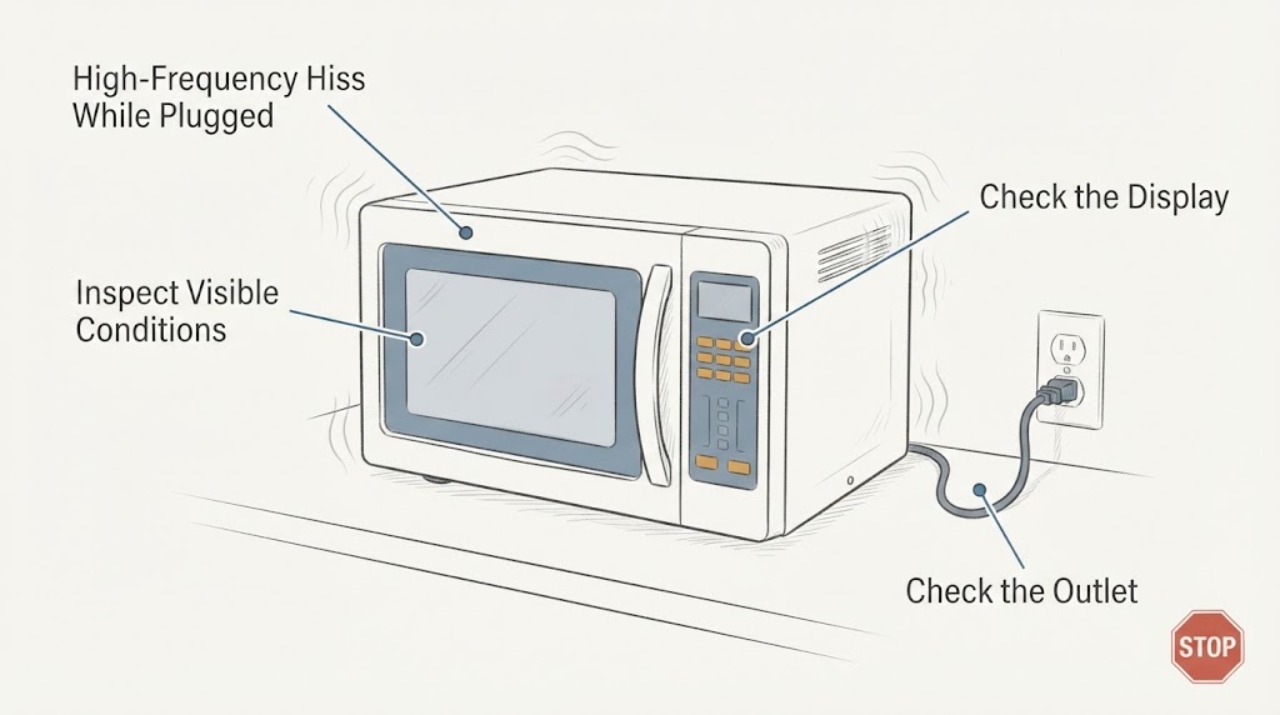
Without opening the cabinet or pressing Start, observe the oven for one idle interval. Confirm that the door is closed, no cook or grill countdown is active, the turntable and interior light are not running, and the display is only showing its normal idle state.
Expected result: The sound occurs only while the controls are idle, or the oven is actually running a fan, light, turntable, or heating cycle.
Next step: If it is only idle noise and there are no danger signs, continue with the model-suffix and safety checks below. If a function runs without an intentional command, stop using the microwave and follow the service branch.
Why this matters
Why: A sound limited to the plugged-in idle state fits Samsung's documented standby-noise condition more closely than a cooking-load noise. Any unexpected running function changes the problem from standby noise to abnormal operation.
-
Check 2
Read the complete model code from the rating label or the product paperwork, including the regional/color suffix after MG28J5215. Compare that exact code with Samsung's support page and the linked user manual; do not rely on a generic MG28J5215 search result.
Expected result: The suffix matches a Samsung MG28J5215-family support page/manual, or the label is missing/different.
Next step: Use only the matching manual for any user-level setting or service instruction. If the code cannot be matched, give the full label to Samsung service rather than importing instructions from another model.
Why this matters
Why: Samsung's official page identifies MG28J5215AW and lists its manuals, while the base task omits the suffix. A missing or different suffix means the variant-specific controls and safety wording have not been established.
-
Check 3
With the microwave still closed and unplugged only if the plug is safely accessible, inspect the outside of the plug, cord, outlet area, cabinet, and door for smoke residue, scorching, melted plastic, moisture, or visible arcing marks. Do not remove panels, insert tools, or touch internal parts.
Expected result: There is no visible damage or odor, or there is scorching, smoke, burning smell, moisture near electrics, heat, sparking, or a tripped protective device.
Next step: For any hazard, leave the microwave disconnected when safe, keep it out of use, and request qualified service. Do not reset a breaker repeatedly or power the oven to reproduce the sound.
Why this matters
Why: No visible hazard supports recording the sound and arranging service if it is new or intrusive; it does not prove an internal component is healthy. Any visible or smelled hazard makes continued energizing unsafe.
-
Check 4
Record a short description of when the hiss occurs—immediately after plugging in, only while idle, during cooking, or after a cycle—and whether it changes in volume or character. Do not run the oven empty just to reproduce the sound.
Expected result: The sound is faint and stable only in standby, or it is loud/new, changes during operation, or remains with other abnormal behavior.
Next step: For stable standby-only noise without hazards, monitor it and use the exact manual for the confirmed suffix. For a changed, loud, or mixed symptom, stop using the oven and provide the recording and model/serial to Samsung or qualified service.
Why this matters
Why: Samsung identifies standby switching-power-supply noise as normal, but its noise guidance says significantly louder or unusual noise should be serviced; an empty microwave test can damage the appliance.
Use your observations
Decision map
Find the observation that best matches what you see, then follow the next safe action.
-
PATH 01Next step
What you see
The microwave is truly idle, the high-frequency sound is faint and stable, there is no odor/heat/smoke/arcing, and no control or motor function starts by itself.
Do this next
Keep the cabinet closed, confirm the complete model suffix, and monitor the sound. Use the matching Samsung manual or service channel if it becomes intrusive or changes.
Why this path and its safety boundary
Why it matters: This matches Samsung's published standby-noise explanation for a switching power supply and does not by itself establish a failure.
-
PATH 02Next step
What you see
The noise is significantly louder than before, changes from a faint hiss to harsh buzzing/scraping/popping, or occurs during operation with other performance changes.
Do this next
Stop using the microwave, do not run it empty, and request qualified service with the exact suffix and a recording. Do not remove the cover or perform high-voltage tests.
Why this path and its safety boundary
Why it matters: Samsung treats significantly louder or unusual microwave noise as a reason to request service; the public guide does not justify naming an internal part from sound alone.
-
PATH 03Next step
What you see
The microwave starts heating, turns on, or runs a function without a user interaction, or the sound is accompanied by smoke, burning smell, visible arcing, hot plug/cabinet, or a breaker trip.
Do this next
If safe, unplug or isolate power without touching damaged parts, leave the microwave out of use, and contact qualified service or emergency help as appropriate. Do not attempt another test cycle.
Why this path and its safety boundary
Why it matters: Samsung identifies self-starting as a fire hazard; smoke, burning odor, arcing, or electrical heating are unsafe conditions regardless of whether the standby hiss might otherwise be normal.
-
PATH 04Next step
What you see
The full model suffix cannot be read or the support/manual result does not match the rating label.
Do this next
Treat the sound only with the generic Samsung safety boundary above, and obtain the exact model/serial before any manual-specific step. Do not borrow instructions from another MG28J5215 variant or another microwave.
Why this path and its safety boundary
Why it matters: The assigned base model is not enough to establish variant-specific instructions or component behavior.
Helpful context
Understand the symptom
Standby noise is different from cooking noise
Samsung's standby guidance says a squeak, hum, noise, or whistle heard while a Samsung microwave is waiting can come from the switching power supply and can be a normal design sound. That explanation is for an idle plugged-in appliance; it does not identify the sound as a magnetron, capacitor, transformer, or other replaceable part. First establish that the oven is not running a cooking, grill, or fan function and that the display is simply idle.
Match the regional model suffix before using a manual
Samsung's support page lists MG28J5215AW as a 28-litre grill microwave and links manuals for the AW family, including regional variants and different manual files. The task identifies the base MG28J5215 but does not provide a suffix such as AW, AB, or AS. Read the rating label and use the manual that matches the complete code; do not transfer a control sequence or a component claim from another regional variant.
A changed or unsafe sound needs service, not a cover-off diagnosis
Samsung's noise guide treats low humming or buzzing during operation as potentially normal, but directs the owner to request service when the noise becomes significantly louder or unusual. Samsung also says a microwave that starts by itself is a fire hazard. A standby hiss that is accompanied by burning odor, smoke, visible arcing, heat at the cabinet or plug, breaker trips, self-starting, or other abnormal operation should be treated as an unsafe appliance condition. The microwave high-voltage section is not a user-service area.
When checks do not resolve it
Need a professional?
Request Samsung or qualified microwave service when the sound is new, significantly louder, unusual, accompanied by any unsafe symptom, or cannot be scoped to the confirmed MG28J5215 variant. Treat self-starting, smoke, burning odor, arcing, hot wiring/plug, moisture near electrics, or breaker trips as immediate stop-use conditions.
Safety scope: Do not remove the microwave cover, touch or discharge high-voltage components, insert tools through vents, run the oven empty, bypass door interlocks, repeatedly reset a breaker, or continue using the unit after smoke, burning odor, arcing, self-starting, or electrical damage.
Have this ready
- Provide the complete model and serial label, region, whether the sound occurs only while idle, when it began, whether it changes with cooking or fan operation, and any odor, heat, smoke, arcing, breaker trip, or self-starting event.
Common questions
FAQ
Is a high-pitched hiss from a Samsung microwave while plugged in normal?
Samsung says a squeak, hum, noise, or whistle in standby can come from the switching power supply and be a normal operating sound. A changed or unsafe sound still needs service evaluation.
Does the standby hiss prove the magnetron or capacitor is failing?
No. The opened Samsung standby guidance attributes this symptom to standby power-supply operation and does not identify a failed part. Do not diagnose or test the high-voltage section yourself.
What if the Samsung microwave turns on by itself?
Samsung says a microwave that starts by itself is a fire hazard: unplug it and do not use it, then request service.
Read the exact guide
Official sources
- MG28J5215AW | Samsung Support UKSamsung Electronics · Confirms the official Samsung model family and links manuals for the AW and related regional variant files; the assigned task supplies the base MG28J5215 without a suffix, so variant-specific instructions are gated on the rating-label match.
- Samsung microwave squeak or noise in standby modeSamsung Electronics · Directly matches the assigned plugged-in-idle high-frequency noise symptom at the Samsung-family level; it does not authorize opening the cabinet or identify an internal repair part.
- Samsung microwave turns on by itselfSamsung Electronics America · Used for the safety branch only: self-starting or an unexpected running function is not treated as normal standby noise.
- Samsung microwave is making weird noisesSamsung Electronics America · Used only to distinguish operation noises from the assigned standby symptom and to support service for significantly louder/unusual noise; it does not diagnose the MG28J5215 internal parts.
Community feedback
Share a repair observation
Share a plain-text repair observation. Accepted observations are published automatically; this page may take a moment to update.