
On this page
Start here
Quick answer
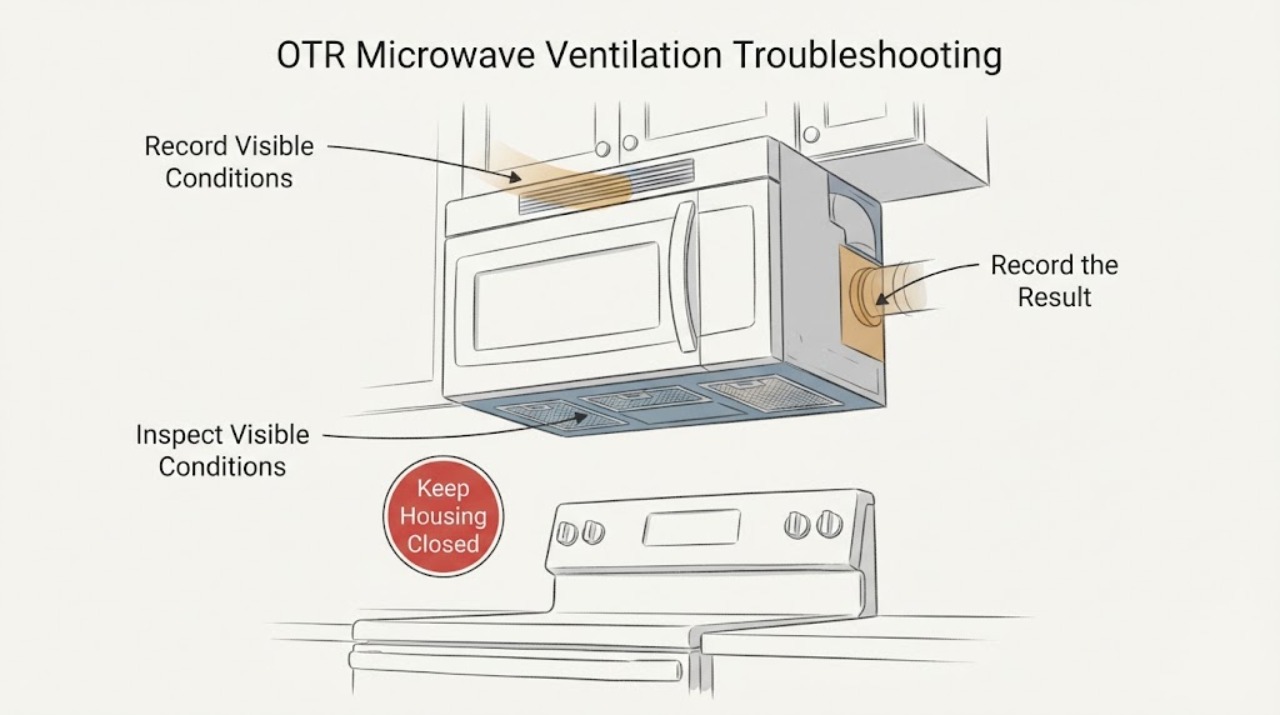
The Samsung ME21DG6300SRAC is a Canadian 2.1-cu.-ft. over-the-range microwave with 400 CFM ventilation, four fan speeds, and grease/charcoal filter provisions. First determine whether the unit was installed to exhaust outdoors through the top or back, or to recirculate into the kitchen; the same fan sound does not prove that air is reaching outdoors. With cooking stopped, check the selected fan speed, visible underside grease filter, and whether the outside damper or kitchen discharge is actually open. In recirculating mode, Samsung says the charcoal filter is the odor filter and is not washable; in outside-vented mode, follow the model installation guide and do not assume a charcoal filter is required. If airflow is weak, steam enters cabinets, the duct or damper is inaccessible, or the unit is loose or damaged, stop trying to improve it by opening the microwave cabinet and have the installation or appliance serviced. Never remove the outer shell, test the high-voltage section, or make live measurements.
Work through in order
Diagnostic checks
Use only checks that match the exact appliance or system and its official guide.
-
Check 1
Confirm the label reads Samsung ME21DG6300SRAC, note the Canadian market, and open Samsung Canada's exact model support page. Record whether the installation guide indicates outside top exhaust, outside back exhaust, or recirculation, and do not use a US SRAA document or another model's grille layout as a substitute.
Expected result: The full SRAC suffix is confirmed and the route is documented; the suffix is different; or the route cannot be established from the guide or installation records.
Next step: Use the exact SRAC guide and ask the installer or landlord for the duct route if records are missing. Keep testing to visible, low-risk observations until the configuration is clear.
Stop if: Do not remove the microwave shell, mounting hardware, top grille, or cabinet panels to identify the route.
Why this matters
Why: Samsung lists SRAC as a Canadian model and provides model-specific English/French manuals and a multi-language installation guide. Vent direction, filters, dampers, and duct work depend on the configured route, so an unconfirmed route makes a fan or filter conclusion unreliable.
-
Check 2
With no cooking underway, place a light tissue or observe steam movement only at safe, visible points: the underside intake above the range, the microwave's room-side exhaust grille if recirculating, and the exterior wall/roof termination if it is safely visible from ground level. Select each documented fan speed once and note whether the sound and visible airflow change.
Expected result: Air is drawn at the underside but nothing exits the expected exterior termination; room-side air exits in a recirculating setup; airflow is weak at every speed; or one speed does not change the fan response.
Next step: Record the route, speed, sound, and visible airflow. Do not insert anything into a grille or reach behind the microwave; have installation service inspect inaccessible ducting or controls.
Stop if: Stop immediately for sparks, smoke, burning odor, a hot cord, water intrusion, or movement of the mounted microwave.
Why this matters
Why: The pattern separates an intake/filter or route problem from a missing or blocked exterior connection and from a control-response concern, but it cannot identify a blower motor or control board. Samsung specifies four speeds for this model; a missing response at one setting is a service clue, not a part diagnosis.
-
Check 3
Inspect the accessible underside grease filter with the microwave off: look for a heavy grease film, deformation, missing filter, or an obstruction over the intake. Clean a removable grease filter only by the Samsung Canada filter instructions and only after disconnecting power as directed; do not remove the outer shell or assume the charcoal filter is washable.
Expected result: The grease filter is visibly clogged or damaged; it is clean and seated; the unit is recirculating and its charcoal filter is overdue or missing; or the configured route is outside exhaust.
Next step: Clean or replace only the accessible filter type allowed for the exact route and manual. For a missing/damaged charcoal filter or an outside duct issue, arrange service or installer correction rather than improvising a filter or duct adapter.
Stop if: Do not energize the microwave with a filter or cover loose, use solvent or flame to clean grease, or open the cabinet to reach an inaccessible filter or blower.
Why this matters
Why: Samsung says grease filters maintain airflow and performance, while charcoal filters are used only for recirculation and cannot be washed. A filter condition can reduce capture and odor control, but it does not prove a fan fault or cure a disconnected duct.
-
Check 4
Inspect only visible installation interfaces: confirm the underside intake is not covered by a shelf or trim, the room-side recirculation grille is not blocked, and any visible exterior flap is not stuck shut or covered. Compare the cabinet opening, clearance, and microwave position with the exact installation guide; do not loosen the mounting bolts.
Expected result: A cabinet or trim blocks an intake/exhaust grille, an exterior flap never opens when the fan runs, the microwave is not level or is loose, or all visible clearances and grilles are normal.
Next step: Remove only a loose, non-structural object outside the appliance if it can be done without tools. Ask the installer, landlord, or qualified appliance technician to correct a duct, damper, clearance, or mounting problem.
Stop if: Do not pull the microwave down, drill cabinets, cut ducting, adjust the blower orientation, or work above the range while the appliance is energized.
Why this matters
Why: Samsung's product and installation materials tie ventilation performance to the OTR installation and duct preparation. A visible obstruction or missing exterior path belongs to installation correction; normal visible conditions leave inaccessible ducting, damper, blower, or control work for qualified service.
-
Check 5
After the route and visible filter checks, run a brief normal fan observation with no active cooking and remain present. Record the selected speed, whether steam or odor is captured at the range, where air exits, and whether the microwave remains firmly mounted. Stop rather than repeatedly cycling the fan if the performance is unchanged.
Expected result: Airflow improves after an allowed filter/obstruction correction; the fan sounds normal but steam still enters the room or cabinet; airflow remains weak at all speeds; or the unit vibrates, shifts, overheats, or smells electrical.
Next step: Give Samsung or the installer the exact model, route, filter condition, speed behavior, and visible airflow results. Stop using the vent fan and microwave for an electrical or mounting hazard until serviced.
Stop if: Do not repeat a hazardous test, operate with arcing/smoke/burning odor, or attempt high-voltage or live electrical measurements.
Why this matters
Why: Improvement after a visible filter or route correction supports an installation/maintenance cause. Persistent weak capture with a clear accessible path requires duct, damper, blower, or control diagnosis; the symptom cannot select a motor or board.
Use your observations
Decision map
Find the observation that best matches what you see, then follow the next safe action.
-
PATH 01Next step
What you see
The underside intake has airflow, the installation is recirculating, and air exits through the room-side grille, but odor capture is poor.
Do this next
Clean the accessible grease filter and replace the charcoal filter only according to Samsung's exact model instructions. If the filter path is correct but capture remains poor, arrange service without opening the cabinet.
Why this path and its safety boundary
Why it matters: The fan is moving air through the intended room-side path; a clogged or missing grease/charcoal filter, filter age, or cooking load is more likely than a disconnected outdoor duct. Samsung says charcoal filters are for recirculation and are not washable.
-
PATH 02Next step
What you see
The fan runs and the underside draws air, but no airflow is visible at the expected outside termination, or steam is pushed into the cabinet or room despite an outside-vented installation.
Do this next
Stop modifying the appliance and have the installer, landlord, or qualified HVAC/appliance technician inspect the duct and damper from accessible building-side points. Do not remove the microwave or cut cabinets as a user test.
Why this path and its safety boundary
Why it matters: An unconnected, blocked, incorrectly routed, or damper-restricted duct is more likely than a microwave high-voltage problem. The product page's fan rating does not guarantee the installed duct path.
-
PATH 03Next step
What you see
Airflow is weak at every documented speed, the filter and visible grilles are clear, and the duct route is confirmed.
Do this next
Request qualified Samsung appliance service and provide the exact suffix, route, filter condition, speed response, and visible airflow results. Keep the microwave cabinet closed.
Why this path and its safety boundary
Why it matters: The remaining possibilities include inaccessible duct resistance, damper/blower operation, or control behavior; the observation does not identify a fan motor or control board.
-
PATH 04Next step
What you see
The microwave is loose, visibly damaged, has a hot or damaged cord, shows smoke/arcing, produces a burning odor, or trips the breaker.
Do this next
Stop cooking and the fan, isolate power only if safe, keep people away from the unit, and request urgent qualified appliance/electrical service. If there is an active fire, leave and call emergency services.
Why this path and its safety boundary
Why it matters: This is a safety or mounting event, not a ventilation-adjustment problem. Continued operation can create shock, fire, falling-appliance, or microwave-radiation safety risks.
Helpful context
Understand the symptom
Start by identifying where the air is supposed to go
An over-the-range fan can be configured for an exterior exhaust route or for recirculation back into the kitchen. A strong sound at the microwave does not establish that a wall or roof duct is connected, that a damper opens, or that the blower orientation matches the installation. The ME21DG6300SRAC support page supplies a model-specific installation guide; use that guide and the installation records to identify the route before judging performance. If the unit is recirculating, a charcoal filter is part of odor control. If it is vented outdoors, inspect only what is visible from the room or outside and leave duct changes to the installer or a qualified technician.
Microwave safety boundary
The ventilation complaint does not make the high-voltage compartment safe to access. Do not remove the outer cover, reach into the blower or wiring, bypass interlocks, disconnect the microwave from inside the cabinet, or test the fan motor, capacitor, magnetron, transformer, or control board while energized. Stop cooking and isolate power only if safe for smoke, arcing, burning odor, a hot or damaged cord, water intrusion, repeated breaker trips, or a loose unit above the range.
When checks do not resolve it
Need a professional?
Call qualified service for persistent weak ventilation after the model-specific route, visible grille, and accessible filter checks; for inaccessible duct/damper or mounting work, contact the installer or landlord. Do not let a ventilation symptom prompt high-voltage troubleshooting.
Have this ready
- Provide Samsung ME21DG6300SRAC, Canada market, the exact manual's configured route, selected fan speed, whether air exits outdoors or through the room grille, grease/charcoal filter condition, visible damper or duct observations, and any loose, electrical, smoke, or water event.
Common questions
FAQ
Does the Samsung ME21DG6300SRAC vent outside by default?
Do not assume that from the OTR label or fan sound. Samsung Canada provides a model-specific installation guide; confirm whether this installation is outside top exhaust, outside back exhaust, or recirculating. A recirculating setup sends filtered air back into the kitchen and uses a charcoal filter for odor control.
Which filter should I clean or replace on this Samsung OTR microwave?
Samsung Canada says the grease filter under an OTR microwave should be cleaned regularly. A charcoal filter is used for recirculation, is not washable, and should be replaced according to the model guidance. Samsung says outside-vented setups do not need the charcoal-filter cleaning/replacement routine; verify the route and exact manual first.
Can I remove the microwave cover to check the fan or duct?
No. The outer shell and high-voltage area are not ordinary ventilation checks. Keep observations to safe visible grilles, filters, and building-side duct points, then use qualified appliance or installation service for inaccessible dampers, blowers, wiring, or controls.
Read the exact guide
Official sources
- Smart 2.1 cu. ft. Over-the-Range Microwave with Auto Connectivity & SmartThings CookingSamsung Electronics America · Official Samsung installation-specification sheet for the ME21D*6300 family, used only for general OTR mounting/duct-preparation and electrical-safety principles; the Canadian ME21DG6300SRAC support page remains the authority for its market-specific guide.
- 2.1 cu.ft Over the Range Microwave with Finger Print Resistant FinishSamsung Canada Support · Exact model support page for the Canadian SRAC suffix; its opened content lists the English/French user manuals and multi-language installation guide associated with ME21DG6300SRAC.
- How to replace and clean Samsung microwave filtersSamsung Canada · Samsung Canada support guidance used for the general OTR distinction between washable grease filters and non-washable charcoal filters, and for the outside-vented versus recirculating boundary; exact model instructions remain controlling.
- 2.1 cu.ft Over the Range Microwave with Finger Print Resistant FinishSamsung Canada · Exact Samsung Canada product page for ME21DG6300SRAC; identifies the OTR installation, 400 CFM ventilation, four fan speeds, and charcoal/grease filter types.
Community feedback
Share a repair observation
Share a plain-text repair observation. Accepted observations are published automatically; this page may take a moment to update.