
On this page
Start here
Quick answer
A Samsung oven smell is only potentially routine when it matches a known situation: a faint odor during first use, odor or smoke during a model-supported self-clean cycle, or smoke from food residue during normal cooking. Identify the oven model, fuel type and when the smell starts before choosing any remedy. For a new oven, remove every packing item and follow the exact Samsung manual's ventilated first-use procedure. For self-cleaning, keep the area ventilated and follow the model manual; do not treat heavy smoke as something to ignore. For normal cooking, stop and inspect the cool cavity for spilled food or melted material only after the oven is safe to approach. A persistent smell from a clean oven, a sharp electrical or burning-plastic smell, visible smoke that does not match a documented cleaning event, abnormal flame, repeated ignition, arcing, uncontrolled heat, or a carbon-monoxide alarm is a stop-and-service condition. If a gas oven smells of gas, do not operate switches, create a flame, or keep testing it: leave the area and contact the local gas emergency service from a safe location.
Before you begin
Safety first
- Owner checks are limited to model identification, controls, ventilation and cool visible surfaces. Do not open panels, test energized circuits, adjust gas parts, manually light gas, bypass an interlock or repeat a high-heat test for an unexplained smell.
Work through in order
Diagnostic checks
Use only checks that match the exact appliance or system and its official guide.
-
Check 1
Stop cooking and classify the odor without leaning into the oven: note whether it is food or grease, oily or new-plastic, sharp electrical or burning, smoke without a strong smell, or gas-like; record whether the smell is from the cavity, vent, controls or surrounding room.
Expected result: The odor fits a first-use, self-clean or food-residue pattern, or it is sharp, worsening, unexplained, accompanied by visible smoke, an abnormal flame or a carbon-monoxide alarm.
Next step: For smoke, burning or electrical odor, abnormal flame, arcing, uncontrolled heat or a carbon-monoxide alarm, stop immediately and use the relevant emergency or qualified-service path. Otherwise continue only with the model and fuel checks below.
Why this matters
Why: Timing and odor character separate a documented operating by-product from a possible electrical, gas or overheating fault. A severe or unexplained sign must not be normalized because the oven still appears to heat.
-
Check 2
Confirm the Samsung model and whether the oven is electric, gas or dual fuel from the label and manual; photograph any display code, warning, flame behavior or door state before resetting anything.
Expected result: The model and fuel type are clear, or they are unknown; a code appears only during a diagnostic event or appears during ordinary cooking.
Next step: Use Samsung Support and the exact manual before selecting a cleaning cycle or reset. If a code returns during ordinary cooking or the manual cannot identify it, keep the oven out of use and request service.
Why this matters
Why: Heating parts, gas ignition, venting, cleaning modes and code meanings depend on the exact model and fuel. Samsung's support material distinguishes model-specific manual and service paths, so an unknown identity limits safe conclusions.
-
Check 3
If the smell began on the first use, with the oven cool and power safely available, check the cavity, racks and packaging areas for every removable plastic tie, film or packing item; compare the result with the model manual's first-use burn-off instructions.
Expected result: Packing remains, or the oven is clear and the odor is a faint temporary new-appliance odor that decreases after the documented first-use procedure.
Next step: Remove only loose, accessible packing identified by the manual and provide ventilation as directed. Do not burn off unknown material or repeat a high-heat cycle when smoke is heavy; escalate a persistent odor to Samsung service.
Why this matters
Why: Packaging and protective production residues can create a temporary smell or smoke during first use. An odor that persists, intensifies, or comes from a clean oven is not confirmed normal by age alone.
-
Check 4
If the odor appears during Self Clean, stop and compare the amount of smoke and odor with the exact Samsung manual; keep the room ventilated and keep birds and people away from fumes as the manual or official support guidance requires.
Expected result: The odor occurs only during self-cleaning and diminishes after the cycle, or smoke is heavy, the smell is electrical or plastic-like, the oven remains hot abnormally long, or the odor continues afterward.
Next step: Follow the model's cancellation and cool-down instructions only if safe. Stop using Self Clean and arrange service for heavy smoke, damage, abnormal heat, a recurring electrical smell or an odor that remains after the oven is clean.
Why this matters
Why: Heating accumulated residue can produce expected odor and smoke during self-cleaning, but heavy or unusual smoke, electrical odor, or persistent symptoms indicates a fault or excessive residue that should not be tested further.
-
Check 5
For an odor during ordinary cooking, wait until the oven is cool and safe to approach, then visually inspect the cavity floor, racks, cookware and visible door area for spilled food, grease, melted plastic or an item that is not oven-safe; do not remove hot residue by hand.
Expected result: A localized food or grease spill is visible, melted material is present, the cavity is clean, or the smell comes from the vent or control area instead.
Next step: Clean only with the method and products permitted by the Samsung manual after full cool-down. Stop for melted plastic, smoke that persists, damage or a vent/control odor, and do not run another cycle to reproduce it.
Why this matters
Why: Food or grease can smoke when heated, while melted material or an odor from the control or vent area can indicate an installation, material or component problem. A clean cavity with recurring odor needs service rather than more heat.
-
Check 6
On a gas or dual-fuel model, distinguish a brief documented ignition odor from a continuing gas smell by observing only from a safe position; do not relight, repeatedly start the oven, inspect gas fittings, or use a flame to locate a leak.
Expected result: There is a continuing or strong gas-like smell, hissing, delayed ignition, a boom, yellow or unstable flame, soot, or a carbon-monoxide alarm; or there is no gas sign and the odor is clearly food or residue.
Next step: For gas odor or suspected fumes, avoid switches and flames, leave the area, and contact local gas emergency service from outside or another safe location. For abnormal flame or delayed ignition, keep the appliance off and use qualified gas service.
Why this matters
Why: Gas odor or abnormal combustion can create fire, explosion or carbon-monoxide risk. It is not a normal oven odor to troubleshoot by repeated ignition. A residue odor remains a lower-risk branch only while no emergency sign is present.
-
Check 7
Inspect only the external control display and household surroundings for a warning, continuous heating after the control is off, arcing, scorch marks, a hot plug or repeated breaker operation; do not open panels or test energized circuits.
Expected result: A code returns, the oven stays hot after it should stop, smoke or a burning electrical odor is present, the outlet is hot or damaged, or the display and oven behave normally after residue is removed.
Next step: Stop using the oven for persistent or electrical symptoms and request qualified Samsung appliance service; have a qualified electrician assess a damaged or repeatedly tripping supply. Do not repeatedly reset a safety symptom.
Why this matters
Why: A returning code, uncontrolled heat or electrical damage moves the fault to professional diagnosis. A normal control state does not clear a smell from a clean cavity or prove that an internal component is safe.
-
Check 8
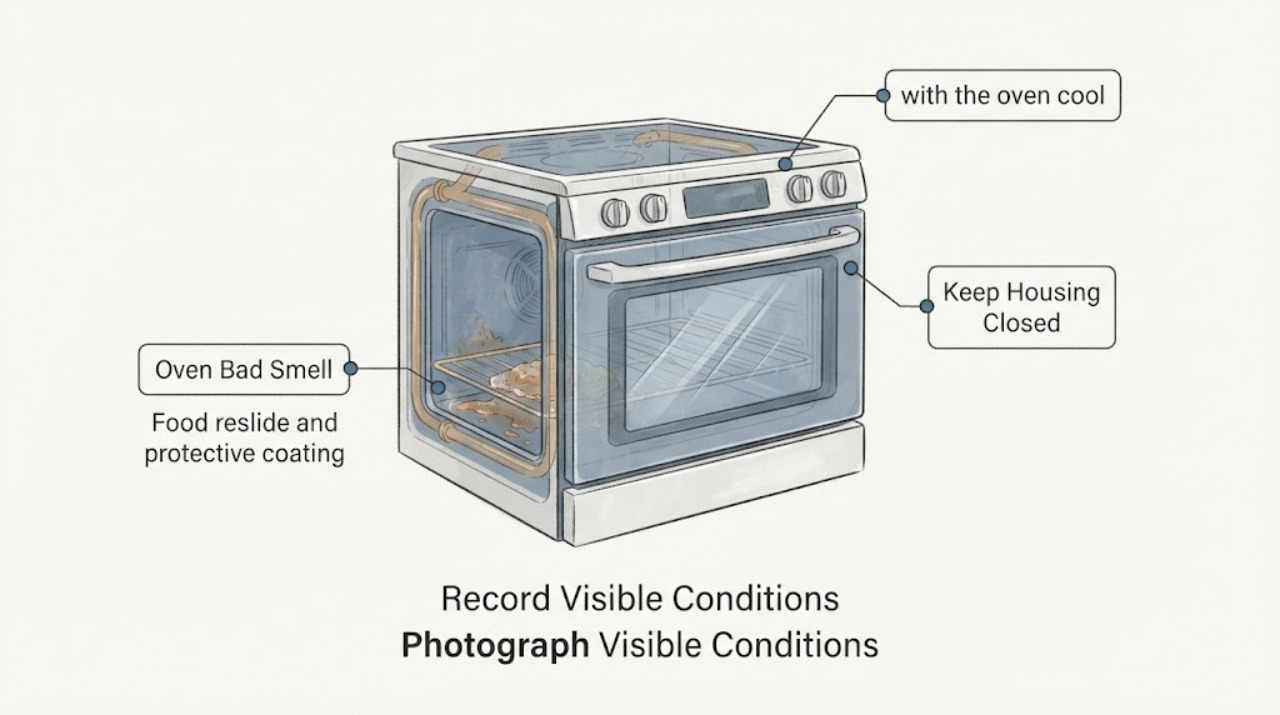
Record the model, fuel type, smell description, exact start time and cooking mode, whether Self Clean was active, cavity condition, display messages, flame or smoke observations, and what stopped the symptom; attach clear photographs without touching hot or energized parts.
Expected result: The record points to a documented first-use or removable residue condition, or the smell is unexplained, recurring, safety-related or model-specific.
Next step: Use Samsung's support and repair route with the exact model information. Keep the oven out of use until an unexplained or safety-related odor has been resolved.
Why this matters
Why: A precise record lets Samsung support or a qualified technician distinguish residue from ignition, vent, sensor, heating-element, wiring or control faults without unsafe trial-and-error.
Use your observations
Decision map
Find the observation that best matches what you see, then follow the next safe action.
-
PATH 01Safety boundary
What you see
The smell is a faint first-use odor and packing has been removed
Do this next
Use only the ventilated first-use procedure in the exact Samsung manual. Stop if smoke is heavy, the odor worsens or it persists after the documented procedure.
Why this path and its safety boundary
Safety stop: Classify self-clean, ordinary cooking, gas, electrical and control symptoms separately.
-
PATH 02Safety boundary
What you see
The odor occurs only during Self Clean and matches residue being heated
Do this next
Ventilate and follow the model manual; cancel and arrange service for heavy smoke, damage, abnormal heat or symptoms that continue after cooling.
Why this path and its safety boundary
Safety stop: Inspect a cool cavity for food or melted material only as the manual permits, then use the service branch for a clean-oven odor.
-
PATH 03Safety boundary
What you see
A visible food or grease spill explains the smell during ordinary cooking
Do this next
Let the oven cool and clean only with the manual-approved method. Do not use more heat to investigate an unexplained residue or melted item.
Why this path and its safety boundary
Safety stop: Treat a recurring smell from a clean cavity, vent or control area as a service issue.
-
PATH 04Safety boundary
What you see
The oven is gas or dual fuel and there is a continuing gas-like smell, hissing, delayed ignition, boom or abnormal flame
Do this next
Stop using it, avoid flames and electrical switches, leave the area, and contact local gas emergency help from a safe location; do not relight or test it.
Why this path and its safety boundary
Safety stop: Do not infer gas safety from the absence of one sign; continue only with the manual's fuel-specific identity and qualified service boundary.
-
PATH 05Safety boundary
What you see
Smoke, burning electrical or plastic odor, arcing, a hot outlet, uncontrolled heating, a carbon-monoxide alarm or repeated breaker operation is present
Do this next
Stop immediately and use emergency or qualified electrical/appliance service as appropriate. Keep the oven out of use.
Why this path and its safety boundary
Safety stop: Continue with documentation and model-specific support rather than repeated high-heat testing.
-
PATH 06Safety boundary
What you see
A code or warning returns during ordinary cooking or the model and fuel type are unknown
Do this next
Photograph the complete code or display and obtain the exact manual; request service if the code is not identified or returns after one manual-authorized reset.
Why this path and its safety boundary
Safety stop: Use the documented residue or first-use branch only when its timing and signs match.
-
PATH 07Safety boundary
What you see
The odor persists after the cavity is clean and the documented first-use or self-clean condition no longer applies
Do this next
Do not run another cycle to reproduce it. Keep the oven out of use and arrange qualified Samsung appliance service.
Why this path and its safety boundary
Safety stop: Follow the exact manual's permitted care instructions and monitor without ignoring new safety signs.
Helpful context
Understand the symptom
The timing and character of the smell matter
A smell on the first use is different from a sharp odor that appears after years of normal operation. A self-clean cycle can produce odor and smoke as residue is heated, while a spill can smoke during an ordinary bake. Record whether the odor is oily, food-like, plastic-like, electrical, or gas-like, and whether it comes from the cavity, vent or the surrounding installation. Do not use smell alone to approve a gas appliance for continued use.
Use Samsung's model identity before changing a setting
Samsung ovens vary by fuel, controls, cleaning functions and error messages. Photograph the model label and display, then use Samsung Support to locate the matching manual. A code, Demo state, temperature message or door-lock behavior can change the next step, but a code from one model is not a diagnosis for another.
Normal residue still has a safe boundary
If a cool cavity visibly contains food or grease residue, clean only as the manual allows and keep the oven ventilated. Do not cover vents, use unapproved chemicals, or use a high-heat cycle to investigate an unexplained smell. When the cavity is clean but the odor returns, service is the correct branch rather than repeated cleaning cycles.
Safety boundary
Stop conditions
- For a gas-like smell, hissing, delayed ignition, a boom, abnormal flame or suspected fumes, do not operate switches, create a flame or continue testing; leave and contact local gas emergency help from a safe location.
- Stop for visible smoke that does not match a documented first-use or self-clean condition, smoke from a clean cavity, a sharp electrical or burning-plastic odor, arcing, scorch marks, a hot outlet, uncontrolled heating or repeated breaker operation.
- Treat a carbon-monoxide alarm or symptoms such as headache, dizziness, nausea or confusion as an emergency: leave the area and seek urgent help; do not re-enter until it is declared safe.
- Do not open panels, probe energized circuits, adjust gas components, relight gas manually, bypass a door or safety interlock, or use a high-heat cycle to reproduce an unexplained odor.
- Keep the oven out of use when the smell returns from a clean cavity, the code returns, the source is behind a panel, or the manual does not clearly authorize the next step.
Only after diagnosis
Potential parts
- oven door gasket or cavity seal
Consider this category only if the exact manual and qualified diagnosis identify a damaged seal that is allowing abnormal heat, residue or odor behavior.
Confirm the exact model and door configuration; do not replace a seal based on odor alone. - electric heating element or temperature sensor
Consider this category only after a qualified diagnosis links an electrical odor, abnormal heating or a returning code to the exact electric model.
Verify model fitment and professional diagnosis; do not test or replace energized oven components. - gas igniter, burner or safety valve component
Consider this category only after a qualified gas-appliance professional confirms an ignition or combustion fault on the exact fuel configuration.
Match the exact model and fuel type; never manually light, bypass ignition or adjust gas components as a test.
When checks do not resolve it
Need a professional?
Use Samsung Support and the exact model manual for the correct fuel configuration, first-use and Self Clean instructions, code meanings and service route. Request qualified appliance service for an unexplained smell from a clean oven, persistent smoke, a returning code, abnormal heating, a vent or control odor, or any suspected internal component fault. Use a qualified gas professional or local gas emergency service immediately for gas odor, delayed ignition, a boom, abnormal flame or suspected carbon-monoxide fumes. Use a qualified electrician for arcing, a hot or damaged outlet, scorch marks or repeated breaker operation.
Safety scope: Owner checks are limited to model identification, controls, ventilation and cool visible surfaces. Do not open panels, test energized circuits, adjust gas parts, manually light gas, bypass an interlock or repeat a high-heat test for an unexplained smell.
Common questions
FAQ
Is a smell from a new Samsung oven normal?
A faint first-use odor can come from packaging or protective production residue, but remove all packing and follow the exact Samsung manual's ventilated first-use procedure. Stop for heavy smoke, worsening odor or symptoms that persist.
Why does my Samsung oven smell during Self Clean?
Self Clean heats residue, so odor and some smoke can occur. Ventilate and follow the model manual. Heavy smoke, electrical or plastic odor, abnormal heat or a smell that remains after the cavity is clean needs service.
What if the smell is like burning plastic or electricity?
Stop using the oven. Do not open panels or repeat a high-heat test. Smoke, arcing, scorch marks, a hot outlet or uncontrolled heat require immediate qualified or emergency service.
What should I do if my gas Samsung oven smells like gas?
Do not relight it, operate electrical switches or keep testing. Leave the area and contact local gas emergency help from a safe location. Do not return the appliance to use until it has been checked.
Could spilled food cause an oven smell?
Yes. Once the oven is fully cool and safe, inspect for visible food or grease residue and clean only as the exact Samsung manual allows. A clean cavity with a recurring odor is a service branch.
What information should I give Samsung Support?
Provide the exact model and fuel type, odor description, cooking mode, whether Self Clean was active, cavity condition, complete display code, smoke or flame observations and photographs of cool visible areas.
Read the exact guide
Official sources
- Flame issues on Samsung gas cooktop or rangeSamsung · Gas cooktop or range flame observations; use only for gas or dual-fuel models and follow the exact model manual.
- Odor or smoke from Samsung ovenSamsung · Samsung US oven and range support; exact model and fuel configuration still control the applicable instructions.
- Odor or smoke from Samsung ovenSamsung Canada · Regional Samsung range guidance; the page explicitly applies to ranges sold in Canada and is used here for the shared odor categories, not regional service details.
- Samsung range or wall oven error codesSamsung · Samsung error messages and model-specific support; codes must not be transferred between unrelated models.
- Samsung oven temperature issuesSamsung · Samsung oven temperature guidance; use gas checks only on gas ranges and follow model-specific safety instructions.
- Methane: general informationUK Health Security Agency · General gas-emergency guidance; local emergency contacts and appliance rules vary by region.
- Wall Oven SupportSamsung · Samsung wall-oven support entry point; use the product or model lookup for the applicable manual and service route.
Community feedback
Share a repair observation
Share a plain-text repair observation. Accepted observations are published automatically; this page may take a moment to update.