
On this page
Start here
Quick answer
A Samsung gas oven can ignite and turn its burner off repeatedly during bake or preheat to hold the set temperature; Samsung describes that cycling as normal operation. A click at ignition does not by itself prove that an igniter, relay, valve or control has failed. First note whether the sound occurs only while the oven is actively heating and whether the oven reaches temperature. Stop using the oven and arrange qualified service if it will not ignite, the flame goes out or appears delayed or abnormal, clicking continues when there is no active cooking demand, the sound is much louder than usual, or there is gas odor or persistent smoke. Do not remove panels, adjust gas pressure, bypass an ignition safety, or keep trying to light a gas appliance that may be leaking.
Work through in order
Diagnostic checks
Use only checks that match the exact appliance or system and its official guide.
-
Check 1
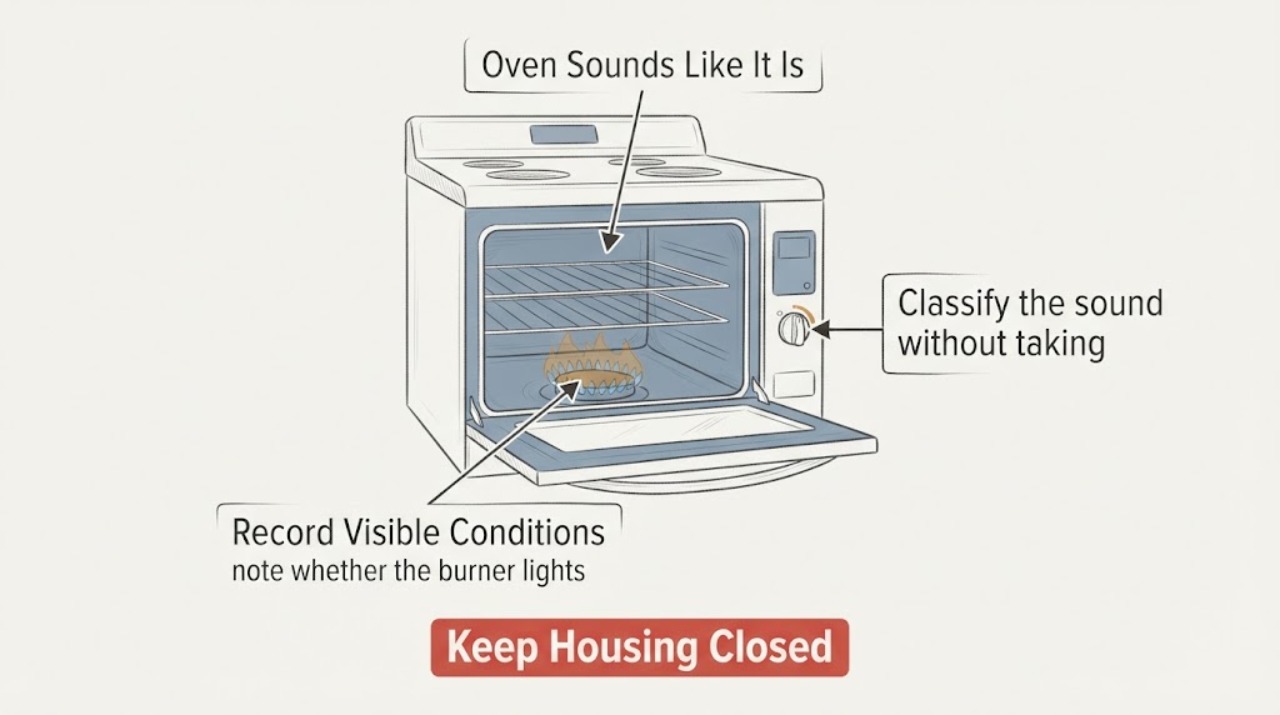
Without deliberately restarting the oven, record when the sound occurs during a normal, otherwise safe use: during preheat, while maintaining the set temperature, after the burner has stopped, or with the oven controls off. Record whether the oven reaches the selected temperature.
Expected result: The sound occurs only while the oven is heating and the oven reaches temperature, or it continues after the heating demand ends or the oven never heats.
Next step: If cycling is limited to normal heating and there is no odor, smoke or abnormal flame, compare the timing with the exact Samsung manual. If it continues with no demand or the oven does not heat, stop using it and arrange service.
Why this matters
Why: A burner that ignites and turns off while cooking can be normal temperature control. A sound outside an active heating demand or a no-heat condition needs model-specific service evaluation rather than a generic parts diagnosis.
-
Check 2
From the normal viewing position only, note whether the burner lights promptly when the oven calls for heat and whether the flame remains stable during the heating period. Do not open a panel, reach into the burner area or try to adjust the gas supply.
Expected result: The burner lights and remains stable while the oven heats, or ignition is delayed, the flame goes out, the oven fails to light or the visible flame is abnormal.
Next step: For delayed or failed ignition, flame-out or an abnormal flame, turn the controls off and use a qualified gas-appliance professional or the gas company. Do not repeatedly attempt ignition or bypass a safety control.
Why this matters
Why: Stable heat with ordinary cycling is consistent with the temperature-control behavior Samsung describes, but it does not identify a particular part. Delayed/no ignition or flame instability is a gas-ignition/service condition.
-
Check 3
Classify the sound without taking the range apart: a brief click or crack during an active cycle, a puff or hum while gas is on, a loud or new noise, or clicking that continues when there is no active cooking demand. Keep cooktop-only ignition observations separate from the oven symptom.
Expected result: The sound is brief and tied to an active heat cycle, or it is continuous, substantially louder than normal, or present with no cooking demand.
Next step: A brief, repeatable sound only during normal heating can be documented and compared with the model manual. For continuous, louder or demand-free clicking, stop operation and request Samsung or qualified appliance service.
Why this matters
Why: Samsung lists several clicks, relay/igniter sounds and gas-operation noises as potentially normal, but its guidance sends continuing ignition clicking or significantly abnormal noise to service. These descriptions do not prove which component is involved.
-
Check 4
Check only the external operating context: confirm the full model from the rating label, note whether the problem occurs with the cooktop off or only when another burner is lit, and do not alter a regulator, gas fitting or pressure setting.
Expected result: The exact model/manual is available and the oven behaves normally with the cooktop off, or the oven heats only when a cooktop burner is also lit or the gas-pressure behavior is otherwise questionable.
Next step: Provide the model, fuel type, timing, sound description and flame observations to Samsung service or a qualified installer. Do not adjust gas pressure or try a cross-model repair sequence.
Why this matters
Why: Samsung says an oven that heats only when a cooktop burner is lit can indicate gas pressure that is too high and needs a professional installer or gas company. The model and fuel configuration are required before applying any more specific procedure.
-
Check 5
Stop and check for gas odor, persistent smoke or an unusual odor; inspect only for an obvious accessible spill or residue without opening the oven or restarting it to test the result.
Expected result: There is gas odor, smoke or a persistent unusual odor, or there is no such warning and the oven is otherwise operating normally.
Next step: If gas odor is present, leave the area and contact the gas utility or emergency service from outside according to local guidance; do not relight or operate switches near a suspected leak. For smoke or persistent unusual odor, keep the oven off and arrange qualified service.
Why this matters
Why: Gas odor, smoke or a persistent unusual odor is a safety/service boundary, not a normal cycling explanation. Samsung recommends ventilation and external spill checks for ordinary odor/smoke and service if the condition persists.
Use your observations
Decision map
Find the observation that best matches what you see, then follow the next safe action.
-
PATH 01Next step
What you see
The Samsung gas oven cycles the flame only during preheat or bake, reaches the selected temperature, and there is no gas odor, smoke or abnormal flame.
Do this next
Continue only normal use permitted by the exact model manual and document the sound if it changes. Do not replace an igniter, valve or control based on cycling alone.
Why this path and its safety boundary
Why it matters: This pattern matches Samsung's description of normal gas-oven temperature control, in which the burner ignites and turns off repeatedly to maintain temperature.
-
PATH 02Next step
What you see
The sound is a brief click or other operating noise tied to an active heat cycle, while heating and the visible flame remain stable.
Do this next
Compare the timing with the exact Samsung manual. If it becomes continuous, much louder, or occurs with no heating demand, stop using the oven and request service.
Why this path and its safety boundary
Why it matters: Samsung's range guidance describes relay/igniter clicks and several gas-operation noises as potentially normal, but the unmodeled appliance evidence cannot identify the sound's exact source.
-
PATH 03Next step
What you see
The oven does not ignite, ignition is delayed, the flame goes out, the flame looks abnormal, or the oven heats only when a cooktop burner is also lit.
Do this next
Turn the controls off, stop repeated ignition attempts and arrange qualified gas-appliance service. Do not adjust pressure, open gas fittings or bypass an ignition safety.
Why this path and its safety boundary
Why it matters: The observation is outside a simple normal-cycling explanation. Samsung directs suspected gas-pressure or ignition failures to a professional installer, gas company or service rather than a homeowner adjustment.
-
PATH 04Next step
What you see
There is gas odor, smoke or an unusual odor that persists after an accessible spill is excluded, or the clicking continues with no active cooking demand.
Do this next
Keep the oven off. For suspected gas, leave the area and contact the gas utility or emergency service from outside; for smoke or persistent unusual odor, use qualified appliance service and do not reopen or test the appliance.
Why this path and its safety boundary
Why it matters: This is a safety/service condition, not evidence that the oven simply needs a normal heat cycle. Samsung's guidance recommends service for persistent smoke/odor and continuing abnormal ignition noise.
Helpful context
Understand the symptom
Separate normal burner cycling from repeated ignition trouble
The title describes a sound, not a confirmed component failure. Samsung's oven-temperature guidance says a gas oven can ignite and turn off repeatedly while cooking to maintain temperature. Samsung's range sound guidance also lists relay/igniter sounds, burner-ignition sparking and normal gas-operation noises. Because no model is supplied, use the exact model manual to identify the appliance's sound and control behavior; do not infer a valve, igniter or control-board diagnosis from the word re-igniting.
Gas odor, smoke or an abnormal flame changes the safe next step
Do not keep cycling a gas oven to reproduce a worrying sound. If there is gas odor, persistent smoke, delayed ignition, a flame that goes out, or a flame that looks abnormal, turn the oven controls off, leave the appliance area as needed and use the gas utility or qualified appliance service route. Samsung says persistent smoke or unusual odor needs service and directs suspected gas-pressure or ignition problems to a professional; the available family guidance does not support a homeowner gas-pressure test or internal repair.
When checks do not resolve it
Need a professional?
Keep the oven off and seek qualified service for no ignition, delayed ignition, flame-out, abnormal flame, continuous or unusually loud clicking, suspected gas-pressure behavior, or persistent smoke/odor. If gas odor suggests a leak, leave the area and contact the gas utility or emergency service from outside according to local guidance.
Common questions
FAQ
Is it normal for a Samsung gas oven flame to turn off and come back on during baking?
Samsung says a gas oven can ignite and turn off multiple times while cooking to maintain the set temperature. That behavior is only reassuring when the oven heats normally and there is no odor, smoke, delayed ignition or abnormal flame.
Does a repeated clicking sound prove that the igniter is bad?
No. Samsung's range guidance lists relay/igniter sounds and other operating noises, while also sending continuing ignition clicking to service. Sound alone does not identify an igniter, valve or control-board failure on an oven with no model-specific diagnosis.
What should I do if I smell gas while the oven is cycling?
Do not continue testing or relighting the oven. Leave the area and contact the gas utility or emergency service from outside according to local guidance. A normal temperature cycle does not make a suspected gas leak safe.
Why is the exact Samsung model important here?
The available Samsung pages support family-level temperature cycling and sound/safety boundaries, but controls and normal sounds vary by model. Use the rating label and exact manual before applying a more specific operating instruction, and do not transfer a procedure from another Samsung range.
Read the exact guide
Official sources
- Samsung oven temperature issuesSamsung · Opened Samsung's official oven-temperature troubleshooting page. It states that a gas oven can ignite and turn off multiple times while cooking to maintain temperature, and it gives conditional professional-service guidance for no ignition, unusual gas-pressure behavior and no heat. No model is supplied, so this source is used at Samsung gas-oven family scope only.
- There is smoke or an odor coming from Samsung ovenSamsung · Opened Samsung's official oven smoke/odor troubleshooting page. It covers ventilation and visible-spill checks during ordinary use and says persistent smoke or unusual odor with a clean oven should be serviced. It does not authorize internal gas or electrical repair.
- Samsung cooktop and range: common sounds and operational noisesSamsung · Opened Samsung's official cooktop-and-range sound guide. It identifies relay/igniter clicks, gas-operation noises and some normal expansion sounds, while directing service for continuing clicking or significantly abnormal noise. It is sound guidance rather than proof of a component fault on an unidentified oven model.
Community feedback
Share a repair observation
Share a plain-text repair observation. Accepted observations are published automatically; this page may take a moment to update.