
On this page
Start here
Quick answer
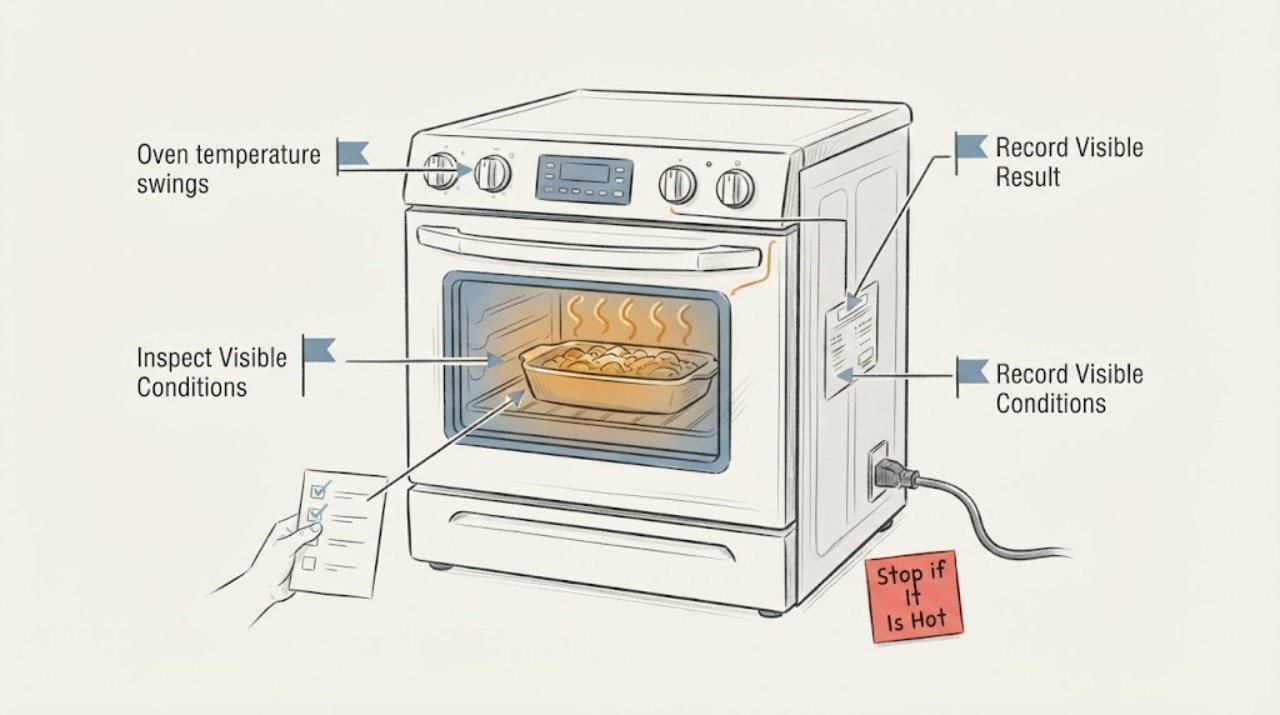
On a Samsung NX58H5600SS gas range, the oven burner normally cycles on and off to hold an average temperature, so an instant high or low reading does not by itself prove a failed sensor or igniter. First confirm the complete market suffix, the selected Bake or Convection mode, and the actual cooking result. If you use a portable oven thermometer, compare repeatable trends rather than the peaks and dips during cycling; Samsung says portable thermometers are not accurate for calibration. A persistent, repeatable under- or over-cooking result can be evaluated through the exact model's calibration guidance. If ignition is delayed, produces a boom, leaves a yellow or unstable flame, creates soot or smoke, or you smell gas, stop using the range and contact the gas provider or qualified appliance service. Do not hand-light the oven, adjust gas pressure, open panels, or keep retrying ignition.
Work through in order
Diagnostic checks
Use only checks that match the exact appliance or system and its official guide.
-
Check 1
Read the rating label and record the complete NX58H5600SS suffix and market. With the oven cool, dry, and free of a gas odor, note whether the complaint occurs in normal Bake, Convection Bake, or another documented mode; record the set temperature, preheat indication, and whether the problem is slow preheat, alternating results, or food consistently under- or overcooked.
Expected result: The suffix or market is incomplete, the symptom occurs in only one mode, the display reaches the set point but food results vary, or all modes show the same result.
Next step: Use the matching manual for the recorded suffix and continue with one controlled comparison. If the model cannot be confirmed, keep the conclusion at symptom level and arrange model-specific service before changing settings or parts.
Stop if: Stop immediately for gas odor, delayed ignition, a boom, abnormal flame, smoke, scorching, a hot or damaged connection, or repeated breaker trips.
Why this matters
Why: Samsung publishes separate regional support records for NX58H5600SS variants, and convection changes how heat is circulated. Mode and suffix prevent applying the wrong control or calibration procedure; they do not identify a failed component.
-
Check 2
For a hazard-free check, start a cool empty oven once in normal Bake at the intended temperature with one rack and the door closed. Observe from outside whether the preheat display rises from its initial value, whether the oven reaches its preheat indication, and whether the burner cycles rather than remaining continuously on; do not reach into the cavity or remove covers.
Expected result: The display progresses and the burner cycles, the display does not progress, the oven never ignites, or heating remains continuously on instead of cycling.
Next step: If the normal cycle completes, compare cooking results rather than repeatedly restarting. If preheat never progresses, ignition is absent, or heat does not stop normally, leave the oven off and request qualified service.
Stop if: Do not repeat the start to reproduce a delayed ignition, and stop for gas odor, a boom, yellow or unstable flame, soot, smoke, sparks, or abnormal heat.
Why this matters
Why: Samsung explains that a gas oven may ignite and turn off multiple times to maintain temperature. A progressing preheat with cycling is different from no ignition or uncontrolled continuous heating, but this observation alone cannot name the igniter, sensor, valve, or control part.
-
Check 3
If you use a portable oven thermometer, place it on the same rack position for two comparable, supervised cycles and record the stable trend and the food result; do not judge the appliance from one instant high or low reading. Do not use a portable thermometer as a calibration instrument or open the oven to chase a target reading.
Expected result: The thermometer moves above and below the set point while the same recipe cooks consistently, or repeated cycles produce a consistent under- or over-cooking result.
Next step: For consistent cooking error without a safety symptom, follow the exact model's documented calibration guidance or request service. If readings and cooking results are inconsistent, provide the records to service instead of adjusting repeatedly.
Stop if: Stop if the oven overheats, continues heating after being turned off, produces smoke or scorching, or any gas or electrical hazard appears.
Why this matters
Why: Samsung says oven temperatures cycle above and below the set point and that portable thermometers can be inaccurate for calibration. Consistent food results with normal cycling are less concerning; repeatable cooking error supports a calibration or service question, not a guessed sensor replacement.
-
Check 4
Compare one normal Bake cycle with one documented convection cycle using the same recipe, rack position, and load, while keeping the door closed and leaving vents clear. Record whether Auto Conversion or a mode-specific temperature setting is active; do not cover the cavity floor or vents with foil.
Expected result: Only convection is different, Auto Conversion changes the entered temperature, the problem follows the rack or load, or both modes produce the same repeatable error.
Next step: Use the exact manual's mode and rack guidance, repeat the recipe once under controlled conditions, and escalate a persistent error for calibration or service rather than changing parts.
Stop if: Do not continue high-heat tests if there is smoke, scorching, abnormal cabinet heat, or a gas or electrical warning sign.
Why this matters
Why: Samsung documents that convection circulates heat and that Auto Conversion can reduce the entered temperature. Rack position, cookware, airflow, and door opening can change cooking without proving an appliance component fault; the same error in both modes makes a settings-only explanation less likely.
-
Check 5
Only if there is no gas odor or other hazard, observe an existing cooktop burner using the range's ordinary controls from a safe position; do not loosen fittings, adjust pressure, hand-light anything, or repeatedly attempt the oven. Record whether the cooktop burners operate normally and whether the oven-only symptom remains.
Expected result: The cooktop burners also fail or flicker, the cooktop works but the oven does not ignite, or the oven ignites late or cannot sustain a normal flame.
Next step: If all burners are affected, stop ignition attempts and contact the gas provider or qualified professional. If the cooktop is normal but the oven is not, stop using the oven and request qualified Samsung appliance service.
Stop if: Stop at once for gas odor, delayed ignition, a boom, yellow or unstable flame, soot, smoke, or any need to alter the gas path.
Why this matters
Why: Samsung uses the cooktop comparison to separate a possible household gas-supply concern from an oven-only ignition problem. It does not establish a pressure value or identify a valve, igniter, burner, sensor, or control board.
-
Check 6
Write down any complete display code, blinking pattern, mode indicator, and the point in the cycle where heating changes. Check that record only against the exact NX58H5600SS manual or Samsung support page; if there is no hazard and the manual permits it, perform one power reset, then one normal start.
Expected result: A code returns, the same erratic result returns after the controlled start, the breaker trips again, or the oven now heats and cycles normally.
Next step: Stop testing and give service the model suffix, mode, set temperature, preheat behavior, thermometer trend, cooking result, cooktop comparison, and any safety symptom. Use the oven only if it starts, heats, and shuts down normally.
Stop if: Do not repeat the reset, run self-diagnosis, bypass an interlock, open the control or gas system, or continue after a gas, smoke, spark, overheating, or breaker-trip symptom.
Why this matters
Why: A repeatable code or symptom after a documented external check supports a service diagnosis, while a single successful reset can indicate a temporary control state. Neither result proves a particular part.
Use your observations
Decision map
Find the observation that best matches what you see, then follow the next safe action.
-
PATH 01Next step
What you see
The oven burner cycles, the portable thermometer shows swings, and repeated food results are consistent in the same mode and rack position.
Do this next
Keep the controlled cooking record and use the exact recipe, rack, and mode guidance. Do not replace a part from the temperature graph alone; request service only if the cooking result becomes repeatably abnormal.
Why this path and its safety boundary
Why it matters: This pattern is consistent with normal temperature control and the limitations of a slow portable thermometer, not a confirmed sensor or igniter failure.
-
PATH 02Next step
What you see
The same recipe is repeatedly under- or overcooked in a controlled Bake comparison, with normal-looking cycling and no gas odor, smoke, or abnormal flame.
Do this next
Verify the exact suffix and mode manual, then follow its calibration limits or arrange service if the result remains outside the documented adjustment range or is inconsistent.
Why this path and its safety boundary
Why it matters: A mode, rack, airflow, recipe, or temperature-calibration issue is more plausible than a conclusion that a specific sensor or igniter has failed.
-
PATH 03Next step
What you see
The cooktop burners work normally but the oven fails to ignite, ignites late, cannot sustain a flame, or shows an abnormal flame.
Do this next
Stop using the oven and request qualified Samsung appliance service. Do not hand-light, adjust gas pressure, remove panels, or keep reproducing the ignition attempt.
Why this path and its safety boundary
Why it matters: The pattern points to an oven-specific gas ignition or control path that requires professional diagnosis; it does not identify the igniter, valve, sensor, or board.
-
PATH 04Next step
What you see
Multiple cooktop burners fail or flicker, or there is gas odor, a delayed ignition boom, yellow or unstable flame, soot, or smoke.
Do this next
Do not use flames or electrical switches near a suspected leak; leave by the safest route, close the gas supply only if it is immediately accessible without risk, and contact the local gas emergency provider from a safe location. For smoke or fire, use local emergency guidance.
Why this path and its safety boundary
Why it matters: A gas-supply or immediate combustion safety issue takes priority over the temperature complaint. The appliance should not be tested to identify a part.
Helpful context
Understand the symptom
Treat a temperature swing as an observation, not a part diagnosis
This model is a freestanding gas range with Bake and convection functions. The useful distinction is whether the oven is cycling normally but producing consistent food, whether a mode or airflow choice changes the result, or whether the gas ignition itself is delayed or abnormal. A history of temperature fluctuation does not identify the sensor, igniter, valve, or control component without a model-specific service diagnosis.
Use repeatability and safety signals together
Record the complete label, market, mode, set temperature, preheat behavior, thermometer trend if used, and the result of the same recipe. Keep the door closed during preheat and do not use foil in a way that blocks airflow. Stop before troubleshooting further if any gas, flame, smoke, scorching, or electrical hazard appears.
The safe endpoint
A normal cycling pattern with repeatable cooking results does not justify replacing a part. A repeatable abnormal result without a gas hazard belongs in the exact model's calibration or service path. Any delayed ignition, abnormal flame, gas odor, or recurring electrical symptom takes priority over proving the temperature complaint.
When checks do not resolve it
Need a professional?
Leave the oven unused and request qualified Samsung appliance service when the exact mode, airflow, cooking-result, and one documented external reset do not resolve the repeatable error, when a code returns, or when the oven-only ignition path is abnormal. Use the gas provider or local emergency path for gas odor or suspected leakage, and qualified electrical service for a hot or damaged connection or repeated breaker trips. Do not hand-light the oven, adjust gas pressure, bypass an interlock, open the gas or electrical system, or continue test cycles after a safety symptom.
Common questions
FAQ
Is it normal for a Samsung gas oven flame to turn on and off while baking?
Samsung says a gas oven can ignite and turn off multiple times to maintain temperature. If the cooking result is repeatable and there is no delayed ignition, gas odor, abnormal flame, smoke, or overheating, cycling alone does not prove a failed part.
Can I use an oven thermometer to calibrate the NX58H5600SS?
Use a portable thermometer only as a repeatability clue, not as a calibration instrument. Samsung warns that portable oven thermometers can be inaccurate for calibration; follow the exact model's calibration instructions or ask qualified service when cooking results remain consistently wrong.
What should I do if the oven smells like gas or ignites with a bang?
Stop using the range and do not retry, hand-light the oven, adjust gas pressure, or open panels. Move away from the appliance, avoid flames and electrical switches near a suspected leak, and contact the local gas provider or emergency service from a safe location.
Why can Bake and Convection give different results?
Samsung documents that convection circulates heat and that Auto Conversion can reduce the entered temperature. Compare the same recipe with the correct rack and mode from the exact manual before treating a mode difference as an appliance fault.
Read the exact guide
Official sources
- There is smoke or an odor coming from Samsung ovenSamsung US · Supports the boundary between a limited first-use odor and smoke or unusual odor during ordinary use that needs support.
- NX58H5600SS_V2.inddSamsung Electronics America · Identifies the 5.8 cu. ft. freestanding gas range and its Bake and convection features.
- Samsung range or wall oven error codesSamsung US · Supports checking the exact model's code meaning and using only a documented external reset; it does not assign an unverified code to NX58H5600SS.
- Calibrate your oven's temperatureSamsung US · Explains why portable thermometers are not accurate for calibration and directs model-specific calibration or service for persistent cooking error.
- NX58H5600SS Gas Range, 5.8 cu.ft | Samsung Support CASamsung Canada · Shows that the same model family has a different regional suffix and support record; it is not a substitute for the user's exact manual.
- NX58H5600SS | Soporte Samsung LatinoaméricaSamsung Latin America · Identifies the NX58H5600SS model family and an AA regional suffix; use the rating label for the user's complete suffix and market.
- What can you do when the burner of your Samsung gas cooktop does not ignite or has other ignition issuesSamsung Canada · Provides the cooktop comparison and identifies delayed/burst or unstable ignition and gas-supply concerns as service or gas-provider matters.
- Samsung oven temperature issuesSamsung US · Covers normal gas-oven cycling, mode and airflow factors, preheat observations, cooktop comparison, and portable-thermometer limitations.
Community feedback
Share a repair observation
Share a plain-text repair observation. Accepted observations are published automatically; this page may take a moment to update.