
On this page
Start here
Quick answer
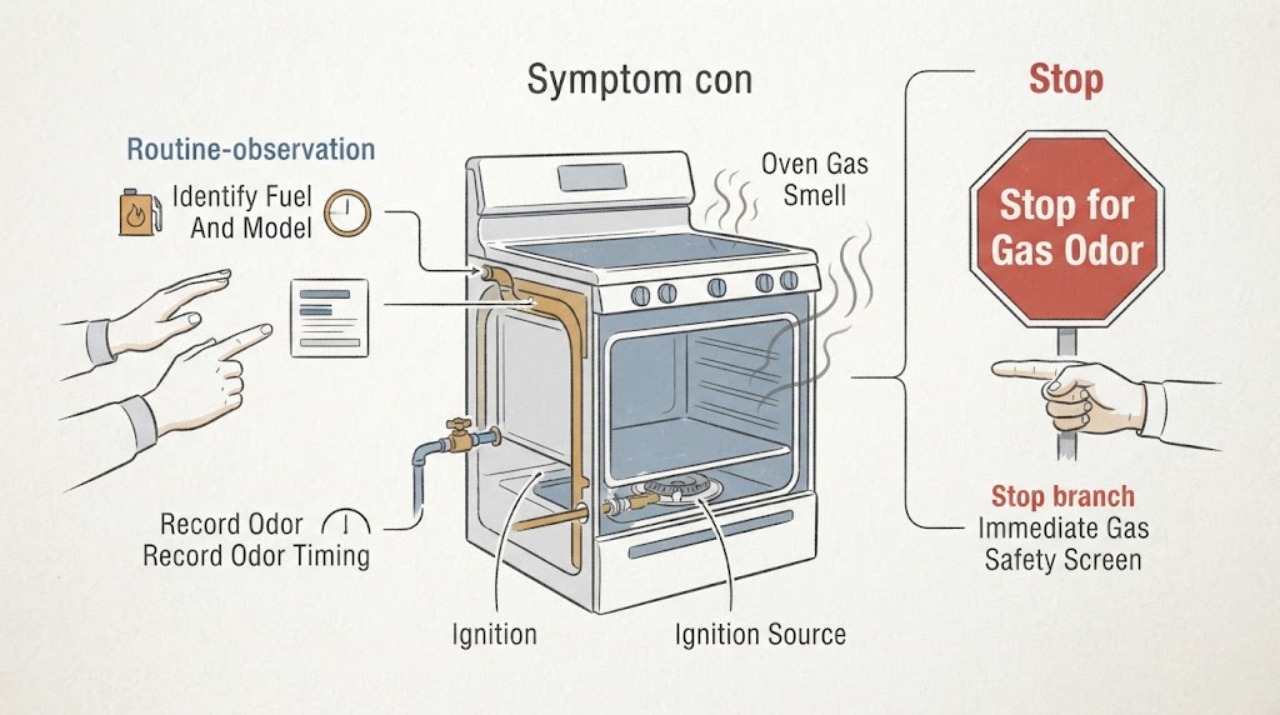
First confirm that the Samsung appliance is a gas oven or gas range and treat a real gas odor as a safety event, not a smell to diagnose by repeated ignition. If the odor is strong, persistent, accompanied by hissing, a delayed or burst flame, smoke, soot, abnormal flame, or a carbon-monoxide alarm, do not operate controls, switches, flames, or phones in the area: leave, and contact emergency or gas-safety help from a safe location. Samsung says a faint gas-like odor can occur during first use from packaging and protective oil, while smoke or odor during self-cleaning or food residue can have a different explanation. That exception applies only when the situation matches the exact model guidance and there is no continuing gas smell or combustion warning. Do not find a leak with a flame, do not relight or repeatedly start the oven, and do not remove panels. When the oven is cool and the air is clear, record the model, fuel type, timing, location, controls, burner behavior, and any code; a clean oven with a new, recurring, or unexplained gas odor needs qualified gas-appliance service.
Work through in order
Diagnostic checks
Use only checks that match the exact appliance or system and its official guide.
-
Check 1
Without switching anything on or off near the suspected odor, assess from the safest available position whether the smell is present now and whether anyone or any detector indicates a combustion emergency.
Expected result: Record strong or persistent fuel odor, hissing, a CO alarm, headache, dizziness, nausea, confusion, smoke, soot, a flash, delayed ignition, burst flame, or an abnormal yellow or unstable flame.
Next step: If any hazard is present, do not operate controls, switches, flames, or phones in the area. Leave for fresh air and contact emergency or gas-safety help from a safe location; do not re-enter or use the oven until cleared and serviced.
Stop if: Stop immediately for fuel odor that is strong, persistent, or unexplained; hissing; CO alarm or symptoms; smoke, soot, flash, burst, delayed ignition, or abnormal flame.
Why this matters
Why: These observations are not a routine oven-care issue. Gas ignition and combustion hazards can worsen while someone searches for a source, and CO cannot be detected by smell.
-
Check 2
From a safe, odor-free position after the emergency screen, record the complete Samsung model number and confirm whether the appliance is a natural-gas or propane oven/range according to its documentation; do not remove panels or disturb the connection.
Expected result: Record gas range versus wall oven, fuel type, recent installation or conversion, whether the smell is from the cavity, vent, rear connection, cooktop, or control area, and whether the oven has ever operated normally.
Next step: Use the exact Samsung manual and preserve the location and timing record for service. If the fuel type or connection is uncertain, do not operate the appliance and request qualified assessment.
Stop if: Do not pull the range out, loosen a fitting, change fuel settings, remove a cover, or assume a cooktop instruction applies to the oven.
Why this matters
Why: Fuel configuration, installation, and model change the applicable manual and professional checks. A smell at the connection or room is not an oven-cavity cleaning problem, while a cavity or vent smell still cannot identify an internal gas component safely.
-
Check 3
When the area is clear and the oven remains off, document when the odor first appeared and whether it occurs before Start, during ignition, during normal heating, after shutoff, during Self Clean, or only on first use; do not recreate a dangerous condition.
Expected result: Classify it as faint and first-use only, Self Clean only, food/grease residue, a gas-like odor during or after ignition, a plastic/electrical smell, or unexplained recurring odor.
Next step: Use the matching low-risk branch only when the context is clear and no hazard occurred. Keep the oven off and arrange service for a fuel-like, electrical, recurring, or uncertain odor.
Stop if: Do not turn the oven on merely to classify the smell, open the door to release suspected gas, or test it with a flame.
Why this matters
Why: Samsung identifies first-use packaging/protective-oil odor, Self Clean odor, and food residue as different contexts. Gas-like, electrical, or recurring unexplained odor is not resolved by assuming residue, especially if the oven did not ignite normally.
-
Check 4
Only if the oven is new or has not been used since installation, and there is no continuing fuel odor, alarm, smoke, abnormal flame, or electrical smell, inspect from outside for remaining plastic, tape, ties, labels, or packaging that the manual says to remove.
Expected result: Record whether all packaging is removed and the faint odor is limited to the initial use, or whether odor persists, is strong, is fuel-like, or comes from a connection or control area.
Next step: If the exact manual authorizes a first-use burn-in, follow its ventilation and operating instructions only after the safety screen is clear. Otherwise keep the oven off and arrange service.
Stop if: Do not burn packaging in place, use the oven to mask a gas smell, or continue first-use operation when smoke, abnormal flame, hissing, or a CO concern exists.
Why this matters
Why: Samsung says a faint gas-like odor during first use can come from packaging and protective oil. A strong or persistent odor, an odor after the initial use, or any abnormal combustion sign is a service or emergency condition instead.
-
Check 5
If the odor is clearly a food or grease smell during ordinary cooking and there is no fuel, electrical, or combustion warning, wait until the oven is cool, then inspect the visible cavity for spills or food debris without removing the bottom panel or burner cover.
Expected result: Record visible residue near the rack, floor, door, or vent; melted plastic or cookware; smoke from a known spill; or a clean cavity with an unexplained odor.
Next step: After cooling, remove only accessible residue using the model's approved cleaning method. If the odor remains or its type is uncertain, keep the oven off and arrange professional service.
Stop if: Do not scrape hot residue, use unapproved chemicals, burn off melted plastic, or clean while gas or electrical hazards are present.
Why this matters
Why: Samsung says spilled food can burn and produce smoke or unusual odor. A clean cavity with recurring odor, a plastic/electrical smell, soot, or a fuel-like smell is not explained by ordinary residue.
-
Check 6
If the odor or smoke occurs only during Self Clean and there is no fuel odor, abnormal flame, electrical smell, or CO concern, compare the situation with the exact Samsung manual's Self Clean ventilation and safety instructions.
Expected result: Record whether the smell and smoke are limited to the Self Clean period, ventilation is available, the oven remains closed as instructed, or odor continues after the cycle or appears during ordinary baking.
Next step: Follow the manual's ventilation guidance only for a clearly normal Self Clean context. Stop the function and arrange service if smoke becomes excessive, a safety alarm occurs, or odor persists afterward.
Stop if: Do not use Self Clean to burn away a gas or electrical smell, leave the home while it runs, or continue with a CO alarm, fire, abnormal flame, or uncontrolled smoke.
Why this matters
Why: Samsung explains that smoke and unusual odors can occur during Self Clean as residue is incinerated. Odor outside that context, persistent smoke, a fuel smell, or an electrical odor changes the decision to service and stop use.
-
Check 7
From a safe position and without moving the appliance, look only at the accessible area around the range, wall, and visible gas connection for signs of a recent installation disturbance or damage; do not touch or leak-test the fitting.
Expected result: Record a recently installed or converted range, a displaced or damaged visible line, soot or scorching, odor strongest at the rear or room, or no visible external abnormality.
Next step: If the connection is damaged, displaced, or the odor is strongest there, leave the area and arrange gas-safety service from a safe location. If the outside appears normal but the odor recurs, arrange appliance service without further tests.
Stop if: Do not pull the range, tighten or loosen fittings, apply a flame or improvised leak test, adjust the regulator, or restart the oven.
Why this matters
Why: Installation, fuel conversion, or a connection odor requires qualified gas assessment. No visible defect does not rule out a valve, burner, igniter, regulator, vent, or combustion problem inside the appliance.
-
Check 8
After the area is safe and the appliance is off, record any CO alarm, symptoms, soot, discoloration, or history of incomplete ignition without attempting to observe a flame or combustion chamber.
Expected result: Record no alarm or symptoms, an alarm that sounded, headache/dizziness/nausea/confusion, soot around the vent, a delayed or failed ignition, or an abnormal flame seen before the appliance was turned off.
Next step: For a CO alarm or possible exposure, leave and seek emergency help from outside; for combustion evidence without an alarm, keep the oven off and arrange qualified gas-appliance service.
Stop if: Do not re-enter to investigate, use the oven for a comparison, or rely on ventilation to make a suspected combustion fault safe.
Why this matters
Why: CO is odorless and colorless and may be present without a recognizable smell. An alarm or symptoms require fresh air and emergency action; soot, failed ignition, or abnormal flame requires the appliance to remain off for trained inspection.
-
Check 9
Using the odor type, timing, location, model, fuel, and safety observations, choose whether the next step is emergency gas/CO response, qualified gas assessment, or Samsung appliance service; do not perform another ignition test.
Expected result: Choose strong/persistent fuel odor or alarm; installation or pressure concern; clean but recurring oven odor; first-use or Self Clean context; food residue; or unexplained electrical/plastic odor.
Next step: Provide the complete record and exact model to the appropriate qualified provider. Keep the oven off whenever the smell is fuel-like, electrical, recurring, or uncertain.
Stop if: Do not relight, reset, run Bake or Self Clean, move the appliance, search for a leak, or open the oven gas or electrical components.
Why this matters
Why: The classification prevents a harmless-residue explanation from being applied to a gas or electrical hazard and prevents a service fault from being repeatedly tested.
-
Check 10
Prepare the service handoff with the model number and the exact odor timeline rather than a guessed failed part.
Expected result: Include fuel type, location and strength of odor, first-use/Self Clean/normal-use context, display or code, door and burner behavior, recent installation or conversion, visible residue or soot, and any alarm, smoke, spark, heat, or trip.
Next step: Leave the oven disconnected or gas appliance off as indicated by the safety branch and arrange qualified service; use an electrician for a confirmed electrical supply or wiring concern.
Stop if: Do not provide a part number as the diagnosis, test live wiring, measure gas pressure, bypass a safety device, or operate after an emergency sign.
Why this matters
Why: These details help separate packaging or food residue from gas supply, ignition, burner, valve, vent, control, electrical, and combustion-safety faults without unsafe homeowner disassembly.
Use your observations
Decision map
Find the observation that best matches what you see, then follow the next safe action.
-
PATH 01Safety boundary
What you see
The smell is strong, persistent, or unexplained; gas is heard; a CO alarm or possible exposure symptoms occur; or there is a delayed ignition, burst, smoke, soot, or abnormal flame.
Do this next
Do not operate switches, controls, flames, or phones in the area. Leave for fresh air and contact emergency or gas-safety help from a safe location; do not re-enter or use the appliance until cleared and serviced.
Why this path and its safety boundary
Why it matters: Treat this as a gas or combustion emergency, not a normal oven odor.
Safety stop: Do not search for the leak, open windows by operating electrical equipment, relight, reset power, or test another burner.
-
PATH 02Safety boundary
What you see
The oven is new or newly installed, the odor is faint and limited to first use, packaging is removed, ventilation is available, and no fuel, electrical, smoke, flame, or alarm warning exists.
Do this next
Follow the exact Samsung model's first-use and ventilation instructions only once the safety conditions remain clear; stop and service if odor becomes strong, persistent, or abnormal.
Why this path and its safety boundary
Why it matters: Samsung says packaging and protective oil can create a temporary gas-like odor during first use.
Safety stop: Do not burn packaging, ignore hissing, or continue if odor occurs after first use or with abnormal combustion.
-
PATH 03Safety boundary
What you see
Smoke or odor occurs only during Self Clean, there is no fuel or electrical smell, and there is no CO alarm, fire, or uncontrolled smoke.
Do this next
Follow the manual's ventilation guidance and monitor safely; stop the function and arrange service if odor persists afterward or any hazard appears.
Why this path and its safety boundary
Why it matters: Samsung identifies odor and smoke during Self Clean as residue being incinerated, subject to the model's safety instructions.
Safety stop: Do not use Self Clean to investigate an unexplained gas or electrical smell, and do not continue with a CO alarm or fire.
-
PATH 04Safety boundary
What you see
The odor is clearly from a visible food or grease spill during ordinary cooking, with no gas-like, electrical, smoke, soot, flame, or alarm warning.
Do this next
After the oven cools, clean only the accessible residue using the exact model's approved method. Arrange service if odor remains or changes character.
Why this path and its safety boundary
Why it matters: Burning residue can produce odor or smoke, but this explanation does not cover an otherwise clean oven or a fuel-like smell.
Safety stop: Do not burn off melted plastic, clean while hot or energized, or continue when smoke, flame, or fuel odor is present.
-
PATH 05Safety boundary
What you see
The range was recently installed or converted, the odor is strongest near the rear/connection, burners are abnormal, or the oven works only under an unusual supply condition.
Do this next
Keep the appliance off and arrange qualified gas or installation service from a safe condition; do not adjust fittings or regulator settings.
Why this path and its safety boundary
Why it matters: A gas connection, fuel configuration, supply, or pressure problem is possible and needs qualified assessment.
Safety stop: Do not pull the range, leak-test with a flame, adjust the gas train, or leave a burner lit as a workaround.
-
PATH 06Safety boundary
What you see
The smell resembles burning plastic or electrical insulation, comes from the controls, cord, receptacle, or vent, or is paired with heat, smoke, sparks, or a trip.
Do this next
Stop using the oven and isolate power only from a dry safe position when possible; arrange qualified electrical or appliance service.
Why this path and its safety boundary
Why it matters: This is not a routine gas-odor or food-residue explanation and may involve electrical or overheated appliance components.
Safety stop: Do not reset protection repeatedly, touch a hot connection, remove panels, or restart to see whether the smell returns.
-
PATH 07Safety boundary
What you see
The oven is clean, the odor returns during ordinary use, or the smell cannot be confidently classified as first-use, Self Clean, or food residue.
Do this next
Keep the oven off and arrange qualified Samsung appliance or gas-appliance service with the exact model and odor record.
Why this path and its safety boundary
Why it matters: Samsung recommends professional service for unexplained odor or smoke from a clean oven; a gas appliance should not be normalized by repetition.
Safety stop: Do not run another Bake, Broil, or Self Clean cycle to reproduce the smell, and do not open the burner or valve area.
-
PATH 08Safety boundary
What you see
No immediate hazard is observed, but the odor is new, recurring, fuel-like, or uncertain after external observation.
Do this next
Do not operate the oven again; provide the model, timing, location, and context to qualified service for inspection.
Why this path and its safety boundary
Why it matters: Absence of visible smoke or an alarm does not prove safe combustion or rule out a gas leak.
Safety stop: Do not rely on smell fading, ventilation, or a single successful ignition as proof of repair.
Helpful context
Understand the symptom
A gas-like smell is not proof of a harmless first-use odor
Samsung describes a faint gas-like odor during first use as a possible result of packaging and protective oil, and it separately describes odor or smoke during self-cleaning and from food residue. Those are context-specific explanations, not permission to ignore a strong, persistent, new, or recurring gas smell. If the odor is unmistakably fuel-like, continues after the appliance is off, or is paired with hissing, a delayed ignition, a burst, smoke, soot, or an abnormal flame, use the emergency path and do not test the oven again.
Separate gas odor, burnt residue, and electrical odor
Record where and when the smell occurs: at the room or connection, from the oven vent during ignition, only from food or grease, during a first burn-in, during Self Clean, or from the control or power area. A food or grease odor may leave visible residue, while a plastic or electrical smell can come from a hot component or wiring. You cannot identify carbon monoxide by smell; a CO alarm or symptoms require fresh air and emergency action, not a search for the oven source.
Do not use ignition to investigate a possible leak
Do not strike a match, use a lighter, operate the hood or lights, cycle a breaker, use a phone in the suspected gas area, or open a gas fitting to locate an odor. PHMSA's gas-emergency guidance says to turn gas appliances off if that can be done without creating risk, leave the area, and contact emergency help from a safe location. Once cleared, a qualified gas professional can inspect the supply, installation, pressure, burner, valve, and combustion path.
When an ordinary odor check can end
If the oven is new, the odor is faint and limited to the first use, all packaging has been removed, ventilation follows Samsung's instructions, and there is no fuel smell, abnormal flame, smoke, or alarm, the smell may be a temporary manufacturing residue. If odor occurs only during Self Clean, follow the model's ventilation and household safety instructions. A clean, established oven that smells during normal operation should not be normalized; leave it off and arrange service.
Safety boundary
Stop conditions
- For strong, persistent, or unexplained gas odor, hissing, delayed ignition, burst flame, smoke, soot, abnormal flame, or a CO alarm/symptoms, stop immediately, leave, and contact emergency or gas-safety help from a safe location.
- Do not operate light switches, hood controls, phones, matches, lighters, breakers, or other ignition sources in a suspected gas area; do not search for a leak or perform a flame test.
- Do not restart Bake, Broil, or Self Clean to reproduce an odor, leave a cooktop burner lit as a workaround, or rely on ventilation to make a combustion fault safe.
- Do not move the range, loosen or tighten gas fittings, adjust pressure or fuel conversion, remove the oven floor or burner cover, or access valves, igniters, wiring, or controls.
- Keep the oven off for a clean-oven recurring odor, unexplained plastic/electrical odor, unresolved smell, or any odor paired with heat, spark, trip, leak, smoke, or abnormal combustion.
Only after diagnosis
Potential parts
- oven igniter or ignition electrode
Consider only after qualified model-specific diagnosis identifies an ignition component fault; a gas odor alone does not identify an igniter.
Confirm the complete Samsung model and fuel configuration before any part selection; installation and testing require qualified service. - oven gas safety valve
Consider only if qualified testing identifies a valve or pressure-control fault after the supply and ignition path are assessed.
Gas-valve fit and fuel configuration are model-specific; do not open or modify the gas train as a homeowner check. - oven temperature or flame sensor
Consider only when the exact model's diagnosis links abnormal cycling, shutdown, or a code to the applicable sensor.
Verify the model manual and professional diagnosis; do not assume a sensor part from another Samsung oven fits. - range control or relay assembly
Consider only when a qualified diagnosis links a control, relay, or power-path fault to the odor or ignition symptom.
Confirm exact model, revision, and diagnosis before ordering; a smell does not by itself identify a control assembly.
When checks do not resolve it
Need a professional?
Use emergency or gas-safety help immediately for strong, persistent, or unexplained fuel odor, hissing, delayed ignition, a burst or abnormal flame, smoke, soot, or a CO alarm or symptoms. Arrange qualified gas or installation service for a recent installation/conversion, a connection or pressure concern, or abnormal burner behavior. Arrange Samsung appliance service for a clean oven with recurring odor, an unexplained fuel-like smell, or an odor that persists after the model-specific first-use or residue context is excluded.
Common questions
FAQ
Is a faint gas-like smell from a new Samsung oven normal?
Samsung says a faint gas-like odor during first use can come from plastic packaging and protective oil. That explanation applies only to the specific first-use context with no hissing, persistent fuel odor, delayed ignition, abnormal flame, smoke, electrical smell, or alarm. Follow the exact model's ventilation and first-use instructions and stop if the smell is not clearly temporary.
What should I do if my Samsung oven smells like gas during normal use?
Do not keep running it or try to find the leak. If the odor is strong, persistent, or accompanied by hissing, delayed ignition, a burst, smoke, or abnormal flame, leave and contact gas-safety or emergency help from a safe location. Keep the oven off until qualified personnel inspect it.
Can food residue cause a Samsung oven to smell?
Yes. Samsung says spilled food or grease can burn and create smoke or unusual odor. After the oven cools, inspect and clean only accessible residue using the model's approved method. A clean oven with recurring odor, a fuel-like smell, soot, or electrical odor needs service instead.
Should I use a lighter to check whether my Samsung gas oven is leaking?
No. Never use a flame to search for a gas leak or repeatedly start the oven to reproduce an odor. Do not operate electrical switches in a suspected gas area; leave and contact gas-safety help from a safe location.
Can I smell carbon monoxide from a Samsung gas oven?
No. CDC says carbon monoxide is odorless and colorless. If a CO alarm sounds or symptoms occur, leave for fresh air and seek emergency help; do not re-enter or use the appliance until it has been inspected and serviced by qualified personnel.
Read the exact guide
Official sources
- Carbon Monoxide Poisoning BasicsCenters for Disease Control and Prevention · Any Samsung gas oven when a CO alarm, symptom, or combustion concern is present
- Samsung SupportSamsung · Samsung ovens when the exact model manual or service route is needed
- Recognizing and Responding to Pipeline EmergenciesU.S. Department of Transportation Pipeline and Hazardous Materials Safety Administration · Indoor gas-odor safety response near a Samsung gas oven or range
- Odor or smoke from Samsung ovenSamsung · Samsung ovens and ranges when odor or smoke is reported; verify the exact model and fuel configuration
Community feedback
Share a repair observation
Share a plain-text repair observation. Accepted observations are published automatically; this page may take a moment to update.