
On this page
Start here
Quick answer
The Samsung NE59T4311SS is a freestanding electric range, so a breaker trip while the oven is preheating above 350°F and the cooktop is in use is a high-load timing clue—not proof that one heating element or control board is bad. Do not keep resetting the breaker, change circuits, use an extension cord, or run modes to reproduce the trip. From a cool, dry, de-energized appliance, record whether the trip happened at power restoration, when Bake started, during preheat, after the range became hot, or only when a cooktop element was also on. Stop immediately for smoke, burning or plastic odor, sparks, a hot or damaged cord/outlet, water, exposed wiring, or another trip. Have a qualified electrician verify the NE59T4311SS installation, 240-volt supply and range-cord/connection arrangement against the exact manual and local code; have an appliance technician assess the range only after the supply is shown to be correct.
Before you begin
Safety first
- Do not reset the breaker repeatedly, use an extension cord, change circuits, alter overcurrent protection, open the terminal or breaker panel, measure live voltage, bypass a safety device, or run the range with damaged wiring. Stop for smoke, burning odor, sparks, water near electrical parts, a hot outlet/cord, exposed conductors, or another trip.
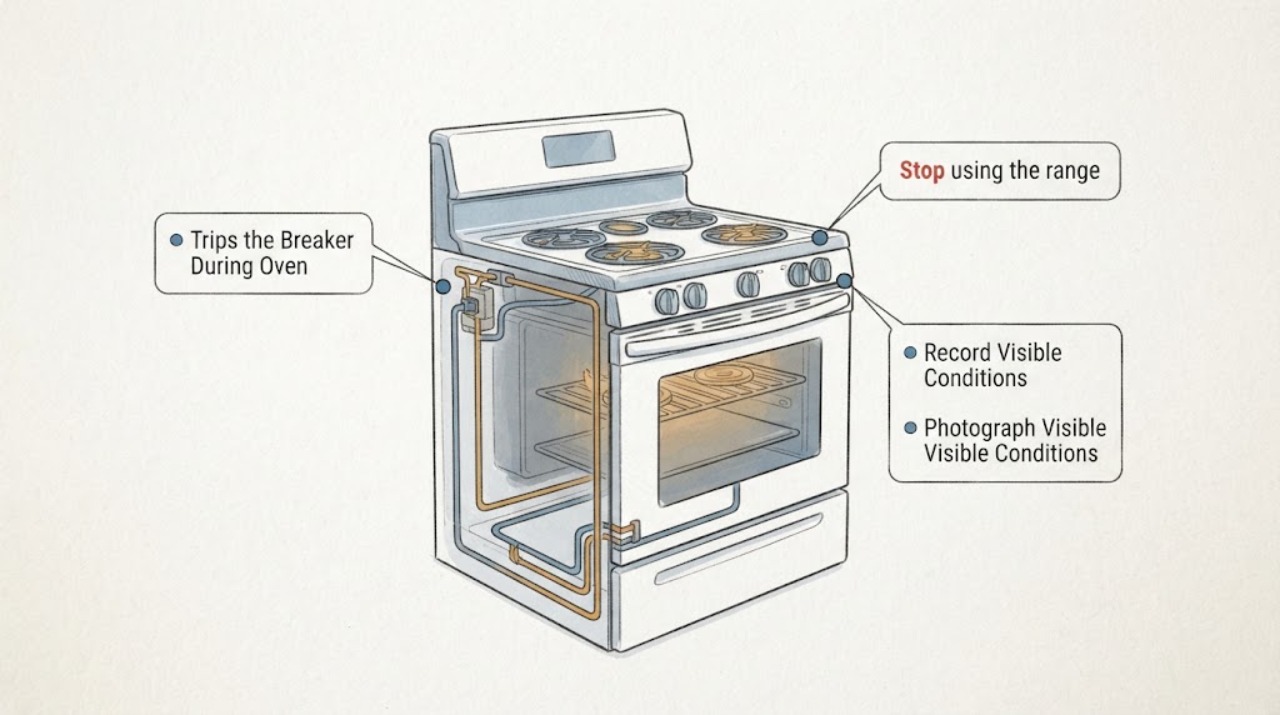
Work through in order
Diagnostic checks
Use only checks that match the exact appliance or system and its official guide.
-
Check 1
Stop using the range from a safe position if there is smoke, a burning or plastic odor, visible sparking or arcing, a hot/discolored cord or receptacle, water near electrical parts, exposed conductors, or a second breaker trip. Do not reset the breaker to see whether the oven will run again, and do not start another preheat cycle.
Expected result: A hazard or repeat trip is present, or the breaker tripped once without any visible hazard.
Next step: Keep the range off. Use emergency help for active fire or arcing; otherwise arrange qualified electrical/appliance service and provide the event record.
Stop if: No repeated breaker reset, extension cord, circuit substitution, panel removal, live measurement, or operation with damaged wiring or a hot outlet.
Why this matters
Why: A hazard or second trip is an electrical/appliance safety event, not ordinary temperature troubleshooting. Even one unexplained trip during heating requires the circuit and range to remain out of service until assessed.
-
Check 2
Without re-energizing the range, write down the last safe state: target temperature, Bake or other selected mode, whether the oven was preheating above 350°F, which cooktop elements were on, what other large kitchen loads were running, and the time from Start or element selection to the trip.
Expected result: The trip occurred immediately at power restoration, when an oven mode started, during preheat, after the oven became hot, or only while a cooktop element and oven load overlapped.
Next step: Give the timing and simultaneous-load record to a qualified electrician and appliance technician. Do not run separate modes to sharpen the timing.
Stop if: Stop any attempt to reproduce the trip, especially if the first event included odor, heat damage, smoke, water, or arcing.
Why this matters
Why: Timing distinguishes a supply/connection or circuit-loading handoff from a load that appears when a heating stage is energized or hot. It does not prove a bake element, broil element, control, breaker, or receptacle is faulty.
-
Check 3
From a cool, dry, untouched range, photograph the complete model/rating label and inspect only the accessible cord, plug or receptacle, surrounding cabinet, and breaker label for looseness, heat discoloration, moisture, crushing, exposed conductors, or recent installation work. Do not move the range or remove the rear cover, terminal cover, breaker panel, or receptacle plate.
Expected result: The suffix or market is uncertain, the supply connection is visibly damaged or wet, the breaker label is unclear, the cord is not the expected range connection, or the exterior appears normal.
Next step: For damage, moisture, uncertainty, or recent installation, leave the range off and request a qualified electrical inspection. Provide the rating label and installation documents rather than altering the connection.
Stop if: Do not tighten terminals, change the breaker, add a cord, use an extension lead, or open any electrical enclosure.
Why this matters
Why: A model/market or connection mismatch prevents safe use of a generic rating. Visible damage or an uncertain installation can explain a trip before an internal component is proven; a normal exterior does not clear the circuit or range.
-
Check 4
Have the electrician compare the installed supply with the exact NE59T4311SS installation instructions and local code. Samsung's U.S. overview describes electric ranges as using a 208Y/120V or 240/120V, 60 Hz system and a 40-amp range cord; treat those as manufacturer guidance for the handoff, not a user wiring instruction.
Expected result: The electrician confirms the model, market, conductors, grounding, cord/strain relief, breaker, receptacle, and supply are correct, or finds a mismatch, loose connection, undersized/overloaded circuit, or damaged protection device.
Next step: Correct installation or circuit defects only through the qualified professional. If supply is correct, hand the documented trip timing to an appliance technician for model-specific diagnosis.
Stop if: Do not measure live voltage, bridge the breaker, change overcurrent protection, rewire the range, or restore power to test a suspected connection.
Why this matters
Why: A verified supply moves the investigation toward the range's own load path; any mismatch or damage keeps the cause in the installation/circuit branch. Neither result justifies the owner selecting a replacement component.
-
Check 5
Record whether the display returned normally after the trip, stayed blank or frozen, showed an exact error code, or showed a control state such as Demo. Use only the NE59T4311SS manual or Samsung's range-code guide to interpret a message; do not clear a code by repeated power cycling.
Expected result: The panel is normal, a code returns, the panel is blank/frozen, or the displayed characters are incomplete or uncertain.
Next step: Photograph the display and include it in the service request. Keep the range off if the code returns, the panel is abnormal, or any heating symptom remains.
Stop if: Do not enter diagnostics, bypass a door/control input, or reset the breaker merely to obtain a new display.
Why this matters
Why: A panel symptom can accompany a supply or control event, but Samsung's code meanings are not interchangeable across ranges. A returning code or blank/frozen panel requires service without another high-load cycle.
-
Check 6
Do not use an oven thermometer or perform a new 350°F comparison after a breaker trip. Instead, give the technician the last observed preheat behavior, including whether the display was progressing normally, stalled, or tripped as the range approached the selected temperature; Samsung's temperature guide can be used only as background for the service handoff.
Expected result: The trip happened only at a particular heat stage, the range had been slow to preheat without a trip, or the display/heat behavior was normal until the breaker opened.
Next step: Keep the range off and provide the timeline, selected loads, and any supply findings for qualified diagnosis; do not test another temperature or mode.
Stop if: Stop for another trip, abnormal heat, odor, smoke, sparks, a hot receptacle, or unexpected heating.
Why this matters
Why: Preheat behavior can help the technician separate a temperature complaint from a circuit interruption, but neither a 350°F threshold nor a slow/normal display isolates the electrical fault. The exact simultaneous cooktop load remains important.
Use your observations
Decision map
Find the observation that best matches what you see, then follow the next safe action.
-
PATH 01Safety boundary
What you see
Smoke, burning odor, sparks/arcing, a hot or damaged cord/outlet, water near electrical parts, exposed conductors, or another breaker trip occurred.
Do this next
Keep the range off and clear. Use emergency help for active fire or arcing; otherwise obtain qualified electrical and appliance service.
Why this path and its safety boundary
Why it matters: The event is an immediate electrical/fire safety branch. It is not safe to reproduce the preheat-and-cooktop combination.
Safety stop: No reset loop, panel removal, live test, circuit change, or restart.
-
PATH 02Next step
What you see
The trip occurred only when oven preheat and one or more cooktop elements overlapped, with no odor, heat damage, moisture, or visible connection problem.
Do this next
Do not repeat the combination. Have a qualified electrician verify the supply and installation, then have an appliance technician assess the range if the circuit is correct.
Why this path and its safety boundary
Why it matters: The simultaneous-load timing is a distinct handoff toward circuit loading, supply/connection, or an appliance load that appears under combined demand. The exact NE59T4311SS wattages provide context but do not identify which element or control failed.
-
PATH 03Next step
What you see
The breaker trips immediately at power restoration, when the oven alone starts, or without the cooktop being used.
Do this next
Leave the range off and request qualified electrical/appliance diagnosis using the exact model, market suffix, breaker history, and display photo.
Why this path and its safety boundary
Why it matters: The cooktop overlap is not required for the symptom, so a supply/connection issue or an oven/range fault remains possible. The timing still does not select a part.
-
PATH 04Safety boundary
What you see
The electrician confirms the installation and supply are correct, but the range still trips during a documented heating stage or the panel shows a returning code.
Do this next
Have a qualified Samsung appliance technician perform the model-specific diagnosis and report what test isolated the failed path before any part is approved.
Why this path and its safety boundary
Why it matters: The unresolved branch is now inside the range's load/control/sensor/wiring system, but the evidence still does not justify naming a bake element, broil element, board, or breaker.
Safety stop: Do not authorize a component by elimination or operate the range unattended.
-
PATH 05Next step
What you see
The visible supply is normal, the panel is normal, and no repeat trip has occurred, but preheat is slow or cooking temperature seems wrong without an electrical hazard.
Do this next
Do not run more high-load comparisons. Give the prior trip and the slow/abnormal heating record to qualified electrical/appliance service.
Why this path and its safety boundary
Why it matters: That is a heating-performance symptom rather than proof of the prior breaker cause. Samsung says electric ranges require 240 V for normal preheat behavior and recommends service if the applicable preheat check remains abnormal; the user should not measure live voltage.
Helpful context
Understand the symptom
Why simultaneous use is a distinct clue
NE59T4311SS is an electric range, not a gas oven. Samsung's exact-model sheet lists a 2,400 W bake element, a 3,400 W broil element, and two 3,000 W dual cooktop elements. Those ratings do not show which loads were energized at the instant of a trip, and they do not identify a failed part, but they make the combination of oven preheat and cooktop use important evidence for the electrician and technician. Do not compare modes by repeatedly running them.
Market and installation boundary
Samsung's U.S. installation overview says electric ranges use a 208Y/120V or 240/120V, 60 Hz system and a 40-amp range cord, while the exact installation guide and local electrical code control the connection. Treat that as a handoff requirement, not permission to open the terminal area or measure live voltage. Preserve the rating-label suffix, purchase market, installation date, breaker details, and any installer paperwork.
Only after diagnosis
Potential parts
- range heating element, control, terminal, or wiring assembly
Consider a part only if a qualified technician documents a reproducible model-specific failure in that path after the supply, cord, receptacle, breaker, grounding, and installation have been verified.
NE59T4311SS, its market suffix, and the measured failure must be matched to the exact Samsung documentation; a breaker trip or simultaneous-load symptom alone does not establish fit or failure.
When checks do not resolve it
Need a professional?
Call a qualified electrician for any trip tied to simultaneous range loads, supply uncertainty, installation or connection concern, or damaged external equipment. Call a qualified Samsung appliance technician after supply verification if the exact NE59T4311SS still trips during a heating stage or shows a returning code.
Safety scope: Do not reset the breaker repeatedly, use an extension cord, change circuits, alter overcurrent protection, open the terminal or breaker panel, measure live voltage, bypass a safety device, or run the range with damaged wiring. Stop for smoke, burning odor, sparks, water near electrical parts, a hot outlet/cord, exposed conductors, or another trip.
Have this ready
- Provide the full rating-label model and suffix, purchase market, installation date and installer, breaker and receptacle details, exact target temperature, oven mode, cooktop elements in use, other large loads, trip timing, display photo, odor/heat/smoke history, and whether the supply has been professionally verified.
Common questions
FAQ
Does using the cooktop while the oven preheats mean the bake element is bad?
No. On the NE59T4311SS, simultaneous oven and cooktop use is a useful timing clue because Samsung lists several substantial electric loads, but it does not identify a failed bake element, control, breaker, or receptacle. Stop repeating the combination and have the supply and range assessed professionally.
Can I reset the breaker once to see if the Samsung range works?
Do not reset it as a diagnostic experiment after this heating-related trip. If there is a hazard or repeat trip, keep the range off. Even if someone has already reset it and it held, that does not prove the fault is cured; provide the event record to a qualified electrician.
What electrical supply does the Samsung NE59T4311SS use?
Samsung identifies the NE59T4311SS as a freestanding electric range. Samsung's U.S. installation overview describes electric ranges as using a 208Y/120V or 240/120V, 60 Hz system with a 40-amp range cord, but the exact installation guide and local code control the actual connection. Have a qualified electrician verify it; do not measure or rewire it yourself.
What should I tell the technician if it only trips above 350°F?
Give the exact target temperature, selected mode, time from Start to trip, whether the oven was still preheating, which cooktop elements and other loads were on, and whether any odor, heat, or display change occurred. Do not run another mode to reproduce the threshold; the timing is evidence, not a safe test plan.
Read the exact guide
Official sources
- NE59T4311SS Samsung Freestanding Electric RangeSamsung Electronics America · Exact-model Samsung U.S. product sheet opened for NE59T4311SS identity, electric configuration, wattages, and one-year parts/labor warranty; it does not specify a user troubleshooting procedure or prove a breaker fault.
- Ranges | Samsung Support USSamsung USA · Official Samsung U.S. range-support landing page opened to preserve the model/manual, warranty, and repair-service handoff; it does not define the breaker fault.
- Samsung oven temperature issuesSamsung USA · Official Samsung range/oven troubleshooting opened for preheat timing and voltage context; it is not a breaker-trip diagnosis and does not authorize owner voltage testing.
- Samsung range or wall oven error codesSamsung USA · Official Samsung range code guide opened for the boundary that codes and control states require exact-model interpretation; it is not evidence that NE59T4311SS breaker trips have a particular code or part.
- Install your Samsung gas or electric rangeSamsung USA · Official Samsung U.S. installation overview opened for electric-range supply and professional-installation boundaries; it is general guidance and does not replace the NE59T4311SS exact installation manual or local code.
Community feedback
Share a repair observation
Share a plain-text repair observation. Accepted observations are published automatically; this page may take a moment to update.