
On this page
Start here
Quick answer
Stop using the Samsung NX58H9500WS/AA if its propane oven suddenly makes a roaring or unusually forceful flame sound after an igniter replacement. Samsung identifies this product as a gas range and says its gas ranges may use natural gas or LP only after the correct conversion; Samsung's model support page provides the model-specific installation and user manuals. A normal gas-system hum or a brief ignition sound is not proof that a new roaring flame is safe, and a recent igniter repair does not prove that the igniter, burner, gas pressure, regulator, or conversion setup is correct. Do not relight the oven to reproduce the sound, adjust an air shutter or valve, move the range, leak-test with a flame, or open the burner area. From a safe location, note whether there is gas odor, hissing, delayed ignition, an abnormal or lifting flame, smoke, soot, or a yellow flame. For any gas odor or uncontrolled flame, do not operate switches or use a phone in the building; leave and contact the gas supplier or emergency help from outside. If there is no active danger sign, keep the range off and have a qualified LP gas installer or Samsung appliance technician verify the exact model's LP conversion, regulator/orifices, gas pressure, burner alignment, igniter installation, and flame quality before any further use.
Before you begin
Safety first
- Do not relight the oven to reproduce the roar, adjust a gas valve, regulator, air shutter, or orifice, disconnect gas, perform a flame leak test, open the burner or control area, move the range, or continue cooking with an abnormal flame or combustion sound. Do not use a flame to check for leaks.
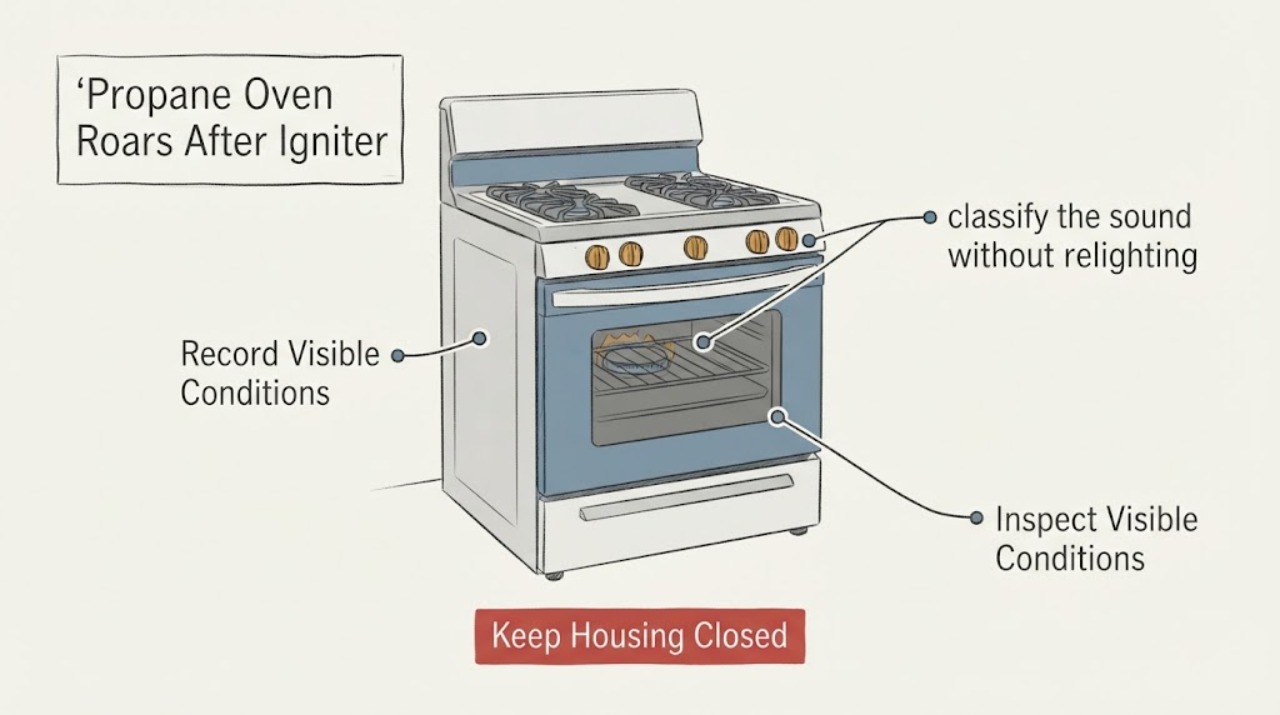
Work through in order
Diagnostic checks
Use only checks that match the exact appliance or system and its official guide.
-
Check 1
From a safe distance and only when the range is not running, record the complete rating-plate model, the exact suffix such as /AA, whether the household supply is LP, the date and scope of the igniter replacement, and whether the roar began immediately after that work. Preserve the repair invoice and any replaced part information.
Expected result: The rating plate confirms NX58H9500WS/AA and LP, the suffix or fuel is unclear, or the repair history is incomplete.
Next step: Give the rating-plate photograph and repair record to Samsung support and the installer or servicer who replaced the igniter. Keep the range off until the model, fuel, and work scope are confirmed.
Stop if: Do not pull out the range, remove the lower drawer or burner cover, or infer LP compatibility from the model family alone.
Why this matters
Why: Samsung provides model-specific manuals and installation material, and gas conversion depends on the actual fuel configuration. A generic Samsung igniter or an unverified LP claim cannot establish that the installed component or conversion is correct.
-
Check 2
From outside the room, classify the sound without relighting the oven: brief ignition click, steady soft gas hum, low puff, forceful roar, delayed whoosh, popping, or a sound that continues after the burner should be off. Note whether it was limited to Bake or also occurred in Broil or a surface burner, if that history is already known.
Expected result: The sound was only a brief click or mild hum, or it was a new roar, delayed ignition, popping, scraping, or a sound linked to an abnormal flame.
Next step: Treat a new roar, delayed ignition, popping, or any sound with abnormal flame or heating as a stop-use condition and arrange qualified gas-appliance service. Do not run another cycle for comparison.
Stop if: Do not put your face near the burner, touch the igniter or burner, adjust the gas valve, or attempt to reproduce the sound.
Why this matters
Why: Samsung lists ignition clicking, gas-system humming or whistling, and some model-specific puffing as possible operating sounds. The source does not establish that a new roar or delayed whoosh after repair is normal, especially when flame behavior or heating changed at the same time.
-
Check 3
Without approaching an active flame, note any gas odor, hissing, visible flame outside the intended burner area, flame lifting or blowing off, mostly yellow flame, soot, smoke, delayed ignition, or heat escaping where it should not. Do not use a flame or electrical device to look for a leak.
Expected result: Gas odor or hissing is present, the flame is yellow or unstable, soot or smoke appears, ignition is delayed, or none of these signs is known.
Next step: For gas odor or hissing, do not use switches, flames, appliances, or a phone inside; leave the building and contact the gas supplier or fire/emergency service from a safe location. For an abnormal flame, soot, smoke, or delayed ignition without odor, keep the range off and arrange qualified service.
Stop if: Do not light another burner to compare flames, apply leak solution yourself around a recently repaired connection, or continue cooking while combustion is abnormal.
Why this matters
Why: Gas odor, unstable combustion, soot, smoke, or delayed ignition can indicate a gas-supply, conversion, burner, or installation hazard. A lack of an observed warning sign does not certify the repaired assembly because the oven is not being re-tested here.
-
Check 4
Have the qualified installer or appliance technician compare the nameplate fuel with the installed gas setup and the exact NX58H9500WS/AA installation instructions. Ask them to verify that the LP conversion, regulator setting, burner orifices, gas pressure, burner alignment, igniter position, and flame quality were completed for this model; do not make those adjustments yourself.
Expected result: The installer confirms a model-matched LP conversion and normal flame, finds an incorrect or incomplete conversion or pressure condition, or cannot document what was changed during the igniter repair.
Next step: Keep the range unused until the installer or Samsung-authorized technician documents safe ignition and flame quality under the correct fuel. If the previous repair cannot be verified, ask for a full model-matched combustion and installation inspection.
Stop if: Do not adjust the regulator, air shutter, valve, or orifice, and do not accept a universal igniter or burner setting based only on the model prefix.
Why this matters
Why: Samsung states that LP conversion requires qualified installation and model-specific instructions. A repair that replaces an igniter without documenting the fuel and combustion setup leaves the cause of the roar unresolved; the correct branch is verification, not another part.
-
Check 5
Provide the service provider with the sound recording if one already exists, the exact mode and timing, whether the sound began after the igniter replacement, the fuel and conversion history, any odor or flame observation, and whether Bake performance changed. Do not create a new recording by running the oven.
Expected result: The roar is repeatable only in Bake, occurs in multiple gas modes, is paired with poor heating or smoke, or cannot be safely reproduced.
Next step: Request a written, model-matched diagnosis before authorizing an igniter, burner, valve, regulator, or control part. Escalate gas-supply concerns to the qualified gas supplier or installer and appliance concerns to Samsung service.
Stop if: Do not keep testing in Bake, use self-clean, or order a replacement valve, orifice, or igniter from an appearance match.
Why this matters
Why: Mode and timing help separate an oven-burner ignition or gas-pressure issue from a surface-burner or cooling sound, but a recording cannot identify a safe part or prove a component failure. Samsung directs unresolved temperature and gas-range problems to support or service.
Use your observations
Decision map
Find the observation that best matches what you see, then follow the next safe action.
-
PATH 01Next step
What you see
There is gas odor, hissing, a flame outside the intended burner area, smoke, or a forceful delayed ignition.
Do this next
Do not operate switches, use a flame, or use a phone inside. Leave the building and contact the gas supplier or emergency fire service from a safe location; keep the range off until cleared by qualified personnel.
Why this path and its safety boundary
Why it matters: This is an immediate gas or combustion safety stop, not a normal operating-sound adjustment.
-
PATH 02Next step
What you see
The oven has a new roar, yellow or lifting flame, soot, popping, delayed ignition, or abnormal Bake heating after the igniter was replaced, even if no gas odor is detected.
Do this next
Keep the oven off and request a qualified Samsung or LP gas installer inspection of the exact NX58H9500WS/AA installation and repair. Do not adjust the regulator, valve, air shutter, or orifices and do not replace another part by symptom alone.
Why this path and its safety boundary
Why it matters: The repair history and combustion behavior point to an unresolved burner, fuel-conversion, pressure, alignment, or ignition-system issue; the sound is not established as normal by Samsung's general noise guidance.
-
PATH 03Next step
What you see
The sound was only the brief ignition click or a soft gas-system hum, there was no flame or heating abnormality, and the sound has not become louder or mechanical.
Do this next
Do not disturb the repair. Monitor only under the exact model instructions, and stop using the range if the sound changes, heating becomes abnormal, or any odor, soot, smoke, or flame problem appears.
Why this path and its safety boundary
Why it matters: Samsung documents ignition clicking and some gas-system humming or whistling as possible normal operating sounds, but that does not validate a new roar or a recently repaired combustion assembly.
-
PATH 04Next step
What you see
The exact fuel setup, LP conversion, model suffix, or igniter work cannot be documented, or the technician cannot confirm safe flame quality for NX58H9500WS/AA.
Do this next
Leave the range unused and have the qualified installer or Samsung service verify the model-matched conversion, regulator, orifices, pressure, burner, and igniter installation. Do not resume cooking based on the absence of an immediate odor.
Why this path and its safety boundary
Why it matters: Compatibility and combustion setup remain unverified. Samsung's LP guidance assigns conversion to a qualified installer or gas supplier, and the model support page points to exact manuals rather than a universal procedure.
Helpful context
Understand the symptom
A roar that begins after an igniter replacement is a combustion and repair-history problem, not just a noisy-fan complaint. Samsung describes a high-pitched hum or whistle while gas is on as a possible normal gas-system sound, but that general explanation does not validate a new forceful roar, flame lift, delayed ignition, soot, or a smell. The replacement may have changed the ignition timing without establishing that the burner, LP conversion, regulator, pressure, and flame adjustment are correct. The safe decision is to stop and have the completed repair checked as one gas system.
The NX58H9500WS/AA is a specific slide-in gas range, while Samsung's support page also lists a model-specific installation guide and user manual. Use those documents for identity and instructions, but do not copy a conversion or burner-adjustment procedure into an owner troubleshooting step. Samsung states that LP conversion is work for a qualified installer or gas supplier, and the range should not be operated in the wrong gas configuration.
When checks do not resolve it
Need a professional?
Use a qualified LP gas installer or gas supplier for conversion, pressure, regulator, or combustion questions and Samsung or qualified appliance service for the igniter, burner, controls, or model-specific repair. Use emergency gas or fire help for odor, hissing, uncontrolled flame, smoke, or immediate danger.
Safety scope: Do not relight the oven to reproduce the roar, adjust a gas valve, regulator, air shutter, or orifice, disconnect gas, perform a flame leak test, open the burner or control area, move the range, or continue cooking with an abnormal flame or combustion sound. Do not use a flame to check for leaks.
Have this ready
- Provide the complete NX58H9500WS/AA rating-plate information, market, LP or natural-gas status, conversion history, igniter part and installation date if known, sound recording, mode and timing, flame or odor observations, heating result, and any visible soot or smoke.
Common questions
FAQ
Is a roaring sound normal on a Samsung propane oven after an igniter replacement?
Do not assume it is normal. Samsung documents some clicking, humming, whistling, and model-specific puffing sounds, but a new forceful roar, delayed ignition, unstable flame, soot, or heating change needs the repaired gas system checked by a qualified installer or appliance technician.
Can I adjust the Samsung NX58H9500WS/AA burner flame or regulator for LP myself?
No. Samsung says LP conversion must be performed by a qualified installer or gas supplier using the manufacturer's instructions and applicable codes. Keep the range off and have the exact model's regulator, orifices, pressure, burner, and flame checked.
What if there is no gas smell but the oven still roars?
Keep it off. Gas odor is not the only warning sign; a new roar, yellow or lifting flame, popping, soot, smoke, or abnormal heating can still indicate an unresolved combustion or installation issue. Give the technician the model, fuel, repair history, and sound recording without running another test.
Read the exact guide
Official sources
- Samsung oven temperature issuesSamsung · General Samsung gas-range temperature guidance; it does not authorize the user to adjust LP pressure or diagnose the repaired igniter assembly.
- Which Samsung Gas Ranges Can Be Converted To Liquid Propane?Samsung · Official Samsung LP guidance; the exact NX58H9500WS/AA conversion instructions, parts, pressure, and local codes must be handled by a qualified installer or gas supplier using the model documentation.
- NX58H9500WS Gas Range, 5.8 cu.ft | Samsung Support CASamsung · Official Samsung support page for the NX58H9500WS family in the Canadian market; it lists model-specific manuals and support, while the task's /AA suffix is a US variant that still requires its own rating-plate and manual confirmation.
- Install your Samsung gas or electric rangeSamsung · Samsung's general range-installation guidance; the exact NX58H9500WS/AA installation manual controls model-specific procedures and the page does not authorize owner gas-line or burner adjustment.
- Samsung cooktop and range: common sounds and operational noisesSamsung · General Samsung range sound guidance, not proof that a repaired NX58H9500WS/AA combustion sound is normal; used to distinguish documented clicking, humming, whistling, and some puffing from a new forceful roar.
- There is smoke or an odor coming from Samsung ovenSamsung · General Samsung oven odor guidance; a clean oven with smoke or unusual odor during normal use should be serviced rather than repeatedly operated.
- Samsung Home Appliance Spring for Something New qualifying productsSamsung Electronics America · Official Samsung product-list PDF used only to confirm that NX58H9500WS/AA is categorized as a Range; it is not a repair or gas-conversion manual.
Community feedback
Share a repair observation
Share a plain-text repair observation. Accepted observations are published automatically; this page may take a moment to update.