
On this page
Start here
Quick answer
The RF23J9011SR/AA support record is confirmed, but a noise heard near the compressor is not automatically a failed compressor: Samsung says a compressor can sound like a quiet engine, change speed and make brief operating sounds, while fans, the water line and contact with a wall can also create noise. Without opening the rear or taking live measurements, listen for whether the sound is a normal changing hum or a new loud vibration, check only safe external clearance and leveling, and arrange Samsung service if the noise is very loud, persistent, or accompanied by cooling trouble.
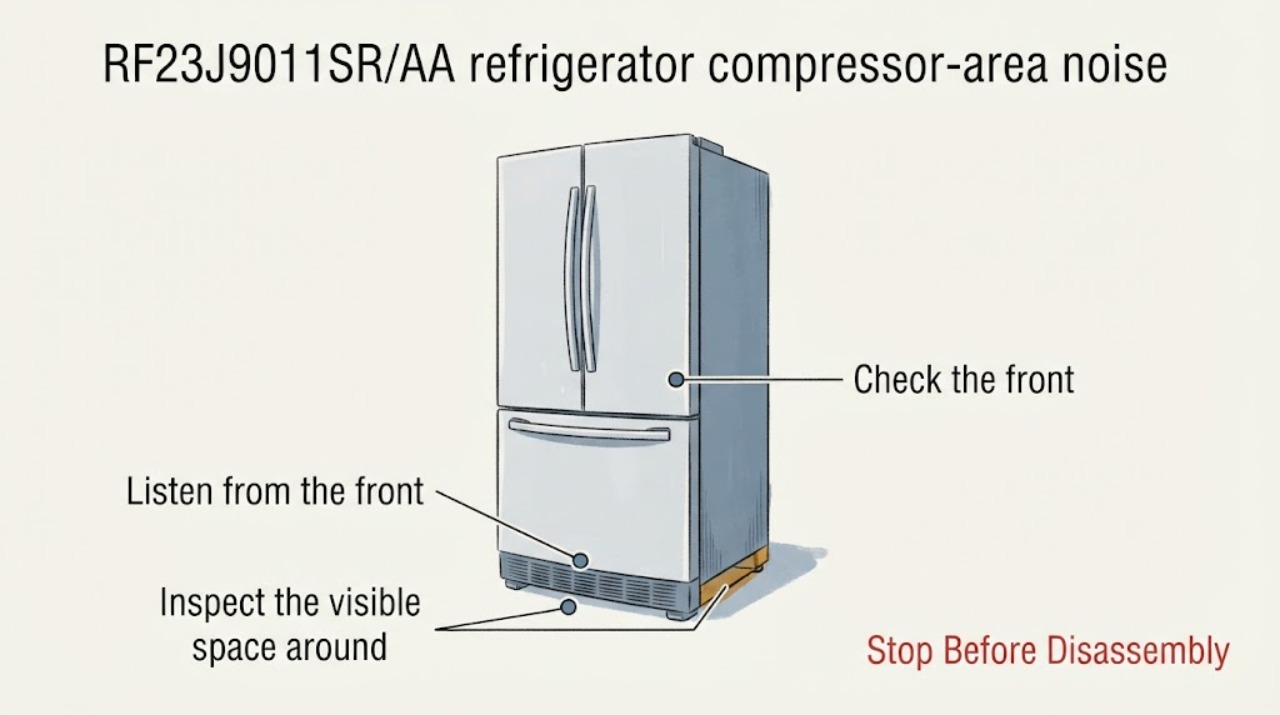
Work through in order
Diagnostic checks
Use only checks that match the exact appliance or system and its official guide.
-
Check 1
Listen from the front and the sides while the refrigerator remains closed and assembled. Note whether the sound is a quiet engine-like hum that starts, runs at different speeds, and stops, or whether it is a new loud vibration that remains disruptive. Do not remove the rear cover or place a hand near the compressor or fan.
Expected result: The hum changes with the cooling cycle and the refrigerator is cooling normally, or the noise is continuously loud, metallic, or strong enough to interrupt conversation.
Next step: If the sound is only a normal changing hum and cooling is stable, continue with the external placement checks. If it is persistently loud or disruptive, stop troubleshooting and request Samsung service without opening the appliance.
Why this matters
Why: A changing low-speed or high-speed compressor sound can be normal operation. A loud persistent sound is not cleared by the word compressor and may come from the compressor, fan, water components or cabinet contact.
-
Check 2
Inspect the visible space around the refrigerator for a wall, cabinet, loose trim or water line touching the cabinet. If the appliance can be moved safely without pulling a water connection or power cord, gently move it forward about an inch and listen again; do not force a heavy or built-in installation.
Expected result: The vibration decreases or stops when contact or tension is removed, or it continues with clear space around the cabinet.
Next step: Leave safe clearance and keep the water line and cord free of strain. If the sound continues, use the model manual or arrange service rather than removing panels.
Why this matters
Why: A change after repositioning points to external contact or installation clearance rather than proving a compressor defect. No change leaves the source unresolved; it does not prove an internal compressor failure.
-
Check 3
Check the front of the installation without disassembling it: confirm the leveling legs are supporting the refrigerator and that the front wheels are not visibly carrying the load. Do not reach behind the appliance or adjust a leveling screw unless the exact installation instructions and a safe moving method are available.
Expected result: The cabinet rocks, touches surrounding surfaces, or the leveling legs are not bearing the front, or the installation is stable and the noise remains.
Next step: Correct only obvious external contact according to the exact manual; otherwise keep the refrigerator in place and contact Samsung service for a model-specific inspection.
Why this matters
Why: Poor leveling or cabinet contact can transmit and amplify vibration. A stable, clear installation with persistent noise requires a service assessment and still does not identify which internal part is responsible.
-
Check 4
Check the result together with cooling: note whether the refrigerator and freezer still hold their normal temperatures and whether the noise is accompanied by water-line buzzing, fan scraping, a repeated click, burning odor, leakage or a loss of cooling. Do not perform live voltage tests, open the rear cover, disturb refrigerant tubing or bypass any control.
Expected result: Cooling is normal with only a mild changing hum, or cooling is worsening, the noise is severe, or another electrical/water symptom appears.
Next step: For worsening cooling, burning odor, water damage or severe noise, keep the appliance closed, avoid further testing and request qualified Samsung service. Preserve food safely if temperatures rise.
Why this matters
Why: Normal cooling and a mild variable hum support monitoring after external checks. Worsening cooling or a severe noise with another symptom needs professional diagnosis; it cannot be reduced to a confirmed compressor problem from sound alone.
Use your observations
Decision map
Find the observation that best matches what you see, then follow the next safe action.
-
PATH 01Next step
What you see
The sound is a quiet hum that changes as the refrigerator starts, runs at low or high speed, or stops, and cooling remains normal.
Do this next
Keep the cabinet clear and level, monitor for a change, and use Samsung service if the sound becomes loud or disruptive.
Why this path and its safety boundary
Why it matters: Samsung describes these compressor operating sounds and speed changes as possible normal operation; this does not prove the compressor is fault-free forever.
-
PATH 02Next step
What you see
The noise decreases after the refrigerator is moved slightly away from a wall, cabinet or water line.
Do this next
Leave the safe clearance in place and do not pull far enough to strain the water connection or cord.
Why this path and its safety boundary
Why it matters: External contact or installation tension is a supported explanation for the vibration; the compressor has not been diagnosed.
-
PATH 03Next step
What you see
The sound remains very loud, metallic or disruptive after safe external clearance and leveling checks, or cooling performance changes.
Do this next
Stop external testing, keep the appliance assembled, and arrange Samsung or qualified appliance service with the exact model and a recording of the symptom.
Why this path and its safety boundary
Why it matters: Samsung recommends service for loud compressor or refrigerator noise; the sound alone cannot identify the compressor, fan, water valve, mount or sealed system as the failed part.
-
PATH 04Next step
What you see
There is burning odor, water near electrical parts, repeated tripping, exposed wiring, severe overheating or a need to remove the rear cover.
Do this next
From a dry safe position, disconnect power only if it can be done without contact with water; otherwise leave it alone and call qualified service. Do not open the cabinet or perform live testing.
Why this path and its safety boundary
Why it matters: The risk exceeds safe user-level noise checks, and live or internal diagnosis is not supported by the opened user guidance.
Helpful context
Understand the symptom
Treat compressor-area noise as a location clue, not a confirmed compressor failure
The original report describes a vibration in the compressor area, but sound location alone cannot separate the compressor from the machine-room fan, water valve, water line or a panel touching the cabinet. Samsung's exact-model support page confirms the RF23J9011SR/AA family and links model support, while its noise guidance says compressors can change speed and that loud or disruptive sounds warrant service. The checks below stay outside the cabinet and do not diagnose sealed-system or electrical parts.
Common questions
FAQ
Does a noise from the compressor area prove the compressor is failing?
No. Samsung says compressor sounds can include a quiet engine-like hum, speed changes and brief operating sounds, while fans, water components and cabinet contact can also create noise. A loud or disruptive change needs service rather than a sound-only part diagnosis.
Should I remove the rear panel to identify the compressor noise?
No. Keep the refrigerator assembled. Check only visible clearance, water-line or wall contact, leveling and cooling behavior; arrange qualified service if the noise persists or cooling changes.
Read the exact guide
Official sources
- Troubleshooting a rattling noise in your Samsung refrigeratorSamsung Canada · Opened Samsung guidance supports checking contact and visible leveling from outside the appliance. It is not a compressor diagnosis or permission to open the cabinet.
- What can you do when you hear unusual noises from the back of your Samsung refrigeratorSamsung Canada · Opened Samsung guidance supports only external repositioning, water-line observation and service escalation; it does not authorize opening the rear or electrical testing.
- RF23J9011SR French Door Refrigerator with Triple Cooling, 22.5 cu.ftSamsung Canada · Opened Samsung support page explicitly identifies RF23J9011SR/AA and links its noise, installation and manual resources. It confirms the assigned model identity but does not diagnose a compressor from a sound report.
- Understand the noises coming from your Samsung refrigeratorSamsung Canada · Opened Samsung guidance says refrigerators may make normal compressor and fan sounds, compressor speed can change, and very loud or disruptive sound should be serviced. It is family guidance and does not identify an internal part for this symptom.
Community feedback
Share a repair observation
Share a plain-text repair observation. Accepted observations are published automatically; this page may take a moment to update.