
On this page
Start here
Quick answer
First identify the sound, where it comes from, and whether it happens during cooling, ice making, dispensing, defrosting, or when a door moves. Quiet, brief cracking, bubbling, hissing, compressor humming, and ice-dropping sounds can be normal. A buzz with no connected water line can come from an enabled ice maker; a grinding noise only while dispensing ice can come from the ice dispenser. If the noise is loud, persistent, a fan-like scrape stops when a door opens, or a rattle continues with cooling or food-temperature changes, check only accessible installation and ice-maker conditions and arrange Samsung service when the sound remains.
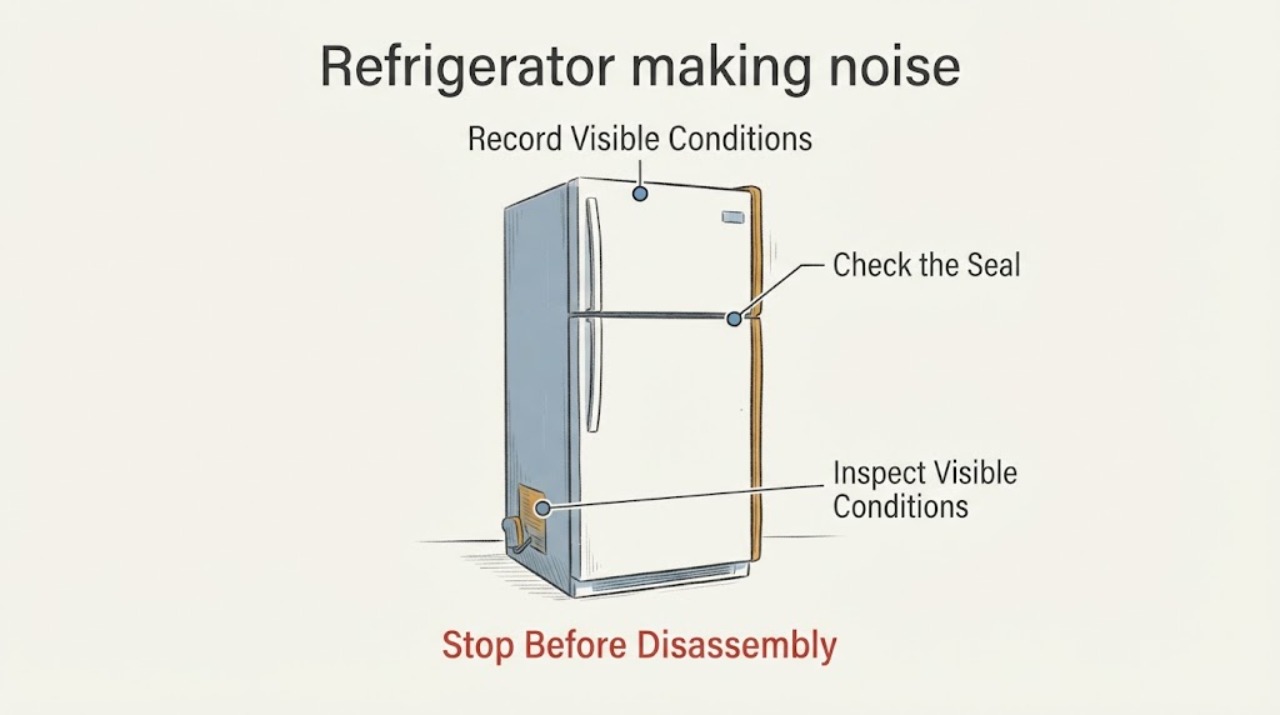
Work through in order
Diagnostic checks
Use only checks that match the exact appliance or system and its official guide.
-
Check 1
Stand beside the refrigerator and record the sound's character, location, duration, and trigger. Note whether it is a snap or crackle, hum or buzz, hiss or gurgle, squeak, rattle, bang, or grind; note whether it starts during cooling, defrost, ice making, dispensing, or door movement.
Expected result: The sound is quiet and brief with a predictable trigger, or it is loud, continuous, repetitive, getting worse, or unrelated to any visible refrigerator activity.
Next step: For a quiet, predictable sound, continue to the matching check below. For a loud, continuous, or unexplained sound, check the refrigerator's cooling and food condition and arrange service if it persists.
Why this matters
Why: Brief sounds that match compressor cycling, refrigerant movement, defrost, ice dropping, or dispensing can be normal. A loud or persistent sound, especially one with no clear trigger, is less consistent with an ordinary operating event.
-
Check 2
For a buzz or hum, check whether the refrigerator has a connected water line and whether the ice maker is enabled. Do not disconnect plumbing or open a sealed component; use only the ice-maker control provided for your model.
Expected result: There is no water line but the ice maker is on; there is a connected water line and the sound occurs while the ice maker fills; or the buzz is very loud or continues outside those events.
Next step: If there is no water line, turn off the ice maker using the model's control. If a connected line is present, observe whether the sound is limited to filling. If the sound stays loud or unexplained, request service.
Why this matters
Why: Samsung says an enabled ice maker without a water connection can create a buzz and may damage the refrigerator. With a water line, a quieter fill sound can be expected. A very loud or unrelated buzz needs service assessment.
-
Check 3
If the sound resembles scraping, squeaking, or a fan striking something, listen from outside the compartments and observe whether it stops as soon as a refrigerator or freezer door opens. Do not remove interior panels or use a heat source to reach hidden ice.
Expected result: The noise stops when a door opens, returns when the door closes, or continues unchanged with the doors open.
Next step: For a fan-like noise that stops with the door, arrange service because manual defrost may only remove the symptom temporarily. Do not use a hair dryer or other heat source. For a noise unaffected by the door, continue with the external rattle and dispenser checks.
Why this matters
Why: A noise that stops with a door opening is consistent with an internal circulation fan stopping; Samsung specifically associates a fan-hitting-ice pattern with ice buildup around the fan. A noise that does not change may come from the compressor, a rear fan, an installation rattle, or another source.
-
Check 4
With the refrigerator operating normally, look behind and beneath it for an accessible object, cover, or nearby surface vibrating against the cabinet. Check that the refrigerator is stable and that the manufacturer's required clearance is not blocked; do not remove service covers.
Expected result: The sound changes when a nearby object is moved away or when the refrigerator is repositioned slightly, or the rattle remains loud and unchanged at the cabinet or compressor area.
Next step: Move only the accessible object or make the small placement correction described by Samsung, then listen once more. If the rattle remains loud, persistent, or is accompanied by cooling trouble, request service.
Why this matters
Why: An external contact or installation position can amplify a mild compressor or fan vibration. A loud rattle that remains after the accessible contact is removed is more likely to need service.
-
Check 5
For a bang or grind, note whether it occurs when ice drops into the bucket or only while cubed or crushed ice is being dispensed. Inspect the accessible ice bucket and chute for an obvious ice clump or blockage without forcing the auger or reaching into moving parts.
Expected result: The sound is brief when ice drops, occurs only during dispensing, or is loud, repeated, or present when no ice is being dispensed.
Next step: If an accessible ice clump is present, follow the model's ice-bucket guidance and refit the bucket correctly. If the sound is loud, repeats while idle, or the bucket/chute is damaged, stop using the dispenser and request service.
Why this matters
Why: Ice falling can sound like a bang, and Samsung says the dispenser motor can grind while pushing ice, especially with crushed ice. A loud grind or one that occurs when the dispenser is idle is not explained by normal dispensing.
Use your observations
Decision map
Find the observation that best matches what you see, then follow the next safe action.
-
PATH 01Next step
What you see
The sound is a quiet, short snap, crackle, pop, bubble, hiss, compressor hum, or ice drop that occurs during defrosting, cooling, filling, or ice harvesting and does not disrupt conversation.
Do this next
Monitor it while confirming the refrigerator maintains temperature. Request service if the sound becomes very loud, changes character, or is joined by cooling loss or another fault.
Why this path and its safety boundary
Why it matters: That pattern matches Samsung's listed normal operating sounds more closely than a failed component.
-
PATH 02Next step
What you see
A buzz occurs with the ice maker enabled and no water line connected, or the buzz appears during a fill event but becomes very loud.
Do this next
Turn off the ice maker when no water line is connected. If the buzz remains loud or continues outside filling, request Samsung service.
Why this path and its safety boundary
Why it matters: The ice-maker water-fill path is more likely than a compressor problem when the sound follows that trigger; loudness or persistence makes it a service issue.
-
PATH 03Next step
What you see
A scrape, squeak, or fan-like noise stops when a refrigerator or freezer door opens and returns when it closes.
Do this next
Arrange service rather than repeatedly defrosting or heating the compartment. Do not use a hair dryer, remove panels, or continue if cooling is affected.
Why this path and its safety boundary
Why it matters: The timing points toward an internal circulation fan, and Samsung identifies ice buildup around the fan as a service condition.
-
PATH 04Next step
What you see
A rattle, knock, or bang is loud and persistent after nearby accessible objects are moved away, or a grind occurs while the ice dispenser is idle.
Do this next
Stop the affected dispenser if applicable, keep the refrigerator doors closed, and request qualified Samsung service with the sound location and trigger.
Why this path and its safety boundary
Why it matters: The sound is less consistent with a short compressor stop, an ice drop, or normal dispensing and may involve a fan, compressor area, dispenser drive, or another internal part.
-
PATH 05Next step
What you see
A squeak comes from the door hinge after the refrigerator was installed or a door was removed and reattached, and the refrigerator is not stable or the door is misaligned.
Do this next
Check stability and the model's door-installation instructions from outside the appliance. If the squeak continues or the door does not seal correctly, arrange service.
Why this path and its safety boundary
Why it matters: Door installation, leveling, hinge seating, or a wire harness can be involved, rather than the cooling compressor itself.
Helpful context
Understand the symptom
A Samsung refrigerator can make several different sounds as the compressor changes speed, refrigerant moves through the cooling system, plastic parts expand during defrost, water enters the ice maker, or ice falls into the bucket. The sound's timing and location are more useful than the word noisy by itself.
Use the checks below to decide whether the sound matches a normal operating event or points to a fan, ice, door, installation, or dispenser condition. Keep the refrigerator running while listening unless a sound is accompanied by a safety concern, loss of cooling, a burning smell, or another urgent symptom.
Samsung's own noise guide uses a practical threshold: a sound should not be so loud that it interrupts ordinary conversation. When a sound crosses that threshold or does not fit the timing of a known operating event, service is the safer next step than repeated testing.
Only after diagnosis
Potential parts
- evaporator or circulation fan assembly
Consider this only after the sound is confirmed to stop with a door opening or otherwise traced to an internal fan, and only after service confirms the part failure.
Samsung refrigerator fan parts vary by model; confirm the complete model and fitment before ordering. - ice maker or dispenser drive component
Consider this only when the noise is tied to ice making or dispensing and an accessible ice blockage is not the cause.
Confirm the refrigerator model and the exact ice-maker or dispenser configuration before selecting a component.
When checks do not resolve it
Need a professional?
Stop troubleshooting and request service if the refrigerator is no longer cooling, food is warming or spoiling, the noise is very loud or continuous, a fan-like scrape returns, the cabinet or cord is hot or damaged, or the sound is accompanied by a burning smell, smoke, water leak, or electrical trip. Do not remove sealed-system or service covers, use a hair dryer to melt ice, reach into moving dispenser parts, or keep cycling the appliance to reproduce a loud fault.
Have this ready
- Give the servicer the refrigerator model, a short recording if safe, the sound location, whether it changes with a door or ice dispenser, and whether cooling or frost has changed.
Common questions
FAQ
Is a humming Samsung refrigerator normal?
A quiet compressor hum or a quieter water-fill sound can be normal. A very loud hum, a hum with no water line while the ice maker is enabled, or a hum that does not match a cooling or fill event should be checked and may need service.
Why does the noise stop when I open the refrigerator door?
Opening a door can stop an internal circulation fan. If the sound is a scrape or fan-like noise that returns when the door closes, Samsung associates that pattern with ice around the fan and recommends service rather than a temporary heat-based fix.
Why does my Samsung refrigerator grind when dispensing ice?
The dispenser motor can sound like grinding while pushing ice, especially when crushed ice is selected. If grinding is very loud or happens when no ice is being dispensed, stop using the dispenser and arrange service.
Can I use a hair dryer to stop a refrigerator fan noise?
No. Samsung warns that a hair dryer or another heat source can damage the refrigerator. A fan noise that stops when a door opens should be handled through service because a manual defrost may not correct its cause.
What should I check if the refrigerator is rattling?
Look for an accessible object or nearby surface touching the cabinet and confirm the refrigerator is stable with its required clearance. If the rattle remains loud or persistent after that check, request service.
Read the exact guide
Official sources
- Frost forms in the Samsung freezer, refrigerator, or ice bucketSamsung · Samsung's frost guide connects door closure and seal conditions with frost and warns against using a hair dryer to defrost.
- Is it Normal for My Refrigerator to Be Making Noises?Samsung · Samsung's refrigerator support overview identifies engine, bubbling, cracking, buzzing, humming, beeping, blowing, ice-dumping, and hissing as possible normal sounds.
- Understanding the different noises coming from your Samsung refrigeratorSamsung · Samsung's refrigerator noise guide covers compressor, ice maker, dispenser, fan, door hinge, defrost, and rattling sounds.
- Issues with Samsung refrigerator ice dispensersSamsung · Samsung's ice-dispenser guide explains normal dispensing delay, clumped ice, the bucket, chute, and dispenser mechanism.
- samsung refrigerator making noiseReddit r/appliancerepair · Exact Reddit post describing a Samsung refrigerator squeaking noise and a conditional suggestion to compare the sound with door opening and runtime.
Community feedback
Share a repair observation
Share a plain-text repair observation. Accepted observations are published automatically; this page may take a moment to update.