
On this page
Start here
Quick answer
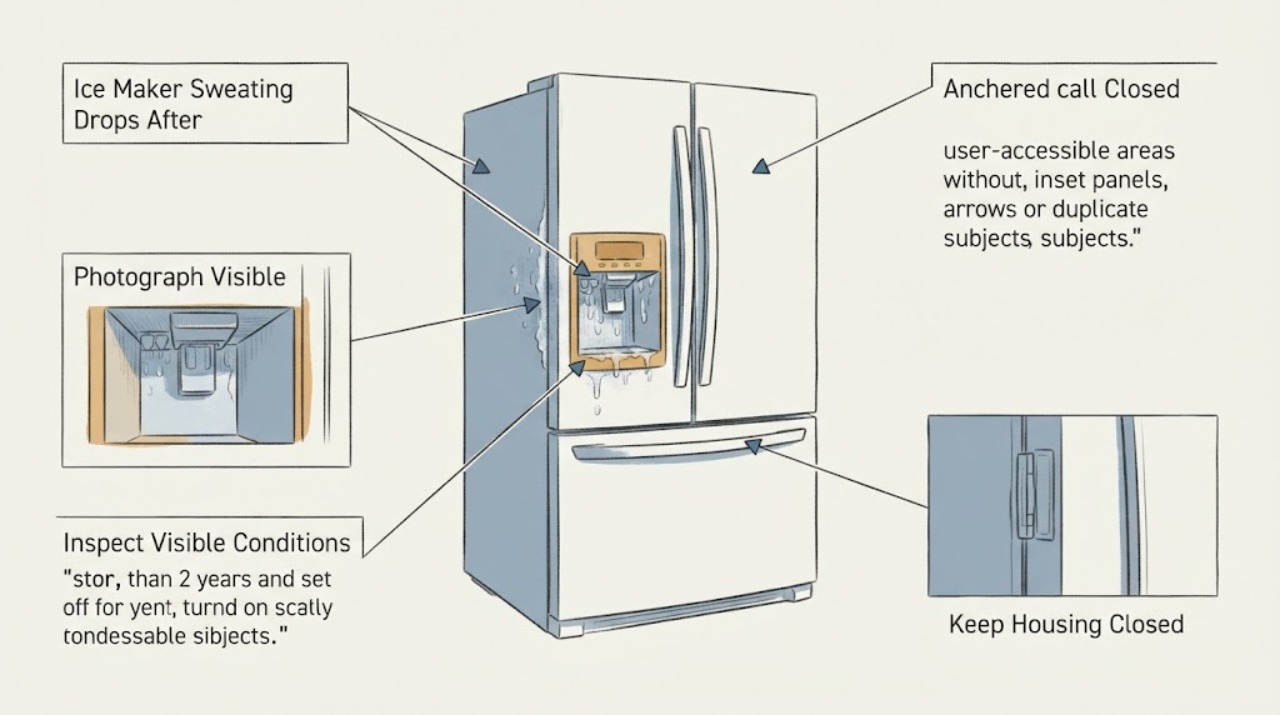
Do not treat every drop on the Samsung RF23M8070 ice-maker area as a water-line leak. First confirm the full model suffix because RF23M8070 is a model family prefix, then dry the accessible outside surface and observe where the next drop forms. Moisture only on a cold exterior surface after humid air or door opening is consistent with condensation; water from a seam, chute, bucket area, or a fitting, or drops that return while the ice maker is idle, need the water supply and ice maker left off and qualified service. Do not remove the ice chamber, use hot air, force a harvest, or run a test cycle just to reproduce it.
Work through in order
Diagnostic checks
Use only checks that match the exact appliance or system and its official guide.
-
Check 1
Read the complete refrigerator model and serial label, including the suffix after RF23M8070, and note the market. Photograph the label and the outside of the ice-maker area without removing the ice bucket, cover, door, or inner panels.
Expected result: The label is a complete RF23M8070 variant that matches the supplied refrigerator, or only the RF23M8070 prefix is available; the ice maker is in the door or another location than expected.
Next step: Use the exact suffix and region when obtaining the owner's manual or service appointment. Until then, limit the inspection to dry, visible surfaces and do not use a procedure from another model.
Stop if: Do not remove the ice chamber, door, cover, or rear panels to identify the variant.
Why this matters
Why: The RF23M8070 family has more than one finish/market variant, and ice-maker layout and controls can differ. A prefix alone cannot establish the correct test button, reset sequence, or replacement fit.
-
Check 2
Dry the accessible outside of the ice-maker housing and nearby door surface with a dry cloth, then leave the refrigerator closed and observe where the next moisture appears without dispensing water or forcing an ice-maker cycle.
Expected result: Moisture beads only on a cold outside surface and changes with humidity or door opening; a drop emerges from a seam, chute, bucket edge, or fitting; or no moisture returns after the surface is dry.
Next step: For exterior-only beads, reduce prolonged door opening and keep the surface dry. For a point source or returning pool, stop using the ice maker and close the refrigerator water supply before arranging service; do not probe the seam.
Stop if: Do not use a hair dryer, heat gun, sharp tool, or pressurized water to dry or clear the area.
Why this matters
Why: A clean exterior bead with a humidity or door-opening relationship supports condensation rather than an active water-line leak. A point source, pooling, or repeated drop from a joint needs leak localization; no recurrence supports a spill or one-time condensation event but does not prove the ice maker is repaired.
-
Check 3
With the doors closed and the appliance idle, visually check the accessible ice-bucket/chute boundary for frost, loose ice, a visibly open gap, or a seal that is not sitting flush; do not remove the bucket or reach into the ice maker.
Expected result: Frost or wet/slushy ice is concentrated at the bucket or chute, the seal has a visible gap, or the boundary is dry and flush.
Next step: If there is frost, slush, or a gap, keep the ice maker off and use the exact full-model manual or authorised service for the seal/bucket correction. Do not scrape, heat, or force the bucket or flap.
Stop if: Do not dismantle the ice maker, hand-turn its mechanism, or use hot air to defrost it.
Why this matters
Why: Samsung explains that a bucket or chute seal gap can let warm air enter the ice-maker compartment, producing frost and melting ice. A dry, flush boundary makes that specific warm-air path less apparent, but it does not rule out a concealed water leak or a model-specific fault.
-
Check 4
Record the timing without creating a test: whether drops appear only after the ice maker was switched on, after dispensing, after a door has been open, during humid weather, or while the refrigerator has been idle; also note whether any ice is wet, clumped, or visibly contaminated and whether the refrigerator is otherwise cooling normally.
Expected result: Drops track door opening or humid conditions and stay on the outside; water or slush returns at the ice bucket/chute; moisture appears after a fill/dispense event; or drops continue while idle.
Next step: Keep the water and ice functions off for a point-source or idle leak, discard any ice that may have contacted unknown water, and give the complete model suffix, timeline, photos, and cooling status to Samsung service. Do not repeat cycles to obtain a clearer pattern.
Stop if: Do not consume questionable ice, bypass the ice-maker switch, or open the water circuit to test pressure or flow.
Why this matters
Why: Humidity and warm-air entry are more consistent with condensation or seal-related melting. A fill/dispense relationship or idle recurrence keeps an active water path in consideration; timing alone cannot identify an inlet valve, tubing, sensor, or ice-maker assembly.
Use your observations
Decision map
Find the observation that best matches what you see, then follow the next safe action.
-
PATH 01Next step
What you see
After drying, the next beads form only on the outside of the cold ice-maker/door surface, with no pooling, no point source, and a clear relationship to humidity or prolonged door opening.
Do this next
Keep doors closed as much as practical, keep the surface dry, and monitor without running a forced ice-maker test. Arrange service if moisture becomes excessive, reaches the floor, or persists without an environmental trigger.
Why this path and its safety boundary
Why it matters: The pattern is more consistent with environmental condensation than with a failed water component. The two-year off period is a timing clue, not proof of a part failure.
-
PATH 02Next step
What you see
Frost, wet/slushy ice, or a visible gap is concentrated where the ice bucket meets the chute or enclosure.
Do this next
Leave the ice maker off, do not scrape or heat the compartment, and use the exact full-model instructions or authorised service for the bucket, seal, or door alignment.
Why this path and its safety boundary
Why it matters: Warm air entering through a seal or alignment gap can create condensation and melt ice in the ice-maker area. This is a different branch from a rear supply-line leak.
-
PATH 03Next step
What you see
A drop returns from a seam, fitting, chute, bucket area, or under the refrigerator, or it appears after a fill/dispense event and continues while idle.
Do this next
Turn off the refrigerator water supply, keep the ice maker and dispenser off, protect the floor, and request qualified Samsung service. Do not remove panels, disconnect tubing, or reproduce the leak.
Why this path and its safety boundary
Why it matters: A recurring point source is not explained by ordinary surface condensation alone. The source could be a water path, seal, or concealed assembly, but the observation does not identify a replaceable part.
-
PATH 04Next step
What you see
The full model suffix cannot be confirmed, the ice-maker location differs from the supplied description, or the moisture is near wiring, controls, or a wet electrical outlet.
Do this next
Keep the appliance and water supply off as safely accessible, keep people away from the wet area, and provide the rating-plate photo and region to Samsung service. Do not guess a reset or part from the RF23M8070 prefix.
Why this path and its safety boundary
Why it matters: The model-specific procedure or source cannot be safely bound, and wet electrical areas raise the risk beyond an external condensation check.
Helpful context
Understand the symptom
Confirm the model before using model-specific controls
Samsung's support catalogue shows RF23M8070 variants such as RF23M8070SG/AA, while the product sheet identifies RF23M8070SR as another finish variant. The supplied identity is only the RF23M8070 family prefix. Record the complete rating-plate suffix and region before following a control-panel, ice-maker, or bucket-removal instruction; do not transfer a procedure from a nearby Samsung model.
Protect the ice and the electrical area
If a drop could have come from a water fitting, an unknown source, or a dirty ice compartment rather than a clean outside surface, do not consume the affected ice. Keep the ice maker and water dispensing functions off, keep the plug and floor dry, and do not open panels or reach into the ice-making compartment.
When checks do not resolve it
Need a professional?
The safe user boundary is model identification, dry-surface observation, and recording timing. Ice-maker disassembly, bucket/chute removal when the variant is unconfirmed, water-line or valve work, forced harvest/reset, hot-air defrosting, and electrical diagnosis belong to qualified Samsung service.
Common questions
FAQ
Can drops on the outside of the ice-maker area be normal condensation?
They can be when beads stay on a cold exterior surface and track humidity or door opening, but a drop from a seam, chute, bucket area, or fitting is a different pattern. Dry the surface and observe the first return without running a test cycle.
Should I reset or test the ice maker after it was off for two years?
Not while the source of the water is uncertain. Confirm the complete RF23M8070 suffix first; keep the ice maker off for a recurring point-source leak, frost gap, contaminated ice, or moisture near electrics, and use authorised service rather than forcing a cycle.
Read the exact guide
Official sources
- RF23M8070SR_V3.inddSamsung Electronics America · Samsung RF23M8070SR product sheet; RF23M8070 four-door French-door refrigerator and ice-maker/pitcher configuration
- 36" Counter Depth 4-Door French Door Refrigerator with Autofill Water Pitcher and Flex Zone™ | Samsung Support CASamsung Canada · Samsung RF23M8070SG/AA support page; exact RF23M8070 family variant, manuals and regional model identity
- Water leaks in a Samsung refrigeratorSamsung US · Samsung refrigerator water-leak troubleshooting; condensation versus leak, ice-maker/dispenser seals, water paths, and service boundary
- Frost forms in the Samsung freezer, refrigerator, or ice bucketSamsung US · Samsung refrigerator ice-bucket and ice-chute frost; seal gap, warm-air entry, wet/slushy ice, and no-hot-air boundary
- How to address condensation or sweating in your Samsung refrigeratorSamsung India · Samsung refrigerator general condensation guidance; environmental humidity, door opening, exterior surface moisture, and escalation
Community feedback
Share a repair observation
Share a plain-text repair observation. Accepted observations are published automatically; this page may take a moment to update.