
On this page
Start here
Quick answer
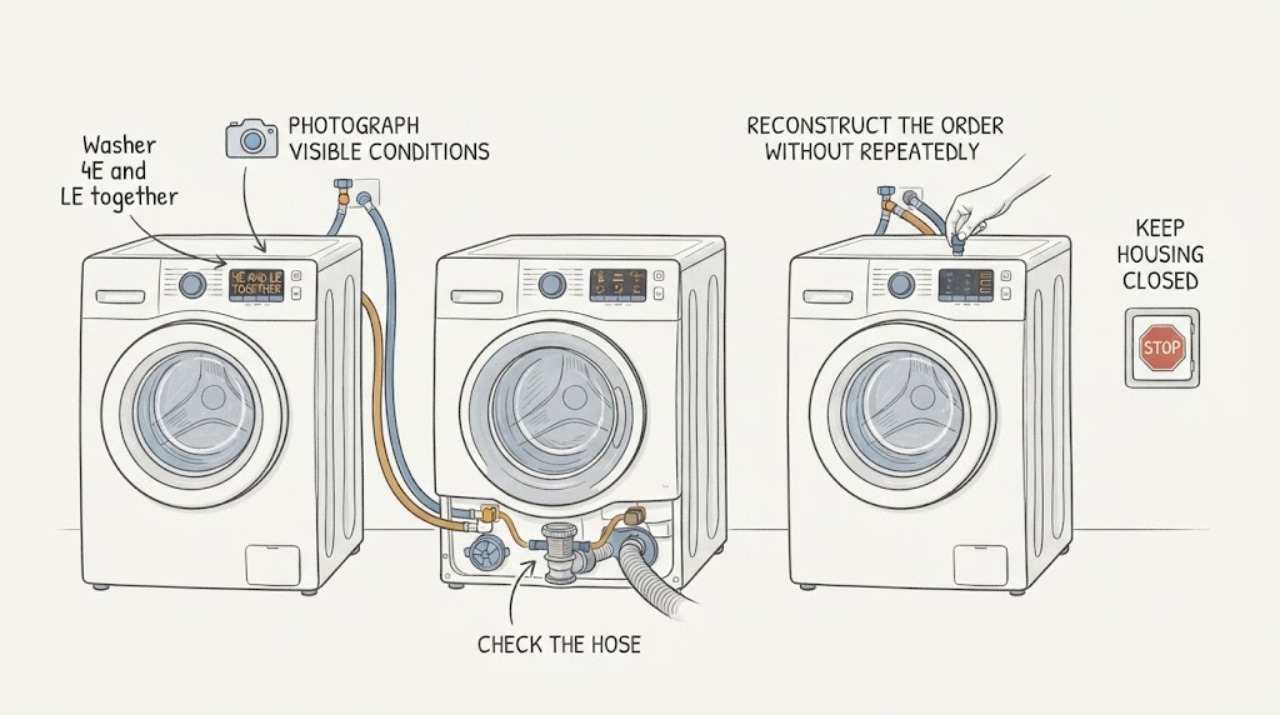
Do not assume a drain check valve caused both Samsung codes. On Samsung's US guide, 4E is a not-filling error—water is not entering correctly—while LE is grouped with 1E/1C/LC as a water-level or leakage error. With no model number, the code family and the order in which the displays appeared are more reliable than a part guess. Photograph the display, record whether the washer was filling, washing, draining, or overflowing, and find the full model before following a model-specific procedure. From a dry, safe location, look for a leak and visible kinks in the supply and drain hoses; do not remove the drain-hose retaining screw, open a pressurized connection, or bypass a sensor. If the machine is a front loader and the exact manual authorizes the pump-filter procedure, cool and drain it before cleaning that accessible filter; top loaders may not have a removable pump filter. If either code returns after the permitted external checks and one appropriate power cycle, stop testing parts and request Samsung service.
Work through in order
Diagnostic checks
Use only checks that match the exact appliance or system and its official guide.
-
Check 1
Photograph every display exactly as shown, including whether 4E and LE alternate, and record the washer's full model number, front-load or top-load style, and the cycle stage where each code appeared.
Expected result: The display clearly shows 4E, LE, both in sequence, a different code, or only an uncertain light pattern; the model is complete, partial, or missing.
Next step: Use the exact model's Samsung manual/support page. If the model or code remains uncertain, continue only with the safety and external observations below and request model-specific service if the fault persists.
Stop if: Do not use a different Samsung model's test sequence or part diagnosis.
Why this matters
Why: Samsung groups 4E with not-filling codes and LE with water-level/leakage codes, but code meanings and light combinations vary by model. A partial display cannot select a valve, sensor, pump, or check valve.
-
Check 2
Reconstruct the order without repeatedly running the washer: note whether 4E appeared while the tub should fill, whether LE appeared with water already present, and whether there was standing water, overflow, or a visible leak.
Expected result: 4E appears during fill; LE appears with moisture or water in/under the washer; both appear at different stages; or neither stage is known.
Next step: Follow the matching fill or leak branch rather than combining the codes into one part replacement. If the stage is unknown, obtain a model-specific interpretation before testing components.
Stop if: Do not run additional cycles with active leakage, overflow, or water near electrical equipment.
Why this matters
Why: A fill-stage 4E points toward the supply/fill path; an LE with moisture points toward a leak, water-level sensing, hose routing, or suds condition. The sequence does not prove that a drain check valve caused either code.
-
Check 3
With the washer off and viewed from a dry, safe location, look for moisture around the floor, door/lid area, supply hoses, drain hose, and detergent area. Check visible hoses for kinks or damage without moving the appliance or loosening fittings.
Expected result: There is a leak or moisture; hoses are kinked/damaged; the drain-hose holder or retaining screw is missing; or the visible area is dry and intact.
Next step: For a plainly visible, safe routing issue, follow the exact manual. For any leak, damaged hose, missing holder/screw, or recurring LE with a dry exterior, stop and request service. Never remove the rear retaining screw as a test.
Stop if: Do not pull out the washer, disconnect hoses, or reach behind wet equipment.
Why this matters
Why: Samsung says LE can reflect moisture where it does not belong or a sensor issue, and directs a leak and hose check. A missing drain-hose holder can change the hose position and requires service; a dry exterior does not rule out an internal leak or sensor issue.
-
Check 4
For a 4E that appears during filling, confirm from a dry location that the hot and cold supply valves are open, the hoses go to the correct inlets, and the visible supply hoses are not bent or damaged. Do not open a pressurized connection.
Expected result: A valve is closed, hoses are crossed/kinked/damaged, the water supply is weak, or the visible supply path is open and intact.
Next step: Correct only a plainly closed valve or visible routing issue allowed by the manual, then try the affected cycle once. If 4E returns with water available, stop and request model-specific service rather than replacing an inlet part.
Stop if: Do not disconnect the supply hose, remove inlet screens, or test the inlet valve unless the exact model manual authorizes a safe, depressurized procedure.
Why this matters
Why: Samsung identifies 4E/4C/nF as water not entering correctly and points to supply connections, open valves, hose condition, and inlet debris. These checks do not identify a drain check valve, inlet valve, or sensor as the failed part.
-
Check 5
If there is standing water or a drain-stage symptom, check only the visible drain-hose route for kinks, crushing, an airtight or incorrect insertion, or an obvious external obstruction. For a front loader, use the pump-filter procedure only when the exact manual permits it and the water is cool; top loaders may not have a removable filter.
Expected result: The hose is visibly restricted or incorrectly routed; the hose is clear; the washer is a front loader with an authorized accessible filter; or the washer is a top loader/no filter is present.
Next step: Make only a safe external routing correction or clean an authorized, cool accessible filter. If water remains, the filter is inaccessible, or a code returns, leave the washer off and arrange service.
Stop if: Do not remove the drain-hose retaining screw, disconnect plumbing, open the cabinet, or reach into a pump with power connected.
Why this matters
Why: Samsung says drain problems can involve hose installation and, on front loaders, a clogged pump filter. A drain-path finding may explain a no-drain or leak symptom, but it is not evidence that a check valve caused the 4E+LE combination.
-
Check 6
After only an allowed external correction and when the washer is dry and safe, use one model-authorized test or power cycle. Record whether 4E, LE, both, or no code returns and at what stage; do not clear the history repeatedly.
Expected result: The code clears once; 4E returns during fill; LE returns with moisture or suds; a drain symptom remains; or a different code appears.
Next step: Stop after the single recheck and request Samsung service with the complete model, code photo, sequence, water observations, hose results, and recheck result. Use a different article only for a clearly different code.
Stop if: Do not repeat cycles or resets with a leak, overflow, hot water, damaged wiring, smoke, burning odor, or a breaker trip.
Why this matters
Why: Samsung says a reset can clear stored codes but does not automatically fix the fault, and repeated resets can erase useful history. A returned code makes a supply, leak/sensor, drain, wiring, or control issue more likely, but still does not select one check valve.
Use your observations
Decision map
Find the observation that best matches what you see, then follow the next safe action.
-
PATH 01Next step
What you see
4E appears during fill, the supply valves or visible hoses are closed/kinked, and there is no leak or electrical hazard.
Do this next
Correct only the plainly visible supply or hose-routing issue allowed by the manual, try once, and request service if 4E returns.
Why this path and its safety boundary
Why it matters: This supports a fill-path problem, not a drain check-valve diagnosis.
-
PATH 02Next step
What you see
LE appears with moisture, a leak, suds, or an absent/damaged drain-hose holder, or LE returns while the visible exterior is dry.
Do this next
Keep the washer off for a leak, missing holder, or recurring LE and request service. Do not remove the rear screw or bypass the sensor.
Why this path and its safety boundary
Why it matters: Samsung's LE family points to water-level/leakage sensing or moisture where it does not belong. The visible drain hose can be relevant, but a check valve is not established as the cause.
-
PATH 03Next step
What you see
Both codes appear at different stages, the model is unknown, or the displayed characters may be 4C/1E/LC/5E or a light pattern rather than exactly 4E and LE.
Do this next
Photograph the display, identify the full model and washer style, and use that model's Samsung documentation; request service if the exact mapping remains uncertain.
Why this path and its safety boundary
Why it matters: The topic is code- and generation-ambiguous. Combining the displays into one failed valve or check valve would risk the wrong repair.
-
PATH 04Next step
What you see
The washer has standing water or a drain symptom, but the visible hose path is correct and an authorized front-load pump-filter check does not restore draining.
Do this next
Leave the washer off, avoid disassembly, and arrange model-specific Samsung service with the water level and code sequence.
Why this path and its safety boundary
Why it matters: A hidden drain pump, hose, wiring, or control issue remains possible. That result does not retroactively explain a fill or leakage code as a check-valve failure.
-
PATH 05Next step
What you see
Water is near electricity, the tub is hot, there is an active leak or overflow, a hose is damaged, the breaker trips, or testing would require opening the cabinet or applying power to a valve, sensor, pump, or check valve.
Do this next
Keep the washer off, close water valves and isolate power only from a dry safe location when appropriate, keep clear, and obtain qualified Samsung appliance or electrical service.
Why this path and its safety boundary
Why it matters: The situation has electrical, scald, water-damage, or moving-part risk beyond safe owner checks.
Helpful context
Understand the symptom
This topic has no model number, and Samsung states that its washers use many makes and models with code and diagnostic differences. The same letters can therefore map to different model generations or display conventions. Before diagnosing a valve, sensor, pump, or check valve, record the rating-label model and whether the washer is front-load or top-load; do not use a part test from another Samsung platform.
Samsung's opened error guide gives two distinct meanings: 4E is listed with 4C/nF as not filling, while LE is listed with 1E/1C/LC as water-level or leakage. A drain hose or drain component can be relevant to a leak or drain symptom, but the code list does not establish a drain check valve as the cause of both codes. Treat the combination as a sequence to reconstruct, not as a component diagnosis.
Stop before any work if water is near electrical equipment, the tub is hot, the washer is leaking heavily, a hose is damaged, or the breaker trips. Samsung specifically warns not to remove the rear screw that holds the drain hose; a missing holder requires service. Do not disconnect a pressurized hose, open the cabinet, test a valve or sensor live, or bypass an error or leak sensor.
When checks do not resolve it
Need a professional?
Have this ready
- Full washer model and front/top-load style, exact display photo, whether 4E and LE alternated, cycle stage for each, water level and leak observations, supply and drain-hose routing, holder/screw status, filter accessibility and result if authorized, and the single recheck outcome.
Common questions
FAQ
Can a drain check valve cause Samsung 4E and LE together?
The official Samsung entries do not support that single-part conclusion. 4E is listed as not filling, while LE is a water-level or leakage family code; a drain path may be relevant to a leak or no-drain symptom, but the code pair alone cannot identify a check valve.
What should I check first for 4E?
Record the model and code, then from a dry location check that the hot and cold water valves are open, hoses are correctly connected and not kinked, and there is no leak. Do not disconnect pressurized hoses or replace an inlet valve based on 4E alone.
What does LE mean on a Samsung washer?
Samsung groups LE with 1E/1C/LC as a water-level or leakage error. Look for moisture and visible hose problems, but understand that a dry exterior does not prove the sensor or internal water path is healthy.
Should I remove the drain hose screw or test the check valve?
No. Samsung specifically warns not to remove the screw that holds the drain hose to the washer; if the holder is missing, service is required. Do not open plumbing or test a check valve with the washer energized.
Can I reset the washer after 4E or LE?
Only after the applicable external checks and only once. Samsung says a reset can clear stored codes but does not fix the underlying issue; if the code returns, repeated resets can erase useful history, so request service with the recorded sequence.
Read the exact guide
Official sources
- What does error 4E mean on my Samsung washing machine?Samsung Caribbean · The opened Samsung regional page describes 4E/4C as a water-supply problem and discusses low flow, hose condition, full tap opening, and supply mesh filters. It is used for the fill-path distinction, not as a model-specific part instruction.
- Samsung washing machine information and error codesSamsung US · The opened Samsung US guide groups 4E with not-filling codes and LE with water-level/leakage codes; it also warns about the drain-hose retaining screw and directs persistent faults to service.
- How to reset your Samsung washing machineSamsung US · The opened Samsung reset page says a power cycle may clear a temporary state but does not automatically fix an error; it warns that repeated resets can clear error history and make diagnosis harder.
- Samsung washing machine will not drainSamsung US · The opened Samsung US no-drain guide distinguishes front-load pump-filter access from top-load machines, warns about hot water, gives visible hose-routing checks, and repeats the warning not to remove the rear drain-hose screw.
- Washers | Samsung Support USSamsung US · The opened Samsung washer support page directs users to search by model code or product name and provides manual, warranty, and repair-support routes.
Community feedback
Share a repair observation
Share a plain-text repair observation. Accepted observations are published automatically; this page may take a moment to update.