
On this page
Start here
Quick answer
Classify the Samsung washer noise by sound, cycle stage, and whether it changes with the load. Some clicks, a brief click followed by a short thump, quiet drain humming, a pop as filling starts, and steady water sounds can be normal. Thumping or knocking during spin commonly calls for a load-balance, leveling, and front-load shipping-bolt check; rattling or clicking throughout a cycle calls for a level check, nearby hose or cord check, and loose-object inspection. Stop immediately for grinding or metal contact, violent movement, smoke, burning odor, a hot cord, or a leak. After the drum is fully stopped, remove visible objects, correct only model-approved load or installation issues, and use the exact Samsung manual for any pump-filter or calibration procedure. If the noise persists with a safe empty or light test, arrange qualified service rather than assuming a bearing, shock absorber, or pump has failed.
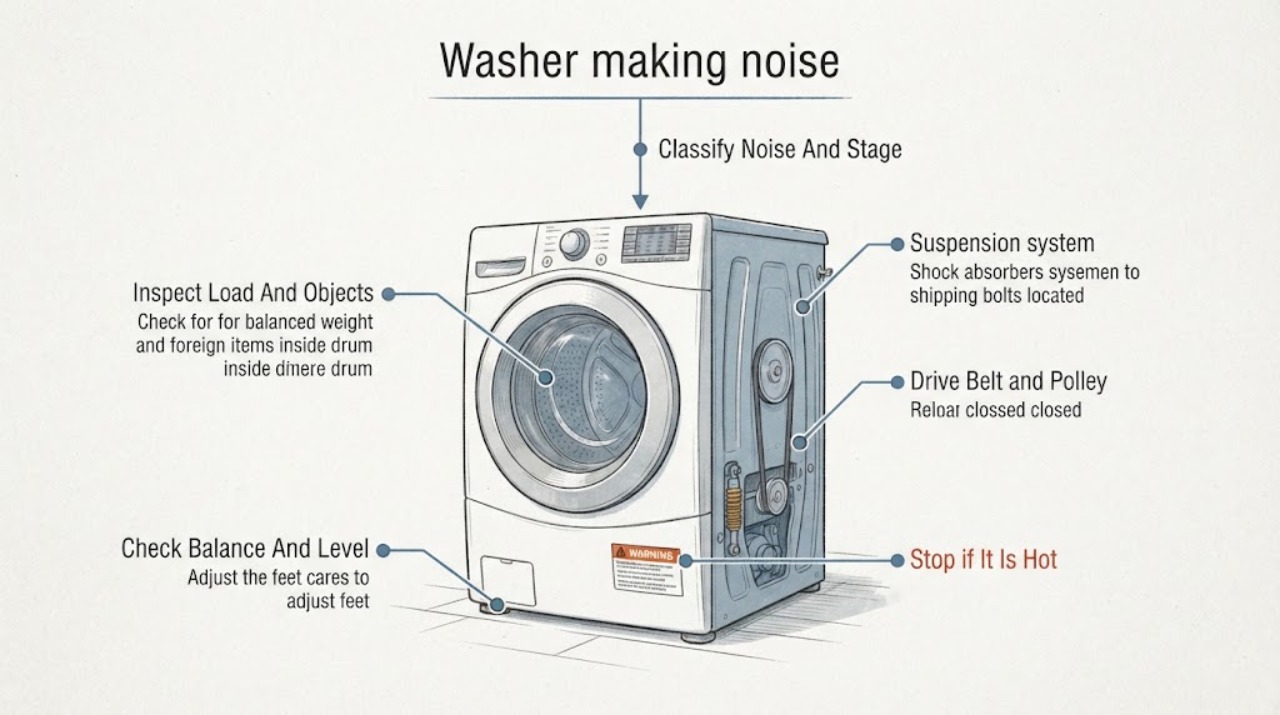
Work through in order
Diagnostic checks
Use only checks that match the exact appliance or system and its official guide.
-
Check 1
Stop the cycle if the sound is worsening and record whether it is a click, pop, hum, gurgle, rattle, thump, knock, squeal, grind, or jet-like roar, plus whether it occurs during fill, wash, drain, or spin. Watch from a safe position for walking, smoke, burning odor, a hot cord, or a leak.
Expected result: The sound matches a listed cycle stage, follows drum speed, occurs only with a load, remains with the drum empty, or is accompanied by movement or a hazard.
Next step: Stop immediately for grinding, metal contact, violent movement, smoke, burning odor, a hot cord, or a leak. Otherwise continue with the matching visible check and avoid repeated cycles just to reproduce a concerning sound.
Why this matters
Why: Stage-specific valve, drain, clutch, or spin sounds may be normal. A load-dependent thump suggests balance or clothing; a persistent metallic, grinding, or hazardous sound is not an ordinary operating noise.
-
Check 2
After the drum has completely stopped, remove coins and other loose objects from the tub and pockets, and fasten or turn garments with buckles, zippers, or metal fasteners inside out. Do not reach into a moving drum or pull at an object that is trapped.
Expected result: Rattling or clanking stops after an object or fastener is removed, occurs only with one type of laundry, or continues when the drum is empty.
Next step: Keep the washer off for a trapped object, metal contact, or persistent empty-drum noise and arrange service. If there is no hazard and the object was removed, use one model-permitted empty or light test only to confirm the sound is gone.
Why this matters
Why: A load-specific rattle supports clothing hardware or a foreign object. Noise that remains with an empty drum shifts suspicion toward installation, the pump, suspension, bearing, or drive system.
-
Check 3
If the washer thumps or shakes during spin, pause it and wait for the lid or door to unlock and all motion to stop. Redistribute the laundry evenly, then check from outside that the washer does not rock and that every foot contacts a firm, stable floor.
Expected result: A bulky or uneven load caused the movement, the washer rocks when empty, the floor is slippery or damaged, or the washer still shakes with a balanced load.
Next step: Use only the model's leveling procedure and run one small supervised test if the washer is stable. Stop for repeated walking, cabinet impact, or vibration that remains after balancing and leveling, and arrange service.
Why this matters
Why: Samsung associates spin movement with an unbalanced load or feet that do not securely contact the floor. Continued vibration after a balanced load and stable installation makes suspension or another mechanical fault more likely.
-
Check 4
If the noise began after installation or moving, check the exact Samsung installation instructions for front-load shipping bolts, spacers, leveling-foot locks, stacking hardware, and any drip-pan or leg-ring requirement for the model. Do not pull a heavy washer out while its hoses or power cord remain connected.
Expected result: Shipping bolts or material remain, the washer is stacked with loose hardware, a drip pan or accessory is rubbing, or installation appears correct but the same noise continues.
Next step: Use only the matching manual and safe installation procedure; obtain help for any movement. Arrange service if bolts or hardware cannot be safely addressed, the washer remains unstable, or noise continues after installation is corrected.
Why this matters
Why: Shipping restraints, loose stacking or leveling hardware, and accessory contact can create severe vibration or grinding after installation. Correct installation does not rule out an internal fault when noise persists.
-
Check 5
When the sound is grating, grinding, rattling, humming, or buzzing during fill or drain, observe whether the washer receives water, drains fully, leaves water in the tub, or has a drain hose rubbing the cabinet. Inspect only visible hose routing; do not open the pump area unless the exact model procedure explains how to make it safe and dry.
Expected result: A pop or hum occurs as water enters, a quiet hum occurs while draining, the washer drains normally, the sound repeats with retained water, or a new grinding sound continues each cycle.
Next step: Correct only visible hose contact under the model instructions. If water remains, the pump area is inaccessible, or grinding repeats, stop and arrange service rather than forcing a filter or opening the cabinet.
Why this matters
Why: A water valve opening or quiet drain-pump hum may be normal. Repeated grinding or rattling with retained water can involve a foreign object or pump path; a hose rubbing the cabinet is a separate installation cause.
-
Check 6
Record the complete Samsung model, washer style, noise description, cycle stage, load type, installation changes, and whether the sound remains during a safe model-permitted empty or light test. Compare only with the matching Samsung manual and do not infer a part from the sound name.
Expected result: The noise persists with an empty drum or light test, appears on every load, becomes louder, or is associated with movement, retained water, a leak, or an error.
Next step: Leave the washer out of service for persistent, worsening, or hazardous noise and provide the recorded pattern to a qualified technician. Do not order or install a component without model-specific confirmation.
Why this matters
Why: A persistent empty-test noise is less likely to be clothing and more likely to need an appliance diagnosis. A shock absorber, drain pump, drum bearing, or drive problem cannot be confirmed from a recording or symptom label alone.
Use your observations
Decision map
Find the observation that best matches what you see, then follow the next safe action.
-
PATH 01Next step
What you see
Do this next
Continue only if the washer remains stable, dry, and free of metal contact. Reassess if the sound becomes continuous, louder, or changes to grinding or banging.
-
PATH 02Next step
What you see
Do this next
Keep loose items out of the tub and fasten or turn garments inside out. Stop for a trapped object or if the same noise remains with an empty drum.
-
PATH 03Next step
What you see
Do this next
Wait for the drum to stop, correct only the model-approved load or installation issue, and run one supervised test. Arrange service for repeated walking, cabinet impact, or noise that persists with a balanced and correctly installed washer.
-
PATH 04Next step
What you see
Do this next
Correct only visible hose contact. Follow the exact model's safe pump-filter procedure only when the area can be made dry and safe; otherwise stop and arrange service for retained water or recurring grinding.
-
PATH 05Next step
What you see
Do this next
Stop immediately, keep clear until all motion ends, and isolate power only from a safe dry location. Arrange qualified service or emergency help as appropriate; do not restart, reach into the drum, or open the cabinet.
Helpful context
Understand the symptom
Sound and timing narrow the path
A pop at the beginning of filling, a quiet hum during draining, and a steady spin sound do not point to the same component as a metallic grind or a repeated bang. Note whether the sound begins during fill, wash, drain, or spin, whether the drum is loaded, and whether the washer moves. Samsung says its VRT system can also create a clanking sound when the tub is spun by hand on applicable models, so do not diagnose a bearing from that sound alone.
Check load and installation before parts
Coins and metal fasteners can rattle, while bulky or overloaded loads can thump and move the washer. A front-load machine that was recently installed may still have shipping bolts, and a washer that rocks or sits on a damaged or slippery floor can vibrate. Keep the cabinet closed; persistent noise with a safe empty or light test needs model-specific service diagnosis.
Banging and metal contact are stop-use conditions
Stop the cycle if the washer bangs repeatedly, grinds, scrapes metal, walks violently, leaks, smokes, smells burned, or has a hot or damaged cord. Wait until the tub is stationary before opening the door or checking the load. Do not reach into moving parts, defeat a door or lid lock, open the cabinet, or test live electrical components.
Only after diagnosis
Potential parts
- washer shock absorber
Consider this only after qualified diagnosis links persistent spin vibration or banging to a suspension component rather than load balance, leveling, shipping restraints, or floor conditions.
Suspension design and fit vary by model. Confirm the complete Samsung model and manufacturer's fit information before ordering. - washer drain pump
Consider this only when recurring drain-stage grinding, retained water, or a drain fault is confirmed as pump-related after visible hose and load checks.
Pump design and filter access vary by model. Confirm the complete Samsung model and service diagnosis before ordering. - washer drum bearing
Consider this only after qualified service confirms a persistent empty-drum rumble or mechanical noise is bearing-related; a sound label alone does not establish bearing failure.
Bearing assemblies and repair procedures vary by model. Confirm the complete Samsung model and manufacturer's fit information before ordering.
When checks do not resolve it
Need a professional?
Stop using the Samsung washer for grinding, metal contact, repeated banging, violent walking, smoke, burning odor, a hot or damaged cord, or a leak. Arrange qualified service for persistent empty-drum noise, repeated vibration after balance and installation checks, retained water with abnormal noise, or any issue requiring cabinet access. Never reach into a moving drum, bypass a lock, or test live electrical parts.
Common questions
FAQ
Which Samsung washer noises are normal?
A water-valve pop or click during fill, quiet drain humming, and a brief click followed by a short thump during a mode change can be normal. Continuous grinding, scraping, or violent movement is not a normal sound to ignore.
Why is my Samsung washer rattling or clicking?
After the drum stops, check for coins, buckles, zippers, or other loose metal and verify that the washer is level and nearby hoses or the cord are not striking it. If the noise remains throughout an empty test, arrange service.
Why does my Samsung washer thump during spin?
A bulky or unbalanced load, an unlevel washer, or front-load shipping bolts left in place can cause thumping or movement. Stop, wait for the tub to stop, redistribute the load, and use the exact installation instructions before testing again.
Why is my new Samsung washer shaking?
Check front-load shipping bolts, secure leveling feet, stable flooring, and any stacking or accessory contact. If the washer still moves or bangs after the installation checks, keep it off and arrange service.
Why does my Samsung washer grind during draining?
Samsung identifies a drain pump as one possible source of intermittent grating or grinding. Retained water or a recurring sound needs the exact model's safe pump-filter procedure or qualified service; do not open the pump area casually.
Should I run a Samsung washer empty to find the noise?
Only after the drum is stopped and there is no banging, scraping, leak, smoke, burning odor, hot cord, or violent movement. Samsung recommends an empty or model-appropriate comparison when a loose object or load is suspected; stop if the noise remains.
Do I need a Samsung washer bearing or shock absorber?
Not based on the sound alone. First separate normal stage sounds, foreign objects, load balance, leveling, shipping restraints, and drain-hose contact. A persistent empty-drum noise or repeated vibration needs qualified diagnosis before a part is selected.
When should I stop using a noisy Samsung washer?
Stop for grinding, metal scraping, repeated banging, violent walking, smoke, burning odor, a hot or damaged cord, or a leak. Arrange qualified service for persistent empty-test noise, retained water with abnormal sound, or any problem requiring cabinet access.
Read the exact guide
Official sources
- Samsung Washer FAQ | Product, Shipping & SupportSamsung · Samsung washer FAQ and normal-noise context
- Samsung washing machine spins poorlySamsung · Samsung washer leveling, floor stability, drain hose, pump filter, and safe test guidance
- Install a Samsung washing machine in your homeSamsung · Samsung washer installation, shipping bolts, accessory contact, and model-specific test or calibration guidance
- Samsung washing machine is shakingSamsung · Samsung washer shaking, load balance, floor contact, and front-load shipping-bolt checks
- Samsung washing machine is too noisySamsung · Samsung washer noise descriptions, load and object checks, drain-pump sounds, water-valve sounds, and service boundaries
Community feedback
Share a repair observation
Share a plain-text repair observation. Accepted observations are published automatically; this page may take a moment to update.