
On this page
Start here
Quick answer
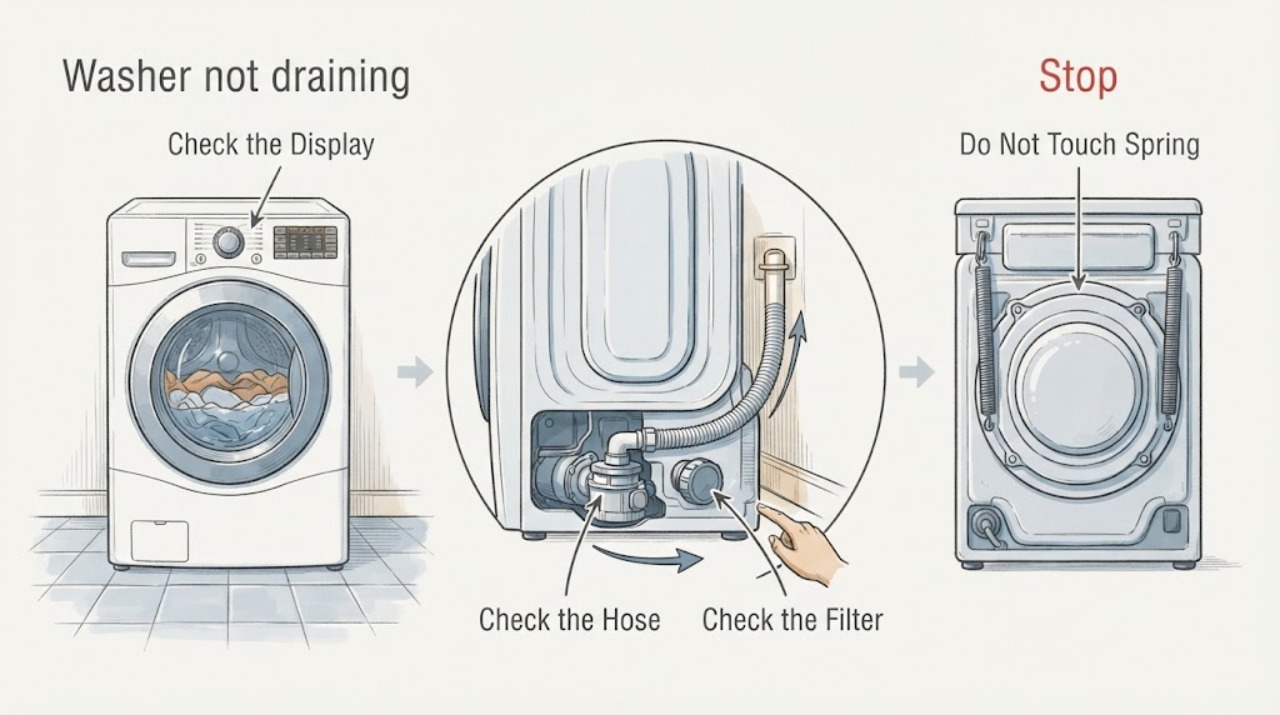
If a Samsung washer leaves water in the tub, first stop the cycle and identify the exact model, front-load or top-load type, displayed code, and whether the water is hot. Let water from a recent hot, Pure Cycle, or Sanitize cycle cool before opening any drain access. Check the visible drain hose for kinks, damage, an airtight connection, incorrect insertion, or a missing holder; Samsung says the hose should follow the model's installation requirements and should not be pulled out by removing its rear retaining screw. On a front-load model with an accessible pump filter, drain the water safely and clean the filter only as the manual directs; top-load models do not have a removable pump filter. Then perform one model-approved drain test. Leave the washer off and arrange service for a returning no-drain or overflow error, water that remains after a clear hose and clean applicable filter, a missing hose holder, a leak, an inaccessible blockage, or any need to open the cabinet.
Before you begin
Safety first
- This article supports model identification, cool external hose and drain checks, and the model-approved front-load filter procedure when applicable. It does not authorize cabinet disassembly, live electrical testing, door-lock bypass, internal pump access, pressurized plumbing work, movement of a water-filled appliance, or handling hot or energized equipment.
Work through in order
Diagnostic checks
Use only checks that match the exact appliance or system and its official guide.
-
Check 1
Stop the Samsung washer and record the complete model number, front-load or top-load type, selected cycle, displayed code or blinking lights, whether water remains, whether the door or lid is locked, and whether a hot, Pure Cycle, or Sanitize cycle ran recently.
Expected result: The tub contains cool or hot water, a no-drain or overflow indication appears, the washer is simply waiting at the drain stage, or the code is absent or unclear.
Next step: If water may be hot, leave the washer off and allow it to cool before any drain access. Then follow the model-specific hose check and, for front-load models only, the applicable pump-filter check. If smoke, sparks, a hot cord, or uncontrolled leakage is present, use the safety stop instead.
Stop if: Do not force the door or lid, reach into water that may be hot, or keep powering the washer for a code or condition you cannot identify safely.
Why this matters
Why: Samsung identifies `nd`, `5E`, `SE`, `5C`, `SC`, and `1 5C` as no-drain indications, but exact code meanings and controls vary by model. Hot water changes the safe handling sequence, and a locked door may be held closed by the water level or temperature.
-
Check 2
With the washer off and the area dry, inspect only the visible drain hose, standpipe or sink connection, hose guide, and rear retaining holder. Check for a kink, pinch, damage, an airtight seal, a hose that slipped too far down, an extension kit, or a missing holder; do not remove the screw that secures the hose to the washer.
Expected result: The hose is kinked, bent, damaged, loose, inserted outside the model's permitted range, sealed airtight, routed too high or low, using an extension, or the external installation appears correct.
Next step: Correct only an obvious, accessible hose position using the Samsung installation instructions for the exact model. If the hose is damaged, the holder is missing, the household standpipe backs up, or the installation is unclear, leave the washer off and arrange appliance or plumbing service as appropriate.
Stop if: Do not disconnect a water-filled hose, remove the rear retaining screw, cut or extend the hose, create an airtight connection, or pull the appliance through standing water.
Why this matters
Why: Samsung says incorrect drain-hose installation is a common drain cause; too-deep insertion can siphon, a loose hose can spill, and a kink or damage can restrict flow. A missing rear holder requires service rather than a guessed hardware change.
-
Check 3
If and only if the Samsung washer is a front-loader with the model's pump-filter access panel, wait until the water is cool, place towels and a container, use the emergency drain hose if provided, and clean and reinstall the pump filter exactly as the manual shows. Skip this action on top-load models or when the panel and procedure do not match.
Expected result: The filter contains lint, coins, hair, or other debris; the accessible impeller is obstructed; the filter or hose cap will not seat; the model has no removable filter; or the filter is clean and secure.
Next step: Rinse the applicable filter with a soft brush, check only the accessible pump opening, reinstall the filter clockwise and secure the emergency hose cap and panel. If the model differs, water remains, or the pump still will not drain, continue to the test and service branch.
Stop if: Do not perform this procedure with hot water, force the cap, probe deep into the pump, remove a top-load cabinet, or run the washer with the filter, cap, or access panel unsecured.
Why this matters
Why: Samsung says a clogged front-load debris filter reduces draining effectiveness and can contribute to odors; top-load models do not have a removable pump filter. A filter that cannot be securely reinstalled or an obstruction beyond the access path is a service condition.
-
Check 4
Check from outside that the washer is level and that the standpipe, utility sink, or household drain is not visibly backing up. Do not open plumbing or move a water-filled appliance; compare the hose height, insertion, and routing with the exact Samsung installation instructions.
Expected result: The washer rocks, the floor or standpipe is unstable or blocked, water backs up at the household drain, the hose height or insertion is outside the manual's limits, or the household drain and installation are clear.
Next step: Correct only a clearly external level or hose-routing issue within the manual's instructions. Contact plumbing service for a blocked standpipe or sink; arrange appliance service if the household drain is clear but the washer still retains water.
Stop if: Do not tip or lift the washer, dismantle the standpipe, pour drain cleaner into the appliance, or continue operation over a wet floor or near an unsafe outlet.
Why this matters
Why: Samsung links an unlevel washer and incorrect drain installation to poor drainage. A household backup can mimic a failed washer, while a clear household drain with persistent water shifts concern toward the washer's internal drain path.
-
Check 5
After the hose and applicable front-load filter are correctly restored, perform one model-approved drain or test cycle with the washer empty or as the manual specifies. Observe whether the pump starts, water exits, the cycle reaches spin, and any code returns.
Expected result: The washer drains and completes, drains slowly, hums without moving water, shows a no-drain or overflow code again, leaks, or the controls do not respond.
Next step: If the test fails or the symptom returns, leave the washer off and arrange qualified Samsung appliance service. Provide the model, code, water temperature, hose measurements or observations, front-load filter result, household drain result, and test behavior.
Stop if: Do not repeat the test continuously, open the cabinet, bypass the door lock, perform live electrical testing, or operate with a leak, smoke, sparks, burning odor, or standing water that cannot be handled safely.
Why this matters
Why: A successful test supports a hose, filter, or temporary blockage cause. Slow or absent flow after the external checks suggests a pump, internal hose, impeller, control, or household drain fault; a returning code is unresolved even if a small amount of water moves.
Use your observations
Decision map
Find the observation that best matches what you see, then follow the next safe action.
-
PATH 01Safety boundary
What you see
The drain hose is kinked, damaged, inserted too deeply or too shallowly, sealed airtight, too high or low, slipping, or missing its Samsung retaining holder.
Do this next
Use the exact Samsung installation instructions to correct only the visible hose position and secure it. Arrange service for a damaged hose or missing holder, and retest once when the area is safe.
Why this path and its safety boundary
Why it matters: Drain restriction, siphoning, or an installation-related spill is more likely than a failed pump.
Safety stop: Do not remove the rear hose screw, disconnect a water-filled line, add an extension, or tape the drain into an airtight seal.
-
PATH 02Safety boundary
What you see
A front-load Samsung washer has an accessible pump filter containing lint, hair, coins, or other debris, and the water is cool enough for the model's drain procedure.
Do this next
Drain through the model's emergency hose if provided, clean and securely reinstall the filter and cap, then run one approved drain test. Arrange service if water remains or the filter cannot be secured.
Why this path and its safety boundary
Why it matters: A clogged debris filter can reduce drain flow and prevent the washer from advancing to spin; this branch does not apply to top-load models without a removable pump filter.
Safety stop: Do not open the filter after a hot cycle without waiting for cooling, force the cap, probe beyond safe access, or operate with the filter panel unsecured.
-
PATH 03Safety boundary
What you see
The Samsung washer is a top-loader or the exact model has no removable pump-filter access, yet water remains or a no-drain code appears.
Do this next
Check the visible hose, level, and household drain using the model manual, then arrange appliance service if the washer still will not drain. Do not remove the top-load cabinet to search for a filter.
Why this path and its safety boundary
Why it matters: The front-load filter procedure does not apply; the visible hose, household drain, pump path, and model-specific controls need separate evaluation.
Safety stop: Do not assume every Samsung washer has a pump filter, open panels, or run a cycle with standing water that cannot be safely contained.
-
PATH 04Safety boundary
What you see
The washer rocks, the standpipe or sink backs up, the floor is unstable, or the household drain and washer hose share a visible blockage.
Do this next
Correct an external leveling issue only as the manual allows and use plumbing service for a blocked household drain. If the drain is clear and the washer remains full, use appliance service.
Why this path and its safety boundary
Why it matters: A plumbing blockage, unstable installation, or poor level can prevent or mimic washer drainage failure.
Safety stop: Do not tip or move a water-filled washer, dismantle plumbing, use drain chemicals in the washer, or continue operation over a wet electrical area.
-
PATH 05Safety boundary
What you see
The hose and household drain are clear, the applicable filter is clean and secured, but the washer hums without moving water, drains slowly, leaves standing water, or returns a no-drain or overflow code.
Do this next
Leave the washer off and arrange qualified Samsung appliance service. Give the technician the exact code, water temperature, remaining water, filter result, hose checks, and whether the pump makes any sound.
Why this path and its safety boundary
Why it matters: A blocked or failed pump, impeller, internal hose, wiring, sensor, or control is more likely than a simple installation issue.
Safety stop: Do not open the cabinet, reach into the pump, test energized wiring, repeatedly run drain cycles, or force a locked door.
-
PATH 06Safety boundary
What you see
The washer contains recently heated water, leaks onto the floor, has smoke, sparks, a burning smell, a hot cord or receptacle, or an otherwise unsafe electrical condition.
Do this next
Keep people away, allow hot water to cool, and isolate power only from a dry safe location without touching wet equipment. For smoke or fire, leave and seek emergency help; otherwise arrange qualified appliance service before draining or operating.
Why this path and its safety boundary
Why it matters: The immediate risk is injury, water damage, or electrical/fire exposure; normal drain troubleshooting must pause.
Safety stop: Do not touch hot water or a wet plug, pull the washer through water, restart it, open the cabinet, or bypass a lock to release water.
Helpful context
Understand the symptom
Start with water temperature and the exact model
A washer that will not drain may show standing water, wet clothing, a no-drain or overflow code, or a cycle that never reaches spin. Samsung's first checks apply to both load types, but a pump filter is a front-load feature only. Before handling drain water, check whether a hot, Pure Cycle, or Sanitize cycle ran recently; Samsung cautions that the water may be very hot and says to allow it to cool before the drain procedure. Use the owner's manual for the exact access panel, controls, and code interpretation.
The drain hose is a primary checkpoint
A kinked, damaged, slipping, over-inserted, or airtight drain hose can prevent normal draining or create siphoning. Samsung's general guidance calls for the hose to be inserted within the model's permitted range, secured, and routed without an airtight seal; the published range is commonly 6–8 inches into a standpipe or sink, with height limits that differ for a standpipe and wash basin. Confirm the exact installation instructions before changing a hose position, and never remove the rear screw that holds the hose to the washer.
Pump-filter access depends on washer type
Samsung says front-load washers have a debris or pump filter that catches lint and foreign material before it enters the drain system; top-load washers do not have a removable pump filter. On an applicable front-loader, the safe sequence is to cool the water, prepare towels and a container, use the small emergency drain hose if provided, remove and clean the filter, inspect the accessible impeller, and reinstall the filter and hose cap securely. If your model does not match that procedure, stop and use its manual rather than forcing a panel or cap.
A failed drain test is a service boundary
After the visible hose and applicable filter are restored, Samsung says the washer should drain at the beginning of a test cycle. If it does not, or if the problem returns, a pump, internal hose, wiring, control, or household drain issue may remain. Do not tip a water-filled washer, open the cabinet, bypass a door lock, or keep retrying a cycle with standing water, leakage, or an electrical symptom.
Safety boundary
Stop conditions
- If a hot, Pure Cycle, or Sanitize cycle ran recently, do not open drain access until the water has cooled; Samsung cautions that it may be very hot.
- Stop for smoke, fire, sparks, a burning smell, a hot or melted cord or receptacle, uncontrolled water, or a wet electrical area; isolate power only from a dry safe location and arrange qualified help.
- Do not force the door or lid, bypass a lock, open the cabinet, probe an internal pump, perform live electrical testing, or move a water-filled washer.
- Do not remove the Samsung rear drain-hose retaining screw, create an airtight drain connection, use an extension kit by guesswork, or pour drain chemicals into the washer.
- Arrange qualified Samsung appliance service for a missing hose holder, damaged hose, inaccessible obstruction, water that remains after the visible path and applicable filter are clear, a returning no-drain or overflow code, or any internal repair need.
Only after diagnosis
Potential parts
- Samsung washer drain hose or retaining holder
Consider this category only when the visible hose is damaged or the model-specific retaining holder is missing or broken and the installation fault matches the drainage symptom.
Confirm the complete model and installation configuration; do not substitute hardware or remove the rear retaining screw by guesswork. - Samsung front-load washer pump filter or filter cap
Consider this category only for a front-load model with the applicable filter when the filter or cap is damaged, cannot seal, or cannot be secured after safe cleaning.
Top-load models may not have a removable pump filter; verify the exact model and filter design before ordering. - Samsung washer drain pump or internal drain component
Consider this category only when the visible hose, household drain, and applicable filter are clear but water remains or the pump does not move water during an approved test.
Confirm the exact model and technician diagnosis; pump access and component fit vary by washer.
When checks do not resolve it
Need a professional?
Arrange qualified Samsung appliance service when the drain hose and household drain are clear but water remains, when a front-load pump filter cannot be safely cleaned or reinstalled, when the drain pump hums without moving water, when a no-drain or overflow code returns, or when an obstruction, control, wiring, or internal pump issue is suspected. Use plumbing service for a backed-up standpipe or sink. Keep the washer off for hot water, leaks, smoke, sparks, burning odor, a hot cord, or unsafe standing water, and provide the exact model, code, hose installation observations, filter result, water temperature, and test-cycle result.
Safety scope: This article supports model identification, cool external hose and drain checks, and the model-approved front-load filter procedure when applicable. It does not authorize cabinet disassembly, live electrical testing, door-lock bypass, internal pump access, pressurized plumbing work, movement of a water-filled appliance, or handling hot or energized equipment.
Common questions
FAQ
Why is my Samsung washer not draining?
Start with the visible drain hose, its routing and holder, the household standpipe or sink, and the washer's level. On front-load models only, a clogged pump filter is another common checkpoint. If those checks are clear but water remains or a no-drain code returns, the pump or an internal drain component needs service.
Does every Samsung washer have a pump filter?
No. Samsung's washer guidance says the removable pump filter procedure applies to front-load models; top-load models do not have that removable pump filter. Use the exact model manual instead of opening a top-load cabinet to look for one.
What do 5C, 5E, or nd mean on a Samsung washer?
Samsung lists nd, 5E, SE, 5C, SC, and 1 5C as no-drain indications, but the display and code behavior vary by model. Record the complete code and follow the model guide; do not assume that a partial code or blinking light has the same meaning on every washer.
Can I open the Samsung washer drain filter right after a hot cycle?
No. Samsung cautions that water after a hot, Pure Cycle, or Sanitize cycle may be very hot. Keep the washer off and allow it to cool before using an applicable front-load emergency drain and pump-filter procedure.
Read the exact guide
Official sources
- Samsung washing machine or laundry smells badSamsung · Samsung washer drain-hose siphoning, pump-filter odor, standing water, and model-specific maintenance clues
- Samsung washing machine will not drainSamsung · Samsung washer no-drain and overflow troubleshooting, drain-hose installation, level, filter applicability, cooling, and service boundary
- Samsung washing machine is leakingSamsung · Samsung washer hose, connection, front-load door-seal, drain-hose, and leak service boundaries
- How to clean your Samsung washerSamsung · Samsung washer cleaning and front-load pump-filter procedure
- Samsung washing machine information and error codesSamsung · Samsung washer no-drain, overflow, door, voltage, unbalanced-load, and model-dependent error-code meanings
Community feedback
Share a repair observation
Share a plain-text repair observation. Accepted observations are published automatically; this page may take a moment to update.