
On this page
Start here
Quick answer
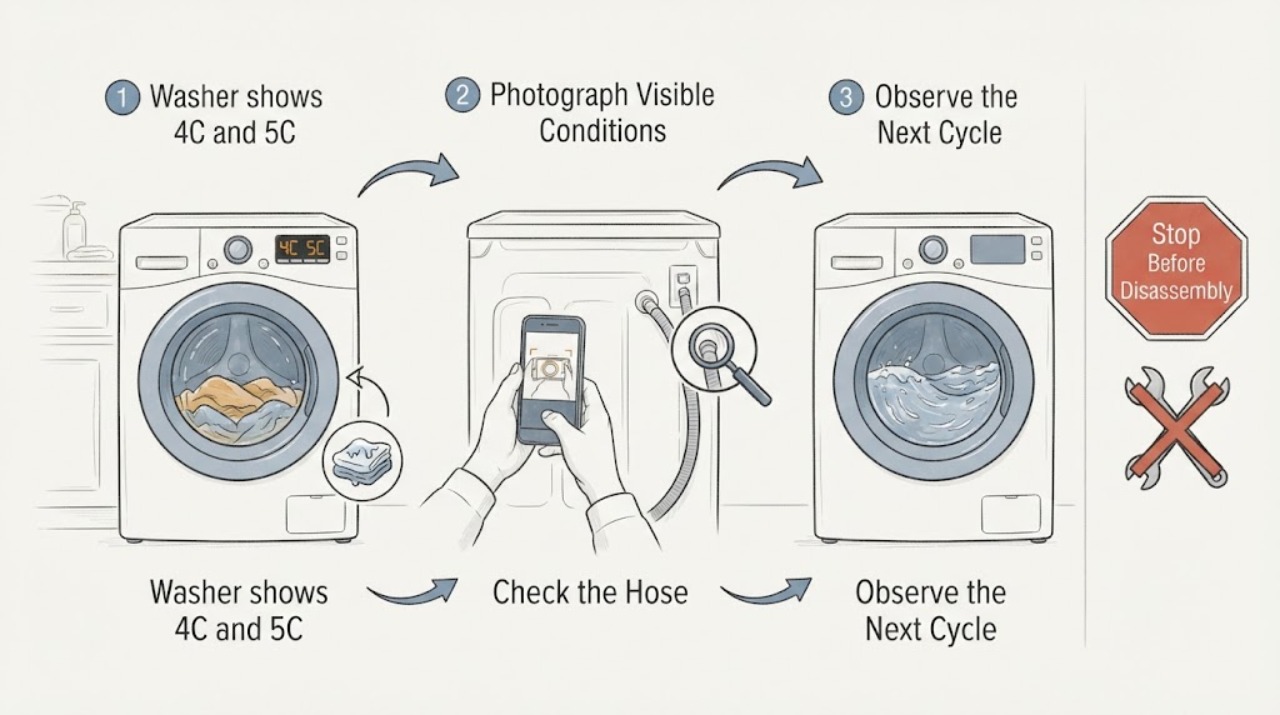
On the Samsung WF45T6000AW/A5 front-load washer, 4C means the washer is not filling correctly and 5C means it is not draining at the required speed. If 4C appears during an empty rinse and 5C later appears during a spin-only cycle with wet towels, treat the sequence as two stage-specific clues: check the visible water-supply path for the rinse failure, then check the visible drain-hose route and standing-water condition for the spin failure. Do not treat 5C as proof that the spin motor is bad, and do not keep rerunning cycles to make the codes reappear. Record the exact order and water state, make only dry external checks, and request service if either code returns with normal visible connections.
Work through in order
Diagnostic checks
Use only checks that match the exact appliance or system and its official guide.
-
Check 1
Stop the affected cycle when the controls allow it and photograph the display before clearing it. Write down the full model as WF45T6000AW/A5, the exact code capitalization, the selected cycle, whether it was the empty rinse or spin-only cycle, which code appeared first, and whether the drum contained standing water.
Expected result: The record shows 4C during the empty rinse, 5C during spin-only with wet towels, both codes in the reverse order, or an uncertain/partial display.
Next step: Keep the washer off while documenting. Use the matching branch below, and do not run another rinse or spin merely to reproduce the display.
Why this matters
Why: Samsung defines 4C as a water-fill problem and 5C as a no-drain problem. The cycle stage and order therefore determine which external path gets priority; an uncertain display cannot support a component diagnosis.
-
Check 2
For a 4C that appeared during the empty rinse, inspect from a dry, safe position that both household water faucets are open, the hot and cold hoses are connected to the matching inlets, and the visible hose sections are not kinked, crushed, leaking, or frozen. Do not loosen a hose or probe an inlet screen.
Expected result: A faucet is closed or weak, a hose is visibly kinked/damaged/leaking, or the visible supply setup is normal but no water entered before 4C.
Next step: Correct only a plainly closed faucet or safe visible routing issue. If there is damage, a leak, no usable water supply, or 4C returns with normal connections, leave the washer unused and request model-specific service.
Why this matters
Why: The first pattern supports an accessible supply or routing issue. If the faucets and visible hoses are normal but the empty rinse still produces 4C, the fault may be in water entry or sensing and cannot be assigned to a valve from the code alone.
-
Check 3
For a 5C that appeared during the spin-only cycle with wet towels, wait until the drum is completely still and look only at the visible drain hose, its insertion at the standpipe, and the floor around the washer. Note whether water is visibly left in the drum; keep hands away from wet electrical areas and any hot water.
Expected result: The drum is empty but the hose is visibly kinked or displaced, water remains in the drum, the floor is wet, or the visible route looks normal and the towels remain waterlogged.
Next step: Make only a dry external hose-routing correction allowed by the installation instructions. Do not tilt the washer, remove the pump filter, open the drain hose, or test a pump. If water remains, there is a leak, or 5C returns, stop using the washer and arrange service.
Why this matters
Why: A 5C means the washer did not drain at the required speed or at all. Standing water and waterlogged towels make an incomplete spin a likely consequence of the drain result, not independent proof of a motor or spin-part failure. A normal visible route with recurring 5C needs deeper service diagnosis.
-
Check 4
Compare the two events without creating another test: put the codes in chronological order and pair each one with the water state. Mark whether 4C occurred before any water entered and whether 5C occurred only after water was present or after the wet-towel spin attempt.
Expected result: 4C is first during the empty rinse and 5C is later during spin-only, 5C occurs first or with standing water, or the display order cannot be established.
Next step: Give the technician the exact sequence, cycle names, whether water entered or remained, and the visible hose observations. Do not combine the codes into a request for a specific valve, pump, sensor, or motor.
Why this matters
Why: Samsung's front-load diagnostic sequence checks water valves before its drain check and high-speed spin check. A 4C-first/5C-later pattern supports separate fill and drain branches in that order; a 5C with retained water prioritizes drainage regardless of the user's description that the washer did not spin.
-
Check 5
Only after the display, water state, and visible connections have been recorded, use a single power cycle if the washer is dry and Samsung's matching code guidance permits it; disconnect power or switch off the washer circuit for the documented interval, then restore power without starting repeated rinse or spin tests.
Expected result: The code clears once and the washer remains normal, or 4C/5C returns immediately or on the next necessary use.
Next step: If either code returns, stop resetting and arrange qualified Samsung or appliance service. If the machine is wet, leaking, electrically abnormal, or the breaker trips, do not restore power yourself.
Why this matters
Why: Samsung says a reset can clear stored codes but does not fix the underlying condition, and repeated resets erase useful error history. A returning code with normal visible connections is a service branch.
Use your observations
Decision map
Find the observation that best matches what you see, then follow the next safe action.
-
PATH 01Next step
What you see
4C appears first during the empty rinse, no water enters, and the faucets and visible hoses are closed, kinked, damaged, or otherwise abnormal.
Do this next
Correct only a plainly closed faucet or safe visible routing issue. If the hose is damaged, leaking, or supply remains weak, leave the washer off and arrange installation or appliance service.
Why this path and its safety boundary
Why it matters: The immediate evidence is consistent with an accessible water-supply or hose-routing problem; it does not justify identifying an inlet valve or sensor.
-
PATH 02Next step
What you see
4C appears during the empty rinse even though the faucets are open and the visible supply hoses are correctly routed, then 5C appears during spin-only with water still present or wet towels that did not drain.
Do this next
Stop using the washer, preserve the display photos and water-state notes, and request model-specific service. Do not order a valve, pump, sensor, or motor from the combined code string.
Why this path and its safety boundary
Why it matters: The timeline contains a fill-stage failure followed by a drain-stage failure. The two codes should remain separate until a technician checks the model; the later lack of spin can be a consequence of retained water.
-
PATH 03Next step
What you see
5C appears with standing water or a wet floor, or the drain path is visibly kinked, displaced, or blocked from the outside.
Do this next
Do not run another cycle or tilt/open the washer. Keep away from wet electrical parts; isolate power only from a dry, safe position if appropriate, and arrange service after addressing any immediate water hazard.
Why this path and its safety boundary
Why it matters: The washer has an unresolved drainage or water-safety condition. The absence of a completed spin is not enough to diagnose the drive system.
-
PATH 04Next step
What you see
Either code returns after the permitted external checks and one documented power cycle, while faucets, visible hoses, and the area around the washer appear normal.
Do this next
Leave the washer unused and provide service with the exact model, code order, cycle stage, water state, photos, and whether any leak or breaker event occurred. Do not enter service mode or perform live tests.
Why this path and its safety boundary
Why it matters: An internal fill, drain, sensing, wiring, or control problem remains possible, but the code pair cannot select the failed component.
Helpful context
Understand the symptom
The WF45T6000AW/A5 is a Samsung front-load washer. The two codes do not name one shared replaceable part: Samsung lists 4C under water-not-filling and 5C under no-drain. An empty rinse and a spin-only cycle test different stages, so preserve the sequence instead of combining the codes into a single pump-or-valve diagnosis.
Before touching the washer, stop if there is a leak, water near the outlet or power cord, hot water, a burning smell, smoke, sparking, or a breaker that trips again. Do not open pressurized hose connections, remove panels, reach into the drum, or run Samsung Smart Install while an error is already displayed.
The useful evidence is: which code appeared first, which cycle was selected, whether water entered the drum, whether water remained afterward, and whether the wet towels were still heavy because the washer could not drain. A later 5C can explain why a spin did not complete, but it does not by itself prove a spin-system failure.
When checks do not resolve it
Need a professional?
Request qualified service when 4C returns with open faucets and normal visible supply routing, when 5C returns with a clear visible drain route, when water remains in the drum, when the washer leaks, or when the two-code sequence repeats. Stop immediately for water near electrical parts, a hot outlet, burning smell, smoke, sparking, or a breaker that trips again; isolate power only from a dry, safe position and do not touch wet plugs or exposed wiring. Do not tilt the washer, open pressurized connections, remove panels or a pump, enter service mode, or perform live voltage tests.
Common questions
FAQ
Does 5C mean the Samsung washer cannot spin?
5C is Samsung's no-drain code. A front-load washer may not complete a spin when water remains, so a wet load and missing spin can be consequences of the drain failure. Check the visible drain route after the drum is still; do not infer a bad motor or pump from the missing spin alone.
What does 4C mean on the WF45T6000AW/A5?
Samsung lists 4C as a not-filling error. From a dry, safe position, verify that the hot and cold faucets are open and the visible hoses are correctly connected and not kinked. If 4C returns with normal visible connections, request service rather than guessing an inlet part.
Should I run Smart Install to separate 4C and 5C?
No while an error is displayed. Samsung says not to run Smart Install when the washer is already showing an error. Preserve the existing code and cycle-stage evidence and give it to service instead of creating more test cycles.
Read the exact guide
Official sources
- Samsung washing machine information and error codesSamsung US · The opened Samsung US guide explicitly lists 4C as not filling and 5C as no drain, notes that codes can vary by model, and gives visible faucet, hose, and drain-routing checks.
- How to reset your Samsung washing machineSamsung US · The opened Samsung US guidance says a power cycle can clear stored codes but does not automatically fix the issue; if the code returns, repeated clearing can erase useful history and service should be requested.
- Run diagnostics on your Samsung washer or dryerSamsung US · The opened page describes a front-load sequence in which water-valve checks can show 4C, the drain check can show 5C, and warns not to run Smart Install when an error is already displayed.
- WF45T6000AW/A5 Front Load WasherSamsung Business US · The opened product page identifies the exact WF45T6000AW/A5 model as a front-load washer with Self Clean+ and VRT Plus.
Community feedback
Share a repair observation
Share a plain-text repair observation. Accepted observations are published automatically; this page may take a moment to update.