
On this page
Start here
Quick answer
On the assigned Samsung WF330ANW/XAA, do not treat an empty-tub rocking symptom as the meaning of 9E1 without checking the display and the power path. Samsung's public washer tables group 9E1 with power, low-voltage, or irregular-current errors, while they list 8C/8E separately for the MEMS vibration sensor. Record the full display, stop a violent spin, check only the external power arrangement, and perform at most one model-appropriate power reset. If 9E1 returns, or the empty tub still moves violently after the washer is stable and level, stop testing and arrange model-specific service.
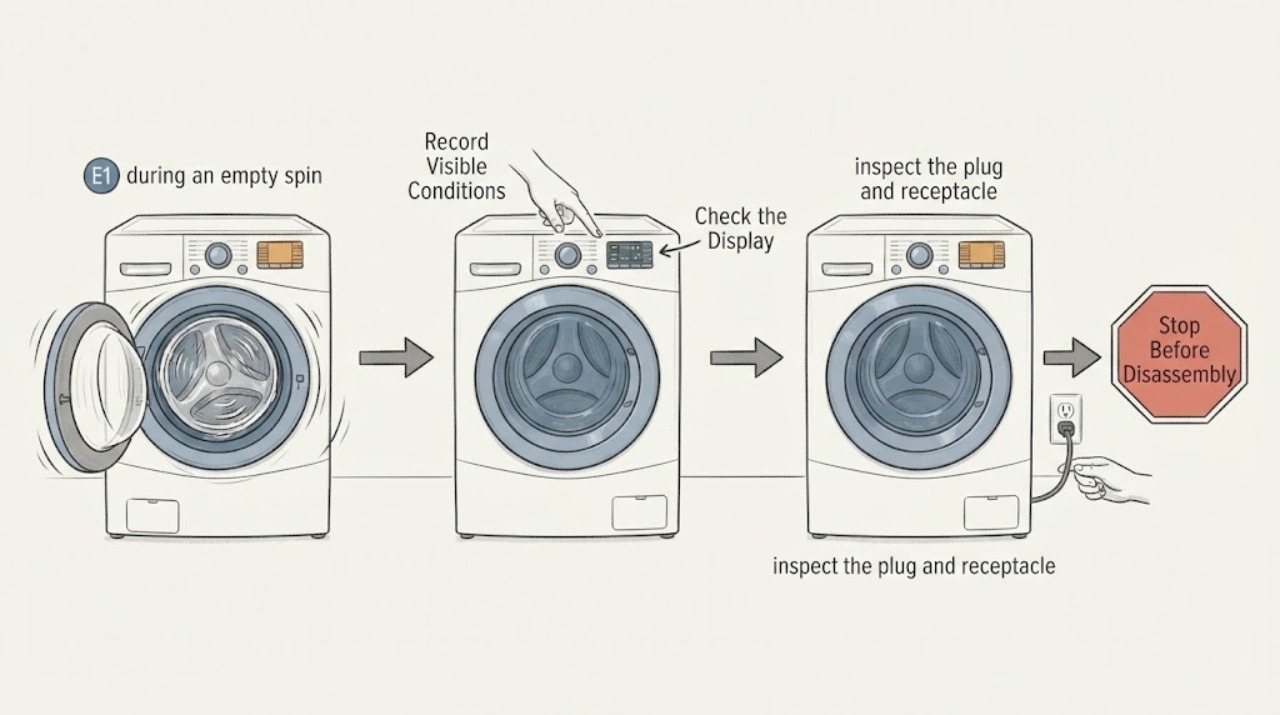
Work through in order
Diagnostic checks
Use only checks that match the exact appliance or system and its official guide.
-
Check 1
Stop the spin test if the washer is still accelerating or walking, using the normal control only if it responds, and wait until the drum is completely still. Copy every display character exactly, including whether it is 9E1, 9E/1, another 9-series code, or an alternating message; also record whether it appeared at start, acceleration, or after the tub began moving.
Expected result: You have a complete display and cycle stage, or the display is partial/ambiguous; the tub either stopped normally or continued violent movement, scraping, or walking.
Next step: Photograph the display if needed and use the full model suffix with the WF330ANW/XAA manual or service record. Do not restart a violent test to obtain a clearer code.
Why this matters
Why: The exact display matters because Samsung groups 9E1 with power-related codes but treats balance and vibration-related indications as a different path. A partial display cannot safely identify a part or a cause.
-
Check 2
With the washer stopped and hands away from the drum, describe the movement separately from the code: note whether the empty basket is centered and quiet at rest, rocks only during acceleration, or keeps banging, scraping, or shifting the cabinet after the control stops.
Expected result: Movement is mild and limited to acceleration, or the empty washer bangs, scrapes, rocks broadly, or walks even without a load.
Next step: If movement is violent, stop using the spin test. Continue only with the dry external checks below; do not remove panels, suspension parts, or the control console.
Why this matters
Why: Samsung identifies 8C/8E as a MEMS vibration-sensor path and lists flat, stable installation for unbalance indications. Persistent violent movement with an empty basket is not evidence that 9E1 itself means imbalance; it is a separate installation or mechanical-service observation.
-
Check 3
From a dry location, inspect the plug and receptacle for looseness, heat, discoloration, or damage, and confirm that the washer is on its own circuit without an extension cord or multi-plug adapter. Do not insert probes or open the cabinet; leave energized-circuit testing to a qualified professional.
Expected result: The plug and receptacle look sound and the washer has a dedicated direct connection, or there is a hot/loose/damaged outlet, an extension, a shared overloaded circuit, or a breaker that trips.
Next step: For a sound setup, proceed to one power reset. For heat, damage, repeated breaker trips, or a loose receptacle, stop using the washer and have a qualified electrician or appliance service provider assess it.
Why this matters
Why: Samsung attributes 9E1 to irregular or interrupted electrical supply and specifically directs users to confirm a dedicated circuit and no extension. A hot or damaged connection is an electrical hazard, not a troubleshooting opportunity.
-
Check 4
If there is no heat, burning smell, water near the outlet, or other hazard, switch the washer off at the mains or breaker, wait one minute, and restore power once; do not cycle the breaker repeatedly or use a button combination that is not in the exact manual.
Expected result: After the single reset, 9E1 clears and does not return, or it reappears immediately/at the same spin-test stage.
Next step: If 9E1 returns, stop repeating the test and provide the service technician the exact code, stage, power arrangement, and motion description. Do not replace a board, motor, or sensor based on the code alone.
Why this matters
Why: Samsung's regional guidance uses a one-minute power-off/reset for 9E1 or related power codes. A temporary clear does not prove the empty-tub vibration was electrical, and a returning code needs model-specific diagnosis.
-
Check 5
Without opening the washer, check that it stands on a firm, flat surface, does not rock when gently tested from outside, and has not been recently moved with shipping hardware still fitted; use only the installation instructions for this exact model before changing any feet or hardware.
Expected result: The cabinet is stable and level with no obvious installation issue, or it rocks on the floor, has shifted, or was recently installed/moved and its transport-hardware status is unknown.
Next step: Correct only a plainly visible, manual-authorized external leveling issue while the washer is empty and powered off. If the unit still moves violently, leave it unused and request service.
Why this matters
Why: Samsung's unbalance guidance links spin problems to a flat, stable surface, but that guidance does not identify a failed component. An empty-machine movement that persists despite a stable installation warrants service rather than a guessed suspension or drive part.
-
Check 6
Do not perform another high-speed empty spin solely to force a result. If the exact manual permits a normal low-risk cycle after the checks, remain nearby and stop it at the first violent movement, scraping, electrical odor, or failure to stop.
Expected result: The washer completes without 9E1 and without abnormal movement, or the code/movement returns during acceleration or the drum will not stop normally.
Next step: Keep the recorded display and observations for Samsung or a qualified appliance technician. Ask them to evaluate the power-error path and the empty-tub movement as separate findings.
Why this matters
Why: A clean single result makes an intermittent supply or installation condition possible but does not prove it fixed. A repeatable code or dangerous motion is a service boundary, not a reason to keep escalating the spin speed.
Use your observations
Decision map
Find the observation that best matches what you see, then follow the next safe action.
-
PATH 01Next step
What you see
9E1 returns at startup or during acceleration even though the washer is quiet and the outlet arrangement is sound.
Do this next
Stop the test after the one permitted reset and arrange model-specific appliance service; use an electrician as well if the receptacle, circuit, or breaker shows a fault.
Why this path and its safety boundary
Why it matters: The observed pattern fits Samsung's power/low-voltage or irregular-current category more closely than an unbalanced-load explanation, although the exact WF330ANW/XAA manual and supply assessment still control.
-
PATH 02Next step
What you see
9E1 clears after the one-minute reset, but the empty washer still bangs, rocks broadly, or walks while the power remains stable.
Do this next
Do not repeat high-speed tests. Verify only the external stable-surface/level condition allowed by the exact manual, then request service if the empty-machine movement persists.
Why this path and its safety boundary
Why it matters: The movement is a separate installation or mechanical symptom; Samsung's published distinction between 9E1 and 8C/8E does not support calling 9E1 an imbalance code or naming a failed part.
-
PATH 03Next step
What you see
The washer has a hot or damaged plug/receptacle, burning smell, water near electrical parts, repeated breaker trips, or the drum keeps moving after stop is pressed.
Do this next
Stop using the washer, keep clear of wet or hot electrical areas, and arrange qualified appliance service; use emergency electrical assistance when there is smoke, arcing, or a fire risk.
Why this path and its safety boundary
Why it matters: This is an immediate electrical or mechanical safety concern; the normal code-triage path no longer makes further user testing appropriate.
-
PATH 04Next step
What you see
There is no 9E1, the tub remains quiet on a permitted low-risk cycle, and only slight settling movement is visible when the empty basket stops.
Do this next
Keep the exact display history and monitor normal use. If 9E1 or violent empty-tub movement returns, stop and use the first two branches rather than guessing a part.
Why this path and its safety boundary
Why it matters: The reported condition is not currently reproducing the power code or a severe imbalance symptom, so a motor or control part is not justified from this observation.
Helpful context
Understand the symptom
What 9E1 does and does not establish
The Samsung US guide places 9E1 in a voltage-error group and describes irregular current supplied to the washer. Samsung Ireland likewise lists 9E1 with low voltage or interrupted power, and separately describes 8C/8E as a MEMS vibration-sensor issue. That distinction is useful here: the code and the empty-machine movement may be two observations from the same test, but the code alone does not prove an unbalanced tub, failed motor, or failed control board. Samsung also warns that codes can vary by model, so the WF330ANW/XAA manual or a qualified service assessment controls if the display differs.
Keep the two symptom paths separate
A front-load washer can move because of installation or suspension conditions, while a power-related code can appear when supply current is interrupted or irregular. First establish whether 9E1 is present and repeatable; then describe the motion only after the drum is stopped. Do not keep running a high-speed empty test simply to make the two symptoms coincide.
When checks do not resolve it
Need a professional?
Stop and arrange qualified service if 9E1 returns after the single model-appropriate reset, if the washer moves violently while empty, if the drum scrapes or will not stop, or if the symptom persists with a stable installation and direct power. Stop immediately for burning smell, smoke, arcing, a hot or damaged receptacle, repeated breaker trips, or water near electrical parts. Do not bypass the door lock, open the cabinet, remove suspension or drive parts, or perform live-voltage tests.
Have this ready
- Tell the technician that Samsung's public tables classify 9E1 as a power/low-voltage or irregular-current code and separately list 8C/8E for the MEMS vibration path. Ask for both the power-error path and the empty-spin movement to be evaluated without assuming they are one failed part.
Common questions
FAQ
Does Samsung 9E1 mean the tub is unbalanced?
Not on the public Samsung code tables used here. They group 9E1 with power or low-voltage errors and list 8C/8E separately for the MEMS vibration sensor. The exact model manual controls if the WF330ANW/XAA display differs.
Should I run the empty spin test again to confirm the error?
Do not repeat a high-speed test when the washer bangs, walks, scrapes, smells hot, or the code returns. Record the display and use the safe external power and installation checks; persistent code or movement belongs with qualified service.
Read the exact guide
Official sources
- What do the codes on my washing machine mean?Samsung UK · Samsung washer code table; exact display and model manual take precedence across markets
- Check out the information codes on my washing machineSamsung Ireland · Samsung washer information-code guidance; regional/model differences require the assigned model manual
- Samsung washing machine information and error codesSamsung US · Samsung washer code guidance; use the exact WF330ANW/XAA manual when its display or regional platform differs
Community feedback
Share a repair observation
Share a plain-text repair observation. Accepted observations are published automatically; this page may take a moment to update.