
On this page
Start here
Quick answer
If fabric softener is still in a Samsung washer drawer after the cycle, first identify whether the machine uses a manual softener compartment or an automatic softener reservoir. With the washer stopped, check that the softener is below the MAX line, has a pourable consistency, and is in the correct compartment. Remove and rinse the drawer and its siphon or insert, brush residue from the accessible spray-jet area, and confirm the washer is level. For an automatic dispenser, confirm Dose per Rinse is enabled and the drawer is fully closed. Run one model-appropriate rinse test. If the compartment stays full after these checks, the drawer or its water supply may need model-specific service; stop sooner for a leak or any water near electrical parts.
Before you begin
Safety first
- Keep the washer off for a leak near electrical parts, smoke, arcing, a hot plug or outlet, a burning electrical smell, or a washer that will not stop. Do not touch wet electrical equipment or remove cabinet panels.
Work through in order
Diagnostic checks
Use only checks that match the exact appliance or system and its official guide.
-
Check 1
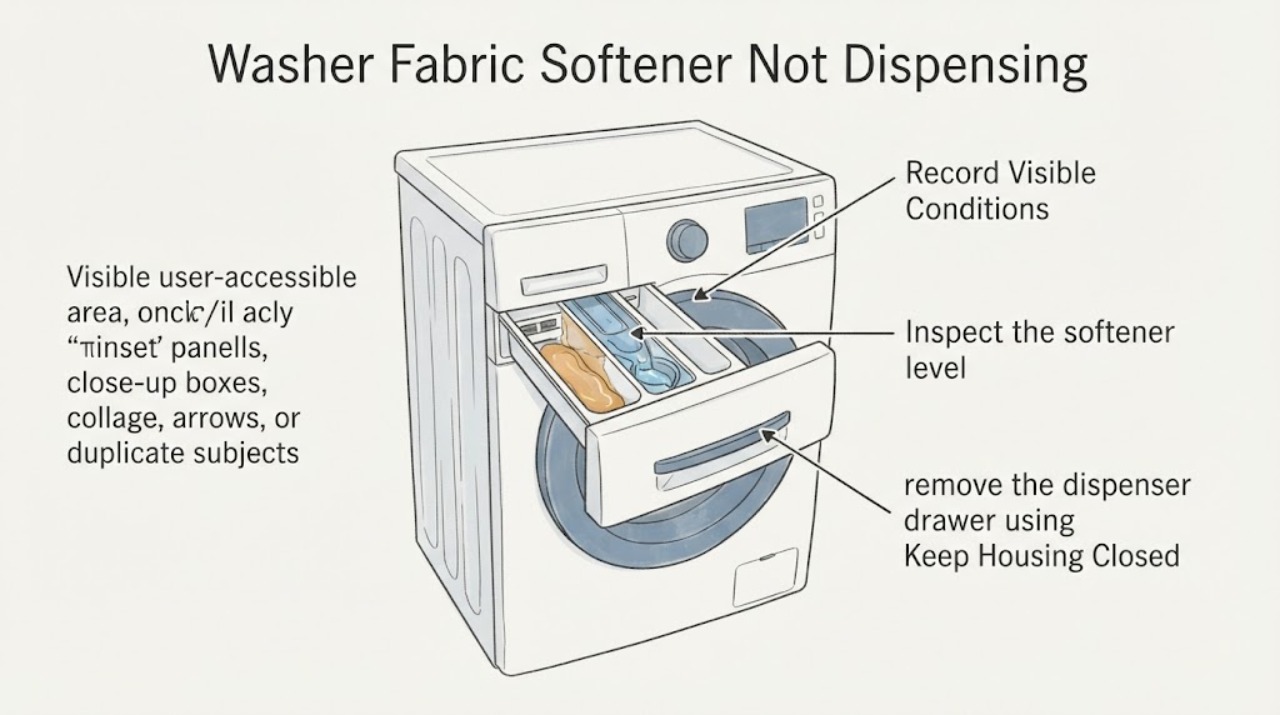
With the washer stopped, identify whether the softener is in a manual fabric-softener compartment or an automatic softener reservoir. Record whether the cycle completed normally and whether the compartment is full of softener, diluted softener, or water.
Expected result: The machine has a manual compartment; it has an automatic reservoir; the compartment is full of the original softener; or it is full mainly of water.
Next step: Continue with the matching drawer and setting checks. Use the full model manual for the compartment layout and do not apply a top-load procedure to a front-load drawer or the reverse.
Why this matters
Why: A manual compartment uses its insert or siphon path, while an automatic reservoir also depends on the Dose per Rinse setting. A compartment full of water after the cycle can indicate incomplete siphoning or a drawer-flow issue rather than a softener-consistency issue.
-
Check 2
Inspect the softener level and consistency without exceeding the compartment's MAX line. Confirm that the liquid is in the softener compartment and is not unusually thick, lumpy, or exposed to conditions that changed its consistency.
Expected result: The softener is above MAX, thick or lumpy, in the wrong compartment, or below MAX with a normal pourable consistency.
Next step: Remove excess additive. If the model and additive instructions allow dilution, restore a normal consistency without crossing MAX; otherwise use a fresh, suitable liquid. Then clean the drawer before the rinse test.
Why this matters
Why: Overfilling can make additive drain into the tub immediately, and thick or lumpy softener can fail to pass through the siphon path. Correct level and consistency make a blocked drawer, spray-jet problem, leveling issue, or automatic setting more likely.
-
Check 3
With the washer off, remove the dispenser drawer using the release method for the model. Rinse away softener residue from the drawer, siphon cap or insert, and compartment; use a soft brush on accessible residue and the spray-jet area above the drawer. Do not force a stuck piece or pry into the cabinet.
Expected result: Residue or a film blocks the siphon path, the spray-jet area is dirty, the drawer and jets are clear, or the drawer cannot be removed or reinstalled normally.
Next step: Rinse the parts until the passages are clear, reinstall every model-specific insert or cap correctly, and push the drawer fully home. Stop and arrange model-specific service if the drawer is cracked, stuck, or cannot seat correctly.
Why this matters
Why: Residue can prevent water from carrying the softener through the drawer. A clear drawer with a normally seated siphon shifts attention to water delivery, washer leveling, automatic settings, or a defective drawer.
-
Check 4
Check that the washer is level on a stable floor and that the drawer is seated squarely and fully closed. If the washer has an automatic dispenser, confirm that Dose per Rinse is set to an active amount rather than Off, using the exact model controls.
Expected result: The washer rocks or is visibly out of level; the drawer is not fully closed; Dose per Rinse is Off; or the washer and setting are correct.
Next step: Correct only the accessible leveling or drawer-seating condition described by the model instructions, and enable automatic softener dispensing when the model provides that feature. Do not infer a control failure from a setting that is Off.
Why this matters
Why: An incorrect washer angle can affect how the dispenser siphons work. An open drawer or disabled automatic softener setting can prevent dispensing even when the reservoir is filled.
-
Check 5
Perform one controlled rinse test after the drawer is clean, correctly assembled, filled below MAX if the model uses a manual compartment, and fully closed. Select the model-appropriate Rinse or Rinse and Spin cycle and observe the drawer after it completes; do not add extra detergent or softener during this test.
Expected result: The softener dispenses normally; the drawer remains full; the drawer fills with water; the additive drains immediately; or the cycle cannot run normally.
Next step: Do not repeat chemical cleaning or disassemble the washer. If the same result returns after one controlled test, record the full model number and arrange qualified Samsung appliance service; stop immediately for leaking water or electrical symptoms.
Why this matters
Why: Improvement supports a residue, consistency, setting, leveling, or seating cause. A full drawer after a clean, correctly assembled test points toward the drawer or its water path. Immediate draining suggests an insert, MAX-level, or drawer-flow problem rather than a completed softener release.
Use your observations
Decision map
Find the observation that best matches what you see, then follow the next safe action.
-
PATH 01Next step
What you see
The softener is above MAX, thick or lumpy, or the drawer contains visible softener film around the siphon cap or insert.
Do this next
Bring the liquid below MAX, restore a model-approved pourable consistency if appropriate, and rinse the drawer and siphon parts with a soft brush before one controlled test.
Why this path and its safety boundary
Why it matters: The additive or residue is more likely restricting the siphon path than a failed washer control.
-
PATH 02Next step
What you see
The drawer and siphon are visibly clean, but the spray-jet area is dirty or the drawer was not fully seated after cleaning.
Do this next
Clean only the accessible jet area, reinstall the model-specific cap or insert, push the drawer fully closed, and perform one model-appropriate rinse test.
Why this path and its safety boundary
Why it matters: Water may not be reaching the softener compartment correctly, or the drawer may not be positioned for siphoning.
-
PATH 03Next step
What you see
The washer is level and the drawer is clean and seated, but an automatic dispenser reservoir remains full while Dose per Rinse is Off or a refill or setting indicator is present.
Do this next
Use the exact model controls to enable Dose per Rinse and confirm the reservoir cover and drawer are closed. If the indicator remains through a complete cycle with the setting enabled, request service.
Why this path and its safety boundary
Why it matters: The automatic softener path has not been enabled or is reporting a model-specific dispenser state; the full reservoir alone does not prove a failed pump.
-
PATH 04Next step
What you see
The softener is below MAX, pourable, the drawer and spray jets are clean, the washer is level, the setting is correct when applicable, and the drawer remains full after one controlled rinse test.
Do this next
Stop repeated testing and arrange qualified Samsung appliance service with the model number, washer style, dispenser type, liquid consistency, drawer condition, and rinse-test result.
Why this path and its safety boundary
Why it matters: A drawer defect or a model-specific water or control problem is more likely than an ordinary residue blockage. The symptom does not identify a replacement part by itself.
-
PATH 05Next step
What you see
Water is leaking onto the floor near the cord, outlet, or controls, or there is smoke, arcing, a hot connection, or a burning electrical smell.
Do this next
Keep the washer off, do not touch wet electrical equipment, and isolate power only from a safe, dry location. Arrange qualified appliance or electrical service and do not run another test.
Why this path and its safety boundary
Why it matters: This is an electrical or water-safety event, not a dispenser-cleaning branch.
Helpful context
Understand the symptom
A drawer that is still full after a completed cycle is a dispenser-flow problem, so the useful observation is what remains and where it remains. A thick or overfilled liquid points toward the additive itself or the compartment's siphon path. A clean compartment with no change during a controlled rinse points toward the drawer, spray water, or a model-specific control setting. Exact drawer removal, siphon access, and automatic-dispenser menus vary by Samsung model; use the manual for the full model number before forcing a part or opening a panel.
Keep the checks dry and external. Do not energize the washer when water has reached the cord, outlet, controls, or other electrical parts, and do not remove the rear drain-hose retaining screw or a cabinet panel to solve a dispenser complaint.
Only after diagnosis
Potential parts
- washer dispenser drawer
Consider this only if the drawer remains full or drains incorrectly after the drawer, siphon, fill level, leveling, setting, and one controlled rinse checks are correct, and the model documentation or a technician identifies the drawer as defective.
Confirm the full washer model and the manufacturer's fit information before ordering; the symptom alone does not establish compatibility.
When checks do not resolve it
Need a professional?
Arrange qualified Samsung appliance service when the clean, level, correctly filled and seated dispenser still leaves softener after one controlled rinse test, when a drawer is cracked or stuck, or when an automatic dispenser remains unchanged through a complete cycle with Dose per Rinse enabled. Use qualified electrical help for heat, smoke, arcing, or damaged connections.
Safety scope: Keep the washer off for a leak near electrical parts, smoke, arcing, a hot plug or outlet, a burning electrical smell, or a washer that will not stop. Do not touch wet electrical equipment or remove cabinet panels.
Have this ready
- Give the technician the full model number, front-load or top-load style, manual or automatic dispenser type, cycle used, softener level and consistency, drawer and siphon observations, setting state, and the result of the controlled rinse test.
Common questions
FAQ
Why is fabric softener still in my Samsung washer drawer after the cycle?
Common dispenser-specific causes include filling above MAX, thick or lumpy softener, residue in the drawer or siphon path, dirty spray jets, an unleveled washer, a drawer that is not fully seated, or an automatic Dose per Rinse setting that is Off. Check those conditions in the order described and use the full model manual for drawer removal.
Can I dilute thick Samsung fabric softener?
Samsung says thick softener may be diluted with water, but the result must still remain below the compartment's MAX line. If the product instructions or your model manual do not permit the change, use a suitable pourable liquid instead.
How do I test whether the softener compartment is dispensing?
After cleaning and reassembling the drawer, fill the manual compartment below MAX when applicable, or enable the automatic softener setting on a supported model. Run one model-appropriate rinse test and check whether the compartment is emptied normally. If it remains full, stop repeated tests and arrange model-specific service.
Should I replace the dispenser drawer immediately?
No. First verify the level, liquid consistency, siphon and spray-jet cleanliness, washer leveling, drawer seating, and automatic setting when applicable. Consider a model-matched replacement only when those checks fail to restore dispensing and Samsung or a qualified technician identifies a defective drawer.
Read the exact guide
Official sources
- Use the auto dispenser on your Samsung washing machineSamsung · Samsung washing machine automatic detergent and fabric-softener dispensers
- Why My Samsung Washing Machine Does Not Dispense Fabric Softener?Samsung · Samsung washing machine fabric-softener dispensing checks
- Dispenser drawer issues in Samsung washing machineSamsung · Samsung washing machine dispenser drawers, softener dispensing, siphons, leveling, cleaning, and service
Community feedback
Share a repair observation
Share a plain-text repair observation. Accepted observations are published automatically; this page may take a moment to update.