
On this page
Start here
Quick answer
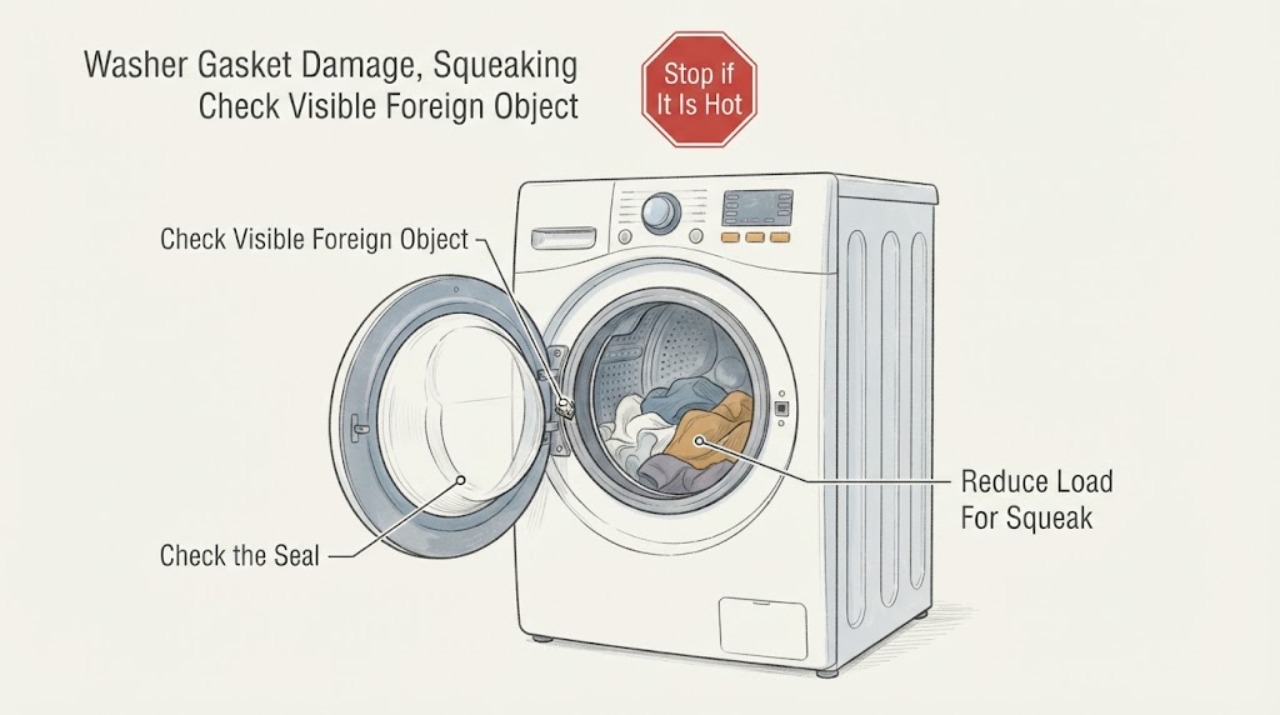
Stop the cycle before investigating. Samsung says a front-load washer's rubber door gasket should be checked for foreign material or damage, and a damaged seal should be serviced; jagged tub or gasket edges can also snag fabric. With the washer stopped, inspect only the visible gasket folds, door glass and drum for hair, thread, metal or other loose objects, and remove only an obvious accessible item. For squeaking, Samsung says to stop and reduce an overloaded load; if the sound continues with a comparable small load, service is required. Also check level, balance, external hoses or cords touching the cabinet, and front-load shipping bolts when applicable. Do not reach into a moving drum, run a cycle with a torn seal, open the cabinet or identify a bearing, belt or motor from the sound alone.
Work through in order
Diagnostic checks
Use only checks that match the exact appliance or system and its official guide.
-
Check 1
Stop the cycle and inspect the visible door gasket folds and door glass for a tear, crack, displaced section, trapped hair or thread, or a place where the drum could rub.
Expected result: The gasket is visibly damaged or rubbing, or it is intact and no trapped material is visible.
Next step: Do not run the washer with a damaged or rubbing seal. Request service and avoid forcing the gasket back into place or ordering a seal without the exact model.
Why this matters
Why: Samsung says a damaged front-load seal can cause leaking and that a torn or jagged edge can snag laundry; a clear visual check does not prove that an internal noise part is healthy.
-
Check 2
With the washer stopped, inspect through the door and around the gasket for an accessible coin, metal item, button, thread, hair or other loose object; do not reach into a moving drum or past a sharp edge.
Expected result: An object is plainly accessible and can be removed without force, or the object is trapped/deep and cannot be safely reached.
Next step: Remove only the plainly accessible object. If it is trapped, the gasket is pulled, or a sharp edge is present, stop and arrange service instead of dismantling the washer.
Why this matters
Why: Samsung lists loose objects in the tub and foreign material in the seal as possible noise, snagging or leak contributors, while jagged edges can injure.
-
Check 3
If the gasket and visible drum are intact, stop the cycle and reduce an overloaded or bulky load; redistribute laundry rather than pressing more items into the drum.
Expected result: The squeak disappears with a smaller balanced load, or it returns even with a comparable small load.
Next step: Use smaller balanced loads only when the seal is sound and no other hazard is present. If the sound returns, stop using the washer and request service.
Why this matters
Why: Samsung says squealing, squeaking or grinding often occurs with overloading; persistence with a comparable load is a reason for service, not proof of a specific internal part.
-
Check 4
From outside the machine, check that the washer is level and that the power cord, drain hose or nearby object is not rattling against the cabinet; for a front-load model, confirm shipping bolts were removed during installation.
Expected result: An installation contact, unlevel condition or retained shipping bolt is found, or the installation appears correct while the sound persists.
Next step: Correct only the accessible installation issue using the model instructions. If the washer remains noisy, do not remove panels or suspension parts; arrange service.
Why this matters
Why: Samsung identifies level, external contact and front-load shipping bolts as noise checks; some hand-spun tub clanking can also be normal on VRT models.
-
Check 5
Record the exact model code, whether the sound occurs during wash, spin or drain, whether the door was closed, and whether there is a leak, odor or visible gasket damage.
Expected result: The sound or leak resolves after a safe external correction, or the gasket/noise problem remains.
Next step: Keep the washer out of use when damage or leaking remains and use Samsung's model support or repair path. Do not select a bearing, belt, motor or gasket from symptom wording alone.
Why this matters
Why: A resolved load or contact issue does not establish an internal failure. Persistent noise, a damaged seal or a closed-door leak needs model-specific service.
Use your observations
Decision map
Find the observation that best matches what you see, then follow the next safe action.
-
PATH 01Next step
What you see
A visible object is removed safely and the squeak or rattle does not return with the washer stopped and the seal intact.
Do this next
Inspect the load pockets before future cycles and stop again if the noise, rubbing or leaking returns.
Why this path and its safety boundary
Why it matters: The observation supports an accessible foreign object as the contributor; it does not establish that internal parts are unaffected.
-
PATH 02Next step
What you see
The gasket is torn, displaced, visibly rubbing, or has an edge that can snag fabric.
Do this next
Do not run another cycle or attempt an unverified gasket repair; use the exact model support path for service.
Why this path and its safety boundary
Why it matters: Samsung treats a damaged seal or damaged washer as a service condition because it can leak or damage laundry.
-
PATH 03Next step
What you see
The squeak disappears after reducing an overloaded load, with no gasket damage, leak or sharp edge.
Do this next
Use balanced loads within the model's capacity and stop if the sound returns with a normal load.
Why this path and its safety boundary
Why it matters: The pattern is consistent with Samsung's overloading explanation for squealing or squeaking and does not prove a failed drive part.
-
PATH 04Next step
What you see
The noise returns with a comparable small load, persists after level/contact checks, or is accompanied by rubbing, burning odor or a leak.
Do this next
Stop using the washer, keep clear of leaking water, and request Samsung or qualified appliance service. Do not open the cabinet or run repeated diagnostic cycles.
Why this path and its safety boundary
Why it matters: Samsung directs owners to service when the noise persists; the added symptom raises the need for prompt professional assessment but does not identify a particular component.
-
PATH 05Next step
What you see
The exact model is unknown or the washer's design does not match a front-load gasket description.
Do this next
Find the model code and use Samsung's washer support search before ordering parts or following model-specific instructions.
Why this path and its safety boundary
Why it matters: Seal layout, shipping-bolt configuration and service procedures vary by model; the general symptom cannot establish a model-specific part or procedure.
Helpful context
Understand the symptom
Treat a damaged gasket as a leak and fabric-snag risk
A door gasket that is torn, cracked, pulled out of position or rubbing the drum can let water escape or catch clothing. Samsung recommends inspecting the rubber seal for foreign material or damage and requesting service if it is damaged. Do not run another wash merely to reproduce a squeak when the seal is visibly compromised.
Inspect only visible, stopped-machine areas
After the cycle is stopped, look through the door and around the gasket folds for hair, thread, metal, buttons or another accessible object. Samsung cautions that jagged edges inside the tub can cause injury. Remove only a loose item that can be reached without forcing the gasket or reaching past a sharp edge; a trapped object or damaged seal is a service issue.
Use the sound and load pattern, not a guessed part
Samsung describes squealing, squeaking and grinding as sounds that can occur with an overloaded washer. Stop the cycle and reduce the load. If the seal and visible drum are intact, the washer is level, and the sound returns with a comparable small load, request service. That result does not identify a belt, bearing, motor or other internal component.
Check installation contributors without opening the cabinet
A washer can make noise when it is unlevel, when a power cord or drain hose contacts the cabinet, or when a front-load washer still has shipping bolts. Samsung also notes that some hand-spun tub clanking can be normal on models with its VRT system. Check only the accessible installation conditions and the exact model's instructions; do not remove panels or alter suspension hardware to chase the sound.
Escalate when damage or persistent noise remains
Keep the washer out of use if the gasket is damaged, water leaks with the door closed, a jagged edge is visible, the noise persists after a safe load correction, or the drum appears to contact the seal. Record the model code and a description of when the sound occurs, then use Samsung's model-specific support path. The official guidance does not support diagnosing or replacing an internal drive part from this symptom alone.
When checks do not resolve it
Need a professional?
Request Samsung or qualified washer service for a torn or displaced gasket, a closed-door leak, a jagged edge, a trapped object, persistent squeaking with a normal load, or noise accompanied by rubbing or burning odor. Do not choose a gasket, belt, bearing, motor or other part without the exact model and a supported diagnosis.
Common questions
FAQ
Can a foreign object in a Samsung washer cause squeaking?
It can cause rattling, clicking, rubbing or fabric snagging, but the sound alone does not identify where the object is. Inspect only visible stopped-machine areas and request service if the item is trapped or a sharp edge is present.
Can I keep using the washer if the rubber door gasket is torn?
No. Samsung says a damaged front-load door seal should be serviced. A damaged or rubbing gasket can leak or catch laundry, so do not run another cycle to test it.
Does a squeaking Samsung washer always need a new bearing or belt?
No. Samsung first distinguishes load weight, level, external contact, loose objects and normal model-specific sounds. Persistent noise with a comparable load needs service, but the symptom does not prove which internal part is involved.
Read the exact guide
Official sources
- Laundry is stained or damaged after using Samsung washing machineSamsung Electronics America · Official Samsung washer guidance to inspect the tub and front-load rubber gasket for jagged or torn edges that can snag laundry, with service when the appliance is damaged.
- Samsung washing machine is leakingSamsung Electronics America · Official Samsung washer guidance for front-load door-seal inspection, foreign material, damage and service when the seal is damaged.
- Washers | Samsung Support USSamsung Electronics America · Official Samsung washer support hub that searches by model code or product name and provides manuals and repair-request paths.
- Samsung washing machine is too noisySamsung Electronics America · Official Samsung washer guidance for squealing, squeaking, grinding, rattling, loose objects, level, load, shipping bolts, external contact and service escalation.
Community feedback
Share a repair observation
Share a plain-text repair observation. Accepted observations are published automatically; this page may take a moment to update.