
On this page
Start here
Quick answer
Stop the Samsung WF-J1254 before another high-speed spin when loud banging is accompanied by water on the floor. Shut off the water supply if the leak is active, isolate power only from a dry safe location, and do not reach into a moving or water-filled drum. With the washer empty, cool, and safe to inspect, first locate the leak: front door seal, detergent drawer, drain hose or filter area, or underneath. Samsung says an outer door seal that rubs the drum can cause unusual noise and a burning smell, while an unlevel machine, shipping bolts, an unbalanced load, or overloading can cause spin vibration. Repair is reasonable when the confirmed fault is an accessible gasket, hose, filter-cap, drawer, leveling, or load issue; persistent roar, drum looseness, repeated leakage underneath, or a damaged tub or drive needs a qualified diagnosis before any repair-versus-replace decision. Do not use price or age cutoffs as a substitute for identifying the fault.
Before you begin
Safety first
- Do not run another high-speed cycle with an active leak or violent noise. Do not reach into a moving or water-filled drum, pull a wet plug, open the cabinet, tip the washer, bypass the door lock, or perform live electrical testing.
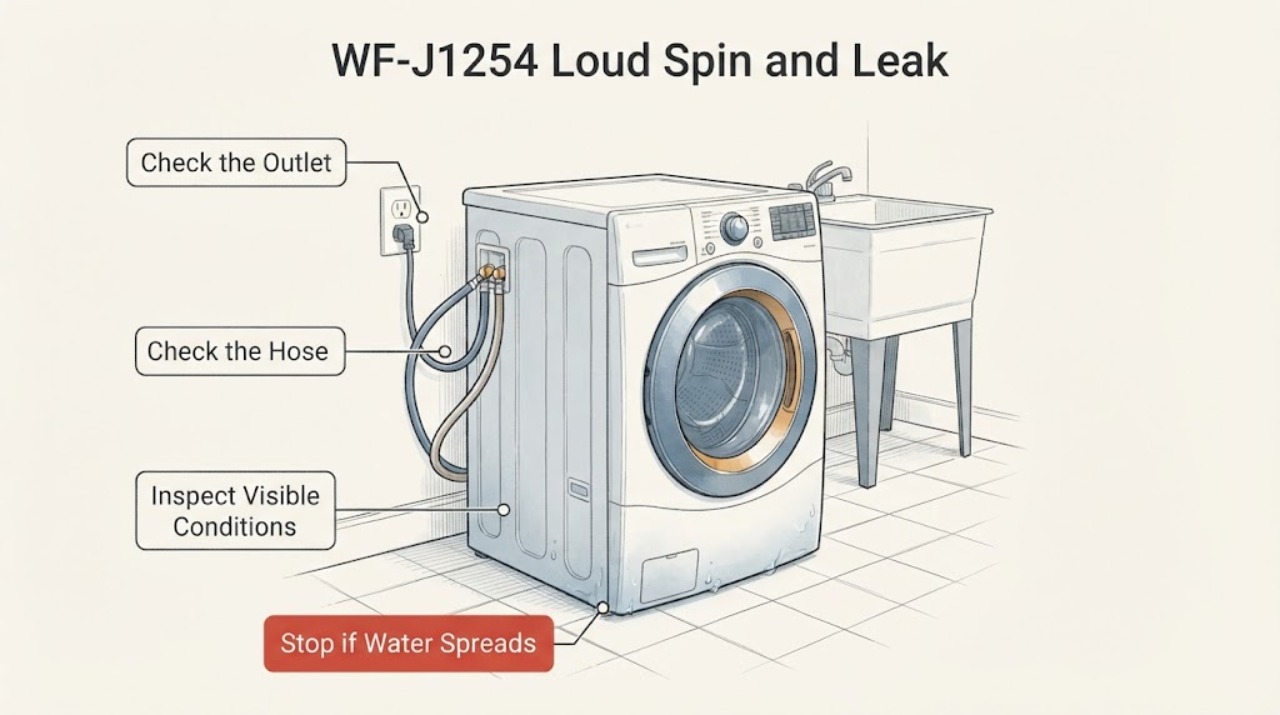
Work through in order
Diagnostic checks
Use only checks that match the exact appliance or system and its official guide.
-
Check 1
Stop the programme normally. If water is actively flowing, shut the washer's supply taps from a dry, safe position. Keep hands away from the door and drum while it moves; if water is near the plug or outlet, do not touch the appliance and use the household disconnect only if it can be done without entering water.
Expected result: Record whether the washer is still moving, whether water is flooding or only dripping, whether the leak is near the outlet or cord, and whether there is smoke, burning odor, a hot plug, or violent cabinet movement.
Next step: Leave the washer off and arrange emergency help for active fire or unsafe flooding. Otherwise wait until the drum is still and the area is dry before any external inspection.
Stop if: Do not restart to reproduce the noise, pull a wet plug, force the door, move a water-filled washer, or reach through the door seal.
Why this matters
Why: A moving drum, water near electrics, flooding, smoke, or violent movement is an immediate stop boundary. The combination of noise and leakage can worsen quickly if another spin is attempted.
-
Check 2
With the washer off, water supply closed, and the drum still, locate the leak without removing panels. Look at the front door gasket and glass, detergent drawer, visible inlet and drain hoses, pump-filter or drain-cap area if this model has one, and the floor beneath the cabinet. Wipe only accessible surfaces after the area is safe.
Expected result: Water starts at the door, drawer, hose connection, filter-cap area, rear, or underneath; the source cannot be seen; or the leak occurs only during high-speed spin.
Next step: Photograph the source and water type, then correct only an obvious accessible debris or hose-position issue. Keep the washer out of service until the leak is confirmed resolved; do not open a pump or cabinet based on a guess.
Stop if: Do not loosen a hose containing water, remove a filter cap over an uncontrolled puddle, dismantle the cabinet, or run a cycle to make the leak appear again.
Why this matters
Why: Samsung associates door leaks with gasket damage, debris, poor sealing, and hinge alignment; it also identifies drain-hose, detergent-drawer, suds, and leveling causes. A leak from underneath or only at high speed can require internal service even when the door looks clean.
-
Check 3
Inspect the door seal closely from outside with the door open and the washer isolated. Look for a tear, hard spot, foreign object, detergent residue, a gap against the glass, or a shiny rubbed track. Turn the drum only gently by hand if it moves freely; do not force it or reach behind the seal.
Expected result: The seal is torn or displaced, debris prevents a clean seal, the seal shows a rubbing track, the drum feels loose or grinds, or the seal and drum appear intact.
Next step: Keep the washer off and request model-specific service for a torn or rubbing seal, drum looseness, grinding, or a leak that persists after accessible cleaning. Do not order a gasket or bearing until the exact model and cause are confirmed.
Stop if: Do not glue the gasket, cut away rubber, force a displaced drum, remove the front panel, or run a high-speed test with a known leak.
Why this matters
Why: Samsung specifically warns that a door seal rubbing the drum can create unusual noise and an unpleasant or burning smell. A damaged seal can explain front leakage, while looseness or grinding shifts concern toward suspension, bearing, tub, or drive components.
-
Check 4
After the leak is safely contained and only if no structural symptom remains, check installation and load conditions from outside: the washer should sit on a solid level floor, all feet should contact the floor, the machine should not touch a wall, and shipping bolts should have been removed on this front-loader. Do not lift or tilt it.
Expected result: The machine rocks, walks, hits surrounding objects, has an unstable foot or floor, shipping bolts were never confirmed removed, or the machine is stable but still becomes violently loud.
Next step: Correct only an obvious external leveling or clearance issue using the exact WF-J1254 manual. Do not run a test until the leak source is repaired; arrange service when the washer cannot be stabilized or the noise persists with a normal load.
Stop if: Do not move a water-filled machine, guess at shipping-bolt removal, place it on an improvised platform, or hold it down during spin.
Why this matters
Why: Samsung identifies leveling, retained shipping bolts, an unbalanced or overloaded load, and inadequate clearance as noise and vibration causes. Stable installation with persistent loud spin makes an internal mechanical problem more likely; installation correction cannot explain an ongoing leak by itself.
-
Check 5
Make the repair-versus-replace decision only after a qualified provider identifies the leak and the source of the spin noise. Give the provider the exact model, leak location, whether the drum has play or grinding, whether the noise changes with an empty drum, and whether leveling or load correction changed anything.
Expected result: The confirmed problem is an external gasket, hose, drawer, filter-cap, leveling, or load issue; the leak is internal or underneath; the drum or tub has looseness; or the diagnosis requires a major drive, bearing, tub, control, or structural assembly.
Next step: Repair when the confirmed fault and scope are acceptable after model-specific diagnosis. Consider replacement only after comparing the documented repair scope, parts availability, safety condition, and the appliance's role in the household; do not decide from the symptom or model age alone.
Stop if: Do not approve a bearing, tub, motor, suspension, pump, or control replacement solely from loud spin and water on the floor, and do not keep operating to postpone the decision.
Why this matters
Why: A confirmed localized external or installation fault is a repair decision with a clear scope. An internal leak combined with persistent loud spin may involve multiple interacting components; the repair quote and parts availability must be evaluated after diagnosis, without inventing a universal age or price rule.
Use your observations
Decision map
Find the observation that best matches what you see, then follow the next safe action.
-
PATH 01Next step
What you see
Water is clearly coming from the front door area, and the gasket has a tear, foreign material, poor contact, or a rubbing track; noise is localized to the seal or the drum edge.
Do this next
Keep the washer off and obtain an exact-model gasket and door-seal diagnosis. Repair is the sensible first decision if the provider confirms the seal is the complete fault; replace only after a broader tub or drive problem is documented.
Why this path and its safety boundary
Why it matters: Samsung identifies gasket damage, debris, poor sealing, and seal-to-drum rubbing as a combined leak/noise path. The rubbing symptom can also produce an unpleasant or burning smell.
-
PATH 02Next step
What you see
Water starts at a visible drain hose, filter-cap, detergent drawer, or door-debris location, while the drum has no looseness or grinding and the machine is otherwise stable.
Do this next
Correct or have service correct the exact hose, cap, drawer, or gasket condition using model-matched parts. Do not run the washer until the leak is resolved and the floor and electrical area are dry.
Why this path and its safety boundary
Why it matters: A localized external leak or accessible residue is more likely than a major tub or bearing failure, but the connection must be confirmed dry and secure before operation.
-
PATH 03Safety boundary
What you see
The washer is level and stable, the load was ordinary and balanced, the leak is absent when stationary, but high-speed spin produces a persistent roar, grinding, drum play, or water from underneath.
Do this next
Keep the washer out of service and request a written model-specific diagnosis. Compare repair or replacement only after the provider identifies whether the leak and noise share one fault or are separate.
Why this path and its safety boundary
Why it matters: The combination is more concerning for an internal suspension, bearing, tub, drive, seal, or related structural fault than for a simple load imbalance. Samsung directs persistent mechanical symptoms to professional assistance.
Safety stop: Do not continue spin cycles to see how quickly the condition worsens, open the cabinet, or select an internal part without diagnosis.
-
PATH 04Next step
What you see
The noise changes or disappears after a normal, balanced load and a verified level installation, and the leak is traced to a corrected external hose, drawer, gasket-residue, or leveling condition.
Do this next
Follow the exact manual, confirm the leak area stays dry, and run at most one supervised low-risk test only when the provider or manual permits it. Stop immediately for renewed water, violent movement, rubbing, or grinding.
Why this path and its safety boundary
Why it matters: An operating or installation condition is more likely than an immediate major drive failure, but a previous leak still requires a dry inspection before one controlled test.
-
PATH 05Safety boundary
What you see
Water is flooding, reaches the plug or outlet, the washer moves violently, smoke or burning odor appears, or the leak cannot be isolated without wet electrical contact or cabinet access.
Do this next
Leave the washer off, close the water supply if safely reachable, isolate power only from a dry safe location, and contact emergency help for fire or unsafe flooding. Arrange qualified appliance or electrical service for the appliance.
Why this path and its safety boundary
Why it matters: This is an immediate safety boundary, not a repair-versus-replace troubleshooting branch.
Safety stop: Do not pull a wet plug, reset a tripping breaker, move the washer while full, or restart it to check whether the hazard has cleared.
Helpful context
Understand the symptom
Loud spin plus a leak is a combined safety symptom, not a reason to keep running the washer until it fails completely. First stop the water and motion, then identify where the water escapes. A front-door leak with rubbing or burning odor is a different decision from a loose drain hose, while a roar or drum looseness with water underneath points to an internal diagnosis. Samsung's public guidance cannot choose a bearing, tub, seal, pump, or other part from the title alone.
WF-J1254 is an older model family with regional variants and a model-specific manual. Use the rating label and the exact manual for any procedure, and treat a repair-versus-replace choice as the last step after the leak location and mechanical condition are known. No universal age or price cutoff is asserted here.
Only after diagnosis
Potential parts
- door gasket or seal
Consider only if inspection and model-specific diagnosis confirm a torn, displaced, leaking, or drum-rubbing seal.
Confirm the complete WF-J1254 regional suffix and fitment; a front leak or loud spin alone does not identify a gasket. - drain hose, filter cap, or detergent-drawer component
Consider only after the leak location is confirmed at that accessible component and the exact manual or provider identifies the needed part.
Do not order a hose, cap, or drawer component from the symptom alone; regional variants and connectors must match. - suspension, bearing, drive, tub, or related seal assembly
Consider only after a qualified provider confirms internal drum looseness, grinding, structural leakage, or another specific mechanical fault.
These are diagnosis-dependent classes, not a recommendation to replace all listed parts; verify the exact model and repair scope before deciding repair or replacement.
When checks do not resolve it
Need a professional?
Call qualified appliance service for a recurring leak, water underneath, a damaged or rubbing gasket, drum play or grinding, persistent roar with a balanced load, an inaccessible drain or tub fault, or any repair-versus-replace decision involving internal parts. Call qualified electrical help when water reaches the cord or outlet.
Safety scope: Do not run another high-speed cycle with an active leak or violent noise. Do not reach into a moving or water-filled drum, pull a wet plug, open the cabinet, tip the washer, bypass the door lock, or perform live electrical testing.
Have this ready
- Provide Samsung WF-J1254 and its full regional suffix, serial information, where the water starts, whether the water is clear or soapy, whether the drum has play or grinding, the selected cycle and load, level and shipping-bolt observations, and photos of accessible damage.
Common questions
FAQ
Is a loud spin with water at the front always a bad bearing on the Samsung WF-J1254?
No. Samsung also identifies door-seal damage or rubbing, foreign material, an unlevel machine, shipping bolts, an unbalanced or overloaded load, and other installation conditions. A bearing or tub fault becomes more concerning when the drum has play, grinding persists with an empty drum, or water comes from underneath; diagnosis is required.
Can I keep using the washer until it stops completely?
No. Stop when loud spin and leakage occur together. Another high-speed cycle can spread water into electrical areas or worsen a seal, suspension, bearing, tub, or drive fault. Close the water supply and isolate power only from a dry safe location.
Should I repair or replace this Samsung WF-J1254?
Make that choice after the leak and noise are identified. A confirmed gasket, hose, drawer, filter-cap, leveling, or load issue has a defined repair scope. A major internal tub, bearing, structural, or multiple-component fault needs a provider's documented assessment and parts-availability check. There is no universal age or price cutoff that can decide it safely.
Can I run a spin cycle with an empty drum to test the noise?
Do not run an empty spin while the leak is unresolved or the washer has violent movement, rubbing, grinding, burning odor, or drum looseness. Record what happened, inspect only from outside when isolated and dry, and use qualified service for persistent symptoms.
Read the exact guide
Official sources
- What to do if your washing machine leaks?Samsung Gulf · Used for general leak-source separation and safety; it supports most Samsung models but does not prove compatibility of any WF-J1254 part.
- Samsung washing machine leaking from the front doorSamsung Levant · Used to identify front gasket, foreign material, sealing, hinge, detergent residue, and door-glass checks; exact WF-J1254 repair procedures remain model-specific.
- What to do if your washing machine is noisy or vibratingSamsung UK · Used for symptom interpretation and safe external checks; Samsung notes procedures and models vary, so the WF-J1254 manual controls exact steps.
- Why is my Washing Machine making Noises?Samsung Australia · The page is for Australian products and explicitly warns that models and settings vary; it is used only for general symptom separation and the professional-service boundary.
- WF-J1254 SupportSamsung Canada · The opened support page lists WF-J1254/XAC and links a user manual; exact suffix and market must still be matched before applying a procedure.
Community feedback
Share a repair observation
Share a plain-text repair observation. Accepted observations are published automatically; this page may take a moment to update.