
On this page
Start here
Quick answer
A Samsung washer that leaves water in the tub may be paused in a rinse-hold or soak stage, blocked by a kinked or badly positioned drain hose, slowed by excess suds, or reporting a model-specific no-drain code such as 5C, 5E, or nd. First note the washer type, cycle stage, exact code, and whether the door or lid is locked; do not keep restarting a machine that is leaking, hot, or electrically unsafe. Check only the visible hose and standpipe from ordinary access. A pump or debris filter is a front-load feature on applicable models, not a universal top-load step, and Samsung's procedure requires the washer to be unplugged, the remaining water collected, and recently hot water allowed to cool. If the water is near electrical parts, the washer is leaking or very hot, there is a burning smell, smoke, a spark, a hot outlet, or a repeated breaker trip, stop and arrange qualified service or electrical help.
Before you begin
Safety first
- This article covers ordinary-access observation and only the exact-model, front-load filter procedure when the washer is cool, unplugged, stable, and dry around power. It does not authorize cabinet access, live electrical testing, interlock bypass, appliance tilting, or work on an unsafe leak or hot-water condition.
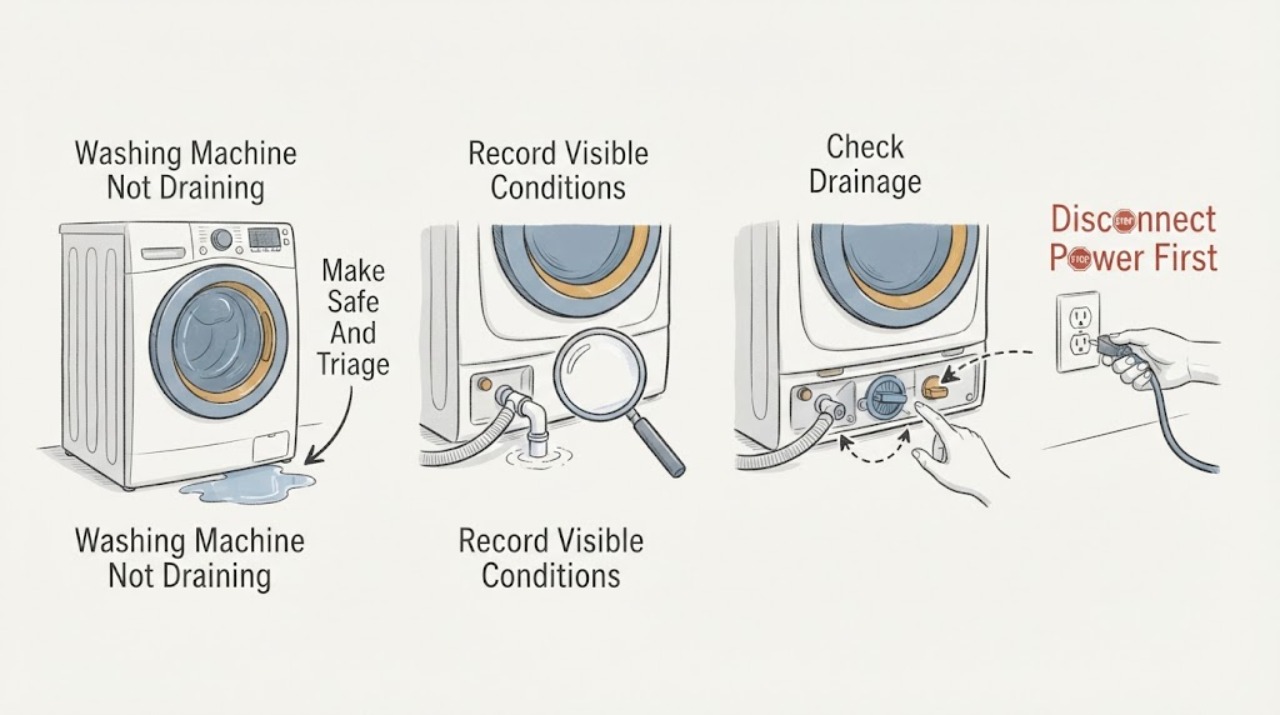
Work through in order
Diagnostic checks
Use only checks that match the exact appliance or system and its official guide.
-
Check 1
Stop the cycle and assess the floor, tub or drum, water temperature, cord and outlet from a dry position before touching the washer or controls; if the model manual permits it and there is no water near electrical parts, remove power using the normal safe method.
Expected result: Record whether water is standing, spilling, or hot; whether the plug or outlet is wet, hot, discolored, or loose; and whether there is a burning odor, smoke, spark, shock, or breaker trip.
Next step: For any electrical or water hazard, keep people away, do not touch a wet plug, do not repeatedly reset the breaker, and arrange qualified appliance or electrical help. Otherwise continue by recording the washer identity and symptom without restarting repeatedly.
Stop if: Stop immediately for hot water that could scald, a leak or flood, water near the cord or outlet, burning smell, smoke, sparks, shock, a hot outlet, or a repeated breaker trip.
Why this matters
Why: Standing water near electrical parts, a hot or damaged outlet, smoke, odor, sparks, shock, or repeated tripping is a safety fault rather than an ordinary drain blockage. A contained, cool, dry washer with no electrical warning can proceed to non-invasive observations.
-
Check 2
From the display and rating label, record the Samsung model, front-load or top-load design, selected cycle, elapsed stage, exact code or blinking pattern, amount of water left, and whether the door or lid is locked.
Expected result: Classify the symptom as water left after wash or rinse, a cycle paused before spin, a drain pump that is silent or humming, a locked door or lid, or a displayed code such as 5C, 5E, nd, SC, SUd, or a model-specific code.
Next step: Photograph the display and use the exact Samsung manual to identify the cancel, drain, or safe reset control. Do not force the door or lid and do not guess a part from the code alone.
Stop if: Stop if the door or lid is damaged, the latch will not release after the documented safe drain procedure, or the washer is hot, leaking, smoking, sparking, or electrically unsafe.
Why this matters
Why: A no-drain code focuses the check on water removal; a suds code may represent a temporary pause; and a locked front-load door can simply mean water is still detected. The same characters can have model-specific variations, so an exact code and manual are needed before interpreting an internal fault.
-
Check 3
Without moving the washer or opening panels, inspect the visible drain hose, hose guide, standpipe or laundry sink, and nearby floor drain for a kink, crushing, loose hose, excessive insertion, an airtight seal, or an obvious household drain backup.
Expected result: Record whether the hose is free and supported, whether the standpipe or sink accepts water, whether the hose end is at the model-specified height and depth, and whether water backs up outside the washer.
Next step: Correct only a plainly visible hose position issue according to the exact installation manual; clear an accessible household drain without pushing objects into the washer. Request service if the route is clear, the appliance must be moved, or the rear restraint or internal hose would need to be disturbed.
Stop if: Do not remove the rear drain-hose restraint, tilt or pull a heavy or stacked washer, open a panel, or work where a leak could reach electrical parts.
Why this matters
Why: A kink, crushed hose, blocked household drain, or incorrect hose position can restrict flow or create siphoning. A clear external path with water still trapped points toward a filter, pump, internal hose, control, or door/lid interlock that requires model-specific diagnosis.
-
Check 4
Check from ordinary access that the front door or top lid is fully closed, no garment is caught in the seal or latch, and the displayed lock indicator matches the exact model instructions; never bypass or defeat the interlock.
Expected result: Record whether the latch closes and locks normally, whether a door or lid code appears, and whether the washer refuses to drain or spin only when the lock indication is absent.
Next step: Remove only a visible item caught at the seal, then use the model-authorized cancel or drain control once. If water remains or the lock fault returns, preserve the code and arrange service.
Stop if: Do not pry the door, insert tools into the latch, bypass the lock, or reach into a moving or water-filled tub.
Why this matters
Why: Samsung washers may require a closed and locked door or lid before drain and spin-related operation, and a front-load door can remain locked while water is inside. A damaged latch, persistent door code, or lock that does not respond is a service condition, not a reason to force the door.
-
Check 5
If there is no leak or electrical hazard, observe the water and foam through the normal opening or display without adding detergent, and compare the selected cycle and spin setting with the exact manual; use a manufacturer-authorized cancel, Rinse+Spin, or drain command only once when the door or lid is safely closed.
Expected result: Record visible persistent suds, a rinse-hold or soak setting, whether the cycle resumes after the documented pause, and whether water drains during the single authorized command.
Next step: Use only the detergent type and amount stated for the model, allow the documented suds pause to finish, and do not keep adding detergent or repeatedly restarting. If the tub still will not drain, continue to the conditional filter check or service branch.
Stop if: Stop for hot water, overflow, a leak, abnormal pump noise, burning smell, smoke, sparks, or a breaker trip; do not run an empty-cycle experiment if water could reach electrical parts.
Why this matters
Why: Samsung identifies SUd, 5UD, Sd, 5d, SUdS, and 5Ud5 as excessive-suds conditions that can pause a cycle while foam dissipates. Rinse Hold or a model-specific cycle setting can also leave laundry in water; no drainage after suds clear or after one authorized command keeps the drain-path fault active.
-
Check 6
Only if the exact front-load model manual identifies a user-accessible pump or debris filter and the washer is unplugged, cool, stable, and dry around the electrical connection, open the documented access panel, drain through the emergency hose if fitted into a suitable container, and clean the filter with the instructed soft method.
Expected result: Record whether the filter access exists, whether the emergency hose releases water, whether lint or a foreign object obstructs the filter, whether the impeller is visibly free, and whether the filter and cap reseat without force or leakage.
Next step: Reinstall the filter and hose cap exactly as documented, close the panel, and perform only one model-authorized drain or Rinse+Spin check if the area remains safe. Skip this action and request service when the manual does not identify the access or any condition is unsafe.
Stop if: Do not open an undocumented panel, use force, handle hot water, reach into a jammed impeller, tilt the appliance, or continue if water is near electrical parts or the refitted filter leaks.
Why this matters
Why: A blocked filter can reduce or stop draining, but top-load models do not have the same pump-filter access and some older or different models omit the emergency hose. A clear filter with no drain, a damaged impeller, or a filter that will not reseat points toward a pump or internal fault.
-
Check 7
After a safe external correction or the exact-model filter procedure, run no more than one manufacturer-authorized drain or Rinse+Spin confirmation and observe the complete result without opening the cabinet.
Expected result: Record whether the tub empties, the door or lid unlocks normally, the pump sounds normal, the cycle reaches spin, and the same code, leak, unusual noise, or electrical symptom returns.
Next step: Stop testing and provide the technician with the model, cycle stage, code, water temperature and level, hose and household-drain observations, filter result if applicable, lock behavior, detergent or suds observations, and any electrical warning.
Stop if: Do not repeat the cycle, reset, or breaker test when the fault returns; stop immediately for smoke, burning odor, sparks, hot water, a leak, shock, abnormal grinding, or a trip.
Why this matters
Why: A complete drain with no recurring code supports a corrected hose, suds, setting, or accessible-filter issue. Persistent standing water, a returning no-drain code, a silent or grinding pump, a damaged lock, or a leak after reassembly indicates an internal pump, hose, control, or interlock fault that needs service.
Use your observations
Decision map
Find the observation that best matches what you see, then follow the next safe action.
-
PATH 01Safety boundary
What you see
Water is near the cord or outlet, the water is hot, the appliance leaks or overflows, there is smoke, a burning odor, a spark, shock, a hot outlet, or a repeated breaker trip.
Do this next
Keep clear, do not touch wet electrical parts or repeatedly reset power, and contact qualified appliance or electrical help from a safe position.
Why this path and its safety boundary
Why it matters: The immediate problem is a water, burn, fire, or electrical hazard, not a routine drain blockage.
Safety stop: Do not continue any washer test or filter access while the hazard is present.
-
PATH 02Safety boundary
What you see
The visible hose is kinked or crushed, the standpipe or sink backs up, or the hose position does not follow the exact installation manual.
Do this next
Correct only the plainly visible position issue or address the accessible household drain; then use one authorized drain confirmation when safe.
Why this path and its safety boundary
Why it matters: The external drain route can restrict discharge or cause siphoning without proving that the pump has failed.
Safety stop: Do not remove the rear restraint, move a heavy or stacked washer, or open a panel to continue this branch.
-
PATH 03Safety boundary
What you see
Persistent suds or a Samsung suds code is present, or the cycle is in rinse hold or soak and the manual says the washer is waiting.
Do this next
Allow the documented pause, use the exact detergent guidance, turn off rinse hold if applicable, and run one authorized drain or Rinse+Spin command.
Why this path and its safety boundary
Why it matters: The washer may be pausing to dissipate foam or holding water by design rather than experiencing a failed pump.
Safety stop: Stop for overflow, hot water, a leak, abnormal pump noise, smoke, burning odor, sparks, or a trip; do not repeatedly restart or add detergent.
-
PATH 04Safety boundary
What you see
The washer is a front-load model and the exact manual identifies a pump or debris filter and emergency drain access; the machine is cool, unplugged, stable, and dry around power.
Do this next
Follow the exact Samsung filter procedure, collect water safely, clean and reseat the filter and cap, then perform one authorized confirmation.
Why this path and its safety boundary
Why it matters: A user-serviceable filter obstruction is a plausible next check, but it is conditional on model design and safe access.
Safety stop: Skip and request service if the model lacks the documented access, water is hot or near electrical parts, the panel needs force, or the filter leaks after reassembly.
-
PATH 05Safety boundary
What you see
The door or lid is not detected as closed and locked, the lock indicator is absent, or a door code remains.
Do this next
Check only the visible seal, latch, and clothing obstruction, use the model-authorized cancel or drain control once, and request service for a damaged or persistent lock fault.
Why this path and its safety boundary
Why it matters: The safety interlock can prevent drain or spin progression, and a front-load lock can remain engaged while water is detected.
Safety stop: Never force the door, bypass the interlock, or reach into a moving or water-filled tub.
-
PATH 06Safety boundary
What you see
The external route is clear, suds or hold settings are excluded, the applicable filter is clear or unavailable, and water still remains or a no-drain code returns.
Do this next
Stop repeated testing and request qualified Samsung appliance service with the recorded code, cycle stage, water condition, observations, and filter applicability.
Why this path and its safety boundary
Why it matters: An internal pump, impeller, hose, control, or interlock fault is more likely than a safe user adjustment.
Safety stop: Do not open the cabinet, test live wiring, bypass a safety device, or substitute a pump without exact model fitment and professional diagnosis.
Helpful context
Understand the symptom
Start with the cycle stage and exact symptom
A washer can appear not to drain when it is in a soak or rinse-hold state, when it has stopped before spin because draining failed, or when a code is being shown. Write down whether water remains in the drum or tub, whether the pump is silent or humming, whether the door or lid is locked, and the complete display code. Samsung notes that the available cycles, buttons, and their behavior vary by model, so use the manual for the exact control sequence. Do not force an interlock or repeatedly run a cycle to see whether it clears.
Check the external drain route before accessing a filter
Inspect the visible drain hose for a kink, crushing, or an end that has slipped too far into the standpipe. Samsung's installation guidance gives model-family installation ranges and warns that an airtight or excessively deep connection can cause siphoning and drain errors; the exact manual for the washer controls a particular installation. Look at the standpipe, laundry sink, or drain opening for an obvious backup without pushing tools into the plumbing. Do not remove the rear screw or move a heavy, stacked, or wet appliance just to reach the hose.
Use the pump-filter procedure only when the model has that access
Samsung describes a pump or debris filter on front-load models and says top-load washers do not have one. If the exact model manual and the front access panel identify a user-serviceable filter, disconnect power, allow a recently hot cycle to cool, place towels and a suitable container, use the emergency drain hose if fitted, and clean only the accessible filter as instructed. Refit the cap and filter securely because an incorrectly seated filter can leak. If there is no documented access, the panel requires force or tilting, or water is hot or close to electrical parts, stop and request service.
Treat codes, suds, and a locked door as evidence rather than a diagnosis
Codes such as 5C, 5E, nd, and SC are grouped by Samsung as no-drain conditions, while SUd or 5UD indicates excessive suds and can temporarily pause a cycle. Door codes can prevent the washer from proceeding, and a front-load door remains locked while water is detected to prevent a spill. Record the code and consult the exact manual instead of applying a different model's code meaning. A single manufacturer-authorized cancel, drain, or reset can confirm the result after a safe external check; a returning code, a failed pump, or a damaged latch belongs with service.
Safety boundary
Stop conditions
- Stop immediately for smoke, sparks, shock, a burning or overheated electrical odor, a hot or discolored outlet, or a breaker that trips again; do not repeatedly reset power.
- Stop for hot or scalding water, a leak or overflow, water near the cord or outlet, or any wet electrical connection; do not touch a wet plug.
- Do not force a locked door or lid, bypass an interlock, reach into the tub or pump, or use tools to defeat a safety mechanism.
- Do not open undocumented panels, tilt or move a heavy or stacked washer, remove the rear drain-hose restraint, or test live wiring.
- Do not clean a pump filter with hot water, do not continue if the filter or hose cap leaks after reassembly, and do not use the front-load filter procedure on a top-load model without documented access.
- Do not keep restarting cycles, adding detergent, or resetting a code after one safe manufacturer-authorized confirmation fails; arrange qualified service.
Only after diagnosis
Potential parts
- drain pump assembly
Consider this category only if the exact model's external drain path is clear, the documented filter is clear or unavailable, and a qualified diagnosis finds that the pump does not move water or has internal damage.
Confirm the complete washer model and the manufacturer's fit information; do not infer a pump from a 5C, 5E, nd, or SC code alone. - pump-filter seal or cap
Consider this category only if the exact front-load model uses a documented user-serviceable filter and the seal or cap is visibly damaged or still leaks after correct, cool reassembly.
Confirm the exact model and the manufacturer's replacement procedure; do not run the washer with a leaking filter or substitute an unverified seal.
When checks do not resolve it
Need a professional?
Request qualified appliance service when the external hose and household drain are clear but water remains, a no-drain code returns, the applicable filter is clear or not user-accessible, the pump is silent or grinding, the lock or lid fault persists, a reassembled filter leaks, or the washer requires panel access. Use an electrician for outlet, cord, shock, arcing, overheating, or repeated-breaker symptoms. Keep the model, cycle stage, code, water temperature and level, hose and standpipe observations, filter applicability, door or lid behavior, detergent or suds result, and safety symptoms for the call.
Safety scope: This article covers ordinary-access observation and only the exact-model, front-load filter procedure when the washer is cool, unplugged, stable, and dry around power. It does not authorize cabinet access, live electrical testing, interlock bypass, appliance tilting, or work on an unsafe leak or hot-water condition.
Common questions
FAQ
Why is my Samsung washer not draining but the pump is humming?
A hum means the pump may be receiving a drain command, but it does not prove that water can pass. Check the visible hose and household drain first, then use the exact front-load filter procedure only if the model documents that access. Stop for grinding, a leak, hot water, odor, smoke, sparks, or a returning code and request service.
Can I open the locked door when water is still in a Samsung front-load washer?
Do not force it. Samsung says the door can remain locked while water is detected to prevent a spill. Follow the exact model's safe emergency-drain instructions only when the washer is cool, unplugged, and safe; otherwise arrange service.
Do all Samsung washing machines have a pump filter?
No. Samsung identifies the pump or debris filter as a front-load feature and says top-load washers do not have one. Confirm the exact model manual and visible access panel before attempting any filter procedure.
What do 5C, 5E, nd, or SC mean on a Samsung washer?
Samsung groups these and related codes as no-drain conditions, but the exact display and remedy can vary by model. Record the complete code, check the visible drain route, and follow the exact manual; a returning code after one safe check needs service.
Can excess detergent make a Samsung washer stop draining?
Excessive suds can pause a cycle and can be shown by SUd-family codes. Use the model-recommended HE detergent and amount, allow the documented pause to finish, and do not add more detergent or repeatedly restart. If water remains after the safe authorized drain attempt, diagnose the drain path or request service.
Read the exact guide
Official sources
- Samsung washing machine does not spin at allSamsung · Samsung troubleshooting guidance; the exact model manual controls whether a particular washer has a pump filter or emergency drain hose.
- Install a Samsung washing machine in your homeSamsung · Samsung installation guidance; dimensions and accessories can differ by model, so the exact manual controls.
- Samsung washing machine information and error codesSamsung · Samsung washer error-code reference; codes can vary by model and exact manual instructions apply.
- CPSC Guide to Home Wiring HazardsU.S. Consumer Product Safety Commission · General household electrical-safety guidance, used here for stop conditions around a powered washing machine.
- How to clean your Samsung washerSamsung · Samsung washer cleaning guidance; filter and cycle availability varies by model.
- Samsung washer door is lockedSamsung · Samsung washer door-lock guidance; exact lock behavior varies by model and load type.
- Cycles, settings, and features on your Samsung washing machineSamsung · Samsung cycle and settings overview; not every cycle or control is present on every model.
Community feedback
Share a repair observation
Share a plain-text repair observation. Accepted observations are published automatically; this page may take a moment to update.