
On this page
Start here
Quick answer
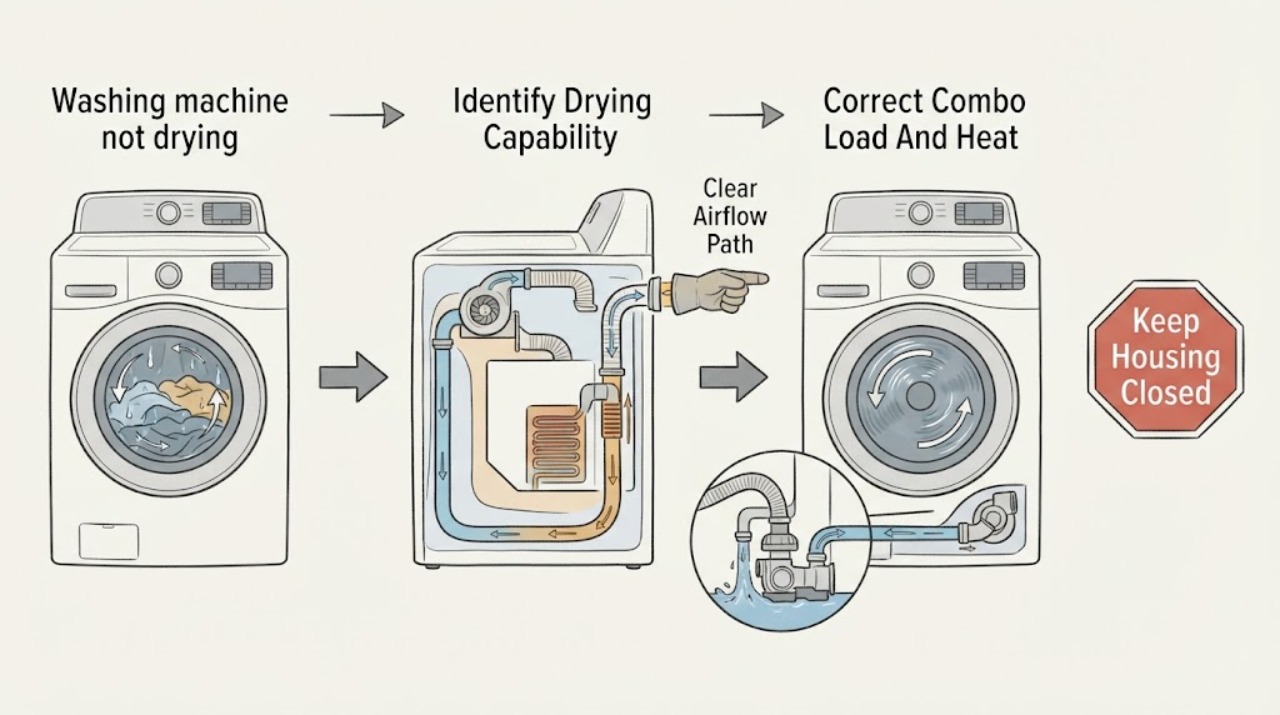
First determine whether the Samsung appliance is a washer-dryer combo or a washer that only washes and spins. A washer without a Dry or drying cycle cannot heat-dry clothes; if the clothes are wet after washing, troubleshoot the final spin and drain instead. On a Samsung washer-dryer combo, reduce an overloaded or mixed-weight load, confirm that a heat setting has not been changed to No heat/Air, clean the model's lint filter and heat exchanger as instructed, and check drainage. If the drum still will not spin, water remains, a vent-blockage test reports a blockage, the appliance shows an error, or an empty-drum calibration does not make the tub move, stop and arrange Samsung or qualified appliance service rather than opening sealed panels or guessing at a heating part.
Before you begin
Safety first
- This article covers identification, ordinary load and setting checks, user-accessible cleaning specified by the model, and safe observation of drain and spin behavior. It does not authorize cabinet removal, live electrical testing, interlock bypass, sealed heating or refrigerant work, or guessed parts replacement.
Work through in order
Diagnostic checks
Use only checks that match the exact appliance or system and its official guide.
-
Check 1
With the appliance idle, check the control panel and the model-specific manual for a Dry, Air, or wash-and-dry cycle; do not remove panels or assume that every Samsung washer has a heater.
Expected result: Classify the appliance as a washer with wash/spin cycles only, a washer-dryer combo with a drying cycle, or a model whose capability cannot be confirmed.
Next step: For a washer-only model, continue with the spin and drain checks below. For a combo, continue with the combo drying checks; if the capability remains unclear, record the model number and ask Samsung Support.
Stop if: Do not energize or disassemble a machine to discover whether it has a heater, and do not treat a washer-only model as a failed dryer.
Why this matters
Why: A washer with no drying cycle is not expected to heat-dry clothes, so damp laundry belongs on the drain-and-spin path. A confirmed combo can be tested for load, heat, filter, heat-exchanger, and airflow conditions. An unconfirmed model should be handled using its exact manual rather than a guessed procedure.
-
Check 2
For a confirmed washer-dryer combo, pause only when the control allows it, separate heavy fabrics from light ones, and compare the load with the model's recommended fill; check that the drying heat is not set to No heat/Air and that the selected dryness and temperature are appropriate for the fabric label.
Expected result: Record whether the drum was overloaded, mostly heavy fabric, extremely small, or set to No heat/Air; after a correctly sized compatible load, note whether drying becomes more even or completes with less residual moisture.
Next step: Run the model-appropriate drying cycle with a correctly sized, fabric-compatible load and compare the result. If the same load remains damp, continue to the filter, heat-exchanger, drainage, and vent checks instead of raising the load size.
Stop if: Do not dry items whose care label or the model manual excludes the selected cycle, and do not exceed the model's stated load or temperature limits.
Why this matters
Why: An overloaded or mixed-weight load can take longer and dry unevenly. A very small load may not tumble properly. No heat/Air is an intentional setting, not evidence by itself of a failed heater. Improvement after a suitable load and setting makes a loading or cycle-selection cause more likely than a failed component.
-
Check 3
With the combo switched off and cool enough to handle, clean the lint filter and heat exchanger only through the access points and method described for the exact model; on a vented combo that supports it, run the model's empty-drum vent-blockage test.
Expected result: Note whether the filter or heat exchanger is visibly loaded with lint or debris, and whether the vent test reports blocked or not blocked; do not infer a result when the appliance lacks that test.
Next step: Restore the cleaned parts correctly and retest with the same suitable load. If the test reports a blockage, clean the vent path as the manual permits or arrange service when the vent is inaccessible; if drying remains poor with a clear path, continue to drainage and service guidance.
Stop if: Do not open sealed heating or refrigerant areas, reach into a moving or hot drum, bypass a filter, or dismantle a vent or heat exchanger beyond the model's ordinary cleaning procedure.
Why this matters
Why: A dirty filter or heat exchanger can restrict the combo's drying process, and a blocked vent test points to an airflow restriction that must be cleaned. A not-blocked result shifts attention back to load, heat setting, drainage, or an internal fault; it does not prove that a heating part is good.
-
Check 4
At the end of a wash or wash-and-dry cycle, check whether water is left in the drum and whether the drain hose is kinked, pinched, or arranged contrary to the model manual; for a front-loader with a user-accessible pump filter, clean that filter only after preparing for residual water and following the manual.
Expected result: Record a dry drum, a small amount of residual moisture with no standing water, standing water, a slow drain, or a pump-filter obstruction; note any drain error or unusual pump noise without putting hands into the pump.
Next step: After a permitted filter and hose check, run the model's drain or spin test. If it drains normally but clothes are still wet, use the balance and spin-setting check; if it still will not drain, arrange service rather than forcing the pump or removing rear hardware.
Stop if: Stop if water is leaking, the filter cap will not release with ordinary safe access, wiring or sealed panels are exposed, or the drain-hose holder or rear fastener is damaged; do not remove the screw that holds the drain hose to the washer.
Why this matters
Why: Standing water or a restricted drain can prevent or limit the final spin and can also interfere with combo drying. A clear filter and hose with continued poor draining makes a pump or internal drain fault more likely. Top-load models may not have the same pump-filter access, so absence of a front filter is not itself a fault.
-
Check 5
If the appliance is a washer-only model or a combo that leaves wet laundry without standing water, redistribute the load, separate a tangled bulky item, and verify that Spin is not set to No Spin or Rinse Hold; use Spin Only or Extra Spin only if the exact model provides it and the fabric permits it.
Expected result: Observe whether the drum reaches a sustained fast spin without repeated stopping, violent wobbling, or a spin-related error, and compare the moisture level before and after the permitted spin test.
Next step: Run a small, balanced test load at a suitable spin speed. If it spins normally and the clothes improve, the original load or setting caused the symptom; if it repeatedly stops or never reaches spin, continue to calibration or service.
Stop if: Do not hold the lid or door open, restrain the drum, wash prohibited bulky items, or continue a test that causes violent movement, burning odor, leaking, or an error.
Why this matters
Why: An uneven, very small, or tangled load can make Samsung washers reduce or stop high-speed spinning, leaving clothes soaking wet. No Spin drains without spinning, while Rinse Hold prevents the cycle from finishing the drain/spin step. A stable fast spin that still leaves water points back toward drainage or a model-specific fault.
-
Check 6
If the tub never begins to spin after the drain, load, and setting checks, empty the washer and use Calibration Mode only when the exact manual supports it; Samsung describes Temp and Delay End held for three seconds as a common method, but button combinations vary by model.
Expected result: During calibration, note whether the display enters the model's calibration state and the tub rotates, or whether the tub remains still, an error appears, or the controls do not match the documented method.
Next step: If the tub moves and the next balanced test works, reassess the original load. If it does not move, request Samsung or qualified appliance service and provide the model, error display, drain result, and calibration result.
Stop if: Do not bypass a lid or door interlock, remove the cabinet, test live wiring, or replace a motor, heater, thermostat, pump, or control board based only on damp clothing.
Why this matters
Why: A completed calibration with tub movement makes an imbalance or learned-load issue more plausible. A tub that does not move during the model-supported calibration, or a model without that mode, leaves a motor, control, door/lid, or other internal fault possible and is not a DIY parts diagnosis.
Use your observations
Decision map
Find the observation that best matches what you see, then follow the next safe action.
-
PATH 01Safety boundary
What you see
The appliance has no drying cycle, the drum is empty of standing water, and clothes remain wet after washing.
Do this next
Check the spin setting, redistribute the load, and run a model-supported Spin Only or Extra Spin test. If a balanced test spins normally, change the load or setting; if it cannot sustain spin, use calibration or arrange service.
Why this path and its safety boundary
Why it matters: This is a wet-spin problem rather than a failed dryer. No Spin, Rinse Hold, a low permitted spin speed, an unbalanced load, or a poor-spin condition is more likely than a heating fault.
Safety stop: Stop for violent vibration, burning smell, leaking, an error, or any need to defeat the lid or door safety.
-
PATH 02Safety boundary
What you see
A confirmed washer-dryer combo completes drying, but a heavy, mixed, overloaded, very small, or No heat/Air load remains damp and there is no standing water.
Do this next
Use a correctly sized, fabric-compatible load, select the documented heat and dryness options, and retest. If the result remains damp, clean the permitted filter and heat exchanger and check the applicable airflow path.
Why this path and its safety boundary
Why it matters: The load or selected drying condition is the leading explanation; this pattern does not establish a failed heater.
Safety stop: Do not exceed the model load limit, dry prohibited fabrics, or open sealed heating areas.
-
PATH 03Safety boundary
What you see
The combo filter or heat exchanger is loaded, or a supported vent-blockage test reports blocked; drying improves after permitted cleaning or the vent is confirmed clear.
Do this next
Restore the cleaned filter or heat exchanger and retest. Clean only an accessible vent path according to the manual, and request service when the blockage is inaccessible or returns quickly.
Why this path and its safety boundary
Why it matters: Restricted lint or vent airflow is a plausible contributor. A clear vent test with continued damp clothes shifts the investigation to load, heat selection, drainage, or service.
Safety stop: Do not bypass filters or dismantle hot, sealed, or refrigerant-related areas.
-
PATH 04Safety boundary
What you see
Water remains in the drum, draining is slow, a drain error appears, or a permitted pump-filter and hose check finds obstruction or damage.
Do this next
Remove only the user-accessible obstruction described in the manual, then retest drain and spin. If water still does not leave or the hose holder, cap, or pump is damaged, arrange service.
Why this path and its safety boundary
Why it matters: The appliance may be unable to complete the drain-before-spin sequence; on a combo, poor drainage can also undermine drying. A clean, correctly routed hose and filter with continued failure makes an internal pump or drain fault more likely.
Safety stop: Stop for a leak, exposed wiring, a stuck filter, damaged rear hose hardware, or any requirement to open the cabinet.
-
PATH 05Safety boundary
What you see
The drain is clear and the load is balanced, but the tub does not move during the model-supported empty-drum calibration or the machine repeatedly stops before high-speed spin.
Do this next
Stop repeated tests, record any display code and the exact model, and request Samsung or qualified appliance service for diagnosis.
Why this path and its safety boundary
Why it matters: The remaining possibilities include an internal drive, control, or safety-interlock problem. Damp clothes alone cannot identify which part has failed.
Safety stop: Do not test live electrical parts, bypass an interlock, or order a motor, pump, heater, thermostat, or board without model-specific diagnosis.
Helpful context
Understand the symptom
“Not drying” can describe two different Samsung appliances
Look at the controls and the model manual before testing parts. If the appliance has no Dry, Air, or wash-and-dry cycle, it is a washer: its job ends after draining and spinning, so clothes that feel wet point to a spin, balance, or drainage issue. If it is a washer-dryer combo, the drying system has its own load, heat, filter, heat-exchanger, and (on vented models) airflow checks. Do not use a generic dryer procedure on a washer that has no drying function.
Read the result before choosing a part
A drying cycle that completes with damp, heavy mixed loads is not the same symptom as a cycle that never heats, a washer that leaves standing water, or a drum that never spins. Use the observed result to choose the next safe check. Samsung notes that not all cycles and settings are available on every model, so use the exact control panel and manual for the appliance in front of you.
Safety boundary
Stop conditions
- Do not assume a washer-only Samsung model should heat-dry clothes; use the wet-spin and drain path instead.
- Do not open sealed heating, refrigerant, electrical, or cabinet areas, test live wiring, or bypass a lid or door interlock.
- Stop for standing water that will not drain, a leak, exposed wiring, a burning odor, unusual smoke, violent vibration, a damaged hose holder, or an error that returns after the permitted checks.
- Do not guess at a heater, thermostat, motor, pump, or control-board replacement from the symptom alone; model-specific diagnosis and fit information are required.
Only after diagnosis
Potential parts
- drain pump assembly
Consider this category only if the pump filter and drain hose are clear, the appliance still cannot drain or complete the drain-before-spin sequence, and a technician confirms pump failure for the exact model.
Confirm the exact model, revision, connector, and manufacturer's fit information before ordering; do not infer pump compatibility from the Samsung brand alone. - model-specific lint filter or heat-exchanger service component
Consider this category only if a confirmed combo has a damaged or missing user-serviceable filter or heat-exchanger component after inspection, and the exact manual or technician identifies it as replaceable.
Confirm the exact combo model and the manufacturer's replacement instructions; do not operate the appliance with a bypassed, missing, or improvised filter.
When checks do not resolve it
Need a professional?
Arrange Samsung or qualified appliance service when a combo remains damp after a correctly sized load, correct heat selection, permitted filter and heat-exchanger cleaning, and a clear applicable vent path; when water remains or will not drain; when the tub never spins or fails model-supported calibration; when an error, burning odor, leak, violent vibration, or damaged hose hardware appears; or when any sealed panel, live electrical test, heater, pump, or control diagnosis would be required.
Safety scope: This article covers identification, ordinary load and setting checks, user-accessible cleaning specified by the model, and safe observation of drain and spin behavior. It does not authorize cabinet removal, live electrical testing, interlock bypass, sealed heating or refrigerant work, or guessed parts replacement.
Common questions
FAQ
Does a Samsung washing machine dry clothes by itself?
Only a Samsung washer-dryer combo has a dedicated drying function. A washer with wash and spin cycles does not heat-dry; if clothes are wet after that cycle, check drain, balance, and spin settings instead of looking for a dryer heater.
Why are clothes wet even though my Samsung washer finished?
The washer may have reduced or skipped high-speed spin because the load was small, tangled, or unbalanced, or because No Spin or Rinse Hold was selected. Standing water or slow drainage can also prevent the drain-before-spin sequence. Check the result before replacing any part.
What should I check when a Samsung washer-dryer combo leaves clothes damp?
Check load size and fabric mix, confirm that No heat/Air was not selected, and clean the lint filter and heat exchanger through the model-approved access. If the combo is vented and supports a blockage test, use that test with an empty drum; also check whether water is draining.
Should I replace the heating element when a Samsung combo does not dry?
Not based on damp clothes alone. First identify the combo model, load and heat setting, filter or heat-exchanger condition, airflow result, and drainage result. Heating-system diagnosis and any replacement should be left to Samsung or a qualified technician with the exact model information.
When should I call for Samsung washer service?
Arrange service when water will not drain, the tub never spins or fails model-supported calibration, an error returns, a leak or burning odor appears, vibration is violent, a hose holder is damaged, or a combo remains damp after the documented load, setting, filter, heat-exchanger, drainage, and applicable vent checks.
Read the exact guide
Official sources
- Samsung Bespoke AI Combo is not drying clothesSamsung · Official Samsung troubleshooting page for Bespoke AI ventless and vented Laundry Combo models; exact model instructions control for other Samsung combos.
- Samsung washing machine spins poorlySamsung · Official Samsung troubleshooting page for washing machines; model-specific control and installation instructions still apply.
- Samsung washing machine does not spin at allSamsung · Official Samsung troubleshooting page for Samsung washing machines; calibration button combinations and pump-filter access vary by model.
- Cycles, settings, and features on your Samsung washing machineSamsung · Official Samsung cycle and setting reference; available cycles and button behavior vary by model and exact manual.
Community feedback
Share a repair observation
Share a plain-text repair observation. Accepted observations are published automatically; this page may take a moment to update.