
On this page
Start here
Quick answer
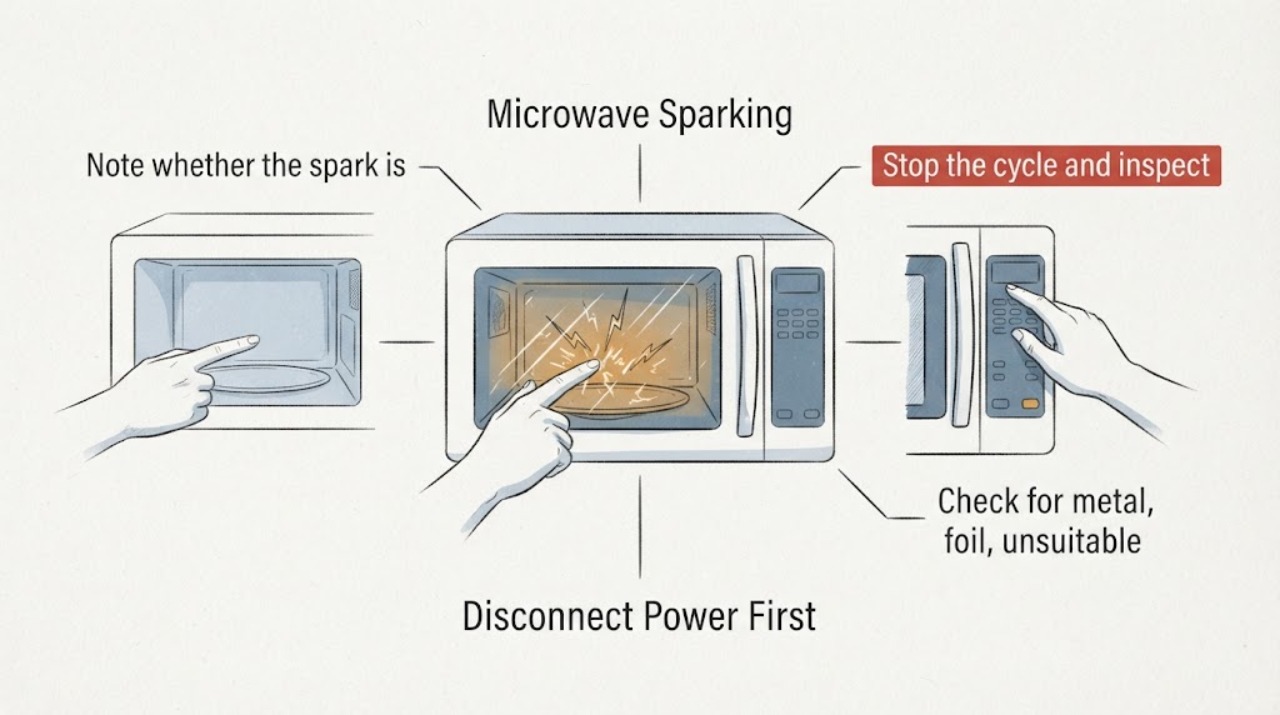
Sparking in a Sharp microwave requires immediate stop. Keep the door closed if material ignites, press Stop/Clear if safe, and disconnect power only when safe. Inspect only for approved cookware, metal, residue, or a damaged waveguide cover.
Work through in order
Diagnostic checks
Use only checks that match the exact appliance or system and its official guide.
-
Check 1
Note whether the spark is in the cavity, at the plug, or outside the cabinet and whether smoke appears.
Expected result: The first visible pattern is recorded without opening the appliance.
Next step: Continue with the stop the cycle and inspect the cavity visually after it is cool and unpowered. check and do not force controls.
Why this matters
Why: This separates the assigned sparking symptom from a different operating state.
-
Check 2
Stop the cycle and inspect the cavity visually after it is cool and unpowered.
Expected result: The accessible control, door, filter, vent, or connection is normal or visibly abnormal.
Next step: Continue with the check for metal, foil, unsuitable cookware, heavy grease, or a visibly damaged waveguide cover. check when safe.
Why this matters
Why: That observation changes whether a user setting or an external obstruction remains plausible; it does not identify an internal part.
-
Check 3
Check for metal, foil, unsuitable cookware, heavy grease, or a visibly damaged waveguide cover.
Expected result: The appliance response after this check is noted: normal, partial, absent, or recurring.
Next step: Use the next branch and stop repeated tests if the symptom persists.
Why this matters
Why: The response distinguishes a temporary state from a persistent fault.
-
Check 4
Observe one later use only if the cavity and door are undamaged and the manual-supported conditions are met.
Expected result: The result is observed once under normal, safe conditions.
Next step: Record the result and avoid internal disassembly.
Why this matters
Why: This confirms whether the symptom follows the control or environmental condition described for this microwave.
-
Check 5
Do not remove the waveguide cover or operate with a damaged door or cavity.
Expected result: The symptom either clears, returns, or is accompanied by another hazard.
Next step: Keep the appliance out of use when the fault returns or safety signs appear.
Why this matters
Why: A returning fault or a hazard needs model-specific diagnosis rather than a guessed component.
-
Check 6
Record the spark location, cookware, residue, cover condition, and whether it recurs.
Expected result: The model, timing, settings, and visible condition are recorded for service.
Next step: Arrange qualified service when the checks do not restore safe, normal operation.
Why this matters
Why: This record lets a technician separate supply, control, airflow, water, or mechanical causes without assuming a part.
Use your observations
Decision map
Find the observation that best matches what you see, then follow the next safe action.
-
PATH 01Next step
What you see
The external setting, door, tray, vent, or visible residue matches the manual and the symptom clears after one documented correction.
Do this next
Apply only the documented user correction once, then monitor; stop if the symptom returns.
Why this path and its safety boundary
Why it matters: This pattern is more consistent with a temporary setting or accessible condition than an internal failure.
-
PATH 02Next step
What you see
The microwave has power or runs, but the assigned symptom persists after the external checks.
Do this next
Stop repeated testing and arrange qualified service with the recorded observations.
Why this path and its safety boundary
Why it matters: This pattern indicates the appliance is powered or connected but the assigned problem persists.
-
PATH 03Next step
What you see
The unit has no power, a blocked/ damaged accessible condition, or a control state that the exact manual must resolve.
Do this next
Isolate power, water, or gas only when safe and obtain qualified help.
Why this path and its safety boundary
Why it matters: This pattern points to a supply, obstruction, or installation issue that cannot be safely corrected internally.
-
PATH 04Next step
What you see
There is smoke, fire, sparking, hot wiring, damaged door/seal, or any need for cabinet access.
Do this next
Stop use, keep clear, isolate only if safe, and seek qualified appliance or electrical service.
Why this path and its safety boundary
Why it matters: This pattern is an immediate safety boundary because the appliance is damaged, overheated, leaking, sparking, or uncontrolled.
Helpful context
Understand the symptom
The Sharp microwave decision for sparking uses the opened operation manual’s external controls, door, cavity, ventilation, and qualified-service boundaries.
When checks do not resolve it
Need a professional?
Provide the full model and serial information, the exact symptom, what changed after each safe check, and any visible hazard to a qualified technician.
Common questions
FAQ
What should I check first for a sharp microwave with sparking?
Record the exact symptom and visible operating state, then perform only the external check supported by the official guidance. Persistent or unsafe symptoms need service.
Can a user setting or accessible obstruction cause this symptom?
It can be one possibility when the documented control state, visible obstruction, or connection matches the symptom. Clear only accessible conditions and stop if the fault returns.
Should I replace a part based on this symptom?
No. The symptom does not establish part compatibility or failure. Give the model and observations to a qualified technician.
When should I stop testing?
Stop for smoke, odor, sparking, uncontrolled heat, leaks, repeated trips, damaged connections, or any need to open the appliance.
Read the exact guide
Official sources
- R-226BS Microwave Oven Operation ManualSharp · Sharp microwave operation and safety guidance for power, door, controls, heating, sparking, odor, noise, and overheating symptoms.
Community feedback
Share a repair observation
Share a plain-text repair observation. Accepted observations are published automatically; this page may take a moment to update.