
On this page
Start here
Quick answer
First protect people, electricity, and frozen food. If water is touching a plug, outlet, controls, or wiring, or if the leak is rapid or reaches the floor, stop using the freezer and isolate power only if you can do so without touching water or creating another hazard. Do not move a heavy freezer to inspect its rear connections. Once the area is safe, identify whether the water is from defrost or condensation, a door that is not sealing, a visible drain path or pan, or a water-fed ice maker/dispenser model. Siemens manuals distinguish water dripping on the floor from a rear pan or drain spout, melting ice after power loss, and a water-connection leak; persistent, internal, or recurring leakage needs qualified service. Protect food while the freezer temperature is uncertain and do not return the appliance to service until the cause is corrected.
Before you begin
Safety first
- Do not move the freezer, open panels, use sharp tools or heat to defrost, touch wet electrical parts, work on a pressurized water line, damage refrigerant tubing, or continue operation with water near power, smoke, sparks, overheating, or repeated trips.
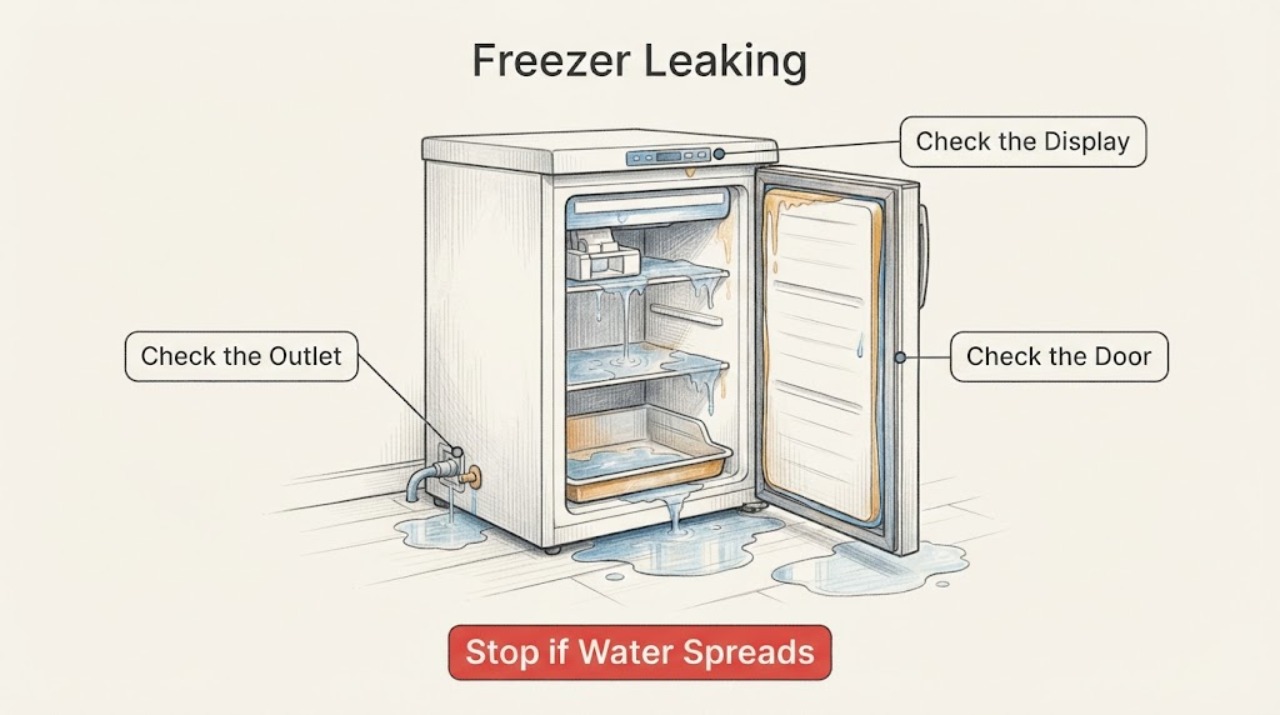
Work through in order
Diagnostic checks
Use only checks that match the exact appliance or system and its official guide.
-
Check 1
Check from a safe position whether water has reached the plug, outlet, cord, controls, lighting, or any wiring, and whether it is spreading across the floor. Keep children and pets away and do not touch wet electrical equipment.
Expected result: Water is near electricity, the leak is rapid or continuous, the floor is slippery or pooling, or the water is limited to a dry, contained area away from electrical parts.
Next step: If it is safe without touching water or the appliance, switch off the appliance and isolate its power at the accessible supply; otherwise leave it alone and obtain qualified help. Contain only water that can be reached without entering the hazard.
Stop if: Stop immediately for shock, smoke, burning smell, sparks, a hot connection, water inside controls, or any need to reach behind a wet appliance.
Why this matters
Why: Water and electricity create a shock and property-damage hazard. A contained drip can be documented, but a wet electrical area or active floor leak takes priority over source tracing.
-
Check 2
Keep the freezer door closed as much as possible and note whether food is still hard frozen, partly thawed, or warming. If food must be moved, do so only after the electrical and floor hazard is controlled and use a safe cold location.
Expected result: Food remains solidly frozen, frost or ice is melting, the appliance has lost power, or food is soft or partially thawed.
Next step: Preserve the cold chain, record any power loss and the time noticed, and follow the exact Siemens manual's thawing guidance. Do not refreeze food that has thawed unless it is cooked first.
Stop if: Stop if food has been contaminated by dirty water, the appliance is warming rapidly, or handling food requires entering a wet electrical area.
Why this matters
Why: A leak can be a defrost or power-loss symptom, and a warmer freezer changes the food-safety decision. The leak should not be treated as only a cosmetic water problem.
-
Check 3
With the appliance stable and the floor safe, use a dry cloth to identify where water first appears: inside a drawer, beneath the door, at a visible rear-bottom pan or drain spout, or beside a water-fed ice maker/dispenser connection. Do not move the freezer or remove covers.
Expected result: Water starts inside or under the door, at a visible pan or drain spout, near a water hose/connection, or the origin cannot be seen.
Next step: Follow the matching branch below. If the source is hidden, recurring, or inaccessible without moving or dismantling the appliance, keep it out of service and arrange qualified inspection.
Stop if: Stop if tracing would require pulling out the freezer, opening a sealed system or panel, touching a wet connection, or reaching near a running fan or compressor.
Why this matters
Why: Location narrows the branch to condensation/door sealing, defrost drainage or pan, water-fed ice/dispenser plumbing, or an internal/unresolved leak. It does not identify a replacement part.
-
Check 4
If water is inside the compartment or under the door, inspect only the visible door seal and closure: look for a trapped package, a visibly separated seal, frost preventing closure, or a door that does not sit squarely. Do not pry ice or remove the seal.
Expected result: The door closes evenly and the seal appears intact, or a package, frost buildup, gap, or door misalignment is visible.
Next step: Remove only a loose visible obstruction and wipe the seal dry. If frost is extensive, use the exact model's safe defrost procedure with power disconnected as directed; arrange service for a damaged seal, hinge, or recurring leak.
Stop if: Stop for a torn seal, damaged hinge, heavy ice that cannot be safely defrosted, water entering controls, or a need to use heat or sharp tools.
Why this matters
Why: Warm humid air can create condensation and frost, while a blocked or damaged seal can allow meltwater to escape. A visible obstruction may be removable without tools; damaged or recurring closure problems need service.
-
Check 5
For a freezer without an active water connection, or when water appears after frost or power loss, inspect only the visible drain path, rear pan, or spout described in the exact Siemens manual. Disconnect power before cleaning or defrosting, and do not use sharp tools, steam, or boiling water.
Expected result: A visible pan is out of position or cracked, a drain spout appears blocked, frost is excessive, the appliance recently lost power, or the visible path appears normal.
Next step: Correct only an obvious, model-documented visible placement or cleaning issue. If water returns, the pan is damaged, the drain is inaccessible, or the freezer does not cool normally, keep it off and arrange qualified service.
Stop if: Stop for water near power, a cracked pan, a blocked inaccessible drain, refrigerant-tube damage, or any need to remove panels or use heat.
Why this matters
Why: Siemens manuals associate floor water with a pan/spout condition or melted ice after power failure and describe condensation drainage and safe defrosting. A hidden blockage, pan damage, or defrost-system fault requires service.
-
Check 6
If the Siemens freezer has an ice maker, dispenser, or household water connection, check only the visible hose and connection for moisture, kinks, or a loose-looking joint without moving the appliance. Turn off the water supply only if the exact manual provides an accessible shutoff and it can be done safely.
Expected result: Water is concentrated at a water connection or hose, the hose is visibly damaged, the leak occurs during ice or water operation, or there is no water-fed feature or visible connection.
Next step: If the hose or connection is wet or damaged, isolate water if safe and keep the appliance out of service until qualified service repairs it. If there is no visible water-line cause, arrange freezer service for a recurring or hidden leak.
Stop if: Stop for a pressurized leak, damaged hose, water reaching electricity, a request to move the freezer, or any hose replacement beyond the model's safe user instructions.
Why this matters
Why: A water-fed model has an additional leak path that does not exist on a dry freezer. Siemens says a non-watertight connection or damaged hose needs qualified replacement and original compatible parts; absence of a visible connection shifts attention to defrost, door, pan, or internal causes.
-
Check 7
Arrange qualified Siemens appliance service when the leak is recurring, the source is hidden, the freezer is warming, the pan or drain is damaged, a water connection is leaking, or a safe external correction does not stop the water. Provide the model and the documented leak pattern.
Expected result: The leak stops after one documented external correction and the freezer remains cold, or it returns, spreads, warms the food, or is accompanied by an error, noise, odor, or electrical symptom.
Next step: Keep the freezer out of service until the technician identifies and repairs the cause. Give the model/E-number if available, leak location, timing, power-loss history, ice/dispenser status, food temperature, and any photos taken only from a dry safe position.
Stop if: Stop use for water near electricity, a continuous or floor-spreading leak, cooling loss, refrigerant-tube damage, smoke, burning smell, sparks, or repeated breaker trips.
Why this matters
Why: A recurring leak may involve an internal drain, defrost heater or sensor, seal or hinge, water valve/hose, ice maker, pan, or wiring. The symptom alone cannot safely select a part.
Use your observations
Decision map
Find the observation that best matches what you see, then follow the next safe action.
-
PATH 01Next step
What you see
Water is touching an outlet, plug, cord, controls, or wiring, or the leak is rapidly spreading across the floor.
Do this next
Do not touch wet electrical parts or move the freezer. Isolate power only from a dry, safe location and obtain qualified or emergency help.
Why this path and its safety boundary
Why it matters: This is an immediate electrical and property-safety stop.
-
PATH 02Next step
What you see
Water appears inside or under the door and a package, frost, door gap, or visibly compromised seal is present.
Do this next
Correct only the visible obstruction or follow the model's safe defrost instruction with power disconnected; service a damaged seal, hinge, or recurring leak.
Why this path and its safety boundary
Why it matters: Warm-air entry, condensation, or frost-related drainage is plausible.
-
PATH 03Next step
What you see
Water is on the floor near a visible rear-bottom pan or drain spout, or ice melted after a power interruption.
Do this next
Check only the visible model-documented pan/spout or ice bucket while keeping the appliance stable; arrange service for damage, hidden blockage, or recurrence.
Why this path and its safety boundary
Why it matters: A pan/spout position or blockage, or meltwater after power loss, is a supported branch for applicable Siemens models.
-
PATH 04Next step
What you see
The freezer has an ice maker/dispenser or water line and moisture is concentrated around a visible hose or connection.
Do this next
Stop ice/water operation, isolate the water supply only if safely accessible, and obtain qualified service for a damaged or non-watertight connection.
Why this path and its safety boundary
Why it matters: A water-connection or hose leak is possible and should not be treated as a defrost-only problem.
-
PATH 05Next step
What you see
The leak source is hidden or inaccessible, water returns after a safe external correction, or the freezer is warming or displaying a fault.
Do this next
Keep the appliance out of service, protect food, and arrange qualified Siemens appliance inspection. Do not move or dismantle it.
Why this path and its safety boundary
Why it matters: An internal drain, defrost, seal, water, cooling, or control problem requires model-specific diagnosis.
-
PATH 06Next step
What you see
The freezer has no ice-maker or dispenser water line and all visible rear, door, pan, and drain checks are normal.
Do this next
Keep it dry and stable, avoid moving it or opening panels, and request qualified service if the water recurs.
Why this path and its safety boundary
Why it matters: A hidden drain/defrost fault, condensation path, or internal leak remains possible; there is no basis for a plumbing-part diagnosis.
Helpful context
Understand the symptom
Stop the water before diagnosing the source
A small amount of meltwater and a pressurized water-line leak do not have the same response. If water is near electricity, the leak is fast, or the floor is becoming slippery, keep clear and stop the appliance safely. Do not pull the freezer out, reach behind it, or remove a panel just to find a hose. A qualified technician can distinguish a drain, pan, door-seal, ice-maker, or supply fault without turning a leak into a larger hazard.
Use the water's location and timing as evidence
Water on the floor behind or under a freezer can point toward a pan, drain spout, or water-fed connection; water inside a drawer or under the door can follow condensation, frost, or a seal that is not closing; a water-fed ice maker or dispenser adds a hose and connection branch. These are observations, not proof of a failed part. Record where the water first appears, whether the freezer lost power, and whether ice or dispensing was active.
Food safety continues while the leak is being handled
A leak may be accompanied by warming or partial thawing. Keep the door closed, move food to a safe cold location only when it is safe to do so, and follow the exact manual's food-safety guidance. Do not refreeze food that has thawed unless it is cooked first, and do not use a freezer with water entering its controls or electrical area.
Safety boundary
Stop conditions
- Water reaches an outlet, plug, cord, controls, lighting, wiring, or any electrical area, or the floor is rapidly pooling.
- The freezer is warming, food is thawing, a critical alarm or fault appears, or a power interruption has not been safely assessed.
- A water-fed hose or connection is pressurized, damaged, or leaking and would require moving the freezer or replacing a line.
- The pan, drain, door seal, hinge, defrost system, refrigerant tubing, or internal area is damaged or inaccessible without panels, tools, heat, or sharp objects.
- Smoke, burning smell, sparks, repeated breaker trips, shock, or any need to move a heavy appliance or work near a running fan/compressor is present.
When checks do not resolve it
Need a professional?
Obtain immediate qualified or emergency help for water near electricity, a rapid floor-spreading leak, smoke, sparks, burning odor, shock, or repeated breaker trips., Arrange qualified Siemens appliance service for a recurring or hidden leak, damaged pan or drain, damaged door seal or hinge, warming freezer, or any unresolved defrost problem., For ice-maker or dispenser models, request qualified service for a leaking or damaged water connection or hose; do not move the appliance or replace a pressurized line yourself., Provide the exact model/E-number if available, leak location, timing, power-loss history, ice/dispenser status, food temperature, water path observations, and safe corrections already attempted.
Safety scope: Do not move the freezer, open panels, use sharp tools or heat to defrost, touch wet electrical parts, work on a pressurized water line, damage refrigerant tubing, or continue operation with water near power, smoke, sparks, overheating, or repeated trips.
Common questions
FAQ
Why is my Siemens freezer leaking water onto the floor?
For applicable Siemens models, water on the floor can involve a rear water pan or drain spout, melted ice after a power loss, or a water connection on an ice-maker/dispenser model. Check only visible, safe areas and arrange service for recurrence or hidden damage.
Can I pull my Siemens freezer out to check the hose?
Do not move a heavy freezer to inspect a leak, especially on a wet floor or near a pressurized connection. Record where water appears and have qualified service inspect inaccessible rear connections.
Could a power outage make a Siemens freezer leak?
Yes, Siemens documentation identifies ice melting after a power failure as one possible explanation for water on the floor. Keep the door closed, protect food, and arrange service if cooling does not return or water recurs.
What if the leak is inside the freezer or under the door?
Check only for a visible package blocking closure, a door gap, frost, or a damaged seal. Warm-air entry and defrost water can contribute to condensation, but a recurring leak with a normal seal needs qualified diagnosis of the drain or defrost path.
What should I do if my Siemens freezer has an ice maker or dispenser leak?
Stop the ice or water function and isolate the water supply only if the exact model provides a safe accessible shutoff. Do not move the appliance or replace a damaged pressurized hose yourself; Siemens reserves damaged-hose replacement for qualified service.
Can I defrost a leaking Siemens freezer with a heater or sharp tool?
No. Use only the exact model's defrost procedure with power disconnected as directed. Do not use sharp tools, steam, or uncontrolled heat, and stop if water reaches electrical areas or the refrigeration tubing is damaged.
When is a Siemens freezer leak an emergency?
Stop immediately for water near an outlet, plug, controls, or wiring, a rapidly spreading floor leak, smoke, sparks, burning odor, shock, repeated breaker trips, or rapid warming and food thawing. Isolate power only from a dry safe location and obtain qualified or emergency help.
Read the exact guide
Official sources
- Instructions for UseSiemens · Official Siemens English freezer manual for a water-fed/freezer product family; exact model instructions and local service guidance control.
- Information for Use KI86V.., KI87V..Siemens · Official Siemens English refrigerator/freezer information manual; use the exact model manual for the applicable defrost and drainage design.
- Built-in Fridges and Freezers SupportSiemens Home Appliances · Official Siemens support category page; it confirms separate Leak, Condensation or humidity, Does not function, fuse-trip, no-ice, and water-dispensing paths but does not replace an exact model manual.
Community feedback
Share a repair observation
Share a plain-text repair observation. Accepted observations are published automatically; this page may take a moment to update.