
On this page
Start here
Quick answer
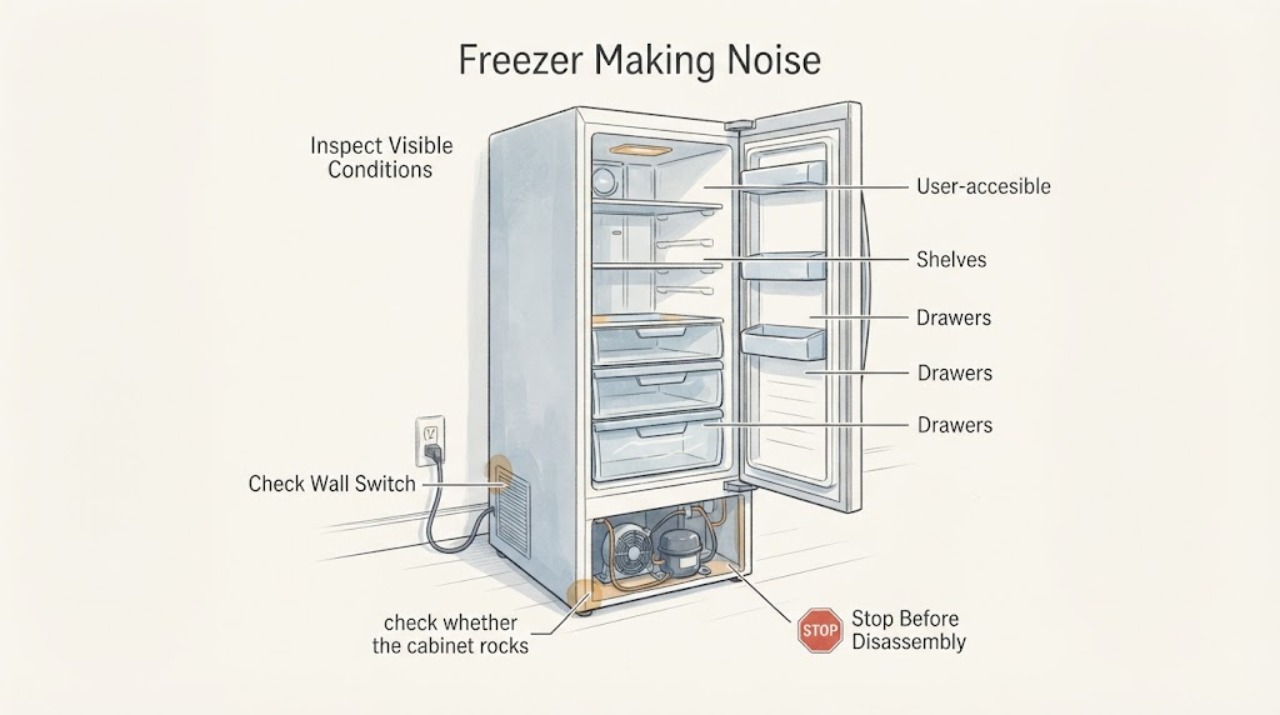
A Siemens freezer may briefly hum, click, gurgle, or move air as the compressor, fan, valves, or refrigerant circuit operate. First note whether the sound is new, continuous, unusually loud, or paired with a warm compartment, alarm, frost, water, burning smell, smoke, sparks, a hot cabinet, or a tripped protective device. Stop the appliance for those warning signs. Otherwise, check that removable containers are seated, receptacles are not touching, the cabinet is stable and clear of adjacent units, and ventilation openings are not blocked. Do not open the sealed refrigeration circuit, remove live electrical covers, chip ice near tubing, or replace a part based on sound alone. If the noise continues after these external checks or cooling is failing, preserve the food and arrange qualified appliance service.
Work through in order
Diagnostic checks
Use only checks that match the exact appliance or system and its official guide.
-
Check 1
If the freezer is running, observe it from outside and record the sound, its location, and whether it changes with compressor or fan operation. If there is smoke, a burning smell, sparks, a hot electrical area, a damaged cord, a repeated fuse or breaker event, or a suspected refrigerant leak, stop using it immediately and do not open any cover.
Expected result: The sound is present without any warning sign, or it is paired with heat, smoke, odor, sparks, electrical protection operation, a damaged tube, or failing cooling.
Next step: For a warning sign, keep people away, isolate power only when safe and permitted, and use qualified or emergency help appropriate to the hazard. For a sound without warning signs, continue only after the appliance is stable and safe to inspect externally.
Stop if: Stop immediately for smoke, flame, burning odor, sparks, a hot plug or cabinet area, repeated fuse or breaker operation, a refrigerant odor or damaged tube, or uncontrolled temperature rise.
Why this matters
Why: A quiet external observation may support a low-risk placement or storage check; a warning sign can indicate an electrical, fire, refrigerant, or cooling hazard that cannot be assigned from sound alone.
-
Check 2
From a safe position, compare the timing and character of the sound with the operating cycle: compressor or motor hum, fan air movement, refrigerant bubbling or gurgling, a switching click, an occasional defrost pop, or a harsh scrape, knock, or grind. Do not place a hand on a moving fan or remove a panel to listen closer.
Expected result: The sound is brief and tied to a start, stop, fan period, or defrost event, or it is continuous, getting louder, or accompanied by vibration or a cooling change.
Next step: If the pattern matches a documented operating sound and cooling is normal, inspect only external contact and storage items. If it is persistent, worsening, or paired with a temperature issue, stop testing and arrange service.
Stop if: Stop if identifying the sound requires contact with the fan, compressor, wiring, refrigerant tubing, or a hot surface.
Why this matters
Why: Siemens documentation identifies several short hum, air, refrigerant, and switching sounds as normal examples. A continuous harsh sound or a sound with reduced cooling needs model-specific diagnosis, even if the freezer still runs.
-
Check 3
With the appliance still, check whether the cabinet rocks gently, touches a wall or neighboring unit, or has a removable trim or panel vibrating against it. For a freestanding freezer, follow the exact Siemens manual for foot adjustment; for a built-in model, do not force the installation cavity or alter fixed supports.
Expected result: The freezer is not stable, an external panel or nearby object touches it, or it stands clear and stable while the sound continues.
Next step: Correct only an obvious external contact or manual-described foot adjustment, then observe one normal cooling cycle. If the sound remains or the unit is built in and inaccessible, arrange service.
Stop if: Stop for a leaning or unstable appliance, damaged housing, a unit that cannot be moved safely, or any need to disturb fixed installation or electrical connections.
Why this matters
Why: A level or clearance issue can amplify normal compressor or fan vibration and a touching surface can create rattling. Stability and clearance do not rule out an internal fan, compressor, or sealed-system fault when the sound persists.
-
Check 4
Open the door only when necessary and, with the appliance stopped if the manual requires it, reseat loose drawers, baskets, shelves, and containers. Move bottles or receptacles so they are not touching one another or the cabinet. Do not overload the compartment or block internal air passages.
Expected result: A loose storage piece or touching container is found, frost or food is obstructing an air opening, or the interior is arranged correctly while the sound continues.
Next step: Reseat or separate only accessible items, then listen during one normal cycle. If the sound remains, or frost is thick enough to contact a fan, follow the exact defrost and service instructions for the model.
Stop if: Stop for a fan striking ice, a damaged liner, a punctured surface, a water leak, or any need to chip ice with a sharp or heated tool.
Why this matters
Why: Loose or touching items can transmit a harmless vibration into a rattling sound; blocked airflow or heavy frost can also affect cooling. A correctly arranged interior with a persistent scrape or knock points away from a simple storage rattle.
-
Check 5
Check only the accessible ventilation openings around the freezer and confirm that the door closes and seals without obstruction. Note whether the temperature alarm is active, frozen food is softening, frost is unusually heavy, or the compressor runs continuously. Do not diagnose or work on the sealed refrigerant circuit.
Expected result: An opening is blocked, the door does not close, an alarm indicates a warm compartment, food is thawing, frost is heavy, or ventilation and closure appear normal.
Next step: Clear only a plainly accessible obstruction and protect the food. If the alarm, warmth, heavy frost, or persistent noise remains, stop normal use and arrange qualified service using the E-Nr. and production details.
Stop if: Stop for a warm compartment with softening food, a damaged seal, heavy frost around a fan, a hot compressor area, refrigerant damage, or an alarm that returns.
Why this matters
Why: Blocked ventilation, an open door, or heavy frost can affect cooling and change compressor or fan behavior. If cooling remains poor with clear ventilation and a good closure, a fan, sensor, compressor, control, or sealed-system issue is possible but cannot be identified safely from sound.
-
Check 6
Only when there is no odor, smoke, spark, leak, heat, or cooling emergency and the manual allows it, make one normal control reset or power cycle using the model instructions. Record whether the sound returns and whether cooling and alarms behave normally; do not repeat resets to suppress a fault.
Expected result: The noise disappears and does not return, or it returns immediately, the freezer remains warm, an alarm returns, or a protective device operates again.
Next step: If the issue returns, leave the freezer out of normal service and arrange qualified appliance repair. Keep the door closed as practical and follow the manual's food-storage safety guidance.
Stop if: Stop for any odor, smoke, sparks, repeated fuse or breaker operation, hot surfaces, a damaged cord, leaking refrigerant, or renewed cooling failure.
Why this matters
Why: A temporary control state may clear once, but a reset cannot prove that a fan, compressor, sensor, control, or electrical circuit is healthy. A recurring noise or alarm is evidence for service, not for repeated cycling.
-
Check 7
Arrange Siemens or qualified appliance service when the noise is persistent, metallic, unusually loud, tied to cooling loss, or not corrected by safe external checks. Provide the E-Nr. or model, production details from the rating plate, sound recording, location and timing, temperature or alarm behavior, and every safe check already performed.
Expected result: The issue repeats with a stable, clear cabinet; the freezer is warming; the sound is a scrape, grind, knock, or severe vibration; or diagnosis would require a rear cover, fan, compressor, wiring, or refrigerant access.
Next step: Keep the appliance out of service when safety or cooling is compromised and let a qualified technician perform model-specific tests. Protect food according to local food-safety guidance.
Stop if: Stop all operation for smoke, burning odor, sparks, repeated electrical trips, a hot cabinet, refrigerant damage, water near electricity, or unsafe food temperature.
Why this matters
Why: The remaining possibilities include a fan obstruction, compressor or motor issue, loose internal support, control or sensor fault, electrical problem, or sealed-system fault. The sound alone does not identify a safe replacement component.
Use your observations
Decision map
Find the observation that best matches what you see, then follow the next safe action.
-
PATH 01Next step
What you see
The sound is a brief hum, fan air movement, bubbling or gurgling, or switching click and the freezer is cold with no hazard sign.
Do this next
Arrange qualified service and follow the exact model guidance.
Why this path and its safety boundary
Why it matters: Compare it with the exact manual, then check only external clearance and loose storage items. Monitor one normal cycle instead of repeatedly restarting the appliance.
-
PATH 02Next step
What you see
The sound changes when a removable container is reseated or when a nearby surface or receptacle is separated.
Do this next
Arrange qualified service and follow the exact model guidance.
Why this path and its safety boundary
Why it matters: Leave the cabinet clear, stable, and level as the manual permits. If the sound returns with a clear cabinet, arrange service rather than assuming the correction was permanent.
-
PATH 03Next step
What you see
A scraping or ticking sound seems to follow the fan, heavy frost, or an internal air opening.
Do this next
Arrange qualified service and follow the exact model guidance.
Why this path and its safety boundary
Why it matters: Stop normal use and follow the model's defrost guidance only if it is safe and does not involve sharp tools or access to tubing. Obtain service if the fan remains obstructed or the liner is damaged.
-
PATH 04Next step
What you see
Noise is paired with a warm compartment, alarm, softening food, heavy frost, or a compressor that runs continuously.
Do this next
Arrange qualified service and follow the exact model guidance.
Why this path and its safety boundary
Why it matters: Limit door opening, protect the food, and arrange qualified service. Do not infer a compressor or refrigerant fault from the sound alone.
-
PATH 05Next step
What you see
The sound is accompanied by sparks, smoke, a burning smell, a hot plug or cabinet area, or repeated fuse or breaker operation.
Do this next
Arrange qualified service and follow the exact model guidance.
Why this path and its safety boundary
Why it matters: Stop using the freezer and seek qualified electrical or appliance help. Do not open the electrical enclosure or repeatedly restore power.
-
PATH 06Next step
What you see
Tubing or the sealed refrigeration circuit appears damaged, or a suspected refrigerant leak accompanies the noise or loss of cooling.
Do this next
Arrange qualified service and follow the exact model guidance.
Why this path and its safety boundary
Why it matters: Keep ignition sources away, ventilate and isolate the appliance only as local safety guidance permits, and contact qualified service. Do not puncture, braze, recharge, or open the circuit.
-
PATH 07Next step
What you see
The freezer is stable and clear but makes continuous grinding, scraping, knocking, or severe vibration, or the sound returns after one safe external correction.
Do this next
Arrange qualified service and follow the exact model guidance.
Why this path and its safety boundary
Why it matters: Keep it out of normal service and provide the E-Nr., recording, timing, cooling result, and observations to qualified Siemens or appliance service.
Helpful context
Understand the symptom
Start with the sound pattern and cooling result
A steady low hum that changes as cooling starts, a brief click before the compressor runs, fan air movement, or a bubbling sound can be part of refrigeration operation on some Siemens models. A new grinding, scraping, knocking, or harsh vibration is different, especially if the freezer is no longer holding temperature. Note when the sound begins, where it is loudest, whether it cycles, and whether the alarm or temperature changes at the same time.
Check contact and placement before suspecting a part
Siemens manuals identify a unit that is not level, contact with nearby furniture, loose containers, or receptacles touching one another as noise sources. With the appliance still, gently check for external contact and reseat only removable storage pieces. Do not pull a built-in unit out by force or touch the compressor, fan, wiring, or refrigerant tubing.
A noisy freezer that is warming is a food-safety problem
If the noise is accompanied by an alarm, softening food, heavy frost, a door that does not seal, or a compartment that is warming, reduce door opening and protect the food while arranging service. Siemens guidance warns that a warm freezer can put frozen food at risk. Do not refreeze thawing food without following applicable food-safety guidance, and do not use a sharp tool to clear ice near tubing.
Stop for electrical, heat, smoke, or sealed-system signs
Smoke, a burning smell, sparks, repeated fuse or breaker operation, a hot electrical area, a damaged cord, leaking refrigerant, or a punctured tube is not a noise-troubleshooting situation. Stop using the freezer, keep ignition sources away from a suspected refrigerant leak, ventilate only as local safety guidance permits, and obtain qualified service. Never open the refrigeration circuit or energized electrical enclosure.
Only after diagnosis
Potential parts
Only if a qualified diagnosis confirms that a fan or its support is causing the persistent sound; do not reach into the fan or clear ice with a sharp tool.
Only after model-specific service confirms an internal motor or mounting fault; normal compressor hum and start clicks do not identify a failed part.
Only when inspection identifies damaged or unstable external hardware and the exact Siemens model documentation confirms the matching component.
Only after qualified diagnosis connects persistent noise with cooling loss; do not open the refrigeration circuit or select a compressor, sensor, or control from sound alone.
When checks do not resolve it
Need a professional?
The freezer makes continuous grinding, scraping, knocking, or severe vibration., The noise returns after the cabinet, storage pieces, and nearby contact are safely checked., The freezer is warming, the alarm returns, food is softening, or frost is obstructing an air path., A fan, compressor, wiring, sealed circuit, or internal mounting needs access for diagnosis., There is smoke, burning odor, sparks, repeated fuse or breaker operation, a hot cabinet, or a damaged cord., Refrigeration tubing appears damaged or a suspected refrigerant leak is present.
Common questions
FAQ
What noises can a Siemens freezer make normally?
Siemens manuals describe compressor or motor hum, fan air movement, refrigerant bubbling or gurgling, and switching clicks as possible operating sounds. A brief normal pattern does not excuse a new continuous scrape, harsh knock, severe vibration, or a sound paired with cooling loss.
Why is my Siemens freezer rattling?
Check whether the cabinet is level or touching a nearby unit, and whether a drawer, container, shelf, or receptacle is loose or touching another item. If the cabinet is stable and clear but the rattle continues, arrange service rather than opening the rear cover.
Can a noisy freezer still be used if it is not warm yet?
Only a short, model-described operating sound without any warning sign may be monitored after safe external checks. Do not keep using a freezer with continuous metal noise, worsening vibration, an alarm, heavy frost, softening food, unusual heat, odor, smoke, sparks, or repeated electrical trips.
What information should I give Siemens service for a noisy freezer?
Give the E-Nr. or model and production details from the rating plate, a recording, the sound's timing and location, whether it changes with cooling or fan operation, the temperature or alarm state, and the safe checks already completed. This helps route the issue without guessing a part.
Read the exact guide
Official sources
- Freezer GI..D.. - Instructions for UseSiemens Home Appliances · Supports normal motor, fan, refrigerant, and switching sounds plus level, clearance, storage, and receptacle checks for the Siemens freezer manual opened here; exact model behavior remains manual-specific.
- Siemens service, user manuals, spare parts, accessories for KG33NA10GB/07Siemens Home Appliances · The opened Siemens support page shows model-specific categories for noise, clicking or rattling, compressor operation, fuse trips, odor, and temperature issues; it is a routing example and not evidence for every model's internal parts.
- Siemens-A4_Titel-4Spr35_de_en_fr_nl - Instructions for UseSiemens Home Appliances · Supports temperature alarm, food thawing risk, ventilation, door closure, frosting, defrost, refrigerant, and service safety boundaries in the opened Siemens freezer instructions; not a universal diagnosis for every Siemens model.
Community feedback
Share a repair observation
Share a plain-text repair observation. Accepted observations are published automatically; this page may take a moment to update.