
On this page
Start here
Quick answer
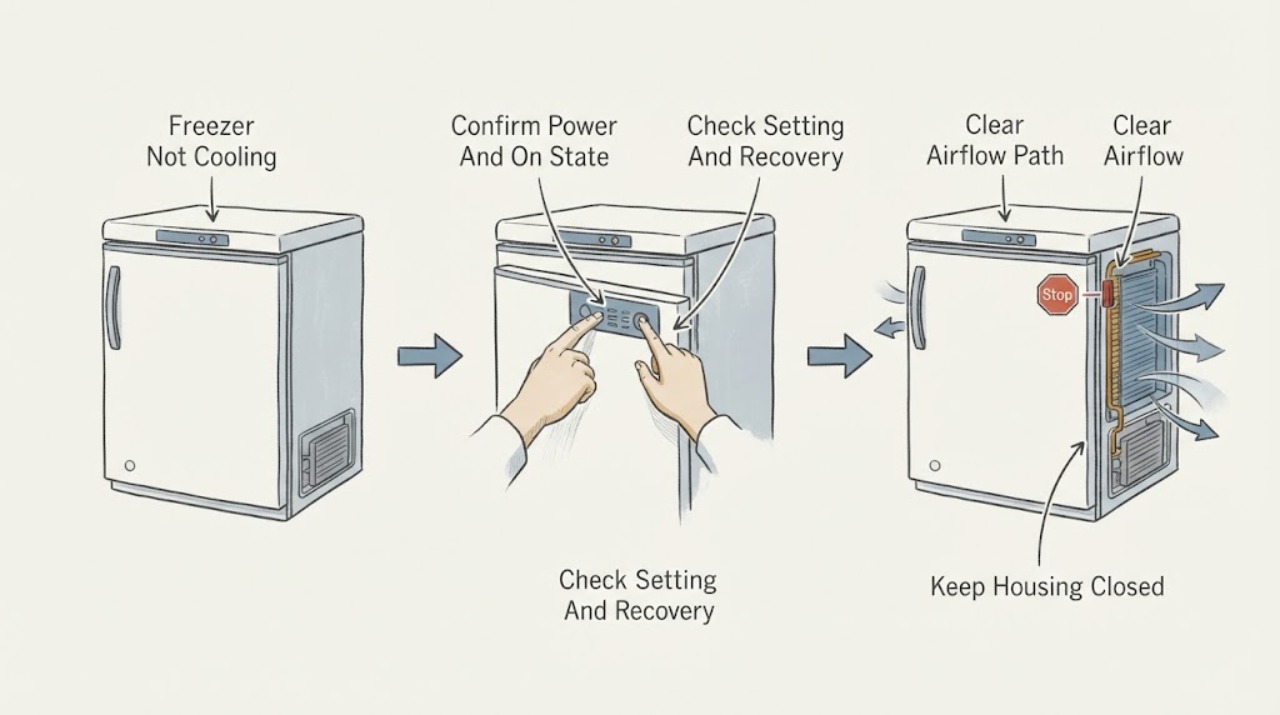
If a Siemens freezer is not cooling, keep the door closed, check that the appliance is powered and switched on, and confirm the freezer setting rather than guessing from one warm item. Siemens manuals use -18 °C as the recommended freezer setting, but controls and ranges vary by model. Check for a door that cannot close, blocked external ventilation, heavy frost, a recent large load, or a long power interruption. If the temperature alarm persists, the compressor never starts or runs continuously, the cabinet is unusually hot, there is a burning smell, smoke, repeated breaker tripping, or food has thawed, stop troubleshooting and arrange qualified Siemens appliance service; do not remove panels or work on the sealed refrigeration circuit.
Work through in order
Diagnostic checks
Use only checks that match the exact appliance or system and its official guide.
-
Check 1
Without moving the cabinet or opening any cover, look for interior light or control-panel activity, confirm the plug is seated if it is safely accessible, and check the appliance's accessible switch and household breaker once; do not repeatedly reset a breaker.
Expected result: The display and light are dead; the display is active and shows a temperature or alarm; the breaker is tripped; or the appliance is powered but there is no normal cooling sound.
Next step: If power is stable and there are no hazardous symptoms, continue with the external temperature and door checks. If the breaker trips again, there is a burning smell, smoke, heat at the plug, or visible damage, leave the appliance off and arrange electrical or appliance service.
Why this matters
Why: A dead display or a tripped breaker points first to power or control supply rather than a temperature-setting error. A powered cabinet with no cooling sound, or a breaker that trips again, needs service rather than repeated resets.
-
Check 2
Read the freezer temperature setting and any alarm indicator from the front control, then note whether the cabinet was recently switched on, loaded with fresh food, or left open; use the exact model manual for the available setting range instead of selecting a generic number.
Expected result: The setting is warmer than the model's recommended storage setting; the temperature display or alarm is flashing; or the setting is appropriate but the cabinet has had several hours with the door closed and remains warm.
Next step: Correct an accidentally warm setting using the normal controls and allow the model's stated recovery time. If the alarm or warm reading remains, continue only with external checks and prepare a service request.
Why this matters
Why: Siemens gives -18 °C as a recommended freezer setting in the opened manual, while the time to recover depends on load, door opening, ambient temperature, and the model. A persistent alarm after the recovery conditions are normal is evidence of a fault, not simply a display preference.
-
Check 3
With the door open only briefly, check that a drawer, package, or shelf is not preventing the door from closing; inspect the door seal for a visible gap or deformation; and look from outside for blocked ventilation openings or a cabinet installed without the model's required clearances.
Expected result: The door does not close or seal evenly; a package is holding it open; the seal has a visible split or gap; or external ventilation is obstructed.
Next step: Reposition only the obstructing package and clear loose external obstructions without dismantling anything. Close the door and monitor recovery. If the seal remains damaged, the cabinet cannot meet its clearances, or the alarm persists, request service and include photographs and the model number.
Why this matters
Why: Warm air entering through a blocked or poorly sealed door can raise the temperature and create frost. Siemens also lists covered external ventilation openings as a cause of a freezer temperature alarm. A damaged seal or installation restriction is not corrected by changing the setpoint.
-
Check 4
Look through the cabinet without removing panels for a thick, widespread frost layer, food packed against air outlets, unusual fan noise, or a compressor that runs much longer than usual; do not chip ice, heat the liner, or open the sealed refrigeration system.
Expected result: Air outlets are covered; there is heavy frost on the rear wall; the fan makes a scraping sound; the compressor runs continuously; or there is no unusual frost or noise.
Next step: Redistribute food away from visible outlets and keep the door closed. Follow a full defrost only if the exact Siemens manual permits it and no water can reach electrics; otherwise stop and arrange service. Do not restart after smoke, burning odor, exposed wiring, repeated trips, or abnormal heat.
Why this matters
Why: Blocked outlets can reduce circulation, while heavy frost in a noFrost model can indicate that automatic defrost is no longer working. Continuous running without temperature recovery, or a new scraping sound, moves the problem toward airflow, defrost, fan, or refrigeration service. The absence of frost does not prove the sealed system is healthy.
-
Check 5
Keep the freezer closed during a suspected power outage, note when power returned, and inspect packages for thawing without tasting them; if a thermometer is already available, record the reading without leaving the door open to search for one.
Expected result: Food is still solid; food is partly thawed but cold; food is fully thawed or warmer than a safe cold-storage condition; or the cabinet is cooling again after power was restored.
Next step: Follow local food-safety guidance for any thawed food, avoid refreezing food that has thawed unless cooked first, and monitor a recovered cabinet. If it does not return to the model's set temperature after the recovery period, book appliance service.
Why this matters
Why: A power interruption can raise the freezer temperature and shorten storage life. Siemens directs the owner to check food quality immediately after an outage and discard thawed food that has exceeded its safety limit. Cooling that returns after power restoration does not undo food-safety decisions.
Use your observations
Decision map
Find the observation that best matches what you see, then follow the next safe action.
-
PATH 01Next step
What you see
The display and light are dead, or the breaker trips again.
Do this next
Leave the freezer off, protect food if possible, and arrange qualified electrical or appliance service. Do not keep resetting the breaker.
-
PATH 02Next step
What you see
The door is held open, the seal has a visible gap, or external ventilation is blocked.
Do this next
Remove only the accessible obstruction, close the door, and allow recovery. A persistent gap, damaged seal, or installation restriction needs service.
-
PATH 03Next step
What you see
Heavy frost covers the rear area, the fan scrapes, or the compressor runs continuously without cooling.
Do this next
Keep the appliance closed and arrange service unless the exact Siemens manual gives a safe defrost procedure for that model. Never use sharp tools, heaters, or sealed-system work.
-
PATH 04Next step
What you see
Power is stable, the door seals, vents are clear, and there is no heavy frost, but the freezer remains warm after the model's recovery period.
Do this next
Record the model, display or alarm, temperatures, noises, and when the problem began, then request qualified Siemens appliance service; internal refrigeration diagnosis is not a user check.
Helpful context
Understand the symptom
Treat this as a temperature and food-safety problem first
A warm drawer does not by itself identify a failed compressor. Keep the door closed as much as possible while you determine whether the freezer has power, whether the display is reporting an alarm, and whether the temperature is actually rising. Move vulnerable food to another working freezer or a safe cold-storage plan if the outage is prolonged. Siemens warns that food can spoil while thawing; do not taste questionable food and do not refreeze food that has thawed unless it is cooked first.
Allow for a recovery period after a change
The freezer may need several hours to reach its set temperature after it is switched on, after a door has been open, or after a large amount of fresh food was added. A short-lived alarm in those circumstances is different from a temperature that stays high after the cabinet has been closed and left to run. Record when the problem started, the display or alarm behavior, and whether the compressor or fan sound changes; that information helps service distinguish a control, airflow, or sealed-system fault.
Do not turn frost or a noisy cabinet into a risky repair
Heavy frost can restrict airflow in a noFrost appliance, but a Siemens manual says that system should not require routine defrosting. Do not chip ice with a sharp object, add a heater, open the refrigerant circuit, or remove covers to reach a fan. If frost returns after a safe, model-approved defrost or if the temperature remains high, give the model number and observations to a qualified technician.
When checks do not resolve it
Need a professional?
Call for qualified appliance service when the freezer stays warm after power, setting, door, ventilation, and recovery checks; when an alarm persists; when the compressor runs continuously without cooling; or when a seal, fan, defrost, control, or refrigeration fault is suspected.
Common questions
FAQ
What temperature should a Siemens freezer be?
The opened Siemens manual recommends -18 °C for freezer storage, but the available range and controls vary by model. Use the setting and recovery guidance for your exact E-Nr/model.
Why is my Siemens freezer alarming but still running?
The temperature alarm can be triggered after startup, a long-open door, or a large fresh-food load. If the alarm continues after the door is sealed and the freezer has had adequate recovery time, treat it as a service symptom.
Can blocked vents make a Siemens freezer warm?
Yes. Siemens lists covered external ventilation openings and obstructed circulation among the conditions to check. Clear only accessible, loose obstructions; do not dismantle the cabinet.
Should I chip away heavy ice to make the freezer cool again?
No. Sharp tools and added heat can damage the liner or cooling circuit. For a noFrost model, heavy frost can indicate an automatic-defrost fault; follow the exact manual or arrange service.
When should I stop using the freezer?
Stop and arrange service for repeated breaker trips, smoke, burning odor, exposed wiring, water near electrics, unusual heat, a suspected refrigerant fault, or food that has thawed and cannot be kept safely.
Read the exact guide
Official sources
- Information for Use KGN..Siemens · Siemens KGN refrigerator-freezer operation, temperature, alarm, airflow, defrost, and food-safety instructions
- Model GS22L401/01: User manuals, spare parts, accessories | Siemens HomeSiemens Home · Siemens freezer support, model documentation, and temperature-problem categories
Community feedback
Share a repair observation
Share a plain-text repair observation. Accepted observations are published automatically; this page may take a moment to update.