
On this page
Start here
Quick answer
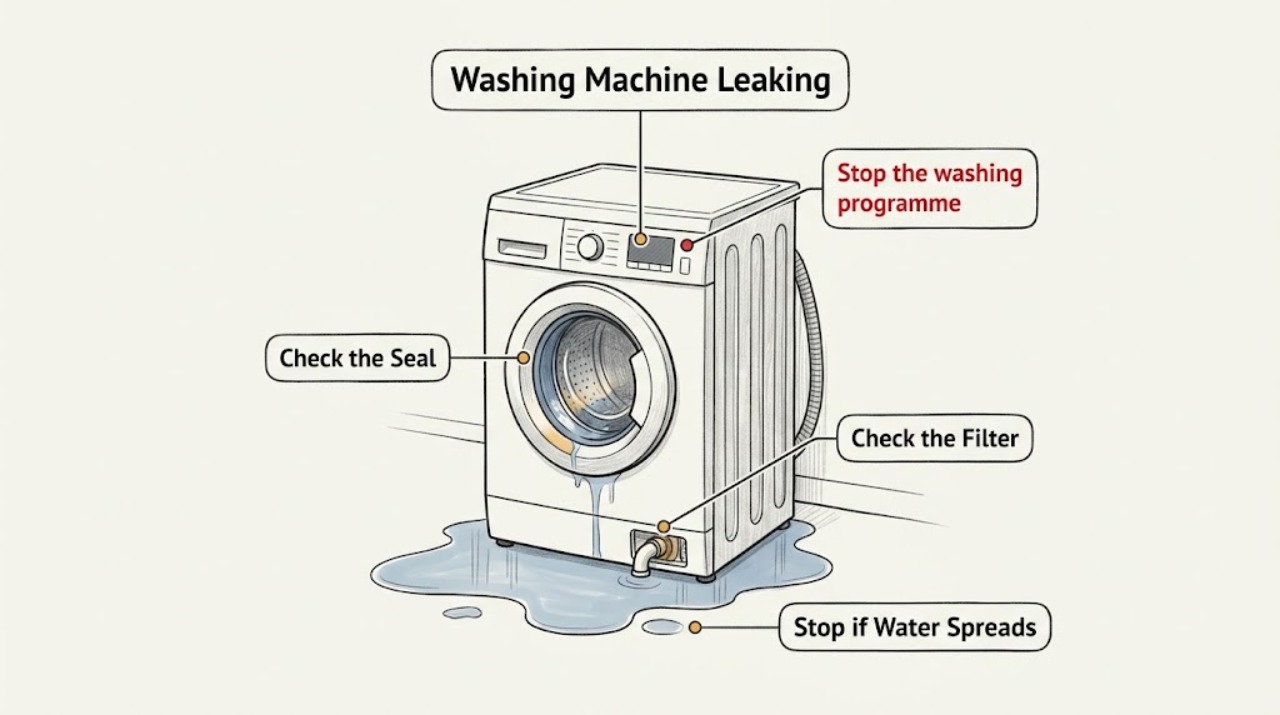
Stop the cycle, keep people away from the water, and close the water supply tap before tracing a Siemens washing-machine leak. If it is safe to do so from a dry position, disconnect power; do not touch a plug or appliance that is wet or standing in water. Find the first wet point rather than the largest puddle: the front commonly points to the door seal, detergent drawer, or filter area, the back to a fill or waste hose, and water directly underneath that remains after external checks may indicate an internal leak. E23 or F23 on applicable models indicates a leak or water in the base plate and Siemens says to turn off the supply tap immediately. Do not run another cycle until the source is corrected or a qualified technician has inspected it.
Work through in order
Diagnostic checks
Use only checks that match the exact appliance or system and its official guide.
-
Check 1
Stop the washing programme and close the wall tap supplying the machine; if water is near the plug, socket, or cabinet base, stay in a dry position and do not touch the electrical connection.
Expected result: The water stops when the tap is closed, or water continues to enter or spread despite the tap being closed.
Next step: Keep the machine off. If the area is dry and safe, isolate power as directed by the model instructions; if not, arrange safe electrical isolation and service.
Why this matters
Why: Stopping with the tap points to the appliance water path; continued flow can indicate stored water, a drain or floor issue, or a valve fault and needs a higher level of caution.
-
Check 2
Without moving the machine, use a dry cloth or paper towel to identify the first wet point at the front door and rubber seal, detergent drawer, filter flap, sides, and visible rear connections.
Expected result: The first moisture is at the door, drawer, filter area, rear hose, or directly beneath the cabinet.
Next step: Follow the matching branch. Do not pull the machine forward or remove panels simply to see farther behind it.
Why this matters
Why: The first point is more useful than the final puddle: Siemens associates the front with the door, drawer, or filter, the rear with the fill or waste hose, and persistent water underneath with a possible internal leak.
-
Check 3
For a front-door leak, inspect the visible door glass and gasket with the machine off and cool; remove only lint, clothing, or detergent residue that is plainly accessible with a soft cloth and no abrasive cleaner.
Expected result: The door was not fully closed, clothing was caught at the seal, the drum was overfilled, or the gasket has a cut, displacement, or persistent wet trail.
Next step: Leave the washer off if the gasket is damaged, the door will not close evenly, or water returns after the external clean-up; request service.
Why this matters
Why: A closure or residue problem can allow water past the seal; a torn, displaced, or repeatedly leaking gasket is a component or alignment fault rather than a reason to press the door harder.
-
Check 4
For water at the detergent drawer, remove and clean the drawer only as described in the Siemens use and care guide, and check that the drawer is seated correctly; do not increase or alter supply pressure beyond the model guidance.
Expected result: Residue or a blocked nozzle is visible, foam is overflowing, the drawer is not seated, or water enters cleanly but still escapes from the cabinet.
Next step: Correct only the accessible residue or dosage issue allowed by the manual. If the drawer or cabinet still leaks, keep the tap closed and arrange service.
Why this matters
Why: Siemens links drawer leaks to blocked nozzles, excessive water pressure, or excessive or unsuitable detergent; foam or a clean drawer with continued leakage points elsewhere.
-
Check 5
For a rear leak, inspect the visible fill and waste hoses and their connections without moving the machine; look for a kink, split, brittleness, corrosion, or a connector that is visibly not seated.
Expected result: A hose is kinked or visibly damaged, a connection is wet at its joint, or the rear is dry while water appears only during draining.
Next step: Keep the supply tap closed and request the correct hose or qualified repair when damage is visible; do not move a wet or heavy appliance to reach hidden connections.
Why this matters
Why: A rear hose or connection is a plausible source, while timing during drain points toward the waste path. A split or brittle hose should not be patched or repeatedly tested under pressure.
-
Check 6
If water appears at the filter flap or lower front, wait for hot water to cool and follow the exact model manual for any accessible filter-cap check; do not open a filter while the drum may contain hot or pressurized water.
Expected result: The cap or drain-hose seal is visibly not seated, the filter area is wet after a prior clean, or water continues from behind the filter area.
Next step: Do not run a test cycle. If the area remains wet after a model-approved reseat, close the tap, isolate safely, and arrange service.
Why this matters
Why: Siemens notes that a drain-hose cap or filter cap that is not securely seated can leak; continuing water behind the area may indicate a damaged seal, pump, or internal path.
-
Check 7
Read and record the complete display message or error code, the cycle phase, and whether the water appeared during filling, washing, draining, or spinning; do not repeatedly reset a leak warning.
Expected result: E23 or F23 appears, another water-related code appears, or no code is shown despite a leak.
Next step: Keep the water supply closed and provide the exact model, code, cycle phase, and first wet point to Siemens service.
Why this matters
Why: On applicable Siemens models E23 indicates a leak or water in the base plate; other codes have model-specific meanings, and no code does not make a visible leak safe.
Use your observations
Decision map
Find the observation that best matches what you see, then follow the next safe action.
-
PATH 01Next step
What you see
Water first appears at the door or front gasket.
Do this next
If the gasket is torn, displaced, or still leaks after a permitted clean-up, keep the machine off and request service.
Why this path and its safety boundary
Why it matters: Check closure, trapped fabric, overloading, visible residue, and obvious gasket damage without forcing the door.
-
PATH 02Next step
What you see
Water first appears at the detergent drawer or foam spills from the front.
Do this next
Clean and reseat the drawer only as the manual allows and correct dosage; persistent drawer or cabinet leakage needs service.
Why this path and its safety boundary
Why it matters: Residue, blocked nozzles, high supply pressure, or too much or unsuitable detergent are possible explanations.
-
PATH 03Next step
What you see
Water first appears at the rear hose or connector.
Do this next
Keep the supply tap closed, do not move the machine across wet flooring, and arrange a correct hose or qualified repair for a damaged or hidden connection.
Why this path and its safety boundary
Why it matters: The fill or waste hose and its connection are the leading external suspects.
-
PATH 04Next step
What you see
Water first appears at the filter flap or lower front.
Do this next
After hot water has cooled, use only the exact model manual for an accessible cap check; if wetness persists, keep the appliance off and request service.
Why this path and its safety boundary
Why it matters: A filter cap, drain-hose cap, seal, pump path, or residual water may be involved.
-
PATH 05Next step
What you see
Water is directly underneath, enters the base, continues after external checks, or the display shows E23 or F23.
Do this next
Do not tilt, open, or run the machine. Keep the tap closed and arrange trained service; provide the code and first wet point.
Why this path and its safety boundary
Why it matters: The leak may be internal or the machine may have detected water in its base plate.
-
PATH 06Next step
What you see
The machine is overfilling or water does not stop entering when the programme is stopped.
Do this next
Close the supply tap immediately and arrange trained service; these are not user repair tasks.
Why this path and its safety boundary
Why it matters: An inlet valve, pressure switch, or pressure chamber fault may be involved.
Helpful context
Understand the symptom
Make the leak safe before looking for its source
Stop the programme and close the water supply tap. If the floor, plug, socket, or appliance is wet, do not handle the plug; isolate power only from a dry, safe location or have an electrician do it. Mop or contain water only when doing so does not bring you close to energized equipment. Do not tilt the machine, pull it out across a wet floor, or open a panel to search for a leak.
Use the first wet point, not the puddle size
Water can travel under a cabinet and make a rear or door leak look like a leak from underneath. After the machine is safe and the area is dry enough to inspect, use a dry cloth to trace the highest or earliest wet point from the front, sides, and rear without moving the appliance. Siemens separates leak guidance into door, detergent drawer, filter, back, and underneath paths; that location narrows the next check.
When a simple check is not enough
A loose cap or residue at an accessible filter area can be different from water entering the base or appearing from a hose hidden behind the cabinet. Any leak that continues after the model-approved external checks, any water in the base, or any supply that cannot be stopped is a service issue. Keep the machine off and record the phase of the cycle, the first wet point, and any display code for the technician.
Safety boundary
Stop conditions
- Close the water supply and stop immediately for uncontrolled inflow, a growing puddle, water in the base, or a leak that cannot be localized safely.
- Do not touch a plug, socket, or appliance that is wet or standing in water; isolate power only from a dry, safe location or arrange qualified electrical help.
- Do not tilt, drag, open panels, reach underneath, or run another cycle to reproduce a leak.
- Stop for hot water, a damaged door glass or gasket, a split hose, burning smell, smoke, arcing, or a repeated electrical trip.
Only after diagnosis
Potential parts
- door gasket
Consider only when the model-specific inspection identifies a torn, displaced, or failed door seal.
Confirm the complete E-Nr. and fitment through Siemens or a qualified technician before selecting a part. - fill or waste hose
Consider only when a visible rear hose or connection is damaged or a technician confirms the hose is the leak source.
Use the exact model and connection specification; do not patch a pressurized hose. - drain pump or filter seal
Consider only after the filter area remains wet with the cap correctly seated and a qualified diagnosis identifies the pump or seal.
Do not infer fit or open the pump housing from a puddle alone; confirm model-specific service information. - water inlet valve or level-control component
Consider only when overfilling or a persistent inlet fault is diagnosed by trained service.
These components affect water safety and require model-specific qualified repair.
When checks do not resolve it
Need a professional?
Request qualified Siemens appliance service when the leak is underneath or internal, E23 or F23 returns, a hose or gasket is damaged, the washer overfills, water enters the base, or an external check does not stop the leak.
Common questions
FAQ
Where does a Siemens washing-machine leak usually start?
Use the first wet point rather than the largest puddle. A front leak may start at the door, detergent drawer, or filter area; a rear leak may start at a fill or waste hose; persistent water underneath needs qualified inspection.
What does E23 mean on a Siemens washing machine?
On applicable Siemens models, E23 indicates a leak or water in the base plate. Close the supply tap immediately, keep the machine off, and arrange service if the cause is not resolved by the exact model guidance.
Can I run another cycle to see where the leak comes from?
No. A new cycle can add water to an electrical or internal fault. Record the cycle phase and first wet point, then use only safe external checks; persistent or underneath leaks need service.
Is it safe to open the drain filter when the washer is leaking?
Only follow the exact model manual after the water has cooled and the appliance is safely isolated. Residual water may spill, and water near electrical parts is a stop condition. Do not tilt or disassemble the machine.
Read the exact guide
Official sources
- Support for Siemens washing machinesSiemens Home Appliances · Siemens washing-machine troubleshooting categories, documentation, and safety support
- Washing machines support and maintenanceSiemens Home Appliances · Siemens washing-machine detergent-dispenser and door-gasket care guidance
- Error codes and messages of washing machinesSiemens Home Appliances · Siemens washing-machine error codes, including E23 or F23 leak indication
- Washing machine is overfillingSiemens Home Appliances · Siemens washing-machine overfilling causes and service boundary
- Washing machine is leaking waterSiemens Home Appliances · Siemens washing-machine leak locations and user-level checks
Community feedback
Share a repair observation
Share a plain-text repair observation. Accepted observations are published automatically; this page may take a moment to update.