
On this page
Start here
Quick answer
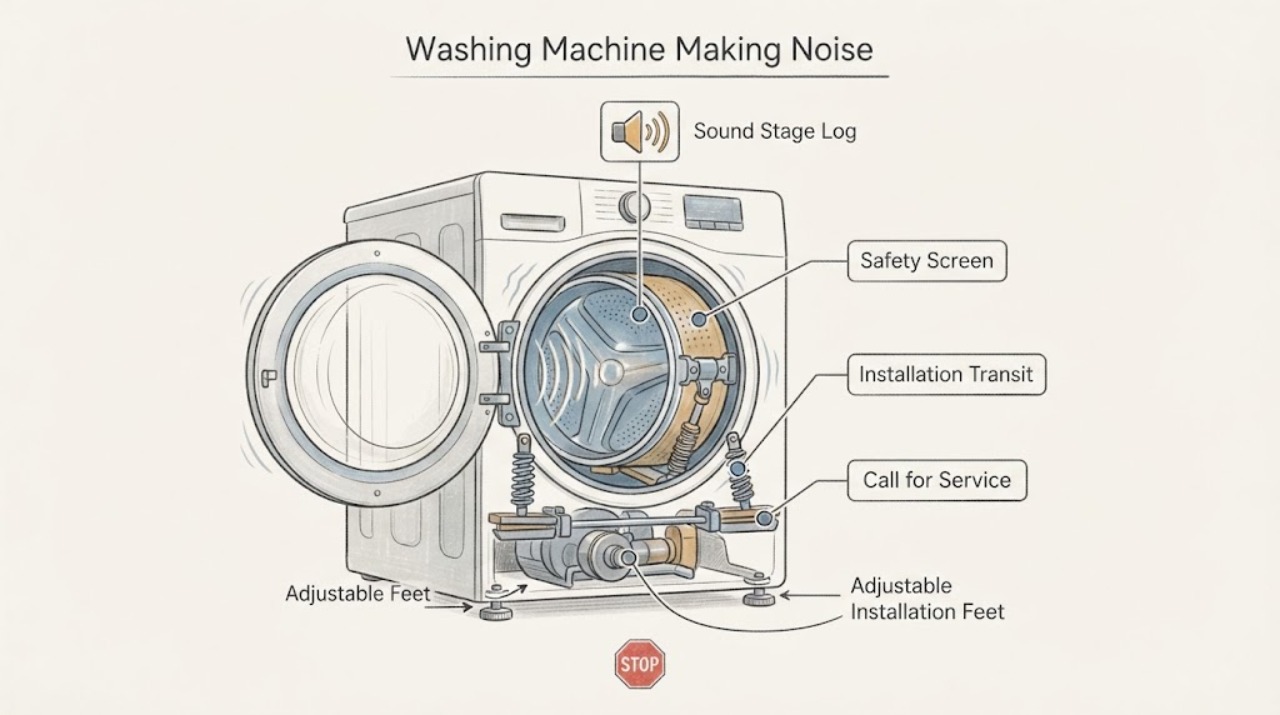
A Siemens washing machine making noise is diagnosed most efficiently by recording the sound and the part of the cycle when it occurs. A clunk or repeated knock during spin points first to an uneven load, an unlevel or unsuitable floor, or—especially after moving or installation—transit restraints. A rattle during washing can come from a foreign object in the drum or drain pump. A hum or water noise during filling or draining should be compared with the water movement and the pump stage rather than treated as a bearing fault. Keep the machine off for metallic grinding, severe scraping, sudden walking, a leak, burning smell, smoke, arcing, or electrical trouble. If the safe installation, load, and visible-object checks do not change a persistent rumble, grinding, or suspension-like movement, stop and arrange Siemens service; the sound alone cannot identify an internal part.
Before you begin
Safety first
- This article supports ordinary-access observation and exact-model installation checks only. Internal drum, bearing, suspension, drive, pump, wiring, cabinet, and electrical diagnosis or replacement belongs to qualified service.
Work through in order
Diagnostic checks
Use only checks that match the exact appliance or system and its official guide.
-
Check 1
Stop the washer from a safe position and screen for hazards before listening more closely or opening any user-accessible area.
Expected result: Look and listen only from ordinary access for water on the floor or near the plug, smoke, burning smell, arcing, a hot or discolored cord or outlet, unusual heat, exposed damage, severe scraping, or a breaker that has opened.
Next step: Keep the washer off and request qualified appliance or electrical service when a hazard is present. If none is present, record the sound and cycle stage without repeatedly running the machine.
Stop if: Do not touch wet electrical equipment, run a cycle after smoke or arcing, reach into moving parts, or keep resetting a breaker.
Why this matters
Why: A leak, electrical symptom, fire sign, or violent mechanical movement changes the issue from noise diagnosis to a safety and qualified-service response. Absence of those signs permits only low-risk observation.
-
Check 2
From a safe position, identify the sound type and the exact cycle stage in which it begins or changes.
Expected result: Record whether it is a hum or water noise during filling, a rattle during washing, a pump-like sound during draining, or a thump, knock, scrape, or deep rumble during spin; note whether it occurs with an empty or loaded drum and whether the cabinet moves.
Next step: Save a short recording and proceed only to the check that matches the observed stage. If the noise is metallic, violent, or accompanied by walking or a leak, keep the washer off and request service.
Stop if: Do not run repeated test cycles, hold the cabinet, or place hands near the drum, belt, pump, or moving hoses while the washer is operating.
Why this matters
Why: Filling and draining sounds point to water-path timing, washing rattles support a foreign-object check, and spin impacts support load, leveling, transit-restraint, or internal-movement checks. The stage does not by itself identify a failed bearing, pump, or motor.
-
Check 3
If the washer is new, was transported, or was recently re-installed, use the exact model installation instructions to confirm the transit restraints and rear covers are in the intended state.
Expected result: Record whether the manual identifies transport bolts or sleeves that remain installed, whether rear covers are missing, and whether the noise began immediately after the move or installation.
Next step: Follow the exact Siemens installation procedure or arrange qualified installation service when the bolt, sleeve, cover, or rear access is uncertain. Do not continue high-speed cycles while the installation state is unresolved.
Stop if: Do not move a stacked or hard-to-access appliance, remove a restraint by force, or operate with missing rear covers or visible damage.
Why this matters
Why: Siemens identifies transport bolts as an installation check for strange spin noise. A restraint left in place or an uncertain rear assembly can explain severe vibration, but the model manual controls the correct removal and replacement procedure.
-
Check 4
With the washer stopped, observe whether it rocks and whether all visible feet rest firmly on a flat, suitable floor; use the model instructions for any leveling adjustment.
Expected result: Record rocking at rest, a gap under a foot, an uneven or flexible surface, a loose lock nut, or a cabinet that is visibly out of level; note whether the machine walks only during spin.
Next step: Correct only a model-approved external leveling condition and secure the feet as instructed, then make one cautious observation on a normal load. If rocking or walking remains, stop and request service or qualified installation assessment.
Stop if: Do not place loose wedges or mats under the machine, lift it while loaded, adjust inaccessible feet under a stacked unit, or continue when it is unstable.
Why this matters
Why: Siemens says an unbalanced installation and unsuitable surface can create thuds and impacts, especially at spin speed. A stable, level installation shifts attention to the load, drum, pump, or internal service boundary.
-
Check 5
For banging or repeated knocks during spin, stop the cycle as the manual describes and inspect the load distribution without reaching into a moving drum.
Expected result: Record whether one heavy item is gathered on one side, the drum is overfilled, the load is unusually small, or the sound and movement change after the load is safely redistributed according to the manual.
Next step: Use the exact cycle and load guidance, then make at most one normal observation after redistribution. If impacts persist, worsen, or occur with an empty drum, keep the washer off and request service.
Stop if: Do not hold the cabinet, push a walking machine, open the door or lid against motion or water, or continue a violent spin.
Why this matters
Why: Siemens associates impacts with an unevenly distributed load and notes that heavy items can unbalance the washer. If the washer still bangs or walks with a balanced, suitable load, the issue is not established as a laundry-load problem.
-
Check 6
For a rattle or clicking sound during washing or draining, switch the washer off and inspect the empty drum and any pump-filter or drain-pump access only as the exact manual permits.
Expected result: Record whether a coin, fastener, wire, zipper piece, or other visible object is in the drum, whether the user-accessible filter area contains an object, or whether the sound persists with no visible object and no accessible cleaning step.
Next step: Remove only an object the manual clearly identifies as user-accessible, restore the filter or cover as instructed, and make one normal observation. If the object is inaccessible or the rattle remains, request service.
Stop if: Do not reach into a moving drum, dismantle the pump, remove hoses under pressure, use tools to fish out an object, or operate with a loose filter or cover.
Why this matters
Why: Siemens identifies foreign objects in the drum or drain pump as possible sources of rattling. A clean visible area does not rule out an internal obstruction, pump fault, bearing, or suspension issue and should not lead to cabinet disassembly.
-
Check 7
If the sound occurs only while filling or draining, compare its timing with visible water movement and the exact model's water-path instructions without opening the cabinet.
Expected result: Record whether the sound starts with water entering, continues after filling stops, begins only when the drain pump should run, changes when the cycle pauses, or is accompanied by slow drainage, a leak, or an error display.
Next step: Follow only the model manual's external hose, filter, or drain guidance where applicable. Request service for a persistent pump-like noise, poor drainage, leak, error, or any access that requires cabinet removal.
Stop if: Do not disconnect pressurized hoses, run the pump with a cover removed, reach into standing water near electricity, or continue after a leak.
Why this matters
Why: Timing that follows filling or draining supports a water-path or pump branch, while a sound that continues with no water movement points elsewhere. These observations cannot identify an internal pump or valve failure by themselves.
-
Check 8
After the safe installation, leveling, load, and visible-object checks, compare the remaining noise without opening the cabinet or trying to identify an internal part by sound alone.
Expected result: Record whether a deep rumble, metallic scrape, repeated knock, or suspension-like movement persists with a balanced or empty drum, whether the drum or cabinet strikes, and whether the noise is becoming louder or more frequent.
Next step: Keep the washer off and request Siemens service with the recording, stage log, installation history, load result, and visible observations.
Stop if: Do not remove panels, pull the drum, test bearings under load, replace a suspension or bearing part, or continue using a machine with metal-on-metal noise or violent movement.
Why this matters
Why: Persistent noise after external checks may involve an internal bearing, suspension, drive, pump, or another component, but the observation cannot distinguish those parts reliably. Escalation is more urgent when the machine walks, leaks, or shows mechanical damage.
Use your observations
Decision map
Find the observation that best matches what you see, then follow the next safe action.
-
PATH 01Safety boundary
What you see
There is a leak, smoke, burning smell, arcing, hot electrical connection, severe scraping, violent movement, or the washer walks across the floor.
Do this next
Keep the appliance off, keep people away from the affected area, and request qualified appliance or electrical service from a safe position.
Why this path and its safety boundary
Why it matters: The washer is outside an ordinary noise observation; continued operation can worsen water, electrical, or mechanical risk.
Safety stop: Do not hold, push, open, or run a walking or leaking washer and do not touch wet electrical equipment.
-
PATH 02Safety boundary
What you see
The sound begins only when water enters or the drain pump should operate.
Do this next
Use the exact manual's external hose, filter, and drain checks where applicable and request service for persistent noise, poor drainage, an error, or a leak.
Why this path and its safety boundary
Why it matters: Timing supports a water-path or pump branch, but does not prove a pump, valve, or obstruction fault.
Safety stop: Do not disconnect pressurized hoses, open the pump while energized, or continue with standing water near electricity.
-
PATH 03Safety boundary
What you see
A rattle or clicking sound occurs during washing and a visible object may be in the drum or user-accessible pump area.
Do this next
Stop the washer and follow the exact model's safe visible filter or drum inspection; request service when the object cannot be removed by the documented user step or the sound continues.
Why this path and its safety boundary
Why it matters: Siemens identifies foreign objects in the drum or drain pump as a possible cause, but an inaccessible object or persistent sound remains unresolved.
Safety stop: Do not fish into moving parts, dismantle the pump, or open the cabinet.
-
PATH 04Safety boundary
What you see
Thumps or knocks occur in spin, especially on a new or recently moved machine, or the cabinet rocks at rest.
Do this next
Follow the exact installation guidance for transit restraints and leveling, then check load distribution once. Escalate if the machine still rocks, walks, or strikes.
Why this path and its safety boundary
Why it matters: Uneven load, transit restraints, leveling, or an unsuitable surface are the first external checks.
Safety stop: Do not continue high-speed cycles while the machine is unstable or the installation state is uncertain.
-
PATH 05Safety boundary
What you see
The washer is level and stable, the load is balanced, but repeated impacts or walking continue, including with an empty drum.
Do this next
Keep the washer off and request Siemens service with the load, movement, and sound record.
Why this path and its safety boundary
Why it matters: The noise is not established as a simple load issue; internal suspension, drive, drum, or another mechanical fault may need diagnosis.
Safety stop: Do not open the cabinet or continue violent spin tests.
-
PATH 06Safety boundary
What you see
A metallic scrape, deep rumble, or suspension-like movement persists after safe external checks.
Do this next
Stop using the washer and arrange qualified Siemens service rather than ordering or replacing a part from the sound.
Why this path and its safety boundary
Why it matters: An internal bearing, suspension, drive, pump, or other component is possible, but sound alone cannot identify the part.
Safety stop: Do not test internal parts under load, remove panels, or continue operation with metal-on-metal noise.
Helpful context
Understand the symptom
Classify the noise before trying to quiet it
Write down whether the sound is a hum, hiss, click, rattle, scrape, metallic grind, thump, or repeated knock, and whether it occurs while filling, washing, draining, or spinning. A pump-stage sound and a high-speed impact sound lead to different checks. Also note whether the washer is new, was moved, walks across the floor, or started making noise suddenly. A short recording from a safe position is more useful than repeatedly running the machine to reproduce a fault.
Installation problems are especially likely after moving
Siemens says correct installation is important for spin noise. For a new or re-installed machine, use the exact model instructions to confirm that transport bolts and sleeves were handled as specified, and that the washer rests on a suitable, hard, level surface with all feet firmly supported. A machine that rocks or walks is not corrected by adding a loose mat or by continuing high-speed cycles.
Separate load impacts from a drum or pump rattle
Siemens associates banging with an unevenly distributed load and rattling during washing with a foreign object in the drum or drain pump. First observe the stage and sound with the machine stopped; then, only if the manual permits and the appliance is safe to access, inspect the empty drum and the user-accessible pump area. A small object or a heavy single item can change the sound, but it does not justify reaching into a moving machine or opening the cabinet.
Persistent grinding or movement needs a service boundary
A metallic scrape, deep rumble, repeated knock with an empty load, or suspension-like movement after the external checks may involve an internal drive, bearing, suspension, or another part. These observations can prioritize service but cannot prove which part has failed. Stop if the noise is worsening, the tub or cabinet is striking, the washer walks, water leaks, or an electrical or burning symptom appears.
Safety boundary
Stop conditions
- Stop immediately for a leak, water near electrical parts, smoke, burning smell, arcing, a hot or damaged cord or outlet, severe scraping, violent movement, or a machine that walks.
- Do not hold or push the cabinet while it is moving, reach into a running drum, disconnect pressurized hoses, or open a pump or filter while energized.
- Do not remove the cabinet, test bearings or suspension under load, or replace an internal part based on the sound alone.
- Do not continue high-speed cycles when transit restraints, leveling, load stability, or floor support is uncertain.
- Request qualified Siemens service when the sound persists after exact-model installation, leveling, load, and visible-object checks, or when the noise is metallic, worsening, or accompanied by poor drainage, a leak, or electrical symptoms.
When checks do not resolve it
Need a professional?
Request qualified Siemens appliance service when the washer continues to make a metallic scrape, deep rumble, or repeated knock after the exact-model installation, leveling, load, and visible-object checks; when it walks or strikes the cabinet; when a pump-like sound persists with poor drainage or an error; or whenever there is a leak, smoke, burning smell, arcing, electrical damage, or severe movement.
Safety scope: This article supports ordinary-access observation and exact-model installation checks only. Internal drum, bearing, suspension, drive, pump, wiring, cabinet, and electrical diagnosis or replacement belongs to qualified service.
Common questions
FAQ
Why is my Siemens washing machine banging during spin?
Start with load distribution, then check whether the machine is level and stable. If it is new or was moved, use the exact installation manual to check transit restraints. Persistent banging, cabinet strikes, or walking with a balanced load needs service.
What does a rattling sound during washing mean?
Siemens identifies a foreign object in the drum or drain pump as a possible cause of rattling. Stop the washer and inspect only the areas the exact model manual makes user-accessible. If the object is inaccessible or the sound continues, arrange service.
Can transit bolts cause noise in a Siemens washer?
Yes, Siemens lists transport bolts as an installation check for strange noise in a new or re-installed washer. Use the exact model installation procedure; do not force rear hardware or continue high-speed operation while the installation is uncertain.
How can I tell whether the noise is from the pump?
Record whether the noise starts only during draining and whether water movement, slow drainage, or an error occurs at the same time. Timing supports a pump or water-path branch but does not prove an internal pump fault; use the model manual and request service for persistent noise or poor drainage.
When does Siemens washer noise need a technician?
Request service for persistent metallic grinding, deep rumbling, repeated knocks after safe installation and load checks, suspension-like movement, walking, cabinet strikes, poor drainage with pump noise, leaks, smoke, burning smell, arcing, or electrical symptoms.
Read the exact guide
Official sources
- De wasmachine maakt een vreemd geluid | Siemens HuishoudapparatenSiemens Huishoudapparaten · Official Siemens Netherlands troubleshooting page; it is regional guidance and does not replace the installed model manual.
- New washing machine makes a strange noise | Siemens Home AppliancesSiemens Home Appliances · Official Siemens Home Appliances UAE troubleshooting page; installation details and service availability vary by model and country, so the installed model manual controls.
Community feedback
Share a repair observation
Share a plain-text repair observation. Accepted observations are published automatically; this page may take a moment to update.