
On this page
Start here
Quick answer
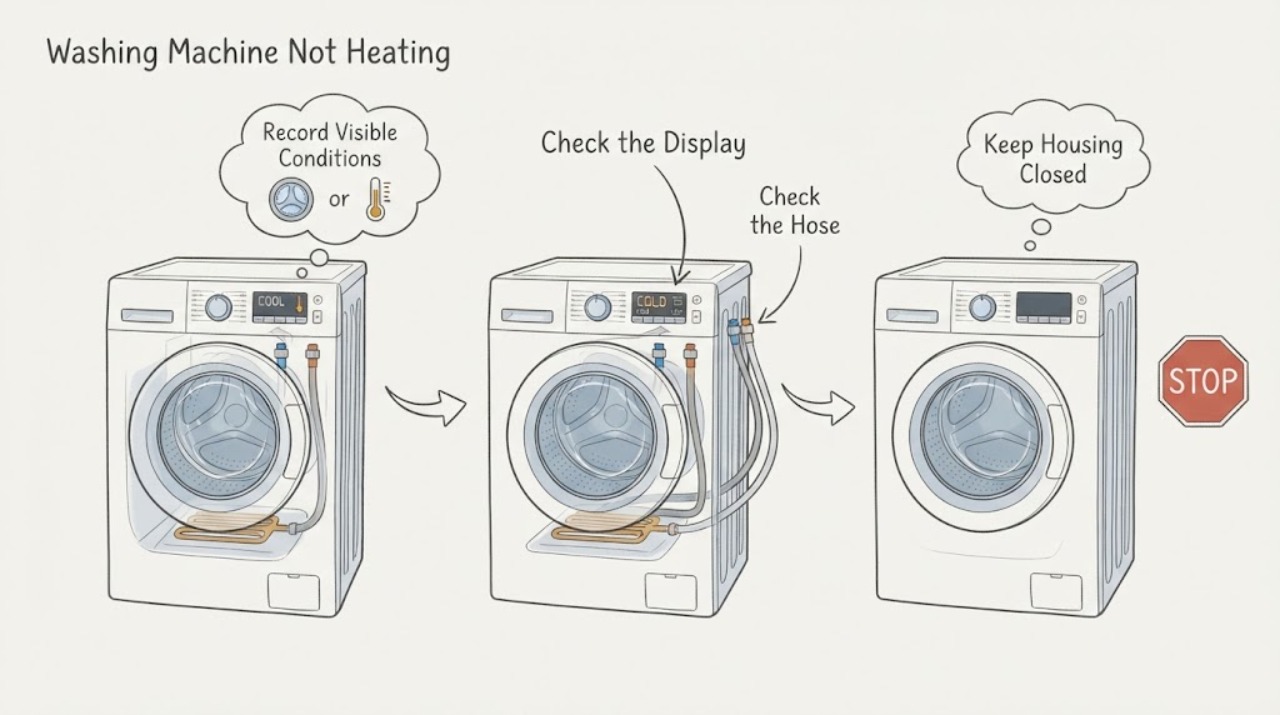
First confirm that the selected Siemens program is meant to heat water and that the result is genuinely cold, rather than a normal low-temperature or cold rinse. Check the model manual for the correct temperature setting, water-inlet arrangement, and any displayed code. A household hot or cold supply issue can stop a program from filling or can swap the expected temperature, but it does not by itself prove that the washer's internal heater is faulty. Siemens states that a confirmed heating-element fault is not a do-it-yourself repair and needs a trained, qualified service engineer. Stop immediately for smoke, burning odor, unusual heat, leaking water near electrics, arcing, or a tripped circuit.
Before you begin
Safety first
- Do not open the cabinet, test energized wiring, handle hot water, bypass a safety device, or attempt internal heater work. Smoke, arcing, major leakage, or immediate danger requires safe isolation and appropriate emergency help first.
Work through in order
Diagnostic checks
Use only checks that match the exact appliance or system and its official guide.
-
Check 1
Record the complete Siemens model identifier, selected program, temperature setting, stage at which the concern appears, and any display code or symbol; do not open the tub or touch the water to test it.
Expected result: The program is explicitly cold or low-temperature, the selected program should heat, the cycle stops during the heating stage, or an error code is shown.
Next step: Use the exact manual and Siemens support path for the recorded model and code. If the code is uncertain, preserve a photo and do not guess at a component.
Why this matters
Why: A cold or low-temperature result may be normal, while a suitable warm program that stops or reports a code points toward a fill, heating, sensor, or control path. Siemens troubleshooting is model-specific.
-
Check 2
Run no further cycle until you compare the program and temperature with the model manual; check whether the program intentionally uses a low temperature, a cold rinse, or a sensor-controlled temperature that may not feel hot at every stage.
Expected result: The manual confirms a low-temperature or cold stage, or the selected program is specified to heat and the laundry remains cold after completion.
Next step: Choose one model-supported warmer program only when no safety symptom is present and the manual allows it. Do not use a high-temperature cycle as a repeated diagnostic test if the machine shows a fault.
Why this matters
Why: Program design can explain a cool result. If the program should heat and the result remains cold, the issue moves from user selection to supply, heating, sensing, or control diagnosis.
-
Check 3
From a dry, safe location, compare the installed water connection with the manual: confirm the required inlet is open, the hose is not visibly kinked or damaged, and hot and cold connections are not swapped where the model uses both; do not loosen a pressurized fitting.
Expected result: The required supply is closed or restricted, hot and cold lines are reversed, water is not entering normally, or the supply appears normal while the washer fills.
Next step: Correct only an obvious external valve or hose-routing issue allowed by the manual, then observe one appropriate cycle. If the supply is normal but heating still fails, request qualified service.
Why this matters
Why: A supply or connection problem can prevent the program from reaching its expected temperature or can cause a code. A normal fill does not establish that the internal heater is sound.
-
Check 4
Observe whether the washer completes the program, stops partway near the stage when water should heat, or displays a heating, temperature, fill, drain, or leak code; write down the exact code and the time in the program without restarting repeatedly.
Expected result: The program completes but the result is cold, stops while heating, shows an error, or also has a fill, drain, or leak symptom.
Next step: Follow only the matching model guide. A repeat stop, heating code, leak, or unexplained cold result is a service condition; do not open the cabinet or attempt internal electrical checks.
Why this matters
Why: Siemens notes that a washer can stop when it detects water not heating sufficiently or at all, and that this is normally accompanied by an error code. A fill, drain, or leak condition can be the earlier cause or a separate fault.
-
Check 5
Check for a safe, visible drain or leak issue before any approved test: inspect the accessible waste hose for a kink or blockage and look for water around the washer, without touching wet electrical equipment or opening a service panel.
Expected result: Water remains, the washer leaks, the waste hose is visibly restricted, or the machine drains normally and stays dry.
Next step: Stop for a leak, standing water near the connection, or an unsafe area. If the manual permits a plainly visible hose correction and the floor is dry, make that correction once; otherwise request service.
Why this matters
Why: A drain problem or detected leak can interrupt a program before or during heating. Wet electrics and an internal leak are not user troubleshooting conditions.
-
Check 6
If the exact model manual authorizes one reset for a control or displayed fault and there is no leak, heat, smoke, or electrical danger, isolate power using the normal safe method for the documented interval; do not test the heater afterward by touching water.
Expected result: The code clears and the model-supported cycle completes, the same code returns, or heating remains absent.
Next step: If the symptom returns or heating remains absent, leave the washer unused and request a qualified service inspection. Do not repeat resets or open panels.
Why this matters
Why: A reset can clear a temporary control state but cannot establish that an internal heating element, sensor, wiring, or control is healthy. Siemens treats a confirmed heater fault as professional work.
-
Check 7
After any safe external correction, compare the completed laundry and code behavior with the manual rather than using skin contact or an improvised thermometer; record whether the result is still cold and whether the washer completed normally.
Expected result: The selected program completes with the expected result, completes but remains cold, stops with a code, or shows smoke, odor, overheating, leak, or electrical symptoms.
Next step: Stop and arrange qualified service for a repeat failure or any safety symptom. Provide the model, program, temperature, code, supply observations, and cycle stage.
Why this matters
Why: A repeat cold result on a program that should heat supports a heating-system diagnosis. A safety symptom overrides all further observation.
Use your observations
Decision map
Find the observation that best matches what you see, then follow the next safe action.
-
PATH 01Next step
What you see
The selected program is cold, low-temperature, or ends with a cool rinse.
Do this next
Arrange qualified service and follow the exact model guidance.
Why this path and its safety boundary
Why it matters: The cool result may be normal. Confirm the program behavior in the exact manual before diagnosing a heater.
-
PATH 02Next step
What you see
A required water supply is closed, restricted, swapped, or not entering normally.
Do this next
Arrange qualified service and follow the exact model guidance.
Why this path and its safety boundary
Why it matters: Correct only an obvious external supply or hose-routing issue allowed by the manual, then observe one suitable cycle. Persistent trouble needs service.
-
PATH 03Next step
What you see
The washer fills normally but a program that should heat remains cold or stops in the heating stage.
Do this next
Arrange qualified service and follow the exact model guidance.
Why this path and its safety boundary
Why it matters: Record the model, cycle stage, and code. Treat the internal heating, sensor, or control path as a service diagnosis; do not open the appliance.
-
PATH 04Next step
What you see
A fill, drain, or leak symptom occurs before the expected heating stage.
Do this next
Arrange qualified service and follow the exact model guidance.
Why this path and its safety boundary
Why it matters: Resolve only safe visible routing issues under the manual. Stop for leaks or wet electrics and request qualified service.
-
PATH 05Next step
What you see
A heating or temperature error appears.
Do this next
Arrange qualified service and follow the exact model guidance.
Why this path and its safety boundary
Why it matters: Use the exact model manual and preserve the code. Siemens states that a suspected heating-element fault is not a user repair.
-
PATH 06Next step
What you see
One model-authorized reset clears the code and the appropriate cycle completes normally.
Do this next
Arrange qualified service and follow the exact model guidance.
Why this path and its safety boundary
Why it matters: Monitor the next ordinary use without repeating resets. If the fault returns, stop and arrange service.
-
PATH 07Next step
What you see
The same no-heat symptom remains after the safe external checks or returns after reset.
Do this next
Arrange qualified service and follow the exact model guidance.
Why this path and its safety boundary
Why it matters: Leave the washer off and request qualified service with the exact model, program, code, supply, and cycle-stage details.
-
PATH 08Next step
What you see
There is smoke, a burning smell, unusual heat, arcing, a hot connection, standing water near electrics, or repeated breaker operation.
Do this next
Arrange qualified service and follow the exact model guidance.
Why this path and its safety boundary
Why it matters: Stop immediately, keep people away, and isolate only by a safe normal method from a dry location. Obtain qualified or emergency help before troubleshooting.
Helpful context
Understand the symptom
Do not judge heat by the outside of the washer
The cabinet and door may remain cool even when a cycle is heating, and many programs use low temperatures or finish with a cool rinse. Judge the setting, cycle stage, laundry result, and any code together. Do not place a hand in the tub to test temperature and do not open a hot cycle just to feel the water.
Separate supply from internal heating
Some Siemens models use a cold-water inlet and heat water internally; other installations or models can have different connections. A closed, kinked, swapped, or weak household supply can cause a fill or temperature-related problem, but a normal fill does not confirm that the internal heater is working. Use the exact manual for the model and region before changing hose connections.
The service boundary is intentional
A heater, temperature sensor, wiring, or control fault is inside the appliance and can involve mains electricity and hot water. Siemens directs suspected heating-element faults to qualified service. Do not remove panels, test energized wiring, bridge a thermostat, or substitute a part based only on cold laundry.
Safety boundary
Stop conditions
- Stop immediately for smoke, burning or electrical odor, unusual heat, arcing, a hot plug or outlet, visible wiring, or repeated breaker trips.
- Stop for active leakage, standing water near electrical equipment, a damaged hose, or water that may be hot.
- Do not open panels, test energized wiring, bypass a thermostat or lock, touch water to judge temperature, or attempt to replace an internal heater.
- Do not repeat high-temperature cycles or resets when the same no-heat symptom or error returns.
Only after diagnosis
Potential parts
- washing-machine heating element
Consider only after qualified diagnosis confirms that a model-supported program should heat and the internal heater is the failed component.
Confirm the complete model, regional configuration, and manufacturer fit information before selecting a part. - temperature sensor or thermostat
Consider only when qualified testing connects a recurring no-heat code or incorrect temperature reading to the exact model's sensor path.
A cold result alone does not identify this component; confirm model-specific documentation and fit. - water inlet valve or control component
Consider only after the supply and hose path are normal and qualified diagnosis links a fill or control fault to a specific component.
Confirm the full model and approved service procedure before any replacement.
When checks do not resolve it
Need a professional?
Use qualified service for a suspected heating element, sensor, thermostat, valve, wiring, control, leak, or recurring program-stop fault. Siemens identifies confirmed heating-element failure as work for a trained service engineer.
Safety scope: Do not open the cabinet, test energized wiring, handle hot water, bypass a safety device, or attempt internal heater work. Smoke, arcing, major leakage, or immediate danger requires safe isolation and appropriate emergency help first.
Common questions
FAQ
How can I tell if my Siemens washer is supposed to heat the water?
Check the exact program and model manual. Some programs use low temperatures or a cool rinse, and the outside of the washer is not a reliable heat indicator.
Can a hot or cold water connection cause a Siemens washer to seem not to heat?
A supply problem, restricted hose, or swapped connection can affect filling or expected temperature on applicable models. Check only visible connections allowed by the manual; normal filling does not prove the internal heater works.
Can I replace the heating element in my Siemens washer myself?
Siemens states that a suspected heating-element fault is not a user repair and requires a trained, qualified service engineer. Do not open the cabinet or test energized wiring.
When should I stop using a Siemens washer that is not heating?
Stop for smoke, burning odor, unusual heat, arcing, a hot connection, active leakage, standing water near electrics, repeated breaker trips, or a recurring no-heat code. Request qualified help.
Read the exact guide
Official sources
- Washing machine: Clothes are not clean | Siemens Home AppliancesSiemens Home Appliances · Siemens washing-program selection, temperature, maintenance, and no-heat effect on cleaning results
- Washing machine is not draining water | Siemens Home AppliancesSiemens Home Appliances · Siemens washer drain, pump, hose, and leakage checks that can interrupt a program
- How to solve problems with your Siemens washing machineSiemens Home Appliances · Siemens washing-machine troubleshooting categories, including not heating, filling, draining, leaks, and overheating
- Washing machine stops partway program | Siemens Home AppliancesSiemens Home Appliances · Siemens washer program stops caused by filling, draining, overheating, leaks, or lack of heating
- Washing machine is not heating water | Siemens Home AppliancesSiemens Home Appliances · Siemens washing-machine no-heat symptoms, heating-element diagnosis, model manuals, and qualified service boundary
- Washing machine is not filling water | Siemens Home AppliancesSiemens Home Appliances · Siemens washer water-supply, hose, door, and model-dependent fill checks
Community feedback
Share a repair observation
Share a plain-text repair observation. Accepted observations are published automatically; this page may take a moment to update.