
On this page
Start here
Quick answer
A Signature Kitchen Suite refrigerator can make normal clicking during defrost or control cycling, rattling from refrigerant, a water line, or nearby items, whooshing from the evaporator or condenser fan, gurgling as refrigerant flows, popping as interior materials change temperature, sizzling during defrost, or a pulsating or high-pitched compressor sound. First identify the sound, when it occurs, and whether the refrigerator is still cooling. Then check that the cabinet is level, the sides and back are not vibrating against a wall or cabinet, and loose items are not touching the appliance. Keep hands and tools away from the rear and underside. If the noise is accompanied by smoke, a burning or chemical smell, water or dust entering the appliance, repeated electrical trips, loss of cooling, a damaged cord, or a sudden severe change, disconnect power when safe and contact Signature Kitchen Suite service.
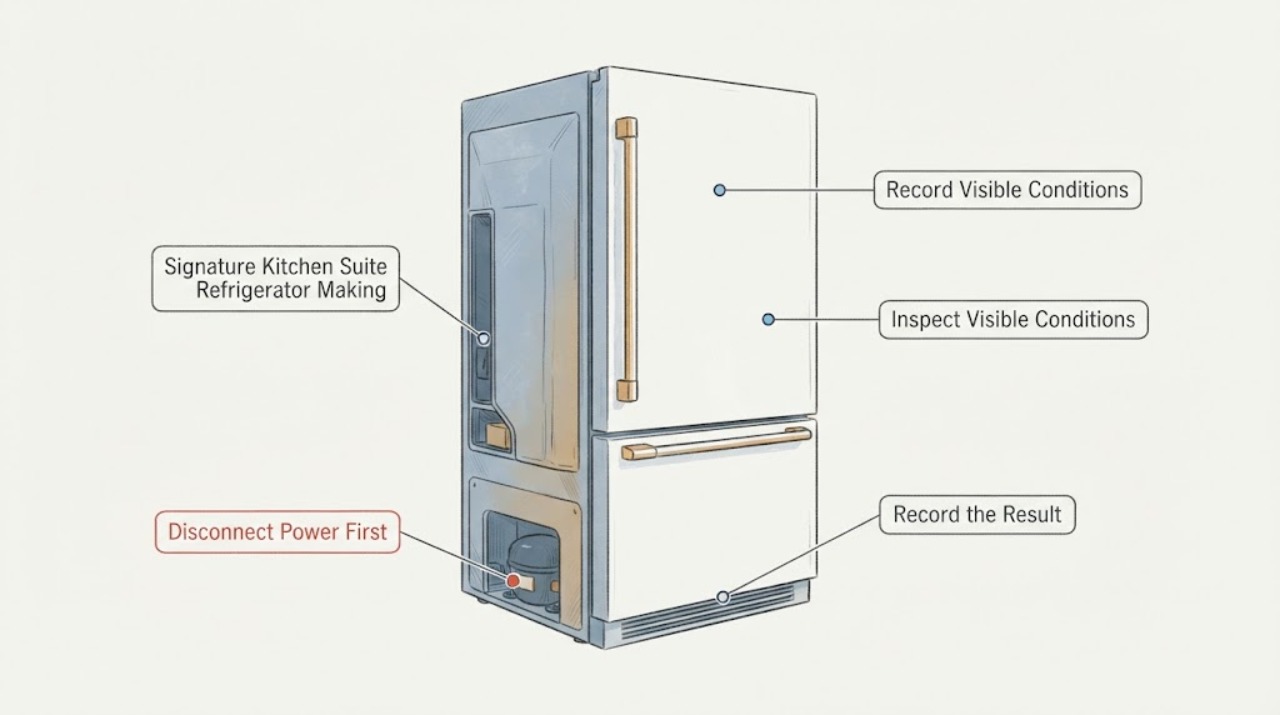
Work through in order
Diagnostic checks
Use only checks that match the exact appliance or system and its official guide.
-
Check 1
From outside the refrigerator, record the sound in plain words and note its timing: on startup, during cooling, when a door closes, during defrost, after dispensing, or continuously. Note whether the cabinet is cooling normally, whether the sound is a click, hum, buzz, rattle, whoosh, gurgle, pop, sizzle, drip, or vibration, and whether any display or temperature warning appears.
Expected result: The sound matches a documented operating sound and cooling is normal, the sound is a vibration or rattle, or the sound is new, severe, continuous, or paired with poor cooling, smoke, odor, water, or an electrical symptom.
Next step: If the sound is severe or paired with a safety or cooling symptom, stop using the refrigerator and follow the service branch. Otherwise continue with the external contact and stability checks while keeping the door closed as much as possible.
Why this matters
Why: Timing and cooling status separate likely fan, compressor, refrigerant, defrost, or material sounds from a fault that needs service. A sound cannot identify a failed component by itself.
-
Check 2
Check for external contact without moving a built-in refrigerator or reaching behind it. Look for the side or back touching a wall, cabinet, trim, countertop, or neighboring appliance, and remove loose objects stored on top or around the cabinet that could vibrate. Do not place hands or tools beneath or behind the refrigerator.
Expected result: The cabinet or a loose item is touching or vibrating, or all visible clearances and surrounding items are stable.
Next step: Remove only a loose surrounding item or correct a clearly accessible contact identified by the installation instructions. If the refrigerator is built in or the contact cannot be corrected without moving it, use a qualified installer or service provider.
Why this matters
Why: Signature Kitchen Suite manuals identify wall or cabinet contact and items around the refrigerator as causes of amplified rattling or vibration. If nothing is touching, the sound is less likely to be a simple contact resonance.
-
Check 3
Observe whether the refrigerator is stable on the floor. Look for rocking, an uneven floor, or a leveling leg that appears out of position, and note whether the noise changes when a door is opened or the compressor starts. Do not crawl under the appliance or adjust hidden components while it is connected to power.
Expected result: The cabinet rocks or sits unevenly, the sound changes with cabinet movement, or the refrigerator is stable and level but the noise remains.
Next step: Have leveling corrected according to the exact installation instructions, especially for a heavy built-in unit. If the refrigerator is stable and the sound is new or worsening, arrange service instead of opening panels.
Why this matters
Why: An unstable floor or incorrect leveling can transmit normal compressor or fan vibration into a loud rattle. A stable cabinet with a persistent internal sound points toward normal operating acoustics or an internal fan, compressor, or sealed-system issue.
-
Check 4
Compare the sound with the normal operating descriptions in the exact owner manual. A click may occur when defrost or a control cycles, a whoosh may be a fan, a gurgle may be refrigerant, a sizzle or drip may be defrost water, and a pulsating or high-pitched sound may come from an efficient compressor. Do not rely on a sound alone to declare a failure.
Expected result: The sound follows the manual's timing and the refrigerator maintains temperature, or it occurs outside the expected cycle or the refrigerator is not cooling normally.
Next step: Monitor a documented normal sound while checking only the visible stability conditions. For a changed sound or any cooling problem, record a short description and request service rather than testing the appliance by disconnecting internal parts.
Why this matters
Why: A documented sound with normal cooling is more likely normal operation. A sound outside the documented pattern, with increasing volume, or with loss of cooling requires model-specific diagnosis.
-
Check 5
Check the refrigerator's operating condition at the same time as the noise. Look at the display for a temperature or fault indication, confirm the doors close, and observe whether food remains at the expected temperature. Keep the cabinet closed during the observation and do not remove rear covers to listen closer.
Expected result: Cooling and door operation are normal, only the noise is unusual, or the noise is accompanied by warm food, a fault display, repeated cycling, water, smoke, odor, or a damaged cord.
Next step: If cooling or safety is affected, stop using the refrigerator, preserve the display and timing information, and arrange service. If only sound remains, continue to the model-specific manual and service threshold without making internal adjustments.
Why this matters
Why: Noise with normal cooling can be a normal cycle or vibration issue; noise with a performance or safety change makes a fan, compressor, control, seal, water, or electrical fault more likely.
-
Check 6
If the noise began after installation, transport, or a recent cleaning, verify from outside that the refrigerator is in its specified location and that no packing material, shelf, bin, or surrounding object is loose. Do not pull a built-in refrigerator out or disconnect wiring yourself; use the installation guide or a qualified service provider.
Expected result: The noise began after placement or a removable item is visibly loose, or no installation or removable-item change explains the sound.
Next step: Secure or reseat only an accessible removable item according to the manual. For built-in alignment, electrical, compressor, fan, or sealed-system concerns, stop and contact Signature Kitchen Suite service.
Why this matters
Why: A new contact, loose removable item, or unstable installation can amplify normal operating vibration. A noise with no such change is more likely an operating sound or a developing internal fault.
Use your observations
Decision map
Find the observation that best matches what you see, then follow the next safe action.
-
PATH 01Next step
What you see
The sound matches a documented click, whoosh, gurgle, pop, sizzle, drip, or compressor tone, and the refrigerator is cooling normally with no safety symptom.
Do this next
Monitor the sound and confirm that the exact model manual describes its timing. Request service if it becomes severe, continuous, or associated with poor cooling or another new symptom.
Why this path and its safety boundary
Why it matters: The pattern is consistent with normal defrost, fan, refrigerant, material, drainage, or compressor operation described by Signature Kitchen Suite manuals.
-
PATH 02Next step
What you see
A side or back touches a wall or cabinet, an item around the refrigerator vibrates, or the cabinet rocks on an uneven floor.
Do this next
Remove only loose surrounding items and correct accessible leveling or installation issues according to the manual. Use a qualified provider for a built-in unit that must be moved.
Why this path and its safety boundary
Why it matters: The evidence supports vibration being amplified by contact or instability rather than proving an internal component failure.
-
PATH 03Next step
What you see
The noise is new or rapidly worsening and the refrigerator is warm, displays a fault, cycles repeatedly, leaks, or the door no longer closes correctly.
Do this next
Keep the door closed, protect temperature-sensitive food as appropriate, and arrange Signature Kitchen Suite service. Do not remove panels or attempt to diagnose the sealed system by touch or sound.
Why this path and its safety boundary
Why it matters: The combination of noise and performance change is less consistent with a normal operating sound and may involve a fan, compressor, control, seal, or other service issue.
-
PATH 04Next step
What you see
The refrigerator emits smoke or a burning or chemical smell, water or dust enters the cabinet, the cord or plug is damaged, or power trips repeatedly.
Do this next
Disconnect power immediately if it is safe to do so, do not touch wet or damaged electrical parts, and contact Signature Kitchen Suite service or a qualified electrician. Do not use the refrigerator until it has been assessed.
Why this path and its safety boundary
Why it matters: These are safety or electrical warning signs outside a normal noise diagnosis.
Helpful context
Understand the symptom
The sound itself is the first diagnostic clue. A refrigerator may click as a control or defrost cycle starts, whoosh as a fan moves air, gurgle as refrigerant flows, or pop as interior materials expand and contract. A rattle caused by the cabinet touching a wall, a loose item, or an unstable floor is different from a new noise that occurs with loss of cooling or an electrical warning.
Signature Kitchen Suite offers built-in wine columns, refrigerators, and other refrigerator forms, so construction and normal sound patterns can differ. Use the complete model number to open the matching owner manual. These checks are limited to observation, safe exterior positioning, and removable items; do not remove panels, reach behind the appliance, or attempt compressor, fan, refrigerant, or electrical repairs.
Only after diagnosis
Potential parts
- leveling leg or installation hardware
Consider this category only if the exact installation instructions or a qualified provider confirms that an uneven cabinet or damaged leveling hardware is amplifying vibration. A rattle alone does not prove the leg is defective.
Confirm the complete model and installation configuration before ordering. Built-in units may require professional positioning. - evaporator or condenser fan assembly
Consider this category only after service diagnosis identifies a fan bearing, blade, or motor problem from a noise that is not explained by normal airflow or external vibration.
Fan parts are model-specific and may be behind panels or near electrical and sealed-system components. Use Signature Kitchen Suite service for replacement.
When checks do not resolve it
Need a professional?
Contact Signature Kitchen Suite service when a new or worsening noise occurs with poor cooling, repeated cycling, a fault display, a door or seal problem, smoke, burning or chemical odor, water or dust intrusion, repeated electrical trips, or a damaged cord or plug. Disconnect power when safe and do not pull out a built-in unit, remove panels, or attempt fan, compressor, refrigerant, or electrical repair yourself.
Common questions
FAQ
Which refrigerator noises are normal on a Signature Kitchen Suite appliance?
The owner manuals describe clicking, rattling from refrigerant or nearby items, whooshing from fans, gurgling refrigerant, popping from temperature changes, sizzling or dripping during defrost, and some pulsating or high-pitched compressor sounds as normal when cooling is otherwise normal. The exact timing depends on the model.
Why does my Signature Kitchen Suite refrigerator rattle?
Check whether the cabinet touches a wall or cabinet, an item on or around it is vibrating, or the refrigerator is unstable on an uneven floor. SKS manuals identify those conditions as ways normal vibration can become audible; if the cabinet is stable and the noise persists or cooling changes, request service.
When is a refrigerator noise a reason to stop using it?
Stop when the noise comes with smoke, a burning or chemical smell, water or dust entering the appliance, repeated power trips, a damaged cord, loss of cooling, a fault display, or a sudden severe change. Disconnect power if safe and arrange Signature Kitchen Suite service rather than opening the refrigerator.
Read the exact guide
Official sources
- Built-In R Refrigerator Owner's ManualSignature Kitchen Suite · Signature Kitchen Suite SKSCR3001P and SKSCR2401P built-in refrigerator manual; use the exact model manual for the appliance at hand.
- French Door Counter-Depth Refrigerator Owner's ManualSignature Kitchen Suite · Signature Kitchen Suite UPFXC2466 refrigerator manual; safety boundaries are relevant to refrigerator service, while controls vary by model.
- 48FD Owner's ManualSignature Kitchen Suite · Signature Kitchen Suite 48FD refrigerator manual; noise patterns and installation details vary by model.
- Wine Refrigerator | SKS CanadaSignature Kitchen Suite · Official Signature Kitchen Suite product and support category; individual refrigerator designs and service availability depend on model and region.
Community feedback
Share a repair observation
Share a plain-text repair observation. Accepted observations are published automatically; this page may take a moment to update.