
On this page
Start here
Quick answer
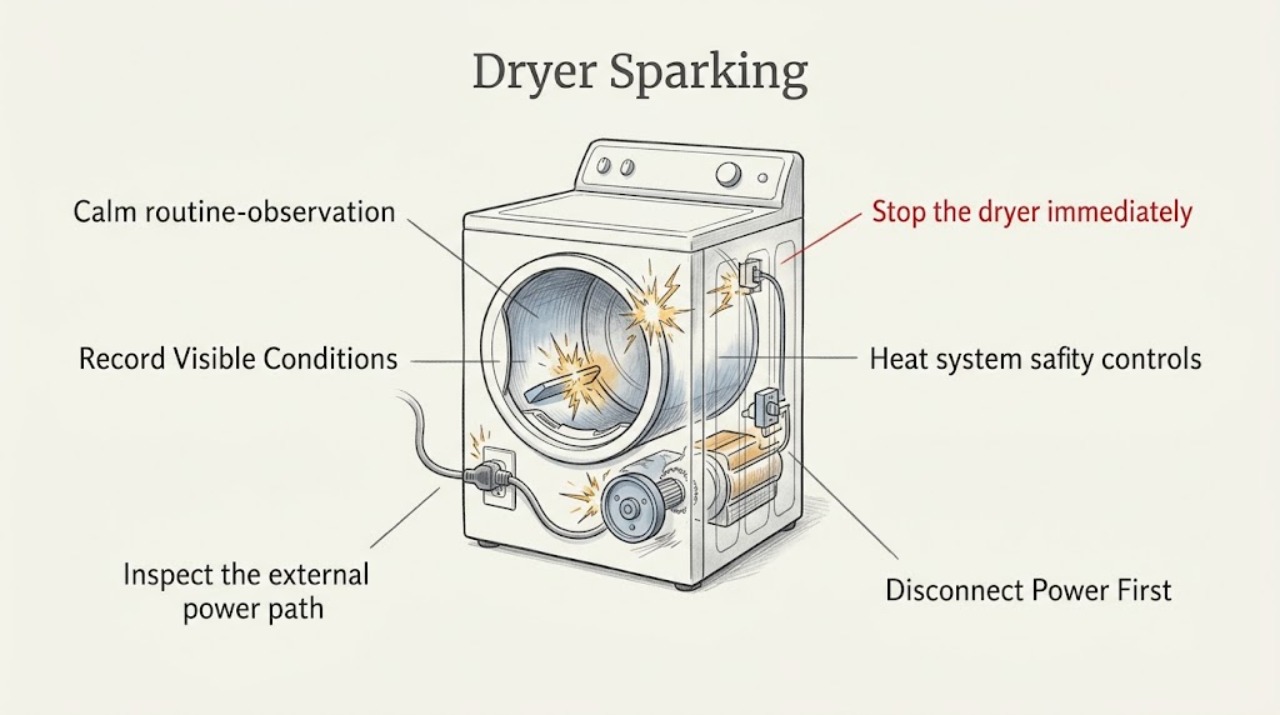
Any visible spark or arc from a Speed Queen dryer, inside the drum, at the plug or receptacle, or from the cabinet is abnormal: stop the cycle immediately, isolate power only from a safe dry position, and do not run the dryer again to check it. A single static snap felt when removing dry synthetic clothing after the dryer has fully stopped may be static electricity, but it does not explain a visible machine spark, repeated crackling, burning odor, smoke, heat, or a breaker trip. Do not bypass the door switch, open the cabinet, remove panels, or inspect a gas system. For a gas model, any gas odor or abnormal flame requires immediate gas-safety action. Arrange qualified appliance or electrical service and provide the model, spark location, timing, load, and any odor or damage.
Work through in order
Diagnostic checks
Use only checks that match the exact appliance or system and its official guide.
-
Stop the dryer immediately
Press the normal stop control only if it responds without putting you near a spark, smoke, hot surface, water, or damaged control. Otherwise move away and isolate power from a safe, dry position if that can be done without touching damaged equipment. Do not restart the dryer, reset a breaker for another run, or leave it operating unattended.
Expected result: The dryer is stopped and isolated with no ongoing hazard, or smoke, fire, sparking, burning odor, severe heat, or a gas odor remains.
Next step: For fire, persistent arcing, smoke, or suspected gas, leave the area and contact the appropriate emergency or gas service from a safe location. If the hazard has stopped, keep the dryer disconnected and continue only with non-powered observations.
Why this matters
Why: A visible spark can be an electrical or fire hazard even if the dryer appears to continue normally. No further powered observation is justified, and a remaining hazard takes priority over troubleshooting.
-
Record where and when the spark occurred
From outside the disconnected dryer, write down whether the spark was seen through the drum opening, near the plug or receptacle, under or behind the cabinet, or only felt as a snap when removing clothing after the drum had stopped. Record the cycle stage, heat status, drum motion, load fabric, and whether the breaker opened. Do not turn the drum or power the dryer to reproduce the event.
Expected result: The event was a single post-cycle clothing shock with no visible machine spark, or it was visible, repeated, synchronized with operation, or associated with a connection, odor, heat, or breaker event.
Next step: Treat every visible or repeated machine spark as a stop-use service condition. Give the technician the location and stage; do not perform a second cycle to distinguish static from an appliance fault.
Why this matters
Why: Speed Queen explains that friction between fabrics can create static electricity, especially with dry synthetic materials. That explanation does not cover a visible arc from the dryer, a spark during powered operation, or any event with heat, odor, smoke, or electrical damage.
-
Inspect the external power path without touching damage
Only from a dry, safe position and with the dryer isolated, look at the visible plug, receptacle, and cord for scorch marks, melted plastic, looseness, exposed conductors, water, or discoloration. Do not remove a cover, open the electrical panel, pull a gas dryer forward, use an improvised test, or handle a hot or damaged connection.
Expected result: The plug, receptacle, or cord shows heat, arcing, moisture, looseness, or damage, or the external parts look normal.
Next step: For any damage, heat, moisture, or looseness, leave power isolated and arrange qualified electrical service. If the external path looks normal, still keep the dryer out of service and arrange appliance diagnosis because a visible machine spark requires more than a visual clearance.
Why this matters
Why: A connection-side fault can create a spark independently of the dryer internals. A normal visual appearance does not rule out an internal electrical fault or a building-supply problem.
-
Check the load and drum opening only after cooling
After the dryer is isolated and completely cool, look through the loading opening for a loose coin, fastener, zipper piece, or other metal object that could have contacted the drum. Remove only a loose, plainly accessible item without tools; do not reach past guards, remove the lint duct, or open panels. Keep items with oil or flammable residue out of the dryer.
Expected result: A loose metal object is present, clothing shows scorch or heat damage, lint is excessive, or the drum appears clear and the load has no visible damage.
Next step: Do not run the dryer after removing an object. Photograph the object or damage for service. If clothing is scorched, the lint path is heavily contaminated, or the cabinet is hot, keep the dryer out of service and request qualified inspection.
Why this matters
Why: A foreign object can explain a scraping or contact mark but does not prove that it caused a visible spark. Speed Queen warns that lint and oil-affected items can create fire risk, and a clear drum does not clear the electrical or drive systems.
-
Use the fuel-type branch without testing ignition
Record whether the dryer is electric or gas from the model label or manual. For a gas model, do not relight, inspect, or adjust an igniter, burner, valve, connector, or gas line. For either type, note only whether there was a gas odor, abnormal flame, heat, smoke, or a breaker event before the spark.
Expected result: A gas odor or abnormal flame was present, or the dryer is electric or has no gas-related symptom.
Next step: For gas odor or abnormal flame, leave the area, avoid flames and electrical switches, and contact gas or emergency assistance from a safe location. Otherwise keep the dryer disconnected and arrange qualified appliance and electrical diagnosis; do not open the cabinet.
Why this matters
Why: A gas odor or abnormal flame is an immediate gas-safety condition, not a normal spark diagnosis. On an electric dryer, a visible arc can involve the cord, receptacle, motor, heater, control, or another internal circuit.
-
Capture display and protection events
Photograph any diagnostic code, flashing display, or status light and record whether the breaker or another protective device opened. Do not repeatedly restore power. Use the model-specific manual only to identify what the recorded code means, not to authorize a confirmation cycle after sparking.
Expected result: A code, overload indication, blank display, or breaker event is present, or no protection message was visible.
Next step: Give the code and protection-event details to a qualified technician. Keep the dryer out of service and do not clear a code by repeatedly cycling power or pressing Start.
Why this matters
Why: Speed Queen guides use displays and status indicators for cycle state and certain overload conditions. A protection event after a spark is evidence for service, even if the display later looks normal.
-
Arrange qualified service without a retest
Provide the technician with the model and serial information available, fuel type, spark location, cycle stage, drum and heat status, load details, external power observations, code, and any smoke, odor, heat, or breaker event. State clearly that the dryer has sparked and has not been retested.
Expected result: A qualified person can inspect the appliance and supply while the dryer remains isolated, or an emergency hazard remains.
Next step: Do not power the dryer for service preparation or a confirmation run. For persistent smoke, fire, arcing, gas odor, or an electrical danger, leave the area when needed and contact emergency assistance from a safe location.
Why this matters
Why: A visible spark cannot be cleared by removing lint or changing a load. Internal electrical, drive, heater, or gas-system diagnosis requires appropriate isolation and qualified service.
Use your observations
Decision map
Find the observation that best matches what you see, then follow the next safe action.
-
PATH 01Next step
What you see
A single snap was felt only while removing dry synthetic clothing after the drum had fully stopped, with no visible dryer spark, odor, heat, damage, or breaker event.
Do this next
Treat static electricity as a possible explanation, reduce overdrying according to the model guidance, and stop using the dryer if any visible spark or machine symptom appears. Do not use this explanation to clear a powered spark.
-
PATH 02Next step
What you see
A spark was visible inside the drum, repeated during operation, or occurred with a metal object, scraping, scorch mark, smoke, or burning odor.
Do this next
Stop immediately, isolate power from a safe position, and do not run the dryer again. Arrange qualified appliance service; do not reach through guards or open the cabinet.
-
PATH 03Next step
What you see
The spark came from the plug, receptacle, cord, or cabinet, or the receptacle is hot, loose, wet, melted, or discolored.
Do this next
Do not touch the connection or restore power. Keep people away and arrange qualified electrical and appliance inspection from a safe, dry position.
-
PATH 04Next step
What you see
A gas dryer has a gas odor, abnormal flame, delayed ignition, or a spark near a gas-related area.
Do this next
Do not relight or test it. Avoid flames and electrical switches, leave the area, and contact gas or emergency assistance from a safe location.
-
PATH 05Next step
What you see
Smoke, fire, persistent arcing, severe heat, scorched clothing, or a breaker trip occurred.
Do this next
Stop use and do not reset or retest. Leave for fire or electrical danger and contact emergency assistance as needed; otherwise keep the dryer isolated for qualified service.
-
PATH 06Next step
What you see
The dryer is isolated, fully cool, and no hazard remains, but the spark source cannot be identified visually.
Do this next
Do not use a confirmation load or open panels. Provide the recorded model, cycle, location, and display details to a qualified appliance technician.
Helpful context
Understand the symptom
A visible machine spark is not a normal dryer sound or a harmless operating cycle. The safe response is to stop immediately and avoid a second run. The useful distinction is between a small static shock associated with dry clothing after the dryer has stopped and a spark that occurred while the machine was powered, was visible inside the drum or at a connection, repeated, or came with heat, smell, smoke, or a breaker event.
Speed Queen models differ in fuel type, controls, drum construction, and safety devices. Use the model number to locate the correct manual, but do not use a manual's normal-cycle or reset instructions to justify testing a dryer that has sparked. A spark may involve a power connection, an internal electrical circuit, a motor or heater, a loose metal object, or a separate building-supply problem.
Do not touch a damaged plug, receptacle, cord, cabinet, or wet surface. Do not reach into a hot or moving drum, and do not move a gas dryer to inspect behind it. If smoke, fire, persistent arcing, or a gas odor is present, leave the area as needed and contact emergency or gas assistance from a safe location.
Only after diagnosis
Potential parts
- power cord or terminal connection
Only relevant if qualified inspection finds connection-side heat, arcing, or damage at the exact model installation.
Do not touch or replace a damaged connection based on the symptom alone; qualified electrical service must identify the safe repair. - door switch or safety interlock
Only relevant if qualified diagnosis finds that the dryer can operate or arc with the door open or the interlock state is abnormal.
Never bypass the switch; verify the exact model before any service decision. - drive motor or drum support
Only relevant when qualified inspection links the spark or abnormal contact to the drive or drum system after isolation.
A loose metal object or noise does not prove that a drive part needs replacement. - heating element or gas heat-control assembly
Only relevant if qualified diagnosis identifies a fault in the applicable electric heating or gas heat-control circuit.
Electric and gas systems differ; do not inspect or replace ignition or heating parts without qualified service.
When checks do not resolve it
Need a professional?
Call qualified appliance service for any visible or repeated dryer spark, a spark during powered operation, a spark associated with a loose object or abnormal noise, or a dryer that has been exposed to smoke, heat, or a protective trip. Arrange qualified electrical service for a hot, loose, wet, melted, or discolored plug, receptacle, or cord. For gas odor, fire, smoke, or persistent arcing, leave the area as needed and contact emergency or gas assistance from a safe location. Do not retest, bypass the door switch, or open the cabinet.
Common questions
FAQ
Is a small shock from clothes the same as a Speed Queen dryer spark?
Not necessarily. A single snap felt when removing dry synthetic clothing after the dryer has fully stopped may be static. A visible spark from the drum, cabinet, plug, or receptacle, or any repeated crackle, odor, smoke, heat, or breaker event is abnormal and requires immediate stop-use action.
Can I run the Speed Queen dryer once more to see whether it sparks?
No. Do not retest after a visible spark or arc. Keep the dryer isolated and provide the spark location, cycle stage, load, and display details to qualified service.
Could a coin or zipper cause a spark inside a dryer?
A loose metal object can create contact or scraping symptoms, but it does not prove the cause of a visible spark. After the dryer is isolated and cool, only remove a plainly accessible loose object without tools, then keep the dryer out of service for inspection.
What should I do if the spark came from the outlet or plug?
Do not touch or reuse the connection. Keep power isolated from a safe, dry position and arrange qualified electrical and appliance inspection. A normal-looking connection does not clear an internal dryer fault.
What if my Speed Queen dryer is a gas model?
Do not relight or inspect the burner or gas controls after a spark. Any gas odor or abnormal flame requires leaving the area, avoiding flames and electrical switches, and contacting gas or emergency assistance from a safe location.
When is dryer sparking an emergency?
Smoke, fire, persistent arcing, a burning odor, severe heat, scorched clothing, a hot or melted receptacle, or a gas odor requires immediate stop-use action. Leave the area as needed and contact emergency assistance from a safe location.
Read the exact guide
Official sources
- User's GuideSpeed Queen by Alliance Laundry Systems · ADE3TR and ADG3TR timer dryer guide represented by the document; other models can differ.
- User's GuideSpeed Queen by Alliance Laundry Systems · ADEE9R and ADGE9R electronic dryer guide represented by the document; features and controls vary by model.
- How to Stay Clear of StaticSpeed Queen · Clothing static in and around dryers; it does not explain visible arcs from a powered appliance or electrical connection.
- User's GuideSpeed Queen by Alliance Laundry Systems · ADEE8B and ADGE8B dryer guide represented by the document; other Speed Queen models may use different controls and instructions.
- Speed Queen | Manuals & DownloadsSpeed Queen by Alliance Laundry Systems · Speed Queen residential and commercial dryers; fuel type, controls, and safety instructions depend on the complete model number.
Community feedback
Share a repair observation
Share a plain-text repair observation. Accepted observations are published automatically; this page may take a moment to update.