
On this page
Start here
Quick answer
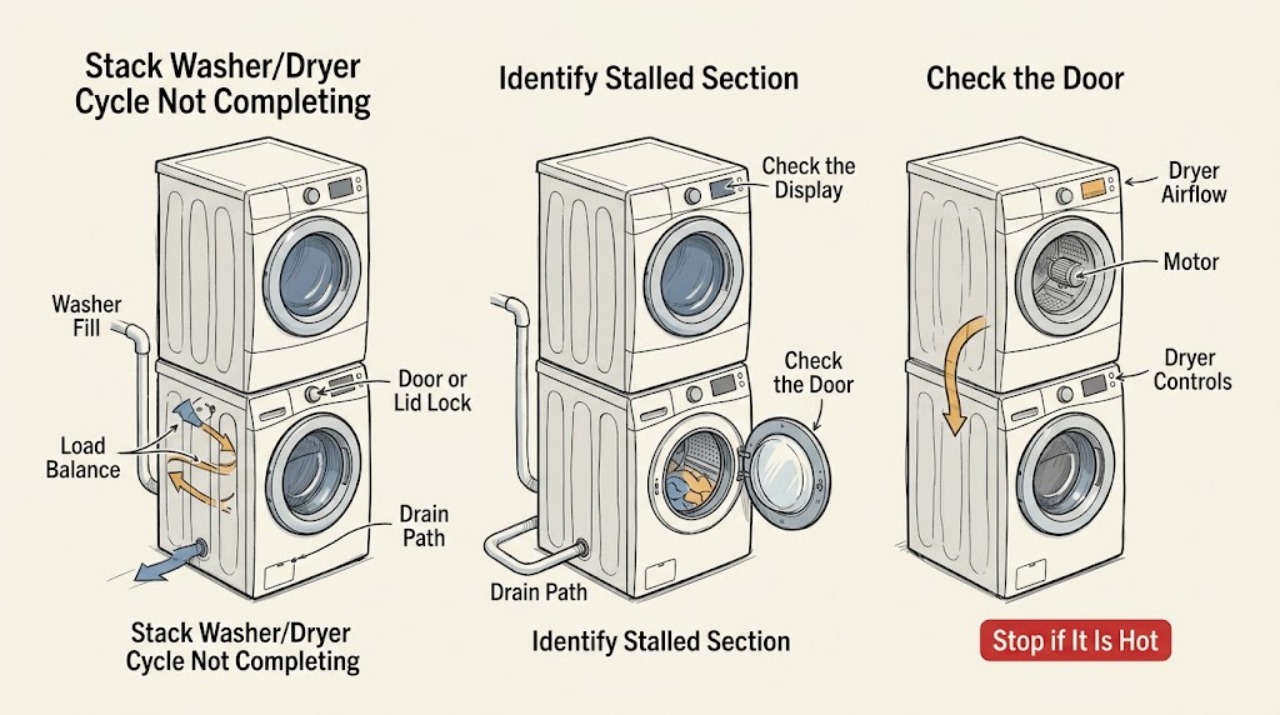
First identify whether the washer or dryer is the section that stops, and note the display, remaining water, door state, and whether the drum or cylinder is moving. A washer may pause normally, protect its motor after an overload, or stop because it cannot fill, balance, or drain; a dryer may be in cooling or extended tumble, or may run long because lint, load size, or the exhaust path restricts airflow. Check only the accessible controls, load, hoses, lint filter, and vent path described for the exact model. Stop for smoke, burning or gas odor, flooding, exposed wiring, repeated breaker trips, a locked door with water inside, or any need to open panels or bypass a safety device, and arrange qualified Speed Queen service.
Work through in order
Diagnostic checks
Use only checks that match the exact appliance or system and its official guide.
-
Check 1
Without opening the cabinet, observe one attempted run from a safe position and record whether the washer or dryer stops, the selected cycle, the display or indicator state, the remaining-time behavior, and whether the drum or cylinder is moving.
Expected result: The washer stops during fill, wash, spin, or drain; the dryer stops while tumbling, heating, cooling, or extending the cycle; or the control goes blank or shows a code.
Next step: Write down the exact model, fuel type if known, cycle, code, and the last normal action before the stop, then continue with the washer or dryer branch that matches the observation.
Stop if: Stop immediately for smoke, burning or gas odor, sparks, flooding, a hot or damaged cord, an uncontrolled motor, or a door or lid that is damaged or unsafe to operate.
Why this matters
Why: The stalled stage changes the next check: water and lock evidence points to the washer, standing water points to drain, and a tumbler that runs long or remains damp points to dryer load or airflow. A blank display or code may indicate a power or control event rather than a mechanical blockage.
-
Check 2
For the affected section, verify that the cycle is actually started and not paused, delayed, locked, or in a special cooling, extended-tumble, or no-heat state; use only the model manual's button or control sequence.
Expected result: The display shows pause, delay, control lock, cooling, extended tumble, no heat, or another documented state, or it shows a normal running state while the stage does not advance.
Next step: Clear only a documented pause or delay, then make one supervised test run; if the same stage stalls, record the result and move to the matching physical check.
Stop if: Do not bypass a lock, enter undocumented diagnostic mode, repeatedly reset a tripping circuit, or open the control panel.
Why this matters
Why: A control state can look like an incomplete cycle without a failed component. If the controls show normal running but the physical stage never changes, the fault is more likely to involve supply, sensing, lock, motor, drain, or airflow and should not be guessed from the display alone.
-
Check 3
If the washer stops before or during fill, check from outside that the hot and cold faucets are open, fill hoses are not kinked, the accessible inlet screens are not visibly obstructed, and the door or lid closes fully; do not disassemble the valve or lock.
Expected result: A faucet is closed, a hose is kinked, an accessible screen is visibly restricted, the door or lid does not close, or the washer fills normally but later stalls.
Next step: Correct only an obvious faucet, hose-routing, or closure issue described by the manual, then run one supervised test; leave internal valves and interlocks for service.
Stop if: Stop for leaking hose connections, flooding, a door or lid that will not lock or unlock safely, or standing water that would make access hazardous.
Why this matters
Why: Insufficient water or an unconfirmed door or lid signal can prevent the program from advancing. If fill and closure are normal, do not infer a failed valve or lock; the next evidence should come from balance, suds, or drain behavior.
-
Check 4
If the washer stops before final spin or ends with wet clothes, stop the program using the model controls and, only when there is no unsafe standing water, redistribute an obviously bunched or very small load and check the external drain hose and receptacle for kinks or visible blockage; use the model's detergent guidance.
Expected result: The load is unbalanced or too small, there are excessive suds, the drain hose or receptacle is kinked or blocked, water remains, or the accessible load and drain path appear normal.
Next step: After safely correcting the load, detergent amount, or visible hose routing, run one appropriate drain or spin test from the manual; do not pull a filter or pump cover with water present unless the exact manual explicitly gives a safe procedure.
Stop if: Stop for flooding, water near electrical parts, an inaccessible or pressurized drain connection, a locked door with water inside, or any need to reach moving or internal parts.
Why this matters
Why: An unbalanced load can limit spin, oversudsing can delay drainage, and a restricted drain path can prevent the washer from completing. A normal external path with persistent water or a recurring code points to pump, trap, sensing, or control diagnosis that should be handled by service.
-
Check 5
If the dryer is the section that does not finish, confirm the chosen cycle and heat setting, clean the user-accessible lint filter, compare the load with the model's capacity guidance, and inspect the external exhaust hose and outside hood for a kink, crushed section, blockage, or flap that cannot move freely; isolate power before disconnecting any vent hose.
Expected result: The dryer is in cooling or extended tumble, the lint filter is restricted, the load is very small or mixed with heavy items, the exhaust path is restricted, or the dryer tumbles but the cycle still does not complete with a clear external path.
Next step: Correct only the documented cycle, load, lint, or accessible vent issue, then run one supervised test with the correct filter installed; arrange service if the stage or fault repeats.
Stop if: Stop for smoke, scorching, gas odor, a hot cabinet, a damaged vent, a repeatedly tripping breaker, or any need to access the heater, burner, motor, or live wiring.
Why this matters
Why: Cycle state, load composition, lint, and restricted exhaust can extend drying or make an automatic cycle appear stuck. A clean accessible path does not prove the heater, sensor, blower, motor, or control is good; those require model-specific testing.
-
Check 6
When one supervised test still stops at the same stage after the applicable external checks, arrange qualified appliance service and provide the model and serial information, washer or dryer position, fuel type, selected cycle, code, water or heat state, and the exact observation sequence.
Expected result: The failure is repeatable, intermittent with an error, associated with a lock, motor, pump, heating, sensing, or control symptom, or cannot be safely reproduced.
Next step: Leave the affected section out of service when the fault is persistent or unsafe, preserve the display code or a photo, and use Speed Queen's support or authorized-service route.
Stop if: Do not continue testing for smoke, gas odor, flooding, exposed wiring, repeated electrical trips, uncontrolled heating, or a lock that will not safely release.
Why this matters
Why: A repeatable stalled stage narrows the technician's diagnostic path, but it does not identify a replacement part. A stacked unit may contain different washer and dryer configurations, so model-specific service information is essential.
Use your observations
Decision map
Find the observation that best matches what you see, then follow the next safe action.
-
PATH 01Next step
What you see
The washer is alternating between agitation and pausing, or the motor has just stopped after a heavy load and restarts after its documented cooling period.
Do this next
Arrange qualified service and follow the exact model guidance.
Why this path and its safety boundary
Why it matters: Treat the pause as potentially normal, observe whether the cycle advances, and use the correct load size. If it does not restart or repeats, arrange service rather than forcing the motor.
-
PATH 02Next step
What you see
The washer cannot fill or reports a door or lid problem.
Do this next
Arrange qualified service and follow the exact model guidance.
Why this path and its safety boundary
Why it matters: Verify the accessible faucets, hose routing, screens, and closure only as the model manual allows. Persistent failure requires service for the inlet, lock, sensing, or control circuit.
-
PATH 03Next step
What you see
Water remains in the washer, the final spin is skipped, or the displayed symptom indicates a drain problem.
Do this next
Arrange qualified service and follow the exact model guidance.
Why this path and its safety boundary
Why it matters: Stop safely, check only the external drain hose and receptacle when water and access conditions are safe, and do not open an internal trap or pump with standing water unless the exact manual directs a safe procedure. Repeated retention needs service.
-
PATH 04Next step
What you see
The washer is noisy, leaves clothes wet, shows an unbalanced indication, or has excessive suds.
Do this next
Arrange qualified service and follow the exact model guidance.
Why this path and its safety boundary
Why it matters: Use an appropriate load and detergent amount, redistribute the load only when safe, and retry one documented drain or spin cycle. If the same stage fails with a suitable load, request diagnosis.
-
PATH 05Next step
What you see
The dryer tumbles but takes too long, stays damp, or appears to remain in an automatic cycle.
Do this next
Arrange qualified service and follow the exact model guidance.
Why this path and its safety boundary
Why it matters: Check cycle selection, load size, lint filter, and accessible exhaust path. If airflow is clear but the dryer still stalls, do not open the heater or motor area; arrange service.
-
PATH 06Next step
What you see
A safety symptom is present, or the same stage fails after the applicable external checks.
Do this next
Arrange qualified service and follow the exact model guidance.
Why this path and its safety boundary
Why it matters: Stop use, isolate the area from people and pets as appropriate, and request qualified appliance, electrical, or gas service. The stack must not be operated to collect more evidence.
Helpful context
Understand the symptom
A cycle that pauses is not always a failed cycle
Watch the unit long enough to identify the stage that stops. Washer pauses can be part of normal operation, and an overload protector may need a short cooling period. A dryer can also spend time in a cooling or wrinkle-prevention portion rather than actively heating. The useful distinction is whether the control advances, whether water remains, whether the door or lid stays locked, and whether the drum or cylinder moves. Use the exact model manual for names and reset sequences because stacked models and fuel configurations differ.
Treat the washer and dryer as separate fault paths
A stacked cabinet does not make the two sections one diagnostic circuit. A washer that stops before drain or final spin needs a water, suds, balance, lock, or drain-path check. A dryer that runs but does not finish needs a cycle-state, load, lint, and exhaust check. The stack product information confirms that Speed Queen offers gas and electric configurations and model-specific cycles, so do not infer the heat source or component from the cabinet alone.
Keep the access boundary external
Do not remove a stacked unit's panels, reach into a moving drum or cylinder, probe wiring, defeat a door or lid lock, or open a pump or gas component as a general troubleshooting step. If there is standing water, isolate the appliance from its controls and arrange service rather than forcing the door. A gas odor, smoke, scorch mark, flooding, or repeated electrical trip changes this from a cycle complaint to a safety stop.
Safety boundary
Stop conditions
- Smoke, scorching, burning odor, sparks, an unusually hot cabinet or cord, or repeated breaker trips.
- Gas odor, hissing, failed ignition, or uncertainty about a gas connection; leave the area and follow local emergency or gas-service guidance.
- Flooding, an active leak, water near electrical parts, or a locked washer door with water inside.
- A damaged door, lid, latch, hinge, cord, hose, vent, or support that makes operation or access unsafe.
- Any need to remove a stacked-unit panel, reach a moving drum or cylinder, probe live wiring, open a gas component, or bypass a safety lock.
- The cycle repeatedly stops at the same stage after one safe external test.
Only after diagnosis
Potential parts
- washer drain pump or foreign-object trap component
Consider this category only if qualified diagnosis confirms that the external drain path is clear but the washer cannot remove water and the pump or trap is the failed component.
Confirm the complete Speed Queen model, washer configuration, pump design, electrical specification, and manufacturer fit information; do not order from retained water alone. - washer door or lid lock assembly
Consider this category only after the door or lid aligns and closes correctly but qualified testing confirms that the lock or its sensing circuit prevents a cycle from advancing.
Match the complete model, door or lid design, connector arrangement, and manufacturer fit information; never bypass the lock. - dryer lint, exhaust, or airflow component
Consider this category only when a technician confirms an internal airflow, blower, or related component fault after the user-accessible filter and exhaust route are clear.
Confirm the exact model, gas or electric configuration, vent arrangement, and approved fit; do not substitute a part to mask restricted airflow or a fire risk.
When checks do not resolve it
Need a professional?
The washer does not fill, drain, unlock, or complete after the documented external checks., The washer repeatedly stops at final spin, retains water, shows an error, or has recurring balance or oversudsing symptoms with an appropriate load., The dryer remains in one stage, overheats, tumbles without expected heat, stops with a code, or stays damp after the lint and accessible exhaust path are clear., The display is blank, the power supply is uncertain, or a breaker opens again., Any gas, electrical, flooding, smoke, or mechanical safety condition is present.
Common questions
FAQ
Why does my Speed Queen washer pause and then fail to finish?
Some pauses are normal, and a motor overload protector can temporarily stop the motor. If the pause does not resolve, check the selected control state, load balance, water entry, suds, and drain behavior. A repeatable stall or error needs model-specific service.
Why does the washer stop with water still inside?
A kinked or blocked external drain path, blocked receptacle, oversudsing, or an internal drain fault can prevent the final stage. Check only the accessible hose and receptacle when safe; do not open a pump or trap with standing water unless the exact manual gives a safe procedure.
Why does my stacked dryer seem stuck in its cycle?
Confirm that the dryer is not in cooling or extended tumble, then check the load, lint filter, and accessible exhaust route. A small or mixed load and restricted airflow can extend an automatic cycle. Persistent stalling, overheating, or a code should be handled by service.
Can I open the stacked unit to find the cause?
No. Do not remove panels, probe wiring, defeat a door or lid lock, or open gas, heater, pump, or motor areas as a general check. Record the safe external observations and arrange qualified service, especially for smoke, gas odor, flooding, or repeated electrical trips.
Read the exact guide
Official sources
- User's GuideSpeed Queen by Alliance Laundry Systems · Supports front-load washer symptoms that may occur in a stacked configuration; exact model and regional manual remain controlling.
- Speed Queen | SupportSpeed Queen · Supports using the manufacturer's manuals and authorized service route for an unidentified stacked washer-dryer model.
- User's GuideSpeed Queen by Alliance Laundry Systems · Supports general washer decision points; it is a model-specific guide for a top-load washer, so the assigned stack model's manual takes precedence.
- Tricks your washer or dryer might be playing on you (and how to solve them!)Speed Queen · Supports checking lint, vent placement, drain hose, drain filters where present, suds, and detergent guidance; exact stack model instructions control.
- User's GuideSpeed Queen by Alliance Laundry Systems · Supports general dryer checks for cycle selection, lint, exhaust duct, outside hood, load size, motor overload, and gas/electric distinctions; exact stacked model controls.
- STACK WASHER-DRYER SF7Speed Queen by Alliance Laundry Systems · Supports the point that stacked models have distinct washer and dryer sections and may be gas or electric; it does not diagnose an unidentified unit.
Community feedback
Share a repair observation
Share a plain-text repair observation. Accepted observations are published automatically; this page may take a moment to update.