
On this page
Start here
Quick answer
Start with the washer section of the Speed Queen stack unit: make sure the selected cycle includes spin, the loading door is fully closed, the controls and power are normal, and the washer has drained. If the load is dripping wet, redistribute it and run the model's Spin cycle; Speed Queen documentation says an unbalanced load can limit spin speed. A blocked pump trap or drain path can also prevent a proper spin. Stop before opening panels, separating the stacked units, or working on wiring, and arrange qualified service if the washer still will not spin, the drum is jammed, the drive belt is suspected, or the unit is making unsafe noises or smells.
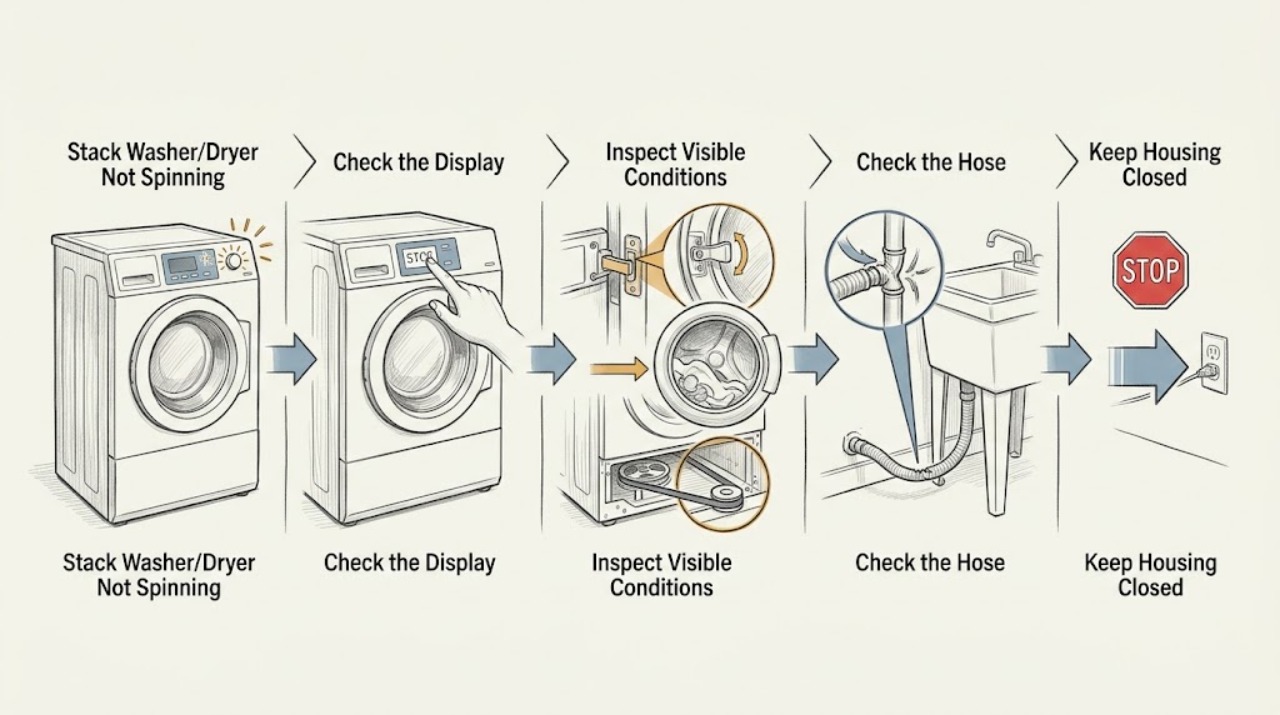
Work through in order
Diagnostic checks
Use only checks that match the exact appliance or system and its official guide.
-
Check 1
Read the washer controls and select a cycle or option that actually includes spin; make sure a no-spin option is not selected, then close the loading door firmly and press Start or Start/Pause as the model instructions require.
Expected result: The door-lock indicator or display should respond and the washer should begin its programmed drain, tumble, and spin sequence; a door warning, no response, or an immediate return to idle is a different fault path.
Next step: If the controls and door are correct but the washer still does not start a spin, check power and the drain path before considering a mechanical fault.
Why this matters
Why: The Speed Queen stack guide states that door closure, the selected controls, and the start control affect whether the washer spins. A no-spin option intentionally replaces spin with drain and tumble on supported models.
-
Check 2
Check the washer's power connection and the laundry-room circuit without opening the stacked cabinet: verify the cord is fully seated and look for a tripped breaker or fuse condition.
Expected result: If the washer controls are dark or the cycle stops whenever the circuit is restored, power is part of the symptom; if controls remain normal, continue to the load and drain checks.
Next step: Do not repeatedly reset a breaker, use an extension cord, or touch a wet or damaged cord. Leave the unit disconnected and call a qualified technician for electrical symptoms.
Why this matters
Why: The Speed Queen troubleshooting table lists the power cord and laundry-room fuse or circuit breaker among the first checks for a washer that will not spin or tumble.
-
Check 3
Look at the end-of-cycle load and listen during the drain portion; if clothes are dripping wet, pause the washer and inspect the accessible drain hose and drain receptacle for a kink, blockage, or backed-up water.
Expected result: A washer that drains freely but leaves a heavy, uneven load wet points toward balance or selection; standing water, slow drainage, or a blocked receptacle points toward the drain path.
Next step: Correct only an obvious hose position or external receptacle issue. Use the model manual for any pump-trap access; stop if water cannot be contained or the trap is not an owner-accessible part.
Why this matters
Why: Speed Queen's stack manual links a failed or limited spin to a clogged pump foreign-object trap or drain path, and it says a severely unbalanced load can limit spin speed to prevent damage.
-
Check 4
Redistribute the wash load after the washer stops or finishes with wet clothes, removing a tangled mass and adding or removing items only within the load guidance in the model manual; then run the documented Spin cycle.
Expected result: If the drum reaches a gradual spin and the load is substantially drier, the earlier result was consistent with imbalance. If the washer repeatedly thumps, pauses, or limits spin with a reasonably distributed load, the fault is not just sorting.
Next step: Keep the stacked unit in its installed position. If the issue persists with different, balanced loads, stop repeated test cycles and arrange service.
Why this matters
Why: Speed Queen describes an out-of-balance condition in which spin speed is limited, and recommends manual redistribution followed by a Spin cycle. A repeated imbalance can also reflect leveling or a mechanical problem.
-
Check 5
With the washer disconnected and the drum empty, inspect only visible areas for a foreign object around the door seal or drum opening; rotate the drum gently by hand only if the model instructions permit it and there is no resistance or damage.
Expected result: A freely moving empty drum with no trapped item makes a simple obstruction less likely; scraping, a jam, visible damage, or resistance indicates that further use could worsen the fault.
Next step: Remove only a loose, visible item without tools. Do not reach behind the drum, remove panels, separate the stack, or work near the belt or motor; request qualified service for any mechanical resistance.
Why this matters
Why: The official troubleshooting guidance separates an accessible pump-trap blockage from a broken drive belt or other service fault. Neither requires an ordinary user to open the stacked cabinet or reach moving-drive components.
-
Check 6
Run one model-supported test cycle after the safe checks, keeping the washer section closed and observing whether it drains, ramps into spin, and completes without abnormal sound, smell, movement, or repeated pausing.
Expected result: Normal draining and a completed spin support a resolved setting, balance, or external drain issue; a repeat no-spin result, persistent wet load, belt-like symptom, or abnormal noise shows that the fault remains.
Next step: Stop using the washer and contact an authorized or qualified servicer if the no-spin symptom recurs after these checks, or if diagnosis would require panels, wiring, the drive system, or separating the stacked equipment.
Why this matters
Why: The Speed Queen manual describes a ramp-spin sequence and identifies a broken drive belt as a service condition. A successful single cycle does not justify continued use if unsafe symptoms return.
Use your observations
Decision map
Find the observation that best matches what you see, then follow the next safe action.
-
PATH 01Next step
What you see
The washer does not respond, shows a door-related state, or a selected option excludes spin.
Do this next
Correct the door closure and cycle selection according to the model guide, then start the cycle again; if the door cannot latch or the controls remain unresponsive, stop for service.
-
PATH 02Next step
What you see
The washer drains but clothes remain wet and the load is tangled or concentrated on one side.
Do this next
Redistribute the load and run the documented Spin cycle. If a balanced load still causes repeated limited spin, arrange service rather than forcing more cycles.
-
PATH 03Next step
What you see
Water remains in the washer, the drain hose is kinked, or the receptacle or accessible trap is blocked.
Do this next
Disconnect power, correct only an obvious external hose or receptacle obstruction, and use the model manual for any owner-approved trap cleaning. Escalate if access is unclear or the blockage returns.
-
PATH 04Next step
What you see
The empty drum is jammed, scrapes, or shows damage, or a drive-belt problem is suspected.
Do this next
Keep the washer disconnected and do not remove panels or separate the stacked units; arrange qualified appliance service.
-
PATH 05Next step
What you see
A breaker trips again, the cord or outlet is damaged or wet, or the unit smells hot or moves unsafely.
Do this next
Stop using the stack, keep clear of wet electrical areas, and obtain qualified electrical or appliance service before another test.
Helpful context
Understand the symptom
The dryer is mounted above or beside the washer in a stack, but the no-spin symptom starts with the washer's own cycle, door, drain, load, and drive checks. The exact controls vary by model, so use the model number to select the correct Speed Queen documentation before changing settings or attempting maintenance.
A pause is not always a failure: Speed Queen describes pauses during the wash action and a gradual ramp into spin. The useful distinction is whether the washer completes its drain and spin stages with an evenly distributed load, or repeatedly leaves clothes wet and never reaches a usable spin.
Safety boundary
Stop conditions
- Stop if the cord, outlet, controls, door lock, or surrounding floor is wet or damaged, or if a breaker trips again after a reset.
- Stop if the empty drum is jammed, scraping, visibly damaged, or the unit moves violently or produces a hot or burning smell.
- Do not separate the stacked washer and dryer, remove panels, bypass a door lock, or work on the motor, belt, wiring, or other moving or energized parts.
- Arrange qualified service when a balanced load and model-supported drain and control checks do not restore spin, or when the washer continues to leave clothes wet.
Only after diagnosis
Potential parts
- washer door-lock assembly
Consider this only if the model-specific diagnosis shows that the door closes but the lock does not confirm a safe closed state.
Confirm the exact model and official fit information before ordering any part. - washer drain pump or pump trap component
Consider this only when the documented drain checks show a confirmed pump or trap fault rather than a hose or receptacle blockage.
Pump and trap designs vary by model; use the model manual and service diagnosis to confirm fit. - washer drive belt
Consider this only after qualified diagnosis identifies a broken or damaged belt; a no-spin symptom alone does not establish belt compatibility or failure.
A stacked washer must be matched by exact model and serviced according to the manufacturer's procedure.
When checks do not resolve it
Need a professional?
Call a qualified Speed Queen servicer when the washer still will not spin after the door, cycle, power, drain, and load-balance checks; when the drive belt or pump is suspected; or when service would require panels, wiring, moving-drive access, or separating the stacked unit.
Common questions
FAQ
Why is my Speed Queen stack washer leaving clothes wet?
First check whether it drained and whether the load was severely unbalanced. Speed Queen documentation says an unbalanced load can limit spin speed; a blocked drain path or pump trap, an excluded spin option, door confirmation problem, or mechanical fault can also prevent a usable spin.
Is a pause during the Speed Queen spin cycle normal?
Some pauses and a gradual ramp into spin are part of the documented cycle operation. A pause that resolves and completes is different from repeated pauses, a dripping-wet load, or a washer that never reaches spin.
Can I repair the belt or motor in a stacked Speed Queen unit?
Treat a belt, motor, wiring, or door-lock fault as a service repair. Do not separate the stack or remove panels as a routine user check; provide the model information and symptom details to a qualified servicer.
Read the exact guide
Official sources
- SF7008WESpeed Queen · Speed Queen stacked washer-dryer product configuration and washer spin features
- User's GuideSpeed Queen · Speed Queen stacked washer operation and troubleshooting
- SupportSpeed Queen · Speed Queen product support, repair requests, service location, and parts guidance
- Manuals & DownloadsSpeed Queen · Speed Queen model-specific manuals and downloads
Community feedback
Share a repair observation
Share a plain-text repair observation. Accepted observations are published automatically; this page may take a moment to update.