
On this page
Start here
Quick answer
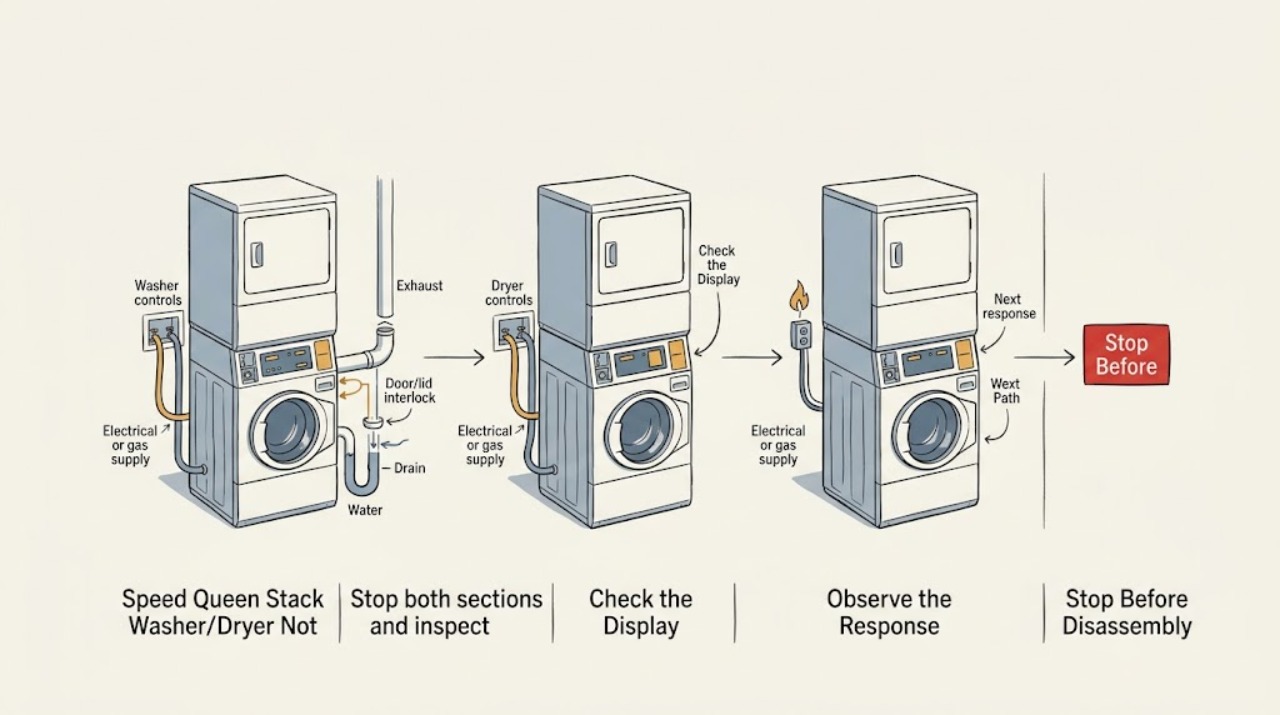
A Speed Queen stacked washer/dryer contains two operating sections, so first identify whether the washer, dryer, or both are affected. Stop immediately for smoke, sparking, gas odor, flooding, a hot or damaged cord, or a drum that will not stop. Otherwise, check that the correct section has power, the controls are set and unlocked, the washer door or lid and dryer door close fully, and the washer water valves, hoses, drain, lint screen, and visible dryer exhaust are clear. Press Start/Pause or the model's start control once, then allow normal sensing or pause behavior to finish. Check the accessible breaker or fuse once without opening the cabinet. If one section remains dead, the door or lid will not latch, water stays in the washer, the dryer has weak airflow or no heat, or a fault persists, keep the unit out of service and arrange qualified Speed Queen appliance service.
Work through in order
Diagnostic checks
Use only checks that match the exact appliance or system and its official guide.
-
Check 1
Stop both sections and inspect from outside for smoke, sparking, gas odor, active water, a hot or damaged cord, a drum that continues moving after stop, or severe dryer heat or weak exhaust.
Expected result: A fire, gas, water, electrical, or moving-part hazard is present, or the stacked unit is cool, dry, and stable.
Next step: For a hazard, close accessible water or gas controls and disconnect power only when the area and plug are dry and safe. Obtain qualified electrical, gas, water, or appliance help. Do not move the stacked cabinet alone.
Stop if: Stop immediately for fire, smoke, gas odor, exposed wiring, a hot or damaged cord, active flooding, or a drum that will not stop.
Why this matters
Why: A hazard makes further start tests unsafe; a stable unit permits section-by-section external checks.
-
Check 2
Try the washer and dryer controls separately without starting a high-risk cycle: note whether each display or indicator responds, whether the washer door or lid and dryer door close, and whether one section works while the other is dead.
Expected result: Only the washer fails, only the dryer fails, both sections fail, or a door or lid will not close or latch.
Next step: Record the affected section and exact model information. Correct only an obvious door closure or control selection described by the guide; do not bypass a latch or open the cabinet.
Stop if: Stop for damaged door or lid hardware, a lock that will not engage, a cracked control panel, or any need to defeat an interlock.
Why this matters
Why: One-section failure points toward that section's controls, interlock, motor, water, drain, heat, or exhaust; both sections failing makes shared power or control state more likely.
-
Check 3
Confirm the intended cycle and settings, press Start/Pause or the model's start control once, and check the accessible laundry-room breaker, fuse, and power plug without removing covers or touching terminals.
Expected result: The controls were not set or the section was paused, a breaker or fuse is open, power appears normal, or the breaker opens again.
Next step: If a breaker or fuse is open, do not repeatedly reset it; have a qualified electrician or appliance technician verify the supply and installation. If power is normal, continue with the washer water/drain or dryer airflow branch.
Stop if: Stop for repeated trips, a hot outlet, a damaged plug, exposed conductors, or uncertain hardwired connections.
Why this matters
Why: A command or supply state can make the stack appear dead; a repeated trip or uncertain connection indicates an electrical fault rather than a reset opportunity.
-
Check 4
For a washer that will not fill, spin, or drain, inspect the accessible hot and cold valves, fill hoses, drain hose, drain receptacle, and any user-accessible pump trap described by the exact guide; do not disconnect pressurized hoses or reach into a moving basket.
Expected result: A valve is closed, a hose is kinked or leaking, the drain is restricted, water remains, the load is severely unbalanced, or the accessible paths look normal.
Next step: Correct only an obvious external valve, hose, load, or drain-receptacle issue. If water remains, the pump only hums, a hose leaks, or the washer still will not operate, close the water valves when appropriate and arrange service.
Stop if: Stop for flooding, a full tub that will not drain, a leaking hose, a jammed pump, or any need to bypass the door lock.
Why this matters
Why: Water supply, drain restrictions, load balance, or a door interlock can stop washer operation without proving an internal control or motor failure; standing water raises flood and lock concerns.
-
Check 5
For a dryer that will not start, heat, or finish, confirm the door is closed, the selected cycle is intended to use heat, the lint screen is clean, and the accessible exhaust outlet and duct are not visibly kinked, crushed, or blocked; do not run with panels removed or the vent disconnected.
Expected result: The door or setting was wrong, the lint or exhaust path is restricted, the drum turns with no heat, the dryer stops early, or the accessible path appears normal.
Next step: Correct only an obvious external setting or lint restriction. If airflow is weak, heat is excessive, or the dryer still fails, stop using it and arrange qualified dryer or vent service.
Stop if: Stop for smoke, burning or gas odor, severe heat, a crushed concealed duct, repeated power trips, or any need to open energized parts.
Why this matters
Why: A door, cycle, lint, or exhaust issue can mimic a dryer fault; a drum that turns without heat or a normal path with persistent failure points toward heater, gas, motor, sensor, or control diagnosis.
-
Check 6
Record the complete model and serial information, which section failed, every indicator or error message, cycle and setting, door or lid state, water and drain observations, airflow and heat result, and whether one safe power check changed anything.
Expected result: The stack works after a safe correction, fails again, or has a persistent dead, locked, leaking, no-heat, or no-drain condition.
Next step: Keep the failed section out of service and arrange qualified Speed Queen appliance service. Provide the records and do not dismantle the stacked unit or replace a lock, pump, heater, motor, or control without diagnosis.
Stop if: Stop for recurring hazards, an unresolved error, internal-access work, a gas symptom, or any request to test live or moving components.
Why this matters
Why: A stacked symptom can involve separate or shared systems; the sequence and section-specific result are more useful than replacing a guessed part.
Use your observations
Decision map
Find the observation that best matches what you see, then follow the next safe action.
-
PATH 01Next step
What you see
Smoke, sparking, gas odor, flooding, a hot or damaged cord, uncontrolled motion, or severe dryer heat is present.
Do this next
Arrange qualified service and follow the exact model guidance.
Why this path and its safety boundary
Why it matters: Stop both sections, isolate water or gas and power only when safe, do not move the stack alone, and obtain qualified service.
-
PATH 02Next step
What you see
The washer works but the dryer does not, or the dryer works but the washer does not.
Do this next
Arrange qualified service and follow the exact model guidance.
Why this path and its safety boundary
Why it matters: Use the affected section's external checks and leave that section off if it remains faulty; a one-section failure does not prove a shared supply failure.
-
PATH 03Next step
What you see
Neither washer nor dryer responds to controls or indicators.
Do this next
Arrange qualified service and follow the exact model guidance.
Why this path and its safety boundary
Why it matters: Check the accessible breaker, fuse, and plug once. Do not repeatedly reset power or open the shared cabinet; uncertain or recurring power faults need qualified diagnosis.
-
PATH 04Next step
What you see
The washer will not fill, spin, or drain, or water remains in the basket.
Do this next
Arrange qualified service and follow the exact model guidance.
Why this path and its safety boundary
Why it matters: Check accessible valves, hoses, drain, load balance, and manual-approved pump-trap access. A leak, full tub, humming pump, or persistent failure needs service.
-
PATH 05Next step
What you see
The dryer runs without heat, stops early, overheats, or has weak exhaust.
Do this next
Arrange qualified service and follow the exact model guidance.
Why this path and its safety boundary
Why it matters: Check the door, cycle, lint screen, and accessible exhaust path. Persistent no-heat, excess heat, or weak airflow requires qualified dryer or vent service.
-
PATH 06Next step
What you see
A washer door, dryer door, or control lock will not engage or clear.
Do this next
Arrange qualified service and follow the exact model guidance.
Why this path and its safety boundary
Why it matters: Use the exact guide's control and closure procedure once. Never pry or bypass the interlock; persistent lock or control failure needs service.
Helpful context
Understand the symptom
Start by separating the two appliances
A stacked unit shares a cabinet but the washer and dryer can show different symptoms. Note whether the washer fills, tumbles, drains, or locks, and separately whether the dryer display, drum, heat, and airflow respond. If neither section responds, investigate shared power or a control condition before assuming two independent failures.
Use the accessible checks in the Speed Queen guide
Speed Queen's stack guidance begins with the door, Start/Pause command, controls, power cord, breakers, water valves and hoses, drain path, pump trap, and exhaust-related care. These checks are model-dependent: use the exact guide for the unit and do not reach behind panels or alter wiring, gas, motor, heater, or lock circuits.
A pause is not always a failure
A washer may pause during normal operation or while balancing a load, and a dryer may use sensing or a selected no-heat cycle. Wait for the documented status period, then compare the actual drum, water, heat, and airflow behavior with the model guide. A persistent stop, leak, or abnormal sound changes the decision to service.
Stop for water, heat, gas, or electrical hazards
Do not run the unit with smoke, sparking, gas odor, active flooding, a hot cord, exposed wiring, or a dryer vent that is severely restricted. Do not force a washer door or lid, defeat an interlock, open a pump or cabinet while energized, or dismantle a gas connection.
Only after diagnosis
Potential parts
Only if qualified diagnosis confirms the affected section's interlock or control fault after safe closure and power checks; a no-start symptom alone does not select a part.
Only when model-specific diagnosis confirms a water or drain fault after accessible valve, hose, and drain checks.
Only after qualified diagnosis identifies the relevant no-heat, airflow, drive, or control failure; do not open energized or gas components.
When checks do not resolve it
Need a professional?
Both sections are dead after one safe accessible power check, or the breaker trips again., The washer remains full, will not drain, leaks, or its door lock will not operate., The dryer has no heat, excessive heat, weak exhaust, gas symptoms, or a returning fault., A door or lid, control lock, motor, belt, pump, heater, gas component, or control appears to need internal access., The stacked unit has smoke, sparking, flooding, a hot cord, exposed wiring, or uncontrolled movement., A safe correction helps only temporarily or the problem returns during a supervised cycle.
Common questions
FAQ
Why is my Speed Queen stack washer/dryer not working?
First identify whether the washer, dryer, or both sections fail. Check the accessible power, settings, door or lid, washer water and drain paths, and dryer lint and exhaust. A section that remains dead, locked, leaking, or overheated needs service.
What should I check if both sections of the stacked unit are dead?
Check the accessible breaker, fuse, and plug once, and confirm the controls are set. Do not repeatedly reset a tripping circuit or open the shared cabinet. If power is normal and both sections remain dead, arrange qualified diagnosis.
Why does the washer in my Speed Queen stack not fill or drain?
Check the hot and cold valves, fill hoses, drain hose, drain receptacle, load balance, and any pump-trap access described by the exact guide. A full tub, leak, humming pump, or recurring failure should be handled by service.
Why does the dryer in my stacked unit run but not heat?
Confirm the cycle is intended to use heat, the door is closed, the lint screen is clean, and the visible exhaust path is clear. If airflow is weak, heat is excessive, or the drum turns with no heat after those checks, stop using it and arrange dryer or vent service.
Can I open the stacked washer or dryer to repair it?
Do not open the cabinet, test live wiring, bypass a lock, or service gas, heater, pump, or motor components as a general user check. Record the affected section and arrange qualified appliance service when external checks do not restore safe operation.
Read the exact guide
Official sources
- Speed Queen Consumer Warranty BondAlliance Laundry Systems / Speed Queen · Opened official Speed Queen warranty document; warranty terms and applicable models vary, and it is not a substitute for the exact service manual.
- Stacked Washers/Dryers: SF7 ATGE9ASpeed Queen by Alliance Laundry Systems · Opened official Speed Queen product page for a stacked washer-dryer family; exact model and market specifications take precedence.
- User's Guide: ATEE9A / ATGE9A Stack Washer-DryerSpeed Queen by Alliance Laundry Systems · Opened official Speed Queen user guide for a stacked washer-dryer; exact model controls, gas or electric configuration, and maintenance access take precedence.
Community feedback
Share a repair observation
Share a plain-text repair observation. Accepted observations are published automatically; this page may take a moment to update.