
On this page
Start here
Quick answer
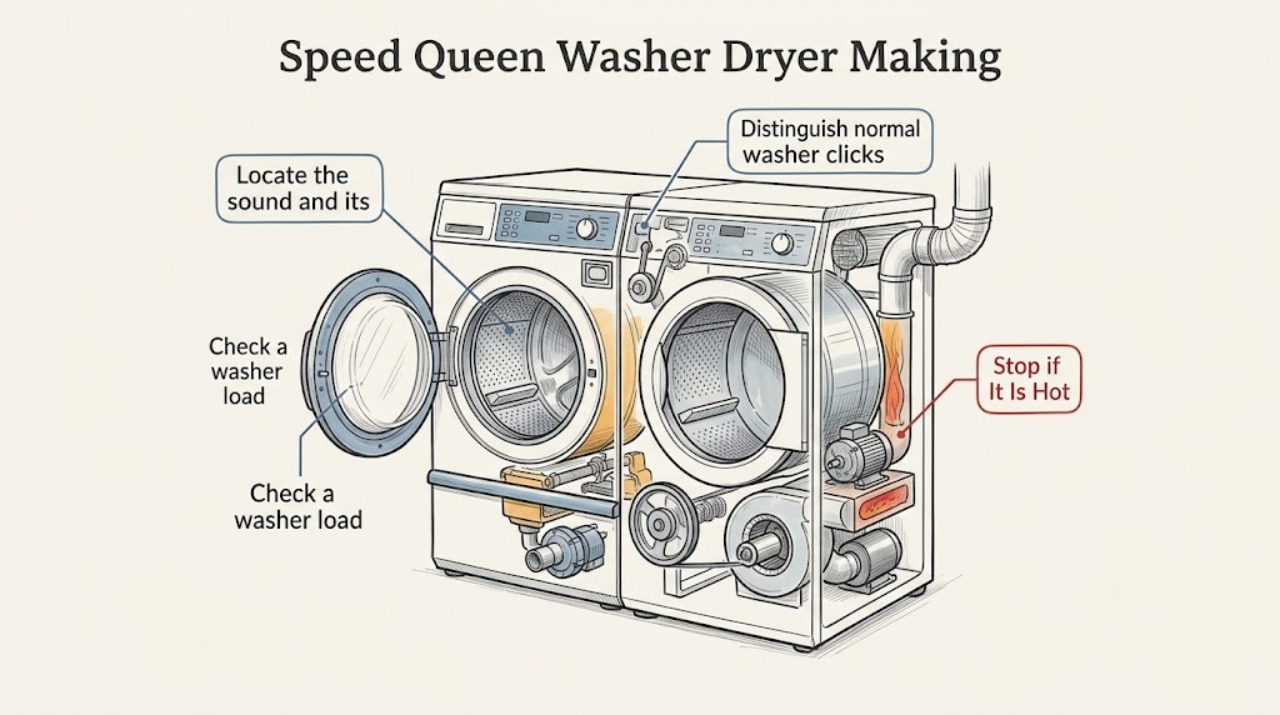
First identify whether the washer or dryer is making the noise, what the sound resembles, and at which stage it starts. Speed Queen documents some normal washer clicks and balance sounds and some normal dryer heat-source or airflow sounds, but thumping, grinding, scraping, repeated banging, a sudden new noise, movement, burning odor, smoke, or abnormal heat is not a reason to keep running the appliance. Check only safe external causes: an uneven or overloaded washer load, a foreign object in the drum, a visibly unstable installation, loose hoses, the dryer lint filter and visible exhaust, or a door that is not closing correctly. Stop and arrange qualified service for recurring noise, a drum or motor symptom, a loose stack, a damaged cord, water, smoke, or any need to remove panels or reach moving parts.
Work through in order
Diagnostic checks
Use only checks that match the exact appliance or system and its official guide.
-
Locate the sound and its cycle stage
From a safe position, note whether the sound comes from the washer or dryer section, and whether it begins during fill, tumble, drain, spin, sensing, heating, cooling, or door movement. Describe it as a click, hum, thump, rattle, squeal, scrape, grind, or bang, and record whether the cabinet moves. Stop rather than repeating a cycle if there is smoke, burning odor, unusual heat, sparking, or water near electrical parts.
Expected result: The noise is a familiar click or hum at the documented stage, a new sound follows drum movement, a bang occurs during washer spin, or the noise is constant or accompanied by movement.
Next step: Use the matching washer or dryer branch and record the sound without running unnecessary tests. Arrange service for a new, worsening, or recurring mechanical sound.
Stop if: Stop immediately for smoke, burning smell, sparks, abnormal heat, flooding, a hot cord, a loose stack, or violent movement.
Why this matters
Why: Timing separates normal door, balance, airflow, or heat-source sounds from a possible drum, pump, motor, belt, roller, bearing, or installation problem. A noise with movement or a safety symptom is a stop condition.
-
Check a washer load and balance symptom
If the washer thumps during spin, wait until the drum has stopped and the door unlocks normally. Look at the load for one heavy item, a tightly bundled item, or a severely uneven distribution; redistribute only when safe and follow the model-specific Start/Pause sequence once. Do not reach into a moving drum or force an early door release.
Expected result: The sound stops after a safe redistribution, the washer repeatedly thumps with a balanced load, or the cabinet moves or walks.
Next step: Use a suitable balanced load and monitor only if the noise fully clears and there is no damage. Keep the washer off and arrange service for recurrence, walking, or abnormal movement.
Stop if: Do not continue with violent shaking, a loose or damaged cabinet, a locked door, or a noise that is accompanied by scraping or grinding.
Why this matters
Why: Speed Queen says an unbalanced load can cause thumping and can limit or interrupt spin. Repeated thumping with a balanced load, excessive movement, or rumbling can indicate leveling, suspension, drum, or drive trouble.
-
Distinguish normal washer clicks from abnormal sounds
Listen only during a normal, supervised cycle if there is no safety concern. A click when the door locks or unlocks, or a light clicking associated with the balance system, can be compared with the guide's normal-sound descriptions. Do not create a test by opening the door during motion or by running the washer empty repeatedly.
Expected result: The sound is a brief click at door locking or normal balance operation, a slow-tub clicking sound, or a new persistent click, squeal, scrape, or grind.
Next step: If the sound matches normal operation and no other symptom exists, monitor. For a new or persistent mechanical sound, stop the washer and provide the timing and description to qualified service.
Stop if: Stop for scraping, grinding, metal-on-metal sounds, smoke, burning odor, water leakage, or a drum that does not move normally.
Why this matters
Why: The documented brief clicks may be normal. A persistent or newly changed sound is not identified by sound alone and can involve a foreign object, pump, bearing, motor, belt, or control and should not be diagnosed by continued use.
-
Check visible washer hoses and floor conditions
With the washer stopped, inspect the accessible fill hoses, drain hose, faucets, and the floor for a hose striking the cabinet, a kink, a loose visible connection, water, or a machine that is visibly out of level. Do not pull the stacked unit away from the wall or adjust hidden installation parts. Close water valves if a hose is actively leaking and it is safe to do so.
Expected result: A hose is contacting the cabinet, a connection leaks, water is on the floor, the machine is visibly unstable, or the visible installation appears normal.
Next step: Correct only an obvious accessible hose-position issue and monitor without forcing the unit. Arrange qualified appliance or plumbing service for leaks, instability, recurrence, or any hidden installation issue.
Stop if: Stop for flooding, water near electrical parts, a loose stack, damaged hoses, or any need to move or open the appliance.
Why this matters
Why: External hoses or an unstable installation can create rattling and vibration, but water or persistent movement can also indicate a deeper installation or appliance fault. A normal visible check does not clear internal noise.
-
Separate normal dryer airflow from a mechanical noise
For a dryer sound, note whether it is the familiar hum of air movement or heat-source cycling, or whether it follows drum rotation as a scrape, squeal, rattle, or thump. With the dryer stopped and cool, remove only an obvious loose object from the drum and confirm the loading door closes. Do not reach behind panels or touch the motor, blower, heater, or gas system.
Expected result: The sound is a steady airflow or heat-source hum, a loose object is visible in the drum, the noise follows drum rotation, or the sound appears with burning odor or abnormal heat.
Next step: Remove only the visible object if the drum is stopped and empty. Keep the dryer off and arrange qualified service for a persistent rotation-linked sound, unusual heat, odor, or any internal suspected component.
Stop if: Stop for scraping, grinding, smoke, burning odor, a hot cabinet or cord, sparks, or a drum that binds.
Why this matters
Why: Speed Queen lists airflow and heat-source cycling among normal dryer sounds. A rotation-linked or worsening sound can involve drum support, belt, roller, blower, or motor; odor or heat raises the fire and electrical risk.
-
Check dryer filter, exhaust, and load conditions
With the dryer off and cool, make sure the user-accessible lint filter is present and clean and inspect the visible exhaust connection for a crush, separation, or loose cover that could rattle. Note whether the sound occurs only with a bulky load or whether the dryer is unstable. Do not dismantle the exhaust or cabinet, and do not run the dryer without its filter or with an unsafe vent.
Expected result: The filter is missing or blocked, the visible exhaust rattles or is damaged, the noise is load-specific, or the accessible airflow path appears normal.
Next step: Restore only the correct user-accessible filter position and keep the dryer off for a damaged or unsafe exhaust. Arrange qualified service for recurrence, internal lint, or persistent noise.
Stop if: Do not operate without the lint filter, with a disconnected or crushed exhaust, or when cleaning requires tools or panel removal.
Why this matters
Why: A loose filter or exhaust connection can create a rattle, while an unsafe or restricted exhaust can increase heat and requires service. Load-specific noise can reflect contact or imbalance, but recurrence without the load needs diagnosis.
-
Prepare a sound-focused service handoff
Record the full model and serial information, washer or dryer section, sound description, cycle stage, load, door and drum behavior, movement, visible hose or exhaust condition, filter state, codes, and any odor, heat, water, or power symptom. Keep the appliance off if the noise returns or has a mechanical or safety character.
Expected result: The sound disappears after a safe load or visible-object correction, matches a documented normal operating sound, or returns at the same stage or grows louder.
Next step: Provide the record to qualified Speed Queen appliance service; use qualified electrical or plumbing service for household supply or water symptoms. Resume normal use only when the persistent fault is cleared.
Stop if: Stop all user troubleshooting for smoke, fire, burning odor, abnormal heat, flooding, sparks, a loose stack, or any need to remove panels or reach moving parts.
Why this matters
Why: A cleared load, object, or normal operating sound has a narrower explanation. A recurring or escalating sound needs inspection of the relevant pump, drive, drum, motor, balance, airflow, or installation system.
Use your observations
Decision map
Find the observation that best matches what you see, then follow the next safe action.
-
PATH 01Next step
What you see
The washer makes a brief click during door locking, balance operation, or slow tub movement and has no other symptom.
Do this next
Monitor without repeated test cycles; arrange service if the sound changes, persists outside that stage, or is accompanied by movement or damage.
Why this path and its safety boundary
Why it matters: The sound may match documented normal washer operation.
-
PATH 02Next step
What you see
The washer thumps during spin and the load is severely unbalanced.
Do this next
Redistribute the load only after the drum stops and the door unlocks normally; arrange service if thumping or walking returns with a balanced load.
Why this path and its safety boundary
Why it matters: Load imbalance may be causing the sound and spin interruption.
-
PATH 03Next step
What you see
The washer rumbles, repeatedly scrapes or grinds, moves excessively, or makes a new sound with a balanced load.
Do this next
Keep the washer off and arrange qualified appliance service; do not remove panels or reach into the drive system.
Why this path and its safety boundary
Why it matters: A leveling, suspension, drum, pump, motor, belt, or bearing fault is possible.
-
PATH 04Next step
What you see
The dryer produces a familiar airflow hum or heat-source cycling sound and completes normally.
Do this next
Monitor it without unnecessary testing; service is needed if the sound changes or another symptom appears.
Why this path and its safety boundary
Why it matters: The sound may be normal dryer operation.
-
PATH 05Next step
What you see
The dryer noise follows drum rotation, a loose object, filter, or exhaust connection.
Do this next
Remove only an obvious object with the drum stopped and restore the correct filter position; arrange service for recurrence or any internal symptom.
Why this path and its safety boundary
Why it matters: A visible object or accessible connection may be rattling, but a drive or blower fault remains possible.
-
PATH 06Next step
What you see
The noise is accompanied by smoke, burning odor, unusual heat, sparks, water, a damaged cord, or a loose stack.
Do this next
Leave the appliance off, keep people away from the hazard, and obtain qualified appliance, electrical, or plumbing service as appropriate.
Why this path and its safety boundary
Why it matters: This is a safety stop rather than a sound-identification task.
Helpful context
Understand the symptom
A normal operating sound is different from a new mechanical noise
The washer may click as the door locks or as its balance system moves, and a dryer may hum as air moves or its heat source cycles. What matters is a change from the normal sound, the stage where it appears, and whether the cabinet moves, the drum stops, or a safety symptom accompanies it. Do not run extra cycles just to make a noise repeat.
Keep checks outside the moving and electrical systems
Remove only an obvious loose object from an empty, stopped drum and inspect visible hoses, doors, filters, and the surrounding floor. Do not reach into a moving drum, remove panels, separate a stacked arrangement, adjust internal suspension or drive parts, or perform live electrical work. A sound that persists after safe external checks is useful service evidence, not a reason to guess at a part.
Safety boundary
Stop conditions
- Stop immediately for smoke, fire, burning odor, sparks, abnormal heat, flooding, water near electrical equipment, a hot or damaged cord, violent movement, or a loose stack.
- Do not reach into a moving drum, force a door, bypass a door lock, remove panels, separate a stacked arrangement, or touch internal drive, motor, pump, heater, or wiring parts.
- Do not operate a dryer without its lint filter or with a disconnected, crushed, or unsafe exhaust path.
- Do not keep running extra cycles to reproduce a new scrape, grind, bang, squeal, or recurring abnormal noise.
- Arrange qualified service for persistent noise, repeated imbalance, water or installation problems, or any sound that returns after a safe external correction.
Only after diagnosis
Potential parts
- washer suspension, balance, or leveling component
Consider this category only when repeated thumping, rumbling, walking, or uneven movement is confirmed and qualified inspection identifies a failed support or balance component.
Confirm the full model and technician diagnosis before ordering; do not adjust or replace hidden stack-unit hardware by sound alone. - washer pump, drive, belt, or bearing component
Consider this category only when a qualified inspection links a persistent stage-specific scrape, grind, or rotation noise to the relevant internal component.
Confirm the exact model, section, and diagnosis before ordering; do not open the cabinet or reach into the drive system. - dryer drum support, roller, belt, blower, or motor component
Consider this category only when a rotation-linked or airflow-related noise is reproduced safely and a qualified technician identifies the failed component.
Confirm the full model and technician diagnosis before ordering; persistent noise, heat, or odor requires the dryer to remain out of use.
When checks do not resolve it
Need a professional?
Arrange qualified Speed Queen appliance service for a new, recurring, worsening, or stage-specific noise that remains after the safe load, door, visible-object, hose, filter, and exhaust checks; for grinding, scraping, repeated banging, excessive movement, or a suspected drum, pump, motor, belt, bearing, roller, blower, or suspension fault. Use qualified electrical or plumbing service for damaged power, repeated breaker symptoms, or water and hose problems.
Common questions
FAQ
What washer sounds are normal on a Speed Queen?
A brief click during door locking or balance operation and some clicking during slow tub movement can be normal according to the washer guide. A new, loud, persistent, scraping, grinding, or movement-related noise needs service.
Why does my Speed Queen washer thump during spin?
A severely unbalanced load can cause thumping and interrupt spin. Redistribute the load only after the drum stops and the door unlocks normally. Repeated thumping or walking with a balanced load requires qualified service.
Is a humming sound from a Speed Queen dryer normal?
The dryer guide lists the sound of air moving through the dryer and exhaust and the heat source cycling among normal operating sounds. A new or rotation-linked hum, scrape, squeal, or bang is not cleared by that explanation and needs inspection if it persists.
Can a foreign object cause a Speed Queen washer or dryer noise?
Yes. A visible loose object can rattle or tap. Remove only an obvious object from a stopped, empty drum; do not reach into a moving drum or open panels. Persistent noise after that check needs service.
When should I stop using a noisy Speed Queen washer dryer?
Stop for grinding, scraping, repeated banging, violent movement, smoke, burning odor, unusual heat, sparks, water, a damaged cord, or a loose stack. Keep it off and obtain qualified appliance, electrical, or plumbing service as appropriate.
Read the exact guide
Official sources
- User's Guide for Frontload WashersAlliance Laundry Systems / Speed Queen · Speed Queen washer sections in washer-dryer products when the exact model guide is not yet identified
- Speed Queen | SF7008BESpeed Queen by Alliance Laundry Systems · Speed Queen washer-dryer appliances where the washer and dryer occupy one stacked arrangement
- User's Guide for Frontload DryersAlliance Laundry Systems / Speed Queen · Speed Queen dryer sections in washer-dryer products when the exact model guide is not yet identified
- Speed Queen | Manuals & DownloadsSpeed Queen by Alliance Laundry Systems · Any Speed Queen washer, dryer, or washer-dryer when the exact model instructions are needed
Community feedback
Share a repair observation
Share a plain-text repair observation. Accepted observations are published automatically; this page may take a moment to update.