
On this page
Start here
Quick answer
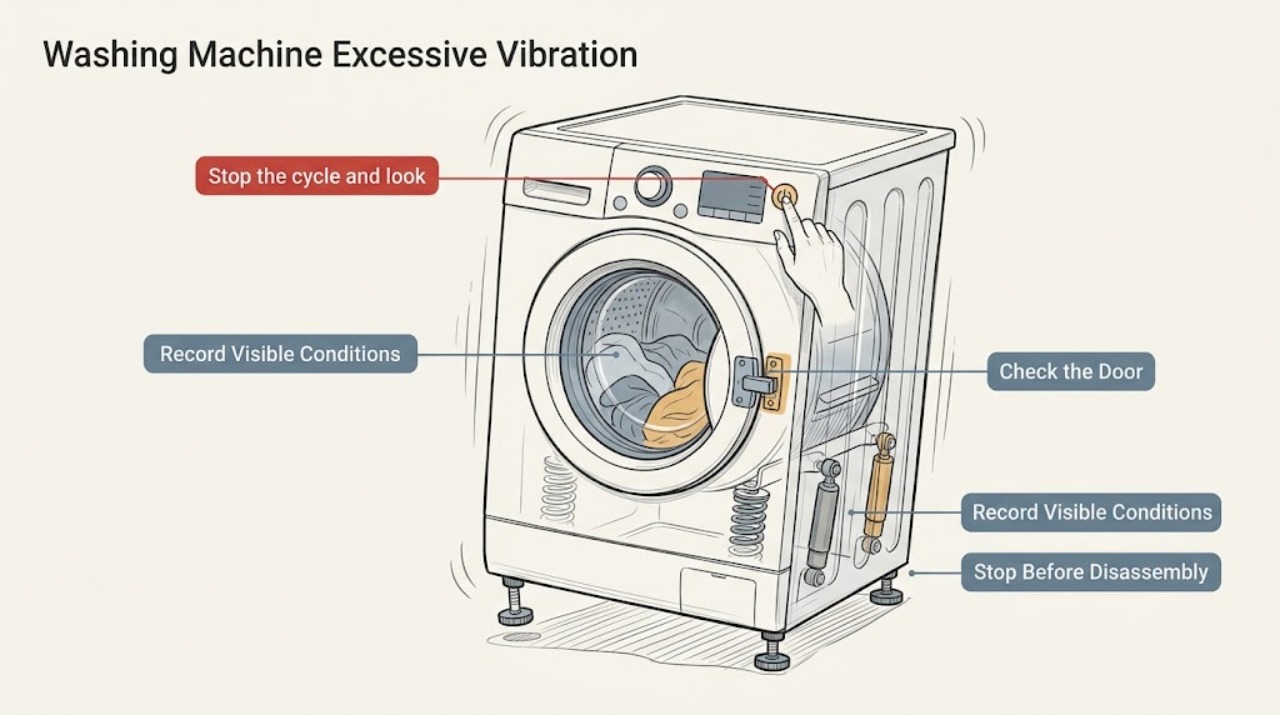
Stop the cycle if the washer is walking, striking nearby objects, leaking, or making a new grinding or metallic sound. Once it is safe, note whether the movement occurs only during spin, redistribute the load without packing the tub, and check that the washer is level, stable, and on a solid floor with all intended rubber feet installed. A newly installed front-load model must also have its shipping materials removed; if the same load-independent vibration remains, or the tub or cabinet appears damaged, stop using it and arrange qualified service for suspension, bearing, drive, or structural inspection.
Work through in order
Diagnostic checks
Use only checks that match the exact appliance or system and its official guide.
-
Check 1
Stop the cycle and look around the washer from a dry, safe position. Do not reach into a moving tub or try to restrain a walking cabinet.
Expected result: The cabinet has struck a wall or fixture, moved noticeably, leaked, exposed a damaged hose or cord, or produced smoke, a burning odor, a sparking sound, or a new harsh metallic noise.
Next step: Stop using it. After motion stops and only if the plug is dry and safely reachable, disconnect power and close the water valves. Arrange qualified appliance service; do not run another test cycle.
Why this matters
Why: The event may involve impact, water near electricity, overheating, or a mechanical or electrical fault rather than an ordinary balance correction.
-
Check 2
Identify when the vibration begins and record the load: watch from outside the closed lid or door during a normal cycle, then note whether it is confined to high-speed spin, occurs during agitation or tumble, or occurs even when the basket is empty.
Expected result: Movement appears only as the washer accelerates into spin and changes with the clothing mix, or it appears at several stages and with different loads.
Next step: For a load-dependent result, continue to the load check. For a repeatable load-independent result, stop after the safe installation checks and request service rather than repeatedly spinning the washer.
Why this matters
Why: A spin-only symptom that follows the load points first to imbalance or loading. Load-independent movement raises the priority of leveling, floor support, shipping hardware, or a mechanical inspection.
-
Check 3
With the washer stopped, open the lid or door and redistribute clothing loosely around the basket. Do not overfill, compress items, or test with one very heavy item by itself; use a normal mixed load appropriate for the model.
Expected result: The clothing is clumped on one side, the tub is tightly packed, the load is unusually small, or the same heavy item is isolated. After redistribution, the washer completes spin with little movement.
Next step: Use the model manual's loading guidance and rerun only one supervised test. If a normally distributed load still walks or bangs, proceed to the installation check and then service if it persists.
Why this matters
Why: The original load was likely out of balance or unable to distribute weight. Speed Queen may limit or interrupt spin to protect the machine when imbalance is severe.
-
Check 4
Check stability without moving the machine: place a level on the cabinet if available, look for rocking at the corners, and verify that the washer sits on a solid, sturdy floor with all four intended rubber feet present and contacting the floor.
Expected result: The cabinet rocks, one foot is not contacting, a foot is damaged or missing, or the washer stands on carpet, soft tile, or a weakly supported surface.
Next step: If the manual permits user leveling for the model, level it using the stated procedure and confirm it no longer rocks. Do not improvise unstable loose wedges or stack materials under the washer; if the floor or feet cannot be corrected safely, call service or an installation professional.
Why this matters
Why: Uneven leveling or weak support can turn normal tub forces into cabinet movement. The manual specifically treats a solid, level floor and installed rubber feet as prerequisites for stable operation.
-
Check 5
If the washer is newly installed, recently moved, or has just been reinstalled, compare the installation with the exact model manual: front-load units must have specified shipping materials removed for operation, while shipping materials are reinstalled for transport.
Expected result: The machine was recently moved, the model manual's shipping brace or bolts may still be installed, or the owner cannot confirm that the required installation pieces were removed.
Next step: Stop operating the washer and use its model number to retrieve the matching Speed Queen installation manual. Remove or reinstall shipping hardware only as that manual directs; if access requires uncertain disassembly, have a qualified installer or technician do it.
Why this matters
Why: Shipping hardware left in place can prevent the suspension from working as designed and can create severe vibration. The exact hardware and access steps vary by model.
-
Check 6
After the load and installation checks, listen from outside the closed lid or door and inspect for a repeatable mechanical pattern; do not remove panels or place hands near the basket, belt, motor, springs, or wiring.
Expected result: The washer still moves with different balanced loads, the tub or basket appears off-center, the noise is scraping or repeated hard knocking, or there is a new rumble that does not track the clothing load.
Next step: Stop using the washer and request qualified Speed Queen appliance service. Give the technician the model number, installation history, cycle stage, load conditions, and whether leveling or redistribution changed anything.
Why this matters
Why: A persistent load-independent symptom can indicate suspension, bearing, drive, structural, or another internal fault that cannot be safely confirmed from the outside.
Use your observations
Decision map
Find the observation that best matches what you see, then follow the next safe action.
-
PATH 01Next step
What you see
Walking, impact, leak, smoke, burning odor, sparking sound, or damaged cord/hose is present
Do this next
Stop the washer, disconnect power only from a dry safe position, close water valves when safely reachable, and arrange professional service.
Why this path and its safety boundary
Why it matters: Safety hazard or possible internal fault
-
PATH 02Next step
What you see
Vibration is limited to spin and follows a clumped, overfilled, very small, or single-heavy load
Do this next
Redistribute clothing loosely and run one supervised normal load; escalate if the symptom returns with a balanced load.
Why this path and its safety boundary
Why it matters: Likely load distribution problem
-
PATH 03Next step
What you see
The cabinet rocks, a foot is missing or not contacting, or the floor is soft or unstable
Do this next
Correct leveling and feet only according to the model manual, or obtain installation help; do not use loose improvised wedges.
Why this path and its safety boundary
Why it matters: Installation or support problem
-
PATH 04Next step
What you see
A recently moved or newly installed front-load washer has severe vibration and shipping hardware status is unknown
Do this next
Stop operation and verify the exact model's installation instructions before any further cycle.
Why this path and its safety boundary
Why it matters: Shipping material or installation error is possible
-
PATH 05Next step
What you see
Movement and harsh noise persist with balanced loads and a stable installation
Do this next
Stop testing and schedule qualified appliance service.
Why this path and its safety boundary
Why it matters: Internal suspension, bearing, drive, or structural fault is possible
Helpful context
Understand the symptom
First decide whether the movement is safe to investigate
Do not hold the cabinet, reach into a moving tub, or keep restarting a washer that is crossing the floor. A small change during a high-speed spin can be a load-balance event, but hard impacts, a damaged cabinet, a water leak, smoke, a burning odor, a sparking sound, or a circuit that trips changes this into a stop-and-service situation. Unplug only from a dry, reachable location after the machine has stopped, and close the water valves if a hose or cabinet is leaking.
Why the same symptom differs by washer design
Speed Queen top-load and front-load washers do not balance in exactly the same way. The top-load design uses a balance ring and a heavy suspension system, while front-load models use balance controls and suspension components. The model-specific manual is therefore the authority for shipping hardware, feet, access panels, cycle behavior, and any error display.
Use the outcome of each check to choose the next check
If the problem follows one heavy or very small load, loading is the leading explanation. If an empty or mixed test load still makes the cabinet move, installation or a mechanical fault becomes more likely. Do not treat a temporary improvement after pushing the washer back into place as a repair; the floor, feet, or suspension still needs attention.
When a technician should take over
Service is appropriate when leveling and a sensible load do not change the symptom, when the washer walks or bangs on more than one cycle, or when you hear repeated scraping, knocking, or bearing-like rumbling. Provide the model number, the cycle and load used, whether the issue is top-load or front-load, and a short description of where the motion starts.
Safety boundary
Stop conditions
- Stop immediately for smoke, burning or melting odor, sparking, repeated circuit trips, or a hot or damaged power connection.
- Stop immediately if the washer walks, strikes a wall or fixture, tips, or the tub or cabinet appears damaged.
- Stop and disconnect power only from a dry, safely reachable position if water is leaking toward the plug, outlet, controls, or other electrical equipment.
- Do not reach into a moving tub, bypass a lid or door safety switch, remove panels, or handle springs, wiring, motor, or drive parts as a household vibration test.
- Stop repeated testing when the symptom is unchanged after one safe load and installation check; arrange qualified service.
Only after diagnosis
Potential parts
- suspension or damper components
Consider only if a qualified diagnosis finds persistent load-independent movement after load balance and installation are verified.
Confirm the complete model and serial information and the manufacturer's fit information before selecting any component. - leveling feet or foot hardware
Relevant only when a foot is missing, damaged, or unable to make stable contact and the exact model supports replacement.
Use the exact model's installation instructions and approved fit information; do not substitute loose wedges or unverified hardware. - bearing or drive component
Consider only after a technician confirms a persistent rumble, scraping, or load-independent movement that points beyond loading and leveling.
These are model-specific service components and should be identified and fitted by a qualified technician.
When checks do not resolve it
Need a professional?
Call a qualified appliance technician when the washer still vibrates or walks with a balanced load on a stable, correctly installed floor, when the basket appears off-center, or when the sound is a persistent scrape, hard knock, or rumble. Service is also required for leaks near electrical equipment, smoke, burning odor, sparking, repeated trips, damaged controls, or any repair that would require internal access.
Common questions
FAQ
Why does my Speed Queen washer vibrate only during spin?
Spin concentrates the forces from an uneven load. Stop safely, redistribute clothing loosely, and check levelness and floor support. If a balanced load still moves the cabinet, stop repeated tests and arrange service.
Can an unbalanced load make a Speed Queen washer walk?
Yes. A clumped, tightly packed, very small, or single-heavy load can make movement worse. Redistribute the load and use the exact manual's loading guidance; persistent walking is not normal to ignore.
What should I check if my washer rocks when it is not running?
Check for a stable, solid floor and four intended rubber feet making contact, then follow the exact model's leveling instructions. Do not stabilize it with loose improvised wedges.
Could shipping bolts cause severe vibration?
On applicable front-load models, shipping materials must be removed for operation. If the washer is new or was moved and their status is uncertain, stop and verify the exact installation manual before running another cycle.
When is washer vibration a service issue?
Arrange qualified service when vibration remains with balanced loads and a stable installation, or when there is repeated impact, scraping, rumbling, damage, leaking, smoke, burning odor, sparking, or repeated electrical trips.
Is it safe to hold the washer still while it spins?
No. Do not restrain a moving cabinet or bypass a lid or door safety switch. Stop the cycle and use the safe observation and installation checks above.
Read the exact guide
Official sources
- User's GuideSpeed Queen / Alliance Laundry Systems · Official top-load guide used for unbalanced-load and vibration troubleshooting; verify the user's exact model.
- Home Laundry: Less-Vibrations = Worry-FreeSpeed Queen / Alliance Laundry Systems · Official Speed Queen product knowledge article used for top-load suspension, balance ring, and vibration context; it is not a substitute for the exact model manual.
- Manuals & DownloadsSpeed Queen / Alliance Laundry Systems · Official support page used to direct model-specific installation and operating manual lookup.
- User's GuideSpeed Queen / Alliance Laundry Systems · Official model guide used for front-load vibration, floor, feet, load, control-lock, error, and shipping guidance; verify the user's exact model.
- Properly Loading your Washing MachineSpeed Queen / Alliance Laundry Systems · Official Speed Queen loading article used for loose, balanced loading and model-specific manual referral; confirm the exact washer type.
- Quick Consumer ManualSpeed Queen / Alliance Laundry Systems · Official quick installation guide used for shipping-material removal, rubber feet, stable placement, drain routing, and leak checks; verify exact model.
Community feedback
Share a repair observation
Share a plain-text repair observation. Accepted observations are published automatically; this page may take a moment to update.