
On this page
Start here
Quick answer
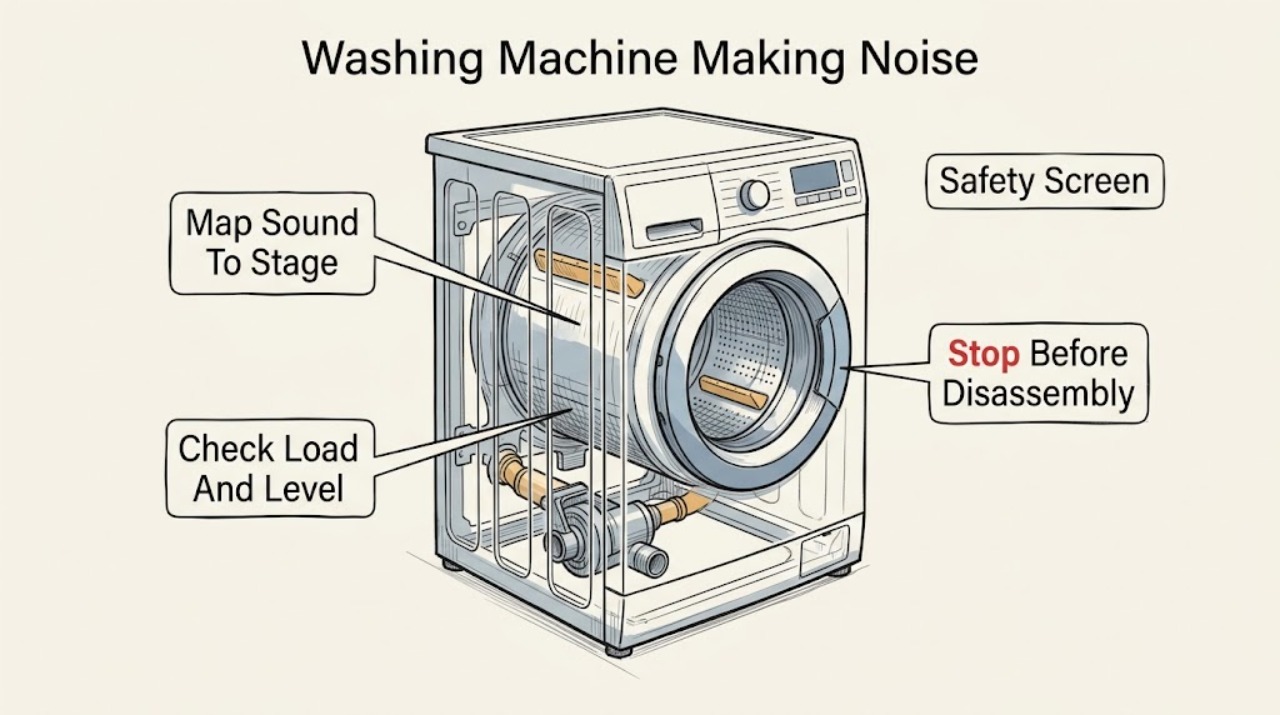
First identify when the Speed Queen washer makes the noise: filling, washing, draining, or spinning. Some clicks and pauses are normal cycle sounds, while a new grinding, scraping, repeated knocking, or loud hum is more useful when tied to a stage and location. Speed Queen's user guide recommends checking level and load balance, and says that water on the floor, increased operating noise, or water remaining after a cycle are reasons to call for service. Stop the washer for walking, violent banging, metal-on-metal scraping, leakage, burning smell, smoke, sparking, or repeated electrical trips; do not run it again just to reproduce a dangerous sound.
Work through in order
Diagnostic checks
Use only checks that match the exact appliance or system and its official guide.
-
Check 1
Stop the cycle and assess from a safe position for walking, violent banging, metal scraping, active leakage, water near electricity, burning smell, smoke, sparks, a hot cord or outlet, or a repeated circuit trip.
Expected result: The washer is stable and dry with no electrical or fire warning, or a safety warning is present.
Next step: For a warning, stop using the washer, keep clear, and obtain qualified or emergency help appropriate to the hazard. If safe and dry, continue only with external checks.
Stop if: Do not run another cycle to reproduce a dangerous sound or handle a wet plug, outlet, or floor connection.
Why this matters
Why: A stable washer permits low-risk observation after it is stopped; movement, leakage, heat, smoke, sparking, or tripping takes priority over noise diagnosis.
-
Check 2
During a normal, supervised cycle only when no hazard is present, record whether the noise occurs during fill, initial lock, wash or agitation, drain, ramp-up to spin, high spin, or the final stop. Note whether it is a click, hum, gurgle, rattle, scrape, or repeated knock and where it seems to come from.
Expected result: The sound is a brief click or pause tied to a normal transition, a pump-like hum or gurgle during drain, a load-related knock during spin, or a scrape, rumble, or persistent noise that follows the drum.
Next step: Stop the cycle after the useful observation and follow the matching branch; do not continue a cycle that becomes loud, unstable, or damaging.
Stop if: Stop immediately for metal contact, violent impact, smoke, odor, leakage, or a sound that worsens with speed.
Why this matters
Why: Stage and sound narrow the path: transitions can be normal, drain sounds point to the pump or path, load-related knocks point to balance, and rotation-related rumble or scraping needs service assessment.
-
Check 3
With the washer stopped and safe to approach, check that the load is not tightly balled or made of one heavy item, and inspect the machine's external stance for rocking, a visible gap at a foot, or a soft or uneven floor. Do not tilt the machine or reach underneath while it is connected.
Expected result: The noise occurs mainly in spin and changes when the load is redistributed, or the cabinet rocks or sits unevenly; alternatively, the load and stance are stable but the noise persists.
Next step: Use the model manual to level or load the washer and make one cautious, low-risk check. If the washer walks, bangs, or remains noisy, stop and arrange service.
Stop if: Do not keep spinning a washer that walks, strikes the wall, or causes hose strain or leakage.
Why this matters
Why: A spin-only knock with an unstable load or stance is consistent with imbalance or leveling; persistent noise with a stable load and floor points toward a mechanical or pump issue.
-
Check 4
If the sound occurs while draining, inspect the external drain hose and drain receptacle for a kink, blockage, vibration against the cabinet, or overflow. If the exact manual authorizes cleaning the pump trap, do so only with the washer disconnected, cool, stable, and prepared for residual water; otherwise leave the access area closed.
Expected result: The noise changes when the hose is stabilized externally, water drains normally, the receptacle or hose is blocked, the pump remains noisy with slow draining, or the drain area cannot be checked safely.
Next step: Correct only a clearly accessible external hose or receptacle issue under the manual's guidance. If drainage remains slow or the pump noise persists, keep the washer unused and arrange service.
Stop if: Do not reach into a powered pump, open a flooded access area, tip the washer, or handle water near electrical parts.
Why this matters
Why: A hose or receptacle issue can create vibration or pump strain; persistent noise with slow drainage can involve the pump or a foreign object, while an unsafe or internal condition needs service.
-
Check 5
After disconnecting the washer through a safe, dry, accessible control and waiting for motion to stop, inspect only visible areas for a loose coin, zipper, bra wire, hose contact, loose external panel, or object caught at the door seal or tub opening. Remove only an object that is plainly accessible without tools or dismantling.
Expected result: A visible object or external contact matches the noise, or the visible areas are clear and the sound follows the drum or motor.
Next step: Remove only the plainly accessible object and stop if the noise returns. If the sound is internal, persistent, or not safely reachable, arrange qualified service.
Stop if: Do not insert tools, remove panels, reach between moving parts, or continue if a metal object appears to be inside the tub.
Why this matters
Why: A visible loose object can cause a stage-specific rattle; a clear exterior with rotation-related rumble, scrape, or grinding suggests a bearing, suspension, drive, or internal-object diagnosis.
-
Check 6
Only if the washer is stable, dry, hazard-free, and the exact model manual documents a reset, perform one reset through the normal control or accessible plug, then observe the idle state and do not start a full cycle merely to test it.
Expected result: The washer returns quietly to idle, or the noise, error, instability, leak, odor, or electrical trip returns when operation is attempted.
Next step: Do not repeat the reset. Keep the washer unused if the noise returns and provide the technician with the stage, sound description, location, load, and reset result.
Stop if: Stop immediately for smoke, burning odor, sparking, water near electricity, violent movement, or a repeated trip.
Why this matters
Why: A reset can clear a temporary control state but cannot repair an imbalance, obstruction, worn mechanical part, or unsafe electrical condition.
Use your observations
Decision map
Find the observation that best matches what you see, then follow the next safe action.
-
PATH 01Next step
What you see
The sound is a brief click at a lock or a pause during wash movement and there is no worsening symptom
Do this next
Continue to monitor only if the sound remains unchanged; use the model manual if it becomes persistent or louder.
Why this path and its safety boundary
Why it matters: The guide identifies some such sounds as normal front-load operation.
-
PATH 02Next step
What you see
Knocking or shaking appears mainly during spin and changes with load distribution or a rocking stance
Do this next
Redistribute the load and use the exact manual to level the washer. Stop if it walks, bangs, or strains hoses.
Why this path and its safety boundary
Why it matters: An unbalanced load or leveling problem is more likely than a constant internal noise.
-
PATH 03Next step
What you see
Hum, rattle, or vibration occurs during drain and drainage is slow or incomplete
Do this next
Check the external hose and receptacle, and clean a user-accessible trap only as the exact manual directs. Arrange service if drainage or noise does not recover.
Why this path and its safety boundary
Why it matters: The external drain path or a pump foreign-object trap may be involved.
-
PATH 04Next step
What you see
Scrape, rumble, or grinding follows drum rotation despite a balanced load and clear visible area
Do this next
Stop using the washer and arrange qualified service; do not remove panels or continue spinning to confirm the source.
Why this path and its safety boundary
Why it matters: An internal object, bearing, suspension, drive, or other mechanical condition may require diagnosis.
-
PATH 05Next step
What you see
Noise is accompanied by leakage, water on the floor, burning smell, smoke, sparks, a hot outlet, or repeated circuit trips
Do this next
Stop using it, keep clear, and obtain qualified or emergency help appropriate to the immediate hazard. Do not restart it to reproduce the sound.
Why this path and its safety boundary
Why it matters: The washer is a water, fire, or electrical safety concern rather than a routine noise issue.
Helpful context
Understand the symptom
The stage and sound are the diagnosis
A washer can click while a lock engages, pause as part of a programmed tumble, hum while a pump moves water, or make a brief sound as a load changes direction. Those patterns differ from a scrape that follows drum rotation, a rattle that changes when an object moves, or a knock that grows during spin. Note the stage, speed, side of the cabinet, and whether water is moving before choosing a repair path.
Top-load and front-load checks are not identical
Speed Queen offers different washer designs. The opened front-load guide discusses a loading door, pump trap, balance and spin behavior, while Speed Queen's top-load material discusses a suspension system and balance ring. Use the full model number to select the correct manual and do not remove panels or apply a front-load check to a top-load machine without model-specific instructions.
When a noise becomes a stop condition
A washer that moves across the floor, leaks, smells hot, trips its circuit, or makes metal contact may be damaging itself or creating a safety risk. Keep the door or lid closed if water or moving parts are involved, isolate power only through a safe, dry, accessible control, and arrange qualified service.
Safety boundary
Stop conditions
- Stop immediately for walking, violent banging, metal scraping, active leakage, water near electrical parts, smoke, burning odor, sparks, a hot cord or outlet, or repeated circuit trips.
- Do not tip the washer, remove panels, reach into a powered pump or drum, insert tools, or run repeated cycles to reproduce a dangerous noise.
- If operating noise has increased, water remains after a cycle, or the sound persists after one safe external correction, keep the washer unused and arrange qualified service.
Only after diagnosis
Potential parts
- pump or foreign-object trap component
Only consider this class if a qualified diagnosis links a drain-stage noise or slow drainage to the pump after the external path is clear.
Confirm the exact model and diagnosis before sourcing any component. - suspension or leveling component
Only consider this class if a qualified diagnosis finds a persistent spin imbalance or suspension issue after load and floor checks.
Design differs between Speed Queen washer families; verify model-specific fitment. - drum bearing or drive component
Only consider this class if a qualified technician confirms rotation-related rumble, grinding, or mechanical wear.
Do not order from sound alone; confirm the exact model and professional diagnosis.
When checks do not resolve it
Need a professional?
Arrange qualified Speed Queen service when a scrape, rumble, or grinding follows drum rotation, a pump remains noisy after the external drain path is clear, the washer walks or bangs, the noise is accompanied by water on the floor, or any internal bearing, suspension, drive, pump, or control diagnosis would be needed. Use emergency help for smoke, fire, sparking, or another immediate hazard.
Have this ready
- Full Speed Queen model and serial information
- The cycle stage and approximate location of the sound
- The sound description and whether it changes with speed or load
- Whether the washer rocks, walks, leaks, drains slowly, or leaves water in the tub
- Any error, odor, smoke, spark, hot outlet, trip, and result of one safe external check
Common questions
FAQ
Are clicks from a Speed Queen washer normal?
Some brief clicks can be normal, including a front-load door-lock click or a balance-ring click during agitation. If the sound is new, loud, persistent, or accompanied by movement, leakage, or poor draining, stop and use the model-specific troubleshooting path.
Why does the washer knock only during spin?
A spin-only knock often changes with load distribution, level, or floor stability. Stop if the washer walks or bangs, then check the load and use the exact manual for leveling. Persistent knocking needs service.
What if the noise happens while draining?
Check the external drain hose and receptacle for a kink, blockage, or contact with the cabinet. A pump trap may be user-cleanable on some models, but only follow the exact manual with power safely disconnected and residual water controlled.
Should I run another cycle to find a grinding sound?
No. Do not reproduce a grinding, metal-scraping, violent, or worsening sound. Keep the washer unused and arrange qualified service, especially if there is water, odor, smoke, sparking, or a circuit trip.
Read the exact guide
Official sources
- User's GuideSpeed Queen by Alliance Laundry Systems · Opened Speed Queen AFNE9B front-load user guide; use the exact model manual for other washer designs
- Speed Queen | Manuals & DownloadsSpeed Queen · Speed Queen washer and dryer documentation portal
- Home Laundry: Less-Vibrations = Worry-FreeSpeed Queen · Speed Queen product guidance; exact model installation and service instructions control
Community feedback
Share a repair observation
Share a plain-text repair observation. Accepted observations are published automatically; this page may take a moment to update.