
On this page
Start here
Quick answer
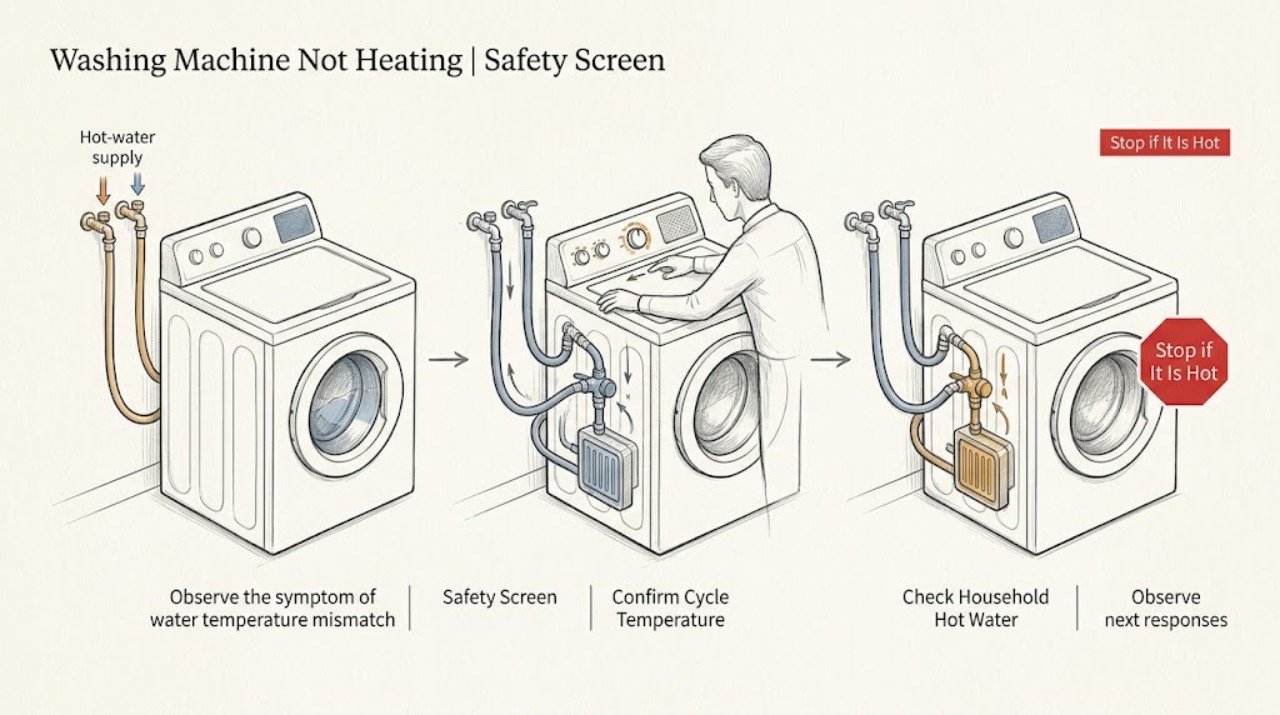
A Speed Queen washer that seems not to heat may be receiving cold water because of a household hot-water issue, a closed or crossed hose, a temperature selection, or a model-specific control or heating fault. First confirm what the selected cycle is supposed to do and whether the machine is top-load or front-load; some rinse stages intentionally use cold water. Speed Queen's troubleshooting guidance says to check the controls, connect the hot and cold hoses to their matching mixing-valve connections, and check the household water heater. Check hot water carefully to avoid burns. If there is a leak, water near electricity, smoke, burning odor, sparking, a hot outlet, or repeated tripping, stop using the washer and obtain qualified help rather than testing heat again.
Work through in order
Diagnostic checks
Use only checks that match the exact appliance or system and its official guide.
-
Check 1
Before checking temperature, look from a safe position for active leakage, standing water near the cord or outlet, steam or unusually hot water, a burning smell, smoke, sparks, a hot plug or outlet, damaged hoses, or a repeated circuit trip.
Expected result: The washer is dry and stable with no hazard, or water, heat, odor, smoke, sparking, damage, or electrical abnormality is present.
Next step: If a hazard is present, stop using the washer, keep clear, shut off water or power only if safely reachable without contact with water or heat, and arrange qualified or emergency help. Otherwise continue.
Stop if: Do not touch hot hoses, wet electrical connections, or a damaged cord, and do not run another cycle to reproduce an unsafe symptom.
Why this matters
Why: A dry, stable washer permits low-risk supply checks; a water, burn, fire, or electrical warning takes priority over diagnosing temperature.
-
Check 2
Record the washer model, load type, selected cycle, temperature option, rinse stage, and any display message. Confirm in the exact manual whether that stage calls for hot, warm, cold, spray, or a model-specific temperature behavior.
Expected result: The test occurred during a cold rinse or cold cycle, the control was set below the expected temperature, the control does not respond, or the manual confirms a hot or warm stage.
Next step: Choose a documented temperature and stage suitable for the test fabric, then observe only when the manual indicates water should enter. If the control remains unresponsive, arrange service.
Stop if: Do not select a hotter setting than the fabric or manual allows, and stop if the control is wet, damaged, or electrically abnormal.
Why this matters
Why: A cold stage or setting is not evidence of failed heating; a confirmed hot or warm stage with cold water needs supply and hose checks.
-
Check 3
With the washer idle and the area dry, verify that the household hot-water supply is available at a nearby safe fixture and that the water heater has not been intentionally disabled. Do not place hands under unexpectedly hot water; use a safe brief observation and follow local burn precautions.
Expected result: Hot water is unavailable at the home, hot water is available but the washer receives cold water, or the household supply appears normal but cannot be safely checked.
Next step: Resolve a household water-heating issue through the appropriate qualified provider. If the home supply is normal, continue with external hose and connection checks.
Stop if: Do not adjust a water heater while unsure of its operation, work around scalding water, or continue with a leak or unsafe utility condition.
Why this matters
Why: No household hot water can explain a cold wash without a washer fault. Normal household hot water with cold washer fill shifts attention to hose routing, valves, controls, or a model-specific fault.
-
Check 4
After the washer is cool enough to approach, check externally that both household faucets are open as the manual requires, each hose is not kinked, and the hose marked or connected for hot water reaches the washer's hot mixing-valve connection while the cold hose reaches the cold connection. Do not disconnect a pressurized hose.
Expected result: A faucet is closed, a hose is kinked, the hot and cold connections are crossed, a connection leaks, or the hoses and connections appear correct and dry.
Next step: Correct only a clearly accessible, non-pressurized external setting according to the exact manual. If a connection leaks or the correct routing does not restore temperature, stop and arrange service.
Stop if: Do not loosen a pressurized connection, handle a hot hose, or run the washer with a leak or water near electrical parts.
Why this matters
Why: A closed, kinked, crossed, or leaking connection can produce the wrong water temperature or a fill fault; correct dry routing with cold hot-cycle water points toward controls or an internal valve.
-
Check 5
Observe whether the washer fills normally during the documented hot or warm stage and record the exact code, status light, or unusual pause. Check only visible hose strain, overflow, and the external floor area; do not open the console or valve housing.
Expected result: The washer does not fill, fills slowly, shows a fill or water-level message, fills normally but remains cold, or water leaks during the attempt.
Next step: Use the exact manual for a documented external fill check and code interpretation. If the code returns, the water remains cold, or a leak appears, keep the washer unused and arrange qualified service.
Stop if: Do not bypass water-level or lid/door safety controls, remove panels, or continue a cycle with overflow, leakage, or electrical exposure.
Why this matters
Why: A fill restriction or code can prevent the expected hot-water portion; normal fill with a correct supply but cold water suggests a valve, control, sensor, or model-specific heating path.
-
Check 6
Only when the washer is stable, dry, cool, and hazard-free, perform one power reset if the exact manual documents it. Recheck the same documented temperature stage once without opening the machine or repeating the reset.
Expected result: The correct temperature returns, or the water remains cold, the code returns, the washer leaks, or an electrical or overheating symptom appears.
Next step: Do not repeat the reset. Keep the washer unused if the temperature fault returns and provide the technician with the model, cycle, supply result, hose routing, code, and reset result.
Stop if: Stop immediately for scalding water, smoke, burning odor, sparking, a hot outlet, water near electricity, or a repeated circuit trip.
Why this matters
Why: A stable recovery may indicate a temporary control state; recurrence means the supply, valve, sensor, control, or model-specific heating path needs diagnosis rather than repeated resets.
Use your observations
Decision map
Find the observation that best matches what you see, then follow the next safe action.
-
PATH 01Next step
What you see
The selected cycle or rinse stage is documented as cold
Do this next
Use a documented hot or warm stage suitable for the fabric and observe the expected fill stage.
Why this path and its safety boundary
Why it matters: The cold water may be normal and does not prove the washer cannot heat.
-
PATH 02Next step
What you see
Hot water is unavailable at the household supply
Do this next
Have the household supply checked by the appropriate qualified provider before diagnosing washer components.
Why this path and its safety boundary
Why it matters: The home water-heating or supply condition can explain the washer's cold fill.
-
PATH 03Next step
What you see
The hot and cold hoses are kinked, crossed, closed, or leaking
Do this next
Correct only the clearly accessible, dry external condition under the exact manual; arrange service for leaks or pressurized connections.
Why this path and its safety boundary
Why it matters: The washer may receive the wrong temperature or fail its fill sequence.
-
PATH 04Next step
What you see
The household supply and hose routing are correct, the washer fills normally, but a documented hot stage remains cold
Do this next
Keep the washer unused after one documented reset and arrange qualified Speed Queen service. Do not open the cabinet or measure live parts.
Why this path and its safety boundary
Why it matters: A mixing valve, control, sensor, or model-specific internal heating path may need diagnosis.
-
PATH 05Next step
What you see
There is leakage, overflow, water near electricity, smoke, burning odor, sparking, a hot outlet, or repeated circuit tripping
Do this next
Stop using it, keep clear, and obtain qualified or emergency help appropriate to the immediate hazard. Do not restart it to test temperature.
Why this path and its safety boundary
Why it matters: The washer is a water, fire, or electrical safety concern rather than a temperature fault.
Helpful context
Understand the symptom
“Not heating” may be a supply or cycle issue
Most Speed Queen washers use household hot and cold water through a mixing system, so the machine may not contain a user-accessible heater. A cold rinse can be normal, and a warm setting may be a blend rather than a constant hot stream. Compare the water result with the selected cycle and the clothing-care requirement before assuming a component has failed.
Top-load and front-load instructions differ
Speed Queen publishes different manuals for top-load and front-load families. The opened guides both emphasize matching hot and cold connections, but their controls, displays, and service procedures differ. Use the full model number to select the right manual, and do not apply a front-load code or panel sequence to a top-load washer.
Avoid burn and electrical risks
A hot supply hose or hot water can burn skin, and a leak can put water near electrical parts. Make observations from accessible, dry areas, do not open the cabinet or measure live wiring, and stop if the washer shows smoke, burning odor, sparking, a hot connection, or repeated circuit trips.
Safety boundary
Stop conditions
- Stop immediately for scalding water, active leakage, overflow, water near electrical parts, smoke, burning odor, sparks, a hot plug or outlet, damaged wiring, or repeated circuit trips.
- Do not disconnect pressurized hoses, open the cabinet, bypass a lid or door safety control, measure live wiring, or repeatedly run cycles to test heat.
- If a documented hot or warm stage remains cold after the household supply and hose connections are confirmed, keep the washer unused and arrange qualified service.
Only after diagnosis
Potential parts
- water inlet or mixing valve
Only consider this class if a qualified diagnosis finds that the household supply and hose routing are correct but the washer delivers the wrong temperature or fails a valve test.
Confirm the exact model and diagnosis before sourcing a part. - temperature sensor or control component
Only consider this class if a qualified technician identifies a sensing or control fault after the documented supply checks.
Fit and service procedure vary by washer family and model. - model-specific internal heating component
Only consider this class if the exact model documentation confirms an internal heating path and a qualified diagnosis identifies its failure.
Do not assume every Speed Queen washer has this component; verify model-specific documentation.
When checks do not resolve it
Need a professional?
Arrange qualified Speed Queen service when household hot water is available and the hoses and settings are correct but a documented hot or warm stage remains cold, a water-level or fill code returns, a connection leaks, or internal valve, sensor, control, or heating diagnosis would be required. Use emergency help for smoke, fire, severe flooding, or another immediate hazard.
Have this ready
- Full Speed Queen model and serial information
- Top-load or front-load design and selected cycle or stage
- Household hot-water result and hot/cold hose routing
- Fill behavior, exact display code or status light, and any leak
- Whether one documented reset changed the temperature and whether any odor, smoke, spark, or trip occurred
Common questions
FAQ
Does a cold rinse mean my Speed Queen washer is not heating?
Not necessarily. Some rinse stages are intended to use cold water. Check the exact cycle and temperature option before diagnosing a heating fault.
What should I check when a hot Speed Queen wash is cold?
Check the selected stage, household hot-water availability, and external hot and cold hose routing. Speed Queen's guides specifically call out matching hose connections and the household water heater. Stop for leaks or burn and electrical hazards.
Can I swap the hot and cold washer hoses to test them?
Do not disconnect pressurized hoses. Confirm the routing visually against the exact manual when the area is dry and safe; arrange service if a connection leaks or the routing cannot be safely corrected.
When does a cold wash indicate a washer fault?
If household hot water is available, the settings and hose routing are correct, and a documented hot or warm stage still fills cold, keep the washer unused and arrange qualified service for valve, sensor, control, or model-specific heating diagnosis.
Read the exact guide
Official sources
- Speed Queen | Manuals & DownloadsSpeed Queen · Speed Queen washer documentation portal
- User's GuideSpeed Queen by Alliance Laundry Systems · Opened AWNA62 top-load user guide; use the exact model manual for other washers
- Speed Queen | Washing Machine TemperatureSpeed Queen · General Speed Queen laundry temperature guidance; follow the exact washer manual and fabric label
- User's GuideSpeed Queen by Alliance Laundry Systems · Opened AFNE9B front-load user guide; use the exact model manual for other washers
Community feedback
Share a repair observation
Share a plain-text repair observation. Accepted observations are published automatically; this page may take a moment to update.