
On this page
Start here
Quick answer
Treat a stove that sparks, smells of burning plastic, trips its breaker, overheats while switched off, or shows smoke as a stop-use problem, not a reset or DIY electrical test. Keep people away, stop cooking, and leave the appliance off; if there is an active fire, keep an oven door closed when that is safe, leave immediately if flames escape, and call emergency services from outside. Do not open the control panel, probe wiring, bypass a thermostat or switch, replace an element by appearance, or keep resetting a breaker. Once the area is safe, have the exact stove model and installation inspected by a qualified appliance technician or electrician. A generic stove topic has no model-specific short-circuit diagnosis or part recommendation.
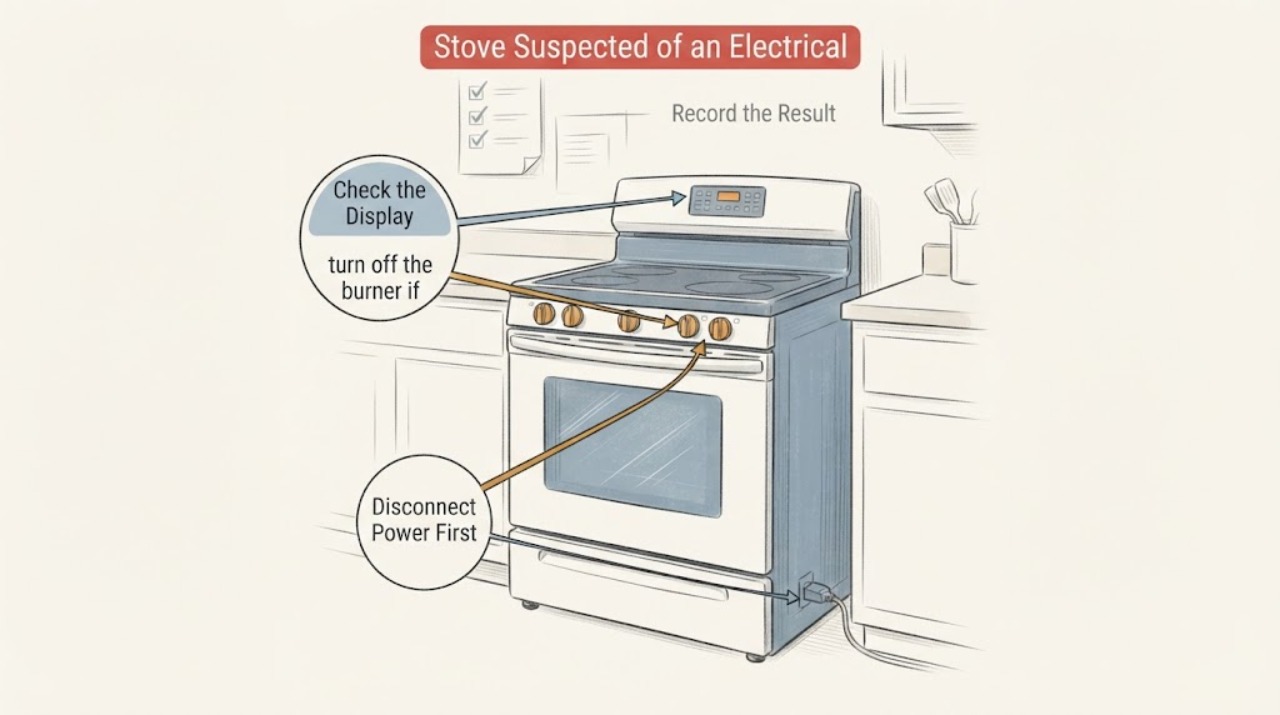
Work through in order
Diagnostic checks
Use only checks that match the exact appliance or system and its official guide.
-
Check 1
Stop cooking and look only from a safe position for active flames, smoke, visible arcing, a glowing or uncontrolled burner, a burning-plastic smell, a hot or damaged cord, or a receptacle that is hot or discolored. Do not touch the stove, pull a hot plug, open a panel, or move a burning pan.
Expected result: Flames or smoke are escaping, the appliance is sparking or burning, a burner remains on unexpectedly, or the area is dry and there is only a past odor or breaker trip with no active fire.
Next step: If flames escape or the room is filling with smoke, leave, close the door behind you if possible, and call 911 or the local emergency number from outside. If there is no active fire, keep the stove off and arrange qualified appliance/electrical service; do not reproduce the event.
Stop if: Do not continue operating, reset a breaker repeatedly, or reach toward the stove when there is smoke, fire, arcing, heat damage, or a gas odor.
Why this matters
Why: Escaping flames, smoke, or active arcing are an emergency rather than a troubleshooting symptom. A past odor or trip still leaves an unresolved electrical or appliance fault, but does not identify which component failed.
-
Check 2
If there is a small pan grease fire and no electrical or gas emergency is present, turn off the burner if that can be done without reaching through flames, slide a lid over the pan, and leave the pan where it is. Never pour water on a grease fire or carry the pan.
Expected result: The fire is contained in a pan and goes out under the lid, or flames spread beyond the pan, reach the hood or wall, or cannot be safely covered.
Next step: Keep the lid in place until the pan is cool if the fire is fully contained. If flames spread or you cannot cover the pan safely, leave immediately and call emergency services. Have the stove inspected before using it again after any fire.
Stop if: Do not use water, do not move the pan, and do not attempt an extinguisher unless you are a trained adult with a suitable Class K extinguisher and a clear escape path.
Why this matters
Why: USFA and NFPA distinguish a contained pan fire from an oven or spreading fire. Water can spread burning grease, and a pan that has been moved can spread fire or burns.
-
Check 3
For an oven fire, do not open the oven door to investigate. Turn off the heat only if the control can be reached without exposure to flames or smoke, keep the door closed while the contents cool, and do not reopen until you are confident the fire is out.
Expected result: The fire stays inside the oven with the door closed, or smoke/flames escape around the door or into the room.
Next step: If flames escape or the fire is not clearly contained, leave and call 911 from outside. Even if the fire goes out, keep the oven out of service until a licensed professional checks it.
Why this matters
Why: The closed oven contains heat and limits oxygen; flames escaping the oven change the event to an evacuation and emergency-response situation.
-
Check 4
When no fire is active and the stove is cool, record the exact model and serial information, the fuel type, what was running, when the breaker or fuse opened, where any odor or spark appeared, and whether the receptacle, cord or controls show visible damage. Do not remove covers or make a continuity, voltage, or live-load test.
Expected result: The event can be described without touching damaged parts, or the cord, plug, receptacle, control area, or appliance surface is cracked, loose, charred, melted, wet, or overheated.
Next step: Keep the stove out of service and give the record and photographs, taken from a safe distance, to a qualified appliance technician or electrician. If the supply receptacle or household wiring is damaged, the electrician must assess that installation as well as the appliance.
Why this matters
Why: The timeline and model help a professional select the correct manual and safety procedure. Visible damage or overheating supports a stop-use decision but does not identify a safe replacement part or prove a short at a particular component.
-
Check 5
Check only the installation boundary from outside the appliance: confirm that a major stove is not connected through an extension cord or power strip, and keep paper, towels, packaging, curtains and other combustibles away from the stovetop. Do not change wiring, add a cord, or substitute an element or fuse.
Expected result: An extension cord or power strip is present, the outlet or cord is damaged or loose, or combustible items are near the heat source while the electrical installation otherwise appears intact.
Next step: Stop using the appliance and have the installation corrected by a qualified professional. Remove only loose, cool, accessible combustibles from the area; do not reach behind the stove or work on a live receptacle.
Why this matters
Why: USFA says major stoves should be connected directly to a wall outlet and damaged cords or outlets need attention; USFA and NFPA also identify combustible materials near cooking heat as a fire risk. These observations do not reveal an internal short.
Use your observations
Decision map
Find the observation that best matches what you see, then follow the next safe action.
-
PATH 01Next step
What you see
Flames or smoke escape from the oven or stovetop, or the fire is spreading beyond a contained pan.
Do this next
Leave immediately, close the door behind you if possible, and call 911 or the local emergency number from outside. Do not re-enter to retrieve the stove or investigate the cause.
Why this path and its safety boundary
Why it matters: This is an active home-fire emergency, not an appliance-repair diagnosis.
-
PATH 02Next step
What you see
A small pan grease fire is fully contained and goes out after the heat is turned off and a lid is placed over the pan without moving it.
Do this next
Leave the lid on until cool, never use water, and have the stove checked before using it again if any appliance part or control was exposed to heat or smoke.
Why this path and its safety boundary
Why it matters: The immediate pan fire is contained, but heat or smoke may still have affected the stove and surrounding installation.
-
PATH 03Next step
What you see
There is no active fire, but the stove sparked, smelled of burning plastic, tripped its breaker, or a burner did not respond to its control.
Do this next
Leave the stove off and arrange qualified appliance and, when needed, electrical service. Do not reset the breaker to reproduce the event or open the control area.
Why this path and its safety boundary
Why it matters: An unresolved electrical or control fault remains; the symptom does not identify an element, relay, switch, thermostat, board, cord, or household wiring defect.
-
PATH 04Next step
What you see
The stove has a damaged or loose cord, hot or discolored receptacle, extension-cord connection, or other visible installation damage.
Do this next
Stop using it and have a qualified electrician inspect the outlet, circuit and connection; have the appliance separately assessed. Do not touch a hot, wet or damaged electrical connection.
Why this path and its safety boundary
Why it matters: The supply or installation itself may add fire risk, and the appliance cannot be cleared by a visual reset.
-
PATH 05Next step
What you see
No visible hazard remains, but the owner cannot provide a model, fuel type, event timing, or safe external observation that distinguishes a cooking fire from an electrical fault.
Do this next
Keep the stove out of service until a qualified professional identifies the appliance and installation and confirms that it is safe to use.
Why this path and its safety boundary
Why it matters: The available evidence is insufficient for a component diagnosis or repair instruction, and a generic stove reset would be unsafe.
Helpful context
Understand the symptom
A suspected short is a safety triage question
The supplied topic has no brand, model, fuel type, or description of the event. A spark, a breaker trip, a glowing element, a burning smell, an oven fire, and a pan fire are different observations with different emergency responses. Do not assume that an electrical short is the cause or that the inside of the stove will catch fire; use the visible hazard to decide whether to leave immediately and whether the appliance can remain out of service for professional inspection.
Do not turn an unknown fault into an energized test
USFA and NFPA place damaged, cracked, loose, or overheating appliance parts and cords in the professional-repair boundary. That boundary is especially important when the stove has a hardwired connection, a hot receptacle, a breaker that trips, visible arcing, or a burning odor. Without the exact model and a technician's inspection, no element, relay, thermostat, control board, fuse, cord, or wiring repair can be selected safely from the symptom alone.
When checks do not resolve it
Need a professional?
Arrange qualified appliance service and, where the receptacle, breaker or household wiring is involved, licensed electrical service before using the stove again after sparks, smoke, burning odor, repeated breaker trips, uncontrolled heating, visible damage, or any fire. Call emergency services first for an active or spreading fire.
Have this ready
- Provide the exact model and serial information, fuel type, installation type, event timeline, control setting, breaker or fuse behavior, location of any spark or odor, visible damage, and whether a fire occurred. Do not provide a part number or ask for a live electrical test based only on the symptom.
Common questions
FAQ
Can the inside of a stove catch fire from an electrical short?
An electrical fault or overheated component can create a fire risk, but the supplied topic has no model or observed event that establishes what happened. Treat sparks, smoke, burning odor, uncontrolled heat or a repeated breaker trip as stop-use signs and have the appliance inspected; do not open the stove to look for a short.
Should I reset the breaker to see whether the stove works?
No. Repeatedly restoring power can re-energize an unresolved fault. Keep the stove out of service and arrange qualified inspection, especially if the breaker opened after a spark, odor, smoke or uncontrolled heating.
What should I do if the oven itself is on fire?
USFA and NFPA say to turn off the heat if it is safe, keep the oven door closed while it cools, and leave and call 911 if flames escape. After any oven fire, have the oven checked by a licensed professional before using it again.
Read the exact guide
Official sources
- Educational Messages Desk Reference: Cooking and Electrical Cooking Equipment SafetyNational Fire Protection Association · General household guidance for oven fires, electrical cooking equipment, damaged or overheating appliance parts, compatible listed components, and professional service after a fire.
- Appliance and Electrical Fire SafetyU.S. Fire Administration · General guidance for major appliances including stoves: direct wall connection, no extension cords, and professional attention for damaged appliance cords or electrical parts.
- Cooking Fire Safety PictographsU.S. Fire Administration · General cooking and stove safety, including keeping combustibles away, pan-fire response, oven-fire response, evacuation when flames escape, and direct wall connection.
Community feedback
Share a repair observation
Share a plain-text repair observation. Accepted observations are published automatically; this page may take a moment to update.