
On this page
Start here
Quick answer
A continuous click is expected only while a gas burner is being ignited or, on some appliances, while a relight system is responding to a flame interruption. Because the topic gives no brand, model, or fuel type, first determine whether the sound is a gas spark or an induction/electronic operating sound. On a gas cooktop, confirm every knob is fully OFF and note whether the clicking began after cleaning or a spill; moisture can make igniters click. Let the cool burner area dry according to the exact owner manual. If clicking continues with all knobs OFF, a burner remains unlit, or there is any gas smell, stop using the cooktop. Leave immediately for suspected gas and contact the gas authority or emergency service from outside; persistent clicking without gas odor needs appliance service.
Before you begin
Safety first
- Do not open the control panel, adjust gas settings, touch ignition parts, repeatedly attempt ignition, move a gas appliance to inspect its connector, or operate electrical switches if gas is suspected.
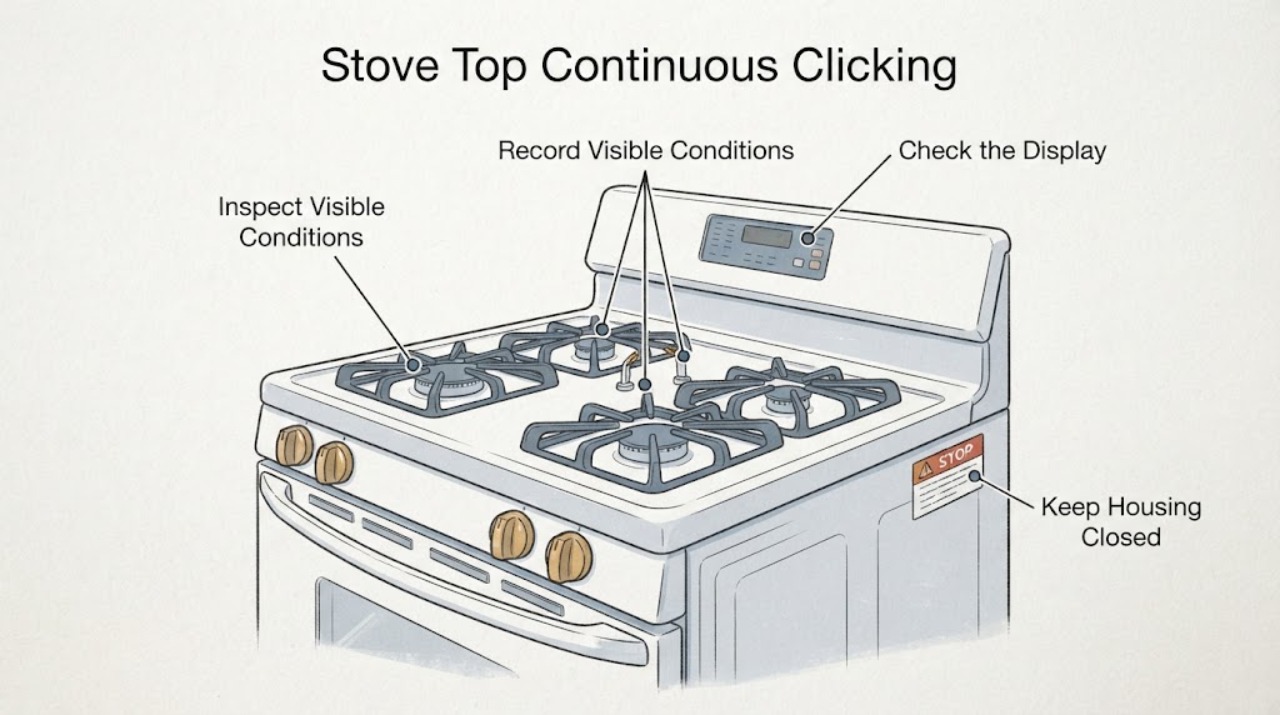
Work through in order
Diagnostic checks
Use only checks that match the exact appliance or system and its official guide.
-
Check 1
Identify whether the cooktop uses gas, induction, or another electric surface, and record the brand/model from the rating label or owner manual before applying any burner advice.
Expected result: A gas cooktop is confirmed, or the appliance is induction/electric or remains unidentified.
Next step: Use the gas-specific checks only when gas is confirmed. For an induction/electric or unidentified appliance, use the exact manual or request model-specific service.
Why this matters
Why: Gas clicking is an ignition sound; induction and electric surfaces can produce different operating sounds. The supplied topic does not justify treating every continuous click as a gas igniter fault.
-
Check 2
If gas is confirmed and there is no gas smell, turn every surface control fully OFF and observe whether the clicking stops without touching the burner or control internals.
Expected result: The click stops when all knobs are OFF, or it continues with all knobs OFF.
Next step: If it stops, use the exact manual for normal ignition and watch that a visible flame is established. If it continues, stop using the cooktop and arrange service.
Why this matters
Why: A click while a knob is at LITE can be normal ignition; clicking with all controls OFF is treated by Samsung and GE as an abnormal condition that may follow moisture or require service.
-
Check 3
If the cooktop was recently cleaned or had a spill, allow the cool burner area and control surroundings to dry thoroughly before another normal-use check; do not spray or open the control area.
Expected result: The clicking began after cleaning/spillage and stops once the surface is dry, or it continues after drying.
Next step: If the sound stops, follow the exact appliance manual and keep liquids away from controls. If it continues, leave the appliance off and arrange service.
Why this matters
Why: GE and Samsung identify moisture as a possible cause of intermittent or continuous gas-ignition clicking. Drying may explain the symptom, but persistent clicking is not confirmed safe by a generic drying step.
-
Check 4
With the burners cool and controls OFF, visually check that each visible burner cap/head is seated flat and matched to its burner position; do not press or adjust an electrode.
Expected result: A cap/head is visibly displaced, or all visible burner pieces appear correctly seated.
Next step: Correct only a clearly displaced cap/head as the exact manual permits. If the click or no-flame condition remains, stop and request service.
Why this matters
Why: GE says incorrect burner head/cap placement can contribute to slow or no ignition and continuous clicking. A correctly seated cap does not identify the internal cause of continued clicking.
-
Check 5
Check for gas odor or a sound suggesting gas escaping without using switches or other electrical equipment near the appliance.
Expected result: Gas odor/leak suspicion is present, or there is no gas odor and only the clicking symptom remains.
Next step: If gas is suspected, leave immediately and contact local gas authorities or emergency service from outside. If there is no gas odor, keep the cooktop off and arrange qualified appliance service for persistent clicking.
Why this matters
Why: A suspected gas leak is an emergency; an odor-free persistent click is an appliance-service issue rather than proof of a leak.
Use your observations
Decision map
Find the observation that best matches what you see, then follow the next safe action.
-
PATH 01Next step
What you see
The appliance is confirmed gas, a knob was left at LITE, and the sound stops after every knob is returned fully OFF.
Do this next
Use the exact owner manual for lighting and confirm a visible flame before adjusting heat; stop if the burner will not light normally.
Why this path and its safety boundary
Why it matters: The observed sound is consistent with the normal electric ignition sequence rather than a continuous fault.
-
PATH 02Next step
What you see
The gas cooktop was recently cleaned or exposed to a spill, there is no gas odor, and clicking stops after the cool area dries.
Do this next
Keep liquids away from the controls and follow the model manual. If clicking returns with a dry surface, arrange service.
Why this path and its safety boundary
Why it matters: Moisture is a supported possible explanation, but this does not establish that the internal ignition system is sound.
-
PATH 03Next step
What you see
All gas knobs are OFF and clicking continues, or a burner does not light after the visible cap/head check.
Do this next
Leave the cooktop off and request qualified appliance service; do not open the control area or continue repeated ignition attempts.
Why this path and its safety boundary
Why it matters: The official user-level checks have not resolved the ignition symptom; a specific switch, electrode, module, or gas issue cannot be selected from this generic topic.
-
PATH 04Next step
What you see
There is any gas smell or a sound suggesting gas is escaping.
Do this next
Leave immediately, do not operate lights or electrical equipment inside, and contact the gas supplier or emergency service from outside.
Why this path and its safety boundary
Why it matters: This is a possible gas leak, not an ordinary clicking diagnosis.
-
PATH 05Next step
What you see
The surface is induction/electric or the fuel type cannot be established.
Do this next
Stop trying gas-specific checks and use the exact model manual or arrange model-specific service.
Why this path and its safety boundary
Why it matters: Gas spark guidance cannot be safely transferred; induction cookware noise and electronic sounds follow a different manual.
Helpful context
Understand the symptom
First separate a gas spark from another cooktop sound
The prompt does not identify a brand, model, or fuel type. A gas surface burner normally clicks while its electric igniter is trying to light, and some models let multiple igniters click when one burner is selected. An induction cooktop can make buzzing or humming sounds related to cookware instead. Do not apply gas-burner cleaning advice to an induction or other electric surface; read the exact owner manual or use service if the sound source is unclear.
A gas cooktop that clicks with every knob off needs attention
For gas appliances, check from the controls and the visible burner surface only: every knob should be fully OFF, with no knob left at LITE. Samsung and GE both identify moisture after cleaning or a spill as a possible reason for intermittent or continuous ignition clicking. Let the cool surface dry as the exact manual allows. The check does not prove a failed igniter or switch, and it does not authorize opening the control area.
Keep gas smell separate from ordinary troubleshooting
A continuous click with no gas smell is an appliance-service issue after the safe external checks. Any gas smell or sound suggesting a leak changes the response: do not operate switches, phones, or other electrical equipment inside; leave immediately and contact the gas supplier or emergency service from outside. Do not move the appliance to inspect a connector.
Stop before internal ignition diagnosis
If all knobs are OFF, the surface is dry, and the clicking continues, arrange service with the appliance manufacturer or a qualified gas-appliance technician. Do not remove the control panel, reach for an electrode, alter gas settings, or repeatedly relight a burner to see whether the sound stops. The official guidance supports service at this point, not a cross-brand component diagnosis.
When checks do not resolve it
Need a professional?
Request qualified appliance service when clicking continues with all gas knobs OFF, returns after the surface is dry, a burner will not light normally, the appliance is unidentified, or the surface is induction/electric and the sound is unexplained. Treat any gas odor as an emergency rather than a service troubleshooting step.
Safety scope: Do not open the control panel, adjust gas settings, touch ignition parts, repeatedly attempt ignition, move a gas appliance to inspect its connector, or operate electrical switches if gas is suspected.
Have this ready
- Provide the brand/model, fuel type, which controls were OFF or at LITE, whether cleaning/spillage preceded the sound, whether a flame appeared, and whether there was any gas odor.
Common questions
FAQ
Is clicking always normal on a gas stove top?
No. Clicking while a burner is being ignited can be normal, and multiple igniters may click when one burner is selected. Clicking with all knobs OFF, a burner that will not light, or clicking that persists after moisture has dried needs service.
What if the clicking began after cleaning?
Moisture around the burner or ignition controls can cause intermittent or continuous clicking. With no gas odor, let the cool surface dry according to the exact manual and retry normal operation only once it is dry. Persistent clicking needs service.
What should I do if I smell gas?
Leave immediately. Do not operate lights, switches, phones, or other electrical equipment inside; contact the gas supplier or emergency service from outside.
Read the exact guide
Official sources
- Gas Range & Cooktop - Electric Ignition for Surface BurnersGE Appliances · General gas ignition behavior and stop-use/service boundary
- Certain Older Gas Connectors May Be DangerousU.S. Consumer Product Safety Commission · Gas-leak emergency response and appliance movement boundary
- Samsung cooktop and range: common sounds and operational noisesSamsung Support · General manufacturer guidance on gas ignition clicks, moisture-related clicking, induction sounds and service boundary
- Gas Range & Cooktop - Common Causes for Slow Ignition, No Ignition or Clicking on Surface BurnersGE Appliances · General gas-burner moisture, cap/head seating and service checks
- Gas Range & Cooktop - One or More Burners Are ClickingGE Appliances · General gas-cooktop knob, moisture and service checks
Community feedback
Share a repair observation
Share a plain-text repair observation. Accepted observations are published automatically; this page may take a moment to update.