
On this page
Start here
Quick answer
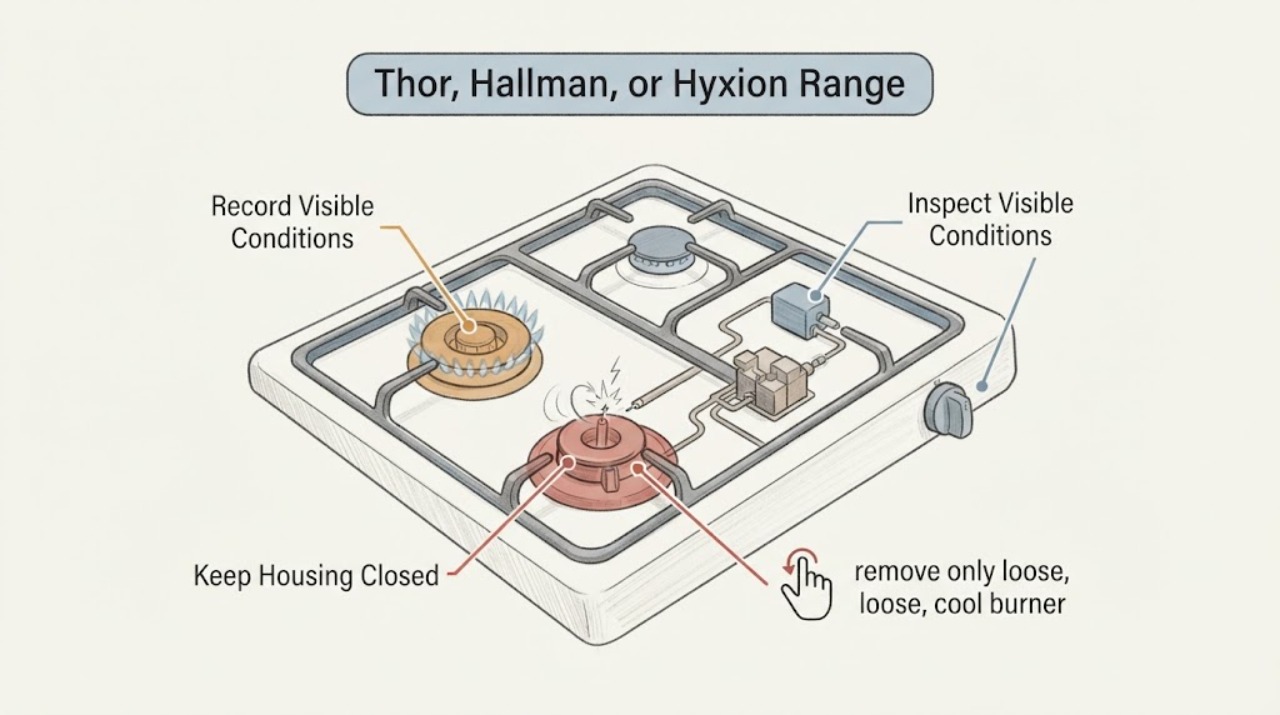
Clicking from a gas range can be normal while a burner is being ignited, and some designs make several igniters click when one knob is turned. The title names Thor, Hallman, and Hyxion, but those are not interchangeable model identities; read the badge and model number before using a manual or ordering a part. With the area cool, confirm every knob is fully OFF, the burner cap and ring are seated as the exact manual shows, and the clicking stops once a stable flame is established. If a burner does not ignite promptly, turn its control OFF and allow gas to dissipate; if you smell gas, do not light anything or operate electrical switches. If clicking continues with all knobs OFF, after the flame is established, or with a weak/unstable flame, stop using that burner, turn off the appliance gas and power when safe, and arrange qualified gas-range service. Do not open the control panel, reposition electrodes, change orifices, or adjust gas pressure from a generic guide.
Work through in order
Diagnostic checks
Use only checks that match the exact appliance or system and its official guide.
-
Check 1
Read the rating plate or badge and record the exact brand, model, fuel type, and whether the clicking is from a cooktop burner, griddle, or oven burner. Do not treat Thor, Hallman, and Hyxion as one family or use a manual found for a similar-looking range.
Expected result: The badge identifies one manufacturer and model, or the label is missing/ambiguous and the title is the only identity evidence.
Next step: Use only the confirmed manufacturer's manual for later user checks. If identity remains unresolved, limit the work to gas-safety, knob-off, visible condition, and qualified-service guidance.
Why this matters
Why: A model identity is required to know whether several igniters normally spark together, how the burner is assembled, and which service path applies. The three names in the topic do not prove a shared design or compatible parts.
-
Check 2
With all controls OFF and the range cool, observe when the clicking starts and stops without opening panels: only while a knob is pushed and turned to ignition, while a stable flame is already burning, or with every knob OFF. Note whether one burner or several click and whether the flame is steady blue, weak, lifting, or absent.
Expected result: Clicking occurs only during ignition and stops after the flame is stable; several electrodes click together; clicking continues after ignition; or clicking occurs with all controls OFF.
Next step: Use the normal ignition sequence from the exact manual only if there is no gas odor. For persistent clicking, stop using the affected burner and arrange service; do not touch a sparking igniter.
Why this matters
Why: Ignition-only or simultaneous multi-electrode clicking can be normal on some designs. Persistent clicking after ignition or with controls OFF is not cleared by the sound alone and can indicate a service-level ignition or grounding condition.
-
Check 3
If the exact manual permits user cleaning, remove only loose, cool burner caps or rings as shown there, clear visible food or moisture, and reseat each piece in its keyed position. Do not bend, reposition, drill, sand, or replace an electrode, and do not change an orifice or gas setting.
Expected result: A cap or ring was visibly displaced or contaminated and the flame becomes stable after the documented cleaning and reseating, or the parts look correct and clicking or unstable ignition remains.
Next step: Allow the parts to cool before touching them, follow the exact manual's reassembly check, and stop if clicking continues, gas does not ignite, or the flame is abnormal. Never test by leaving a knob at ignition.
Why this matters
Why: Mis-seated or dirty accessible burner parts can interfere with flame sensing or ignition. Improvement after the manual's cleaning supports an assembly or residue issue but does not prove the electrode circuit is repaired; persistence requires service.
-
Check 4
If a burner does not light promptly, turn its control OFF and wait for the model's specified gas-dissipation period before any further attempt. If you smell gas at any time, do not try to light the burner, touch electrical switches, use a phone inside, or create a spark; ventilate only as safely directed and contact the gas supplier or emergency service from a safe location.
Expected result: There is no gas odor and the control was turned OFF, or gas odor persists or accumulates around the range.
Next step: For a gas odor, leave the area and call the gas supplier or fire department from outside or a neighbor's location. Do not return to test the burner until cleared. For no odor but repeated failure to ignite, close the manual shutoff if safely accessible and arrange service.
Why this matters
Why: Unignited gas is a fire or explosion hazard. A persistent odor is not an ignition adjustment problem and must be handled as a gas emergency.
-
Check 5
If clicking persists with controls OFF or after a stable flame, document the affected burner, flame behavior, power state, recent spill or cleaning, fuel type, and model label. Turn off the range's electrical supply and gas supply only through accessible controls when safe; do not remove the back panel or control console.
Expected result: The clicking stops only when power is removed, the gas supply or electrical connection looks damaged, the flame remains unstable, or the range is otherwise normal but clicking persists.
Next step: Keep the range out of service and contact the confirmed manufacturer, licensed gas technician, or approved service agency. Do not bypass an ignition or flame-safety device.
Why this matters
Why: The remaining possibilities include an ignition circuit, electrode, burner assembly, grounding, or supply condition, but the symptom does not identify a repair part. Gas and electrical work require qualified service.
Use your observations
Decision map
Find the observation that best matches what you see, then follow the next safe action.
-
PATH 01Next step
What you see
Clicking happens only while one burner is being turned to ignition and stops when a stable flame is established; several electrodes may click together.
Do this next
Continue only with normal cooking after the exact manual's ignition sequence is complete. If the sound continues beyond ignition, stop using the burner and follow the service branch.
Why this path and its safety boundary
Why it matters: This can be normal electric-spark behavior on the confirmed model, including designs that use one spark module for multiple burners.
-
PATH 02Next step
What you see
The flame is lit but clicking continues, or clicking occurs with every knob fully OFF.
Do this next
Turn off the affected burner and, when safe, the range gas and electrical supplies. Arrange qualified service and do not keep cooking to see whether the sound stops.
Why this path and its safety boundary
Why it matters: The behavior is outside the normal ignition-only description and needs a service diagnosis; it does not prove a specific electrode, module, or ground fault.
-
PATH 03Next step
What you see
The burner does not ignite promptly, the flame is unstable or lifts, or clicking continues after the knob is returned from ignition.
Do this next
Turn the control OFF, wait the exact manual's dissipation period, and arrange service if it repeats. Do not adjust gas pressure or internal ignition parts.
Why this path and its safety boundary
Why it matters: Gas ignition or burner seating is not reliable; repeated attempts can allow unburned gas to accumulate.
-
PATH 04Next step
What you see
You smell gas, hear gas escaping, or cannot tell whether the clicking is accompanied by an unlit gas flow.
Do this next
Do not light anything, touch electrical switches, or use a phone inside. Leave the area and call the gas supplier or fire department from a safe location; do not return until cleared.
Why this path and its safety boundary
Why it matters: This is a gas-safety emergency rather than a burner-cleaning problem.
Helpful context
Understand the symptom
First identify which range is actually installed
Thor Kitchen, Hallman Industries, and Hyxion each publish range products, but the supplied topic contains no model number and does not prove that the brands share a burner design. Thor's official range materials show several gas and fuel configurations; Hallman's manual covers its own range family; Hyxion's product page describes a 900 mm cooker with automatic electronic ignition and safety valves. Use the appliance badge and exact manual before applying a brand-specific instruction.
Normal ignition clicking has a clear stop condition
A spark igniter may click while gas is being released and the burner is lighting. Thor's service material says all electrodes can click together when one burner knob is rotated, and Hallman's manual says all burners may spark when one knob is turned. Once the flame is stable and the control is moved away from ignition, the clicking should follow the exact model's behavior. Continued clicking, failure to light, or an unstable flame is a stop-and-service signal rather than proof of a particular electrode or control-board failure.
Gas safety overrides troubleshooting
Do not keep trying to ignite a burner when gas is accumulating or a gas odor is present. Hallman's safety instructions say not to light an appliance or operate an electrical switch when gas is smelled, and to contact the gas supplier or fire department. Cleaning and seating accessible burner parts is a user-level check only when there is no gas leak, the controls are off, and the exact manual permits it.
When checks do not resolve it
Need a professional?
Stop using the range and arrange qualified service when clicking continues after ignition or with all knobs OFF, a burner will not ignite promptly, the flame is weak, lifting, or unstable, the burner parts are correctly seated but the issue remains, or the electrical supply or gas connection may be damaged. If you smell gas, do not troubleshoot: leave the area and contact the gas supplier or fire department from a safe location.
Common questions
FAQ
Is clicking normal on a Thor, Hallman, or Hyxion range?
It can be normal during surface-burner ignition, and some designs make several igniters click when one knob is turned. The brands and models are not interchangeable, so use the confirmed manual. Clicking that continues after a stable flame or with all knobs OFF needs service.
Can I keep trying to light a burner that only clicks?
No. Turn the control OFF and follow the exact manual's gas-dissipation interval. If there is a gas smell, do not light anything or operate electrical switches; leave and call the gas supplier or fire department from a safe location.
Should I replace the igniter or adjust the gas pressure myself?
No. A clicking symptom can involve burner seating, residue, ignition wiring, grounding, gas supply, or a control circuit, and the symptom does not identify the part. Do not open the range or change orifices or pressure; use a licensed gas technician or approved service agency.
Read the exact guide
Official sources
- Range Appliances Service ManualThor Kitchen Customer Service Team · Official THOR service document used only for family-scoped behavior that multiple electrodes may click and for service escalation; internal repair procedures are not presented as user instructions.
- INSTALLATION AND OPERATION INSTRUCTIONSHallman Industries LLC · Official Hallman range manual used for Hallman-specific ignition and gas-safety branches; it is not evidence that Thor or Hyxion models share the same parts.
- Gas Range & Cooktop - Electric Ignition for Surface BurnersGE Appliances · Official GE support used only as a general manufacturer explanation of multi-igniter clicking and persistent-click escalation; it does not transfer GE parts or settings to Thor, Hallman, or Hyxion.
- Hyxion 900mm Range Cooker with Multifunction Oven and 6-Burner Gas HobHyxion · Official Hyxion product page used only to confirm that Hyxion has gas range products with automatic electronic ignition; it does not define persistent-click repair for an unknown model.
- DOWNLOADS - THOR Kitchen, Inc.THOR Kitchen, Inc. · Official THOR downloads index used to require exact model identification before applying a manual; it is not a substitute for the specific manual's technical instructions.
- THOR KITCHEN COOKTOP-RANGETOP MANUALTHOR Kitchen · Official THOR cooktop/rangetop manual used for ignition-only clicking and gas-safety boundaries; model and fuel configuration must be confirmed.
Community feedback
Share a repair observation
Share a plain-text repair observation. Accepted observations are published automatically; this page may take a moment to update.